A suspicious card can fail for very different reasons, and the fix starts with naming the problem correctly. Some cards are legitimate manufacturer-issued reprints or reproductions, some are outright counterfeits, some are real cards that were trimmed or recolored, and some are genuine cards trapped inside mislabeled holders.
For collectors, that distinction matters because the next step changes with each category. The most efficient approach is to work in three layers: verify the card itself, verify any slab or certification, and verify that the card makes sense in an official product or checklist context.
Start by separating four different problems
Collectors often use fake, reprint, altered, and mislabeled as if they mean the same thing. They do not. If you mix them together, you can waste time inspecting print quality on a card that is actually an authorized reissue, or you can trust a slab label that is simply wrong.
The cleanest framework is this. First, an authorized reprint or reproduction is a legitimate later-issued card produced by the manufacturer, often using older imagery or design elements. Modern licensed products can absolutely contain cards that look vintage without being vintage. That means an old-style layout, retro border, or familiar photo is not evidence that the card is from the original year.
Second, a counterfeit is a card made to pass as something it is not. PSA’s grading standards make that distinction explicit by using a “Questionable Authenticity” outcome when a card appears counterfeit or otherwise fails authenticity confidence. That is a very different hobby problem from condition or alteration.
Third, an altered genuine card is a real card that has been changed after it was issued. PSA separates trimming, restoration, recoloration, and altered stock into different categories. That separation is useful for collectors because a suspicious edge, corner rebuild, or added gloss does not automatically mean the whole card was printed illegally; it may mean a real card was manipulated to improve appearance or grade potential.
Fourth, there are labeling and mechanical errors. A slab can be wrong even when the card inside is genuine. PSA’s guarantee terms discuss examples where a reprint was mislabeled as an original issue, including cases in which the card itself clearly identifies the truth through date, copyright, or “REPRINT” wording. That is a reminder that plastic and a printed label are not the final authority if the card’s own printed identity says otherwise.
- Authorized reprint or reproduction: legitimate later issue, not an original vintage release
- Counterfeit: fake item intended to pass as a real one
- Altered genuine card: real card changed after issue
- Mislabeled holder: identification error that can still mislead buyers
Ask the fastest question first: was this card ever officially issued this way?
Before you zoom into dots, fibers, or edge cuts, ask a simpler question: does this card have a plausible home in an official release? That step is faster, cheaper, and often more decisive than physical inspection. If a suspicious card uses a famous old design, your first move should be to confirm whether the manufacturer has ever issued that design again in a modern product.
Topps gives collectors a strong reason to do this homework. Its product pages show that throwback designs remain part of licensed releases. The 2025 Topps Archives Baseball page openly states that the product revisits past Topps designs, including 1964, 1996, and 2005 styles. Separately, Topps checklist material for 2022 Heritage Minor League Baseball lists “1973 Topps 1953 Reprint Autographs.” In other words, official cards can intentionally borrow an older visual language and even identify themselves as reprint-themed inserts.
That changes how you should approach suspicious cards in practice. If you find a card that resembles a famous vintage issue, do not start from the assumption that it is either original or fake. Start by checking whether the design, insert title, or product family appears in official manufacturer materials. If it does, you may be looking at a legitimate modern issue that only echoes a classic release.
A practical example: imagine a card styled like a 1950s classic but offered loose with no pack origin. Your job is not to guess from the front alone. Look for insert names, backs, copyright lines, or product associations that match a documented checklist. If the manufacturer’s own materials support a later release, that immediately narrows the question from “is this vintage?” to “is this authorized modern content, and is it being described honestly?”
- Search the manufacturer’s product pages or checklist hub first
- Match the design style to a documented release, not just a remembered vintage card
- Look for insert names that explicitly mention reprints or retrospectives
- Treat official checklist context as identity evidence, not just marketing copy
Let the card’s own printed clues challenge the story
Once you know a card might have multiple possible identities, let the object argue for itself. The most useful printed clues are often plain ones: date, copyright line, issue language, and any explicit “REPRINT” or similar wording. These details can matter more than a seller description and, in some cases, more than a slab label.
PSA’s guarantee terms illustrate exactly why. The company discusses examples where reprints were mislabeled as original-era issues, including a 1996 Topps Mickey Mantle reprint mislabeled as 1952 Topps. PSA also gives an example of a reprint mistakenly labeled as the original even though the card itself clearly says “REPRINT.” For collectors, that is a powerful lesson: always compare the claim to the words and dates printed on the card.
This is especially helpful when a listing relies on selective photography. A front image may feature a famous design, but the back can reveal a later copyright year, commemorative issue language, or modern insert branding. If those details contradict the listing title, you do not need a microscope to know the offer deserves skepticism.
The practical move is simple. Write down the exact identity claim first: year, manufacturer, set, card number if shown, and whether the seller presents it as an original or reprint. Then compare every part of that claim to the card’s printed evidence. If the front says one thing and the back says another, the card’s printed data wins over wishful thinking.
- Check front and back, not just the glamour photo
- Compare claimed year to printed copyright or issue year
- Look for clear identity words such as REPRINT
- Treat contradictions as major red flags even before condition analysis
On raw cards, separate alteration clues from authenticity clues
When a card is raw, many collectors jump straight to the broad conclusion that something feels fake. A better method is to sort what you are seeing into two buckets: signs of post-issue alteration and signs of questionable authenticity. PSA’s grading standards are useful here because they break suspicious traits into named categories instead of one vague feeling.
For edges and dimensions, PSA flags trimming-related issues such as hooked edges, unusually sharp or uncommon edges for the issue, inconsistent edge tone, and wavy or unnatural-looking cuts. Those clues do not automatically prove a counterfeit; they often point instead to a genuine card that may have been cut down or reshaped. That distinction matters if you are deciding whether to buy a bargain example, pursue review, or walk away entirely.
For structure and surface, PSA separately notes restoration, recoloration, and altered stock. Rebuilt paper stock or corners suggest restoration. Added color points toward recoloration. Foreign substances, enhanced gloss, or surface treatment can signal altered stock. Again, those outcomes differ from a fake card created from scratch, but they still matter because they can materially change value and desirability.
A practical buying routine helps. First, compare all four edges for tone and consistency. Second, ask whether the corners look naturally worn for the apparent age or strangely rebuilt. Third, scan the surface for gloss that seems too fresh or uneven. Fourth, ask whether the card’s overall physical feel matches the identity claim. None of these checks gives you laboratory certainty, but together they help you move from unease to specific concerns you can document and discuss.
- Possible trimming signs: hooked edge, unnatural sharpness, inconsistent edge tone, wavy cut
- Possible restoration signs: rebuilt paper stock or corners
- Possible recoloration signs: added color on wear spots or borders
- Possible altered-stock signs: foreign substances, added gloss, treated surface
If the card is slabbed, investigate the holder as hard as the card
Collectors often relax once a suspicious card is in a major holder. That is understandable, but it is not a complete defense. PSA explicitly warns that criminals may counterfeit holders or documents and may also reuse real certification numbers pulled from public sources. In other words, a cert lookup can be necessary without being sufficient.
Start with the obvious step: run the certification number. Confirm that the database entry matches the card type, year, and description you are being shown. If images are available, compare them. But do not stop there. PSA’s cert-verification language warns that a valid cert number does not eliminate risk because fake slabs can borrow legitimate numbers.
The holder itself deserves physical scrutiny. PSA’s buyer-security guide says holders are tamper-evident, not tamper-proof. Signs of compromise can include frosting or cloudiness along the edges, minor fractures or cracks, and a holder that feels more flexible after the sonic weld has been broken. PSA also warns that some forgers may add a fake front to a real PSA label, creating abnormal thickness that can affect how light passes through the label area.
For collectors, the practical implication is straightforward: treat slab review as a two-part job. Verify the data in the database, then inspect the plastic, seams, label presentation, and overall feel for tampering clues. A slab should reduce uncertainty, not end your research.
- Run the cert number and compare the description carefully
- Remember that real cert numbers can be reused on fake holders
- Inspect seams and edges for frosting, cloudiness, cracks, or flex
- Be alert for unusual label thickness or odd light transmission
Use marketplace rules as risk filters, not proof
Marketplace policy can help you screen listings, but it cannot authenticate a card for you. That distinction is worth keeping in mind because some buyers read platform rules as if they were expert determinations about individual items. They are not. They are guardrails for listing behavior.
eBay’s counterfeit policy is still useful because it specifically states that counterfeit or fake items are not allowed and includes unauthorized reprints of trading cards among prohibited examples. For collectors, that gives you a clear language cue: the word reprint is not automatically benign. The key question is whether it is authorized and accurately described, not whether the seller used the term at all.
That makes listing language a valuable part of your risk screen. Be cautious when a seller uses reprint ambiguously, avoids naming the manufacturer, omits the exact year of issue, or leans on phrases that sound impressive without making a precise identity claim. Vague wording can be a sign that the seller wants the card to inherit the prestige of an original without explicitly claiming it is one.
A useful practice is to read the title, item specifics, and description as if you were writing an invoice. Could you state exactly what the card is, who issued it, and when? If not, ask questions before buying. Marketplace policy may not settle authenticity, but it can help you recognize when a listing’s presentation itself is part of the problem.
- Policy helps identify risky selling behavior, not card authenticity
- Unauthorized reprints are treated differently from legitimate manufacturer-issued reprints
- Vague titles and missing manufacturer details are meaningful warning signs
- Ask for clear year and product identification before purchasing
Build a repeatable research workflow for suspicious cards
The best defense against costly mistakes is a sequence you can repeat. Without a process, collectors tend to overreact to dramatic flaws and overlook basic identity checks. With a process, you can move from claim to evidence in a calm order and stop when the risk outweighs the upside.
Step one is to write down the exact identity claim. Include year, manufacturer, set, card number if known, autograph status, serial numbering, and whether the item is presented as an original issue or reprint. This prevents the common mistake of researching the wrong card because the seller used a famous player and design to imply an entirely different item.
Step two is official product context. Search the manufacturer’s checklist or product pages to see whether the card, design family, or insert type is documented. This is where many mysteries end. A suspicious-looking retro card may turn out to be a standard insert from a licensed modern release.
Step three is physical analysis of the card. Use the PSA framework to sort what you see into trimming, restoration, recoloration, altered stock, or questionable authenticity. This helps you decide whether you are likely dealing with a fake, a modified genuine card, or a card whose issue identity still needs work.
Step four is slab review if the card is encapsulated. Run the cert, compare the details, and then inspect the holder for tampering clues. Remember that a matching cert number is only a starting checkpoint.
Step five is escalation. If the value justifies it and you believe a graded item may be counterfeit or otherwise wrongly identified, PSA’s guarantee materials explain that collectors can contact PSA and submit a Grade Guarantee Review, with fees applying if PSA confirms the item is authentic and correctly graded. That option is not for every midrange purchase, but it matters on cards where the difference between original and reprint, or genuine and altered, is significant.
- 1. Record the seller’s full claim
- 2. Check official checklist or product evidence
- 3. Inspect for alteration versus authenticity issues
- 4. Verify cert and inspect holder if slabbed
- 5. Escalate only when the card’s value warrants it
Know the strongest red flags and the tradeoffs behind them
Some warning signs are stronger than others. The most persuasive red flag is a direct contradiction between the card’s printed identity and the seller’s or slab’s claim. If a card carries a later copyright year or clearly says “REPRINT,” that is not a subtle clue. It is the card telling you what it is. PSA’s own guarantee examples make that kind of contradiction especially important.
Another major red flag is a slab that verifies in the database but shows physical evidence of tampering. PSA’s security guidance on frosting, cracks, flex, and suspicious label construction matters because it addresses a common collector overconfidence: the belief that database confirmation alone settles the question. It does not.
Physical inconsistency is also important, but it has tradeoffs. Strange edges, rebuilt corners, or enhanced gloss can point to serious problems, yet they do not always tell you whether the card is counterfeit or altered genuine. That means physical clues are excellent for risk assessment but sometimes weaker for precise classification unless combined with product-context research and printed identity clues.
A final red flag is the absence of any official product context for a card presented as a mainstream issue. If a seller claims a recognizable manufacturer and well-known style but you cannot place the card in a checklist, product page, or documented release family, skepticism is rational. Still, be honest about the limitation: lack of immediate confirmation is not proof of fraud. It is a sign to slow down, ask for more images, and keep your money in your pocket until the story becomes coherent.
The broader tradeoff for collectors is time versus certainty. A cheap curiosity may not justify intensive investigation. A card whose identity materially affects value almost always does. The goal is not to win every argument online. It is to develop a disciplined habit of refusing unclear stories, especially when the card’s own details or official documentation tell a cleaner version.
- Strongest red flag: printed card evidence contradicts the claim
- Important red flag: holder tampering signs despite a valid cert lookup
- Useful but sometimes ambiguous: edge, surface, and stock abnormalities
- Context red flag: no clear place in official product documentation
What not to assume when a card feels off
Three collector assumptions cause a lot of avoidable mistakes. The first is that an old design must mean an old card. Official modern products can revisit classic layouts and even include explicitly named reprint-themed content. Design nostalgia is a feature of the hobby, not a proof of vintage status.
The second is that slabbed means safe. PSA’s own materials are clear that certification lookup does not remove all risk and that holders can be counterfeited or tampered with. A slab should change your workflow, not end it. You are now researching both the card and the plastic around it.
The third is that every bad card is a counterfeit. PSA’s standards are helpful precisely because they resist that simplification. Trimming, restoration, recoloration, and altered stock are different problems from questionable authenticity. A collector who learns those distinctions makes better buy, sell, and submit decisions because the evidence can be interpreted more precisely.
If you want one concise habit to carry forward, make it this: verify product context before obsessing over forensic details. Many collectors do the reverse. They compare fonts, scan halftone dots, and debate paper feel before asking whether the manufacturer ever officially released the card in that form. Starting with context will not catch every problem, but it will save you from one of the easiest mistakes in the hobby: mistaking a legitimate later issue for either an original or a fake.
- Do not assume old-looking means original
- Do not assume slabbed means risk-free
- Do not assume every flawed card is counterfeit
- Start with checklist context, then move to physical and holder review
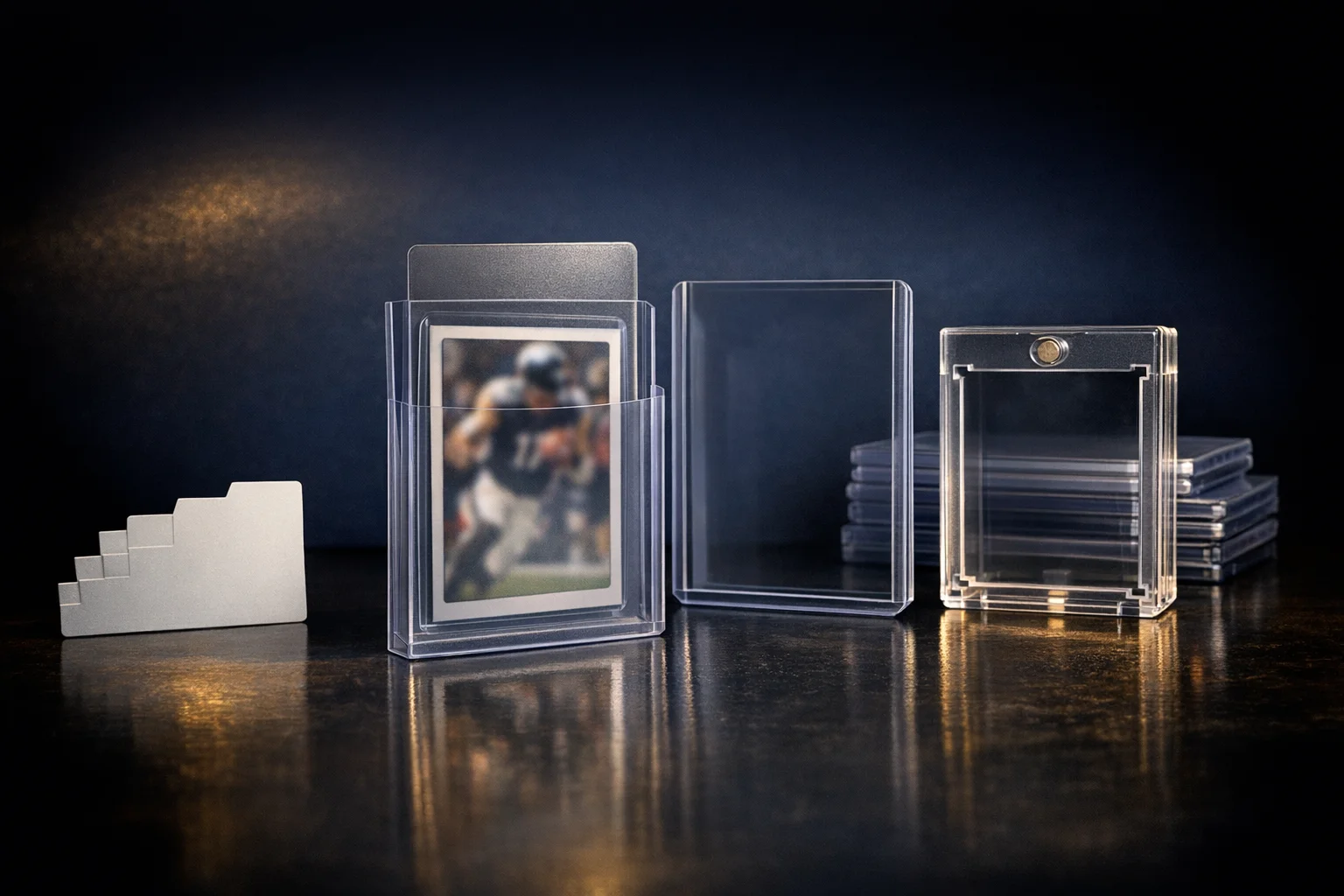
Illustration generated for this guide; not a photograph of an actual card, product or event.
Photo Gallery