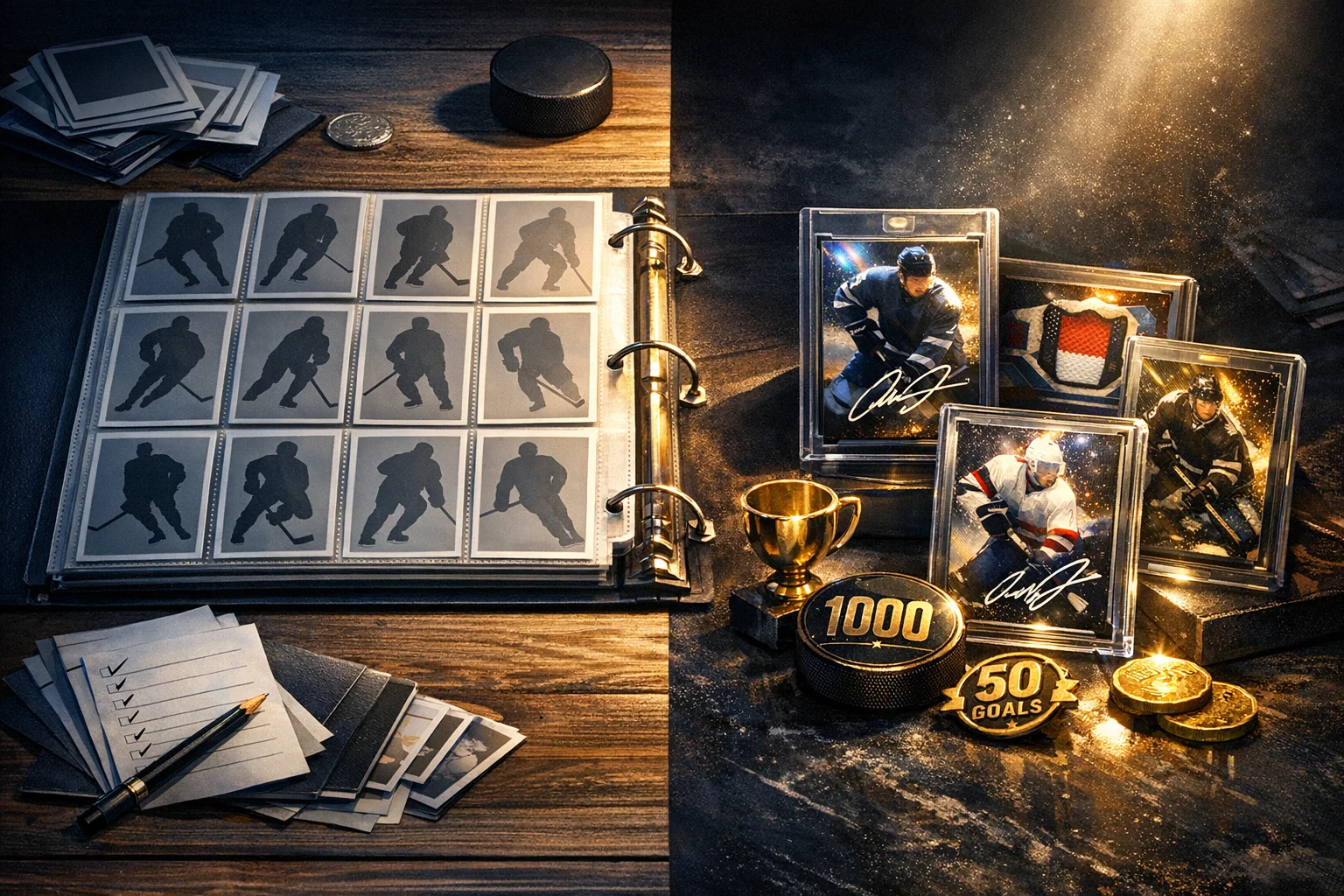
Every hockey collector eventually runs into the same fork in the road: do you build sets, or do you build around a player?
In hockey, that choice is shaped not just by taste but by how the licensed card market is actually organized. The flagship lane gives you a clear annual checklist and a visible finish line. The player-focused lane can be more personal and more exciting, but it can also spread quickly across parallels, autographs, premium releases, milestone cards, and memorabilia-adjacent items.
If you are deciding where to put your money and attention, the most useful question is not which style is “better.” It is which style gives you the kind of collecting experience you will still enjoy six months from now.
Why hockey makes this choice unusually clear
Hockey is one of the easier sports to compare on this question because the modern licensed physical-card landscape is concentrated. As of the November 11, 2026 research date, the NHL and NHLPA had publicly announced long-term extensions with Upper Deck for exclusive licensed physical trading cards. That matters because your practical decision is not being made across a sprawling field of equivalent manufacturers for current NHL-uniform cards. In many cases, you are deciding how to navigate one main ecosystem rather than several competing flagship ecosystems.
That concentration tends to make the contrast sharper. Set building usually points you toward clearly defined annual products with published structure and checklists. Player collecting, by contrast, often means moving horizontally across product types inside the same brand family: flagship base cards, rookie cards, premium autographs, patch cards, event-driven releases, and authenticated signed material.
For collectors, that creates a useful reality check. If you want order, hockey gives you order. If you want depth on one favorite player, hockey also supports that path, but the project can become much broader than it first appears.
- A centralized rights environment can make product navigation simpler.
- That same concentration can also make a player chase expand faster, because so many lanes sit under one umbrella.
- Your choice is less about “which company” and more about “which collecting mission.”
What set building does best in hockey
If your brain likes defined targets, hockey set building has a strong case. Upper Deck’s 2025-26 Series One page spells out a 250-card base set consisting of 198 veterans, 49 Young Guns, and 3 checklist cards. That kind of public structure gives you something player collectors often lack: a project with hard borders.
That clarity changes how you buy. You can decide, before opening anything, whether your goal is a basic veteran-and-rookie run, a full base build including Young Guns, or a deeper version that branches into parallels and inserts. Because the checklist and many odds are published, you can map out what “done” means. Even if you never chase a true master set, you know what you are saying yes to and what you are intentionally skipping.
Set building also naturally gives you class context. Instead of tying your enjoyment to one player’s availability or autograph schedule, you absorb a whole rookie group at once. That can make collecting feel richer on a budget. One binder page tells a bigger seasonal story than one isolated hit. For many collectors, that story is the point.
There is also an emotional advantage: a finish line. Completing a hockey set is satisfying because the hobby itself recognizes the shape of the achievement. You are not just acquiring cards; you are progressing through a visible checklist. That makes it easier to stay disciplined when a product starts tempting you into expensive side quests.
- Best for collectors who enjoy binders, checklists, and measurable progress.
- Easier to budget because the target is publicly defined.
- Naturally captures a full rookie class instead of one-player risk.
What player collecting does best in hockey
Player collecting wins when you want your collection to feel personal rather than complete. Instead of asking, “How close am I to finishing?” you ask, “How well does this card represent the player I care about?” That can be a much more meaningful way to collect, especially if you follow one star, one Hall of Famer, one franchise legend, or one rookie whose career you want to document over time.
Hockey supports that style especially well when you narrow the format. Upper Deck describes 2025-26 Stature as a product that appeals to autograph, rookie, and player collectors alike, and its design revolves around veteran, legend, and rookie cards with hard-signed autographs and or game-worn patch content. That is a fundamentally different experience from building a flagship checklist. You are not trying to cover a season broadly; you are selecting cards that express prestige, design, signature quality, memorabilia connection, or era-specific meaning.
Upper Deck Moments pushes the idea even further. That line is built around individual moments and milestones, typically as one-card event drops with a base version and a defined parallel ladder on select releases. For a player collector, that can be wonderfully focused. You can build a career timeline one event at a time instead of ripping sealed product in hopes of landing the right name.
The catch is obvious: freedom can become sprawl. A player collection can mean rookie-year cards, base cards from every season, all flagship parallels, autograph runs, patch cards, moments cards, and authenticated signed pieces. Without rules, “I collect this player” becomes an open-ended obligation rather than a fun project.
- Best for collectors who want story, identity, and deeper emotional connection.
- Works better when you define a lane: flagship only, autograph only, milestone cards only, or one era only.
- Can create a more distinctive collection than a broad set project.
The hidden strength of set building: it keeps your standards honest
One of the least glamorous reasons to start with sets is that sets force you to define your standards early. Are checklist cards part of your goal? Are short prints required? Are parallels separate projects? Do you care about condition uniformity, or just presence? Those questions are easier to answer when the product itself has a clear structure.
That discipline matters because it prevents drift. A lot of collectors say they are building a set when they are really chasing anything adjacent to that set. A hockey flagship project becomes far more manageable if you write your own rules before you buy your second box or your twentieth single. For example, a practical collector might decide: I am building the full 250-card base set, but I am not treating parallel Young Guns as mandatory. Another collector might decide: I only want the 49 Young Guns and will ignore the veterans completely. Both are coherent strategies if stated up front.
Set building is also better for learning product anatomy. By working through a checklist, you start noticing how base numbering works, where rookie subsets sit, how inserts are separated from the main run, and which cards are true needs versus flashy distractions. That kind of product literacy carries over into smarter buying everywhere else in the hobby.
The tradeoff is that set building can become mechanical if you do not actually enjoy the cards. Completion for its own sake is not a virtue. If the checklist feels like homework, you are probably in the wrong lane.
- Write your rules before you start: base only, base plus rookies, or master-style ambitions.
- Use the checklist as a training tool, not just a shopping list.
- If the process feels joyless, a player focus may suit you better.
The hidden strength of player collecting: it gives every purchase a reason
A focused player collection can make you far more selective, which is often healthy. When every card has to earn its place by saying something specific about one player, impulse buying gets harder. That can keep your budget from leaking into random breaks and side purchases that do not really fit your collection.
The best player collections usually follow a framework. You might collect only first licensed NHL-uniform cards from each career stage. You might collect one hard-signed autograph per major release style. You might build a milestone chronology through event-based cards. You might collect one representative card from each team season of a veteran’s career. None of those approaches requires infinite spending, and each creates a narrative you can explain in one sentence.
This is where premium products can make sense even if you buy fewer cards overall. A Stature card with a hard-signed autograph or game-worn patch content may carry more meaning for your project than twenty random base cards of the same player. That is analysis, not a universal rule; some collectors prefer breadth over centerpiece cards. But if your aim is quality-over-quantity, hockey’s premium lanes are built to support that choice.
The danger is that personal attachment can blur discipline. A collector who loves one player may talk himself into every new parallel, every late-career insert, and every premium card regardless of whether it improves the collection. The cure is simple: define what counts before the next release hits.
- A strong player project should have a sentence-length mission statement.
- Premium can be rational if fewer, better cards fit your goal.
- Personal connection is a strength until it turns into automatic buying.
Do not confuse league licensing, player-group rights, and autograph access
This is the rights issue that trips up many collectors. In hockey, the words licensed and exclusive do not mean one single thing. The NHLPA collective bargaining agreement explains that the NHLPA group licensing program covers player identity elements such as names, signatures, pictures, stats, numbers, and likenesses when used in groups of three or more players, but it also states that picture and likeness do not include club uniforms or logos. The same agreement says retail trading cards showing current players in NHL club uniforms are to be jointly licensed by the NHLPA and the club or NHL side.
For collectors, the practical lesson is simple: team visual rights and player-group rights are related, but they are not interchangeable. If your goal is current players pictured in NHL uniforms on retail cards, you are dealing with a joint licensing structure. If you move into other uses of player identity, the rights analysis can differ.
Autographs add yet another layer. Upper Deck’s authenticity materials say an Upper Deck representative must witness each autograph for its authenticated athlete program. Its memorabilia pages also identify specific exclusive athlete relationships, and Upper Deck’s November 6, 2026 announcement regarding Wayne Gretzky states that the Legacy Partner arrangement includes exclusive rights to produce premium autographed collectibles, including trading cards and memorabilia, featuring his authenticated signature and likeness. In other words, broad trading-card rights do not automatically mean identical autograph access for every athlete.
This matters when you compare cards and signed collectibles. Two items can both feel “official” in everyday conversation while relying on different rights paths behind the scenes. Knowing that helps you ask better questions before you buy.
- Current-player NHL-uniform retail cards rely on joint licensing, not just one bucket of rights.
- NHLPA group rights do not automatically include club uniforms or logos.
- Autograph availability may depend on separate athlete agreements and witnessed-signature programs.
Rookies are where the two strategies diverge most
Rookie cards often decide the whole argument. Set builders usually want rookie-class coverage. Player collectors usually want one specific rookie arc. Hockey’s production pipeline makes that difference important. The NHLPA’s Rookie Showcase coverage from September 2023 says Upper Deck’s primary purpose at the event was to gather photo and video of players in NHL team jerseys for their first official rookie hockey cards. That tells you something useful: rookie-card production is structured, but it is also staged. A prospect’s card footprint does not appear all at once just because collector interest exists.
For set builders, that structure is a benefit. You are not trying to predict every future release. You are waiting for the licensed annual rookie subset to present itself in an organized way. For player collectors, the same reality can be frustrating. If you are all-in on one young player, patience becomes part of the hobby. The card story may unfold product by product rather than in one satisfying launch.
This is also where collectors need to keep their labels clean. A licensed NHL rookie subset and a prospect-era card are not the same kind of item, even if both are desirable. If your player collection centers on “firsts,” define exactly which first matters to you: first licensed NHL-uniform card, first autograph, first premium patch card, first flagship rookie, or first event-based release. Without that definition, you can end up arguing with yourself at every purchase.
As a practical exercise, write down your rookie rule before spending. If you are a set builder, decide whether Young Guns are the essential core of your annual project. If you are a player collector, decide whether your collection begins at prospect stage or only once licensed NHL-uniform cards appear.
- Set builders benefit from the annual rookie-subset structure.
- Player collectors often need patience as a rookie card footprint develops.
- Define what “first” means for your collection before you chase it.
How to choose based on budget, time, and tolerance for chaos
A good collecting strategy should fit your real life, not your idealized hobby persona. If you have limited time and want obvious next steps, set building is usually more forgiving. The checklist tells you what exists. You can make a want list, chip away at it, and know when the project is complete. That predictability is valuable if collecting has to fit around work, family, and other priorities.
If your budget is uneven, player collecting can still work well, but only if you embrace selectivity. Instead of buying something every week, you can save for cards that genuinely move the project forward. In practical terms, that might mean passing on several minor parallels so you can afford one hard-signed card later. It might mean buying one Moments card tied to a favorite milestone rather than opening sealed product hoping the right player appears.
Your tolerance for chaos matters more than many collectors admit. Some people love open-ended hunts. They enjoy discovering obscure parallels, oddball signed items, and niche moments releases. Others hate the feeling that the target keeps moving. Those collectors usually thrive with sets because the project has edges.
A useful self-test is this: when you miss a card, do you feel energized or drained? If the miss makes you want to research harder, player collecting may be your lane. If the miss just makes you want a cleaner task list, set building probably fits better.
- Choose set building if you value routine, progress tracking, and a clear stop point.
- Choose player collecting if you prefer patience, selectivity, and storytelling.
- Be honest about whether open-ended hunts excite you or exhaust you.
A smart starting plan for most hockey collectors
For most people entering or re-entering hockey, the safer starting point is set building first, player collecting second. That is not because player collecting is inferior. It is because hockey’s flagship structure gives you a cleaner on-ramp. You learn the release rhythm, the rookie subset logic, the checklist habits, and the product language in a format that is publicly defined and easier to control.
After one annual set project, your own preferences usually become obvious. Maybe you discover that the rookies are all you care about, which points you toward a rookie-focused player strategy. Maybe you realize you only light up for premium hard-signed cards, which suggests a selective player collection through products like Stature. Maybe event cards and milestones are what hold your attention, which makes a Moments-style chronology more compelling than a binder build.
If you already know you are a player collector at heart, start anyway with rules. Pick one player. Pick one format. Pick one budget limit. For example: one flagship rookie, one hard-signed autograph, and one milestone card per season. That kind of framework turns a vague supercollection into a realistic collecting plan.
The best strategy is the one that survives your future self. If your collecting plan is so broad that you cannot explain it, budget it, or maintain it, it is not a strategy yet. In hockey, set building gives you the easiest structure. Player collecting gives you the deepest identity. Choose the one whose tradeoffs you can happily live with.
- Start with one annual flagship project if you want the simplest foundation.
- If going player-first, limit yourself by format, era, or card type.
- A workable collecting plan should be easy to explain in one or two sentences.
Illustration generated for this guide; not a photograph of an actual card, product or event.
Photo Gallery