Older golf cards ask you to slow down. They do not follow the neat, annual flagship pattern that many collectors learn first in baseball, football, or basketball, and the cards themselves can look radically different from what the modern hobby usually expects.
That difference is not a problem. It is the appeal. Once you understand the major eras, learn how condition works on issue-specific designs, and build a simple research routine, older golf cards become much easier to navigate and much more enjoyable to collect.
First, define what you mean by an older golf card
In golf, “older” can mean two different things, and mixing them together causes confusion. One definition is the hobby catalog definition. Beckett’s golf guide uses a broad split of 1980 and older as vintage and 1981 to present as modern. That is a practical organizational line if you are browsing a database, sorting cards by era, or trying to understand how a price guide groups the category.
The second definition is the one many collectors actually use when they talk about the history of golf cards. PSA’s golf records show the sport’s cardboard history beginning in 1898, with substantial pre-war representation through the 1910s, 1920s, and 1930s. In everyday collecting terms, that means the phrase older golf cards often points first to pre-war tobacco and specialty material, then to a scattered post-war stretch, and only after that to the more familiar packaged-card era.
This distinction matters because it changes how you look at the card in front of you. If you assume every older golf card should behave like a standard modern release, you will misread size, stock, imagery, distribution style, and condition expectations. A small tobacco card, a larger instructional piece, a multi-sport premium, and a modern pack-issued card may all belong to golf collecting, but they should not be approached as if they are the same object with different dates.
- Use the 1980/1981 split as a cataloging tool, not as the full history of golf cards
- Expect older golf cards to include tobacco issues, specialty releases, instructional subjects, and larger formats
- Treat format differences as part of the card’s identity, not a side detail
Era 1: The pre-war foundation is where golf card history really begins
For collectors who want the roots of the category, the pre-war period from 1898 to 1939 is the essential starting point. PSA’s pre-war golf overview says golf cards made their first real appearance in 1898 through Ogden’s Cricketers and Sportsmen, and PSA’s broader golf index shows a deep run of early issues after that, including 1900 Cope’s Golfers, 1901 Ogden’s Guinea Gold, 1914 Marsuma Golfers, and several notable 1920s and 1930s tobacco and player sets.
This era teaches an important lesson right away: old golf cards are often not “sports cards” in the modern visual sense. Many are tiny tobacco cards. Some are monochrome or muted in tone. Some emphasize instruction, portraiture, or broader sports themes rather than a clean action image and a statistics panel. British tobacco issues play a major role, and the category’s early identity is tied as much to printing history and packaging style as it is to player collecting.
That is why pre-war golf rewards set knowledge. A collector can absolutely chase names, but the issue itself often carries much of the meaning. One card may be desirable because it belongs to a scarce tobacco set. Another may stand out because of a larger photographic format. Another may be pursued because the set is notoriously difficult in clean condition. If you only ask who is on the card, you can miss why the card matters.
- PSA’s golf records begin the category in 1898
- Pre-war golf is heavily shaped by tobacco and specialty issues
- Set identity often matters as much as player identity in this era
Era 2: The post-war decades are real, but they are fragmented
Collectors sometimes jump from pre-war history straight to the Tiger Woods era, but that leaves out decades of material. PSA’s golf checklist shows plenty of post-war issues, including 1940 Wheaties Champs of the USA, 1945 Peerless Scales, 1948 Kellogg’s Pep, 1951 Berk Ross, 1954 Topps Scoop, 1959 Top Flight Stars, 1960 Clevedon, 1965 Bancroft Tiddlers, multiple Panini Campioni Dello Sport entries from 1968 through 1973, and 1971 Barratt.
The right way to think about 1940 through 1980 is not as a neat annual run, but as a scattered collecting landscape. Golf remained present, yet often through food-related issues, premiums, hand-cut or odd-size items, educational releases, multi-sport products, and multinational sets rather than one dependable mainstream line. That makes the era rich, but not simple.
For collectors, the tradeoff is clear. This period can be fun if you enjoy discovery, unusual formats, and cards that do not fit standard expectations. It can be frustrating if you want tidy checklist logic, easy size assumptions, or a consistent annual product ladder. A practical way to approach the post-war period is to decide whether you like the era for historical continuity or for oddball charm. If you do not know which one attracts you, you may end up browsing a lot without building much direction.
- Post-war golf collecting is broad, but not standardized
- Expect more oddball and multinational material than annual flagship structure
- This era suits collectors who enjoy format variety and detective work
Era 3: Modern classification starts in 1981, but 2001 is the key hobby turning point
Beckett’s golf guide uses 1981 as the start of the modern side of the category, and PSA’s golf index supports that broad transition by listing 1981 and 1982 Donruss Golf before later modern issues appear. For collectors, that gives you a useful practical line between older and modern golf material even if the visual and commercial evolution is not perfectly smooth.
Within the modern era, 2001 matters for a different reason. Upper Deck states that its first golf release came in 2001, and its 2026 anniversary coverage framed that line as 25 years of golf-card history for the company, with Tiger Woods central to that launch and to the product’s modern identity. As of the 2026 research date, that makes 2001 a well-supported commercial milestone for packaged modern golf cards tied to Tiger Woods’ rookie-card era.
The caution is important. A modern company milestone is not the same thing as the birth of golf cards. If you collect across eras, keep the timeline straight in your head. 2001 is a major modern watershed, especially for collectors whose memory of golf cards begins with Upper Deck and Tiger Woods. It is not Year One for golf cardboard, and treating it that way hides more than a century of earlier material.
- Beckett places 1981 onward on the modern side of the category
- PSA’s checklist shows early 1980s issues before the 2001 hobby shift
- Upper Deck identifies 2001 as its own first golf release and a major modern milestone
Condition basics still matter, but older golf cards punish generic thinking
The standard grading vocabulary remains the right foundation. PSA tells collectors to focus on surface, edges, corners, and centering, while also checking for folds, creases, stains, and other damage. Beckett reinforces the same four pillars and adds useful vintage language around roughness, notching, gloss loss, scuffing, staining, and print defects. Even if you never submit a card, these terms give you a disciplined way to see what is actually there instead of reacting to a seller’s headline description.
The problem comes when collectors stop at the basics. On older golf cards, the issue-specific weakness often matters more than a broad statement like “nice for the age.” A card can have honest wear that is normal for its set, or it can have exactly the kind of flaw that should make you hesitate. Two cards with similar corner wear may not be equally attractive if one issue is usually forgiving while the other is notorious for border damage or factory inconsistency.
A useful mindset shift is to stop asking only what grade a card might receive. Ask what defects this issue tends to show, and whether this copy is better or worse than that pattern. That is a more practical buying question, especially for raw cards. In older golf, context often matters more than a speculative number.
- Use surface, edges, corners, and centering as your base checklist
- Add creases, stains, gloss loss, print flaws, and cut quality to your review
- Judge a card against its issue’s normal weaknesses, not just against modern standards
Issue-specific condition traps can matter more than the label on the flip
PSA’s pre-war golf coverage is especially helpful because it ties condition sensitivity to named issues. Ogden’s golf cards are described as very condition sensitive, with black borders, chipping, centering problems, and inconsistent size. That means an Ogden’s example can look appealing in a small online image but still hide exactly the kind of edge and border wear that advanced collectors expect to matter.
The 1914 Marsuma Golfers issue carries a different but equally important warning. PSA notes tannish or gold borders prone to chipping along with chronic centering problems. In other words, lighter border color does not automatically make a card easier. The design may be less dramatic than a black border, but the wear can still be significant and easy to underestimate if you are judging quickly.
Size creates another set of problems. PSA points out that 1927-28 Churchman Famous Golfers are admired for their look, but the larger format makes them tougher and more vulnerable to damage over time. PSA says 1930 Wills Famous Golfers are usually better centered, yet their larger format still creates survival issues in top condition. Bigger cards can be beautiful, but they often pay a durability price.
Surface can be the decisive factor on other issues. PSA notes that 1928 Millhoff Famous Golfers have glossy surfaces prone to scratching and also show inconsistent factory cuts and poor centering on the reverse. That is a strong reminder that a front scan alone is not enough. An older golf card should be studied front and back, and where possible under angled light, because scratches and back-side alignment can change the whole evaluation.
A practical example helps. If you are choosing between two similarly priced pre-war cards, one with a mild corner touch and one with widespread border chipping on a dark design, the second may be the bigger problem even if both are described as nice vintage examples. The right question is not which card sounds cleaner. It is which flaw is more damaging for that specific issue.
- Ogden’s: black-border wear, chipping, centering issues, and size inconsistency
- Marsuma: border chipping and chronic centering trouble
- Churchman and Wills: larger formats that are harder to keep sharp
- Millhoff: glossy scratch sensitivity plus cut and reverse-centering concerns
Alteration risk deserves real attention on older golf cards
Vintage golf cards are not exempt from the same alteration risks that affect other sports categories. Beckett’s guidance on trimming explains that edges may be altered to reduce visible wear or improve the look of centering, and that edge fibers or a mismatch between edges and corners can be warning signs. Beckett’s recoloring guidance also matters because color touch can improve the visual impression of wear while still affecting the card’s surface, edges, and corners.
This matters even more on issues where the card’s design makes defects stand out. Dark borders, edge chipping, and small-format tobacco designs can create temptation for cosmetic improvement. That does not mean a sharp raw card is automatically suspicious. It means unusually clean presentation should be weighed against what the issue normally looks like.
A simple buyer routine helps. If the set is known for inconsistent size, do not assume perfectly even borders are automatically a positive. If the issue is known for chipping, ask whether the color along the edge looks natural and consistent. If a seller provides only soft scans, ask for sharper close-ups of edges and corners rather than relying on a generic statement that the card is unaltered. You are not trying to prove fraud from a screen. You are trying to avoid buying a card that raises questions you could have explored before paying.
- Trimming can target edge wear and apparent centering flaws
- Recoloring can affect more than one aspect of the card’s appearance
- The cleaner a condition-sensitive issue looks, the more carefully you should study it
A better research workflow: checklist first, issue second, card third
The easiest mistake in older golf is to start with a name search and stop there. A stronger method begins with the checklist. PSA’s golf index is useful because it shows what exists across the sport’s history from 1898 forward. Beckett’s guide reinforces the broad vintage-modern split. Together, those tools help you place a card in the right era before you decide whether the listing in front of you is attractive.
The second step is where many buyers improve fastest: research the issue, not just the golfer. PSA’s pre-war golf article shows exactly why. A 1900 Cope’s tobacco card, an Ogden’s black-border issue, a Marsuma example, and a glossy Millhoff each have different manufacturing traits and different survival problems. Once you know the set, you can judge the copy. Without that step, you are just reacting to age and name recognition.
Only after those two steps should you focus on the individual card. Now the grading vocabulary becomes useful in a practical way. You can review surface, edges, corners, centering, creases, stains, gloss, and cut quality with a better sense of what is normal for the issue. This order reduces impulse buying because it answers three different questions in sequence: Is this a real and known issue? What usually goes wrong with it? How does this actual card compare?
That workflow is also a budget tool. Research does not only keep you from buying bad cards. It can keep you from passing on cards that are honestly worn but still desirable because the issue is scarce or naturally condition-sensitive. PSA explicitly notes that vintage cards can still be worth grading even in low grade because rarity or scarcity can matter. Even if grading is not your goal, the underlying principle applies to buying: wear and desirability are not opposites.
- Step 1: confirm the issue and place it historically
- Step 2: learn the issue’s usual flaws and format quirks
- Step 3: evaluate the specific copy with grading language and context
- Remember that low-grade vintage can still matter when rarity or scarcity is part of the story
Questions worth asking sellers before you commit
Good research does not end when you find a listing. Older golf cards reward direct, boring questions. Ask for the exact issue name, clear front and back images, and confirmation that the size appears typical for the issue. That last point matters because some older sets have inconsistent cuts or dimensions, and a clean-looking card with suspiciously precise edges is not always the safer buy.
Ask about flaws in descriptive terms rather than asking what the card would grade. A seller can usually answer whether there is a crease, border chipping, staining, or surface scratching. They may not be qualified to project a grade, and even if they are, that answer often tells you less than a plain condition description. On a glossy issue like 1928 Millhoff, asking specifically about scratches under light is far more useful than asking whether the card looks high grade.
If the card is larger format, ask whether the edges are fully intact and whether the card has been stored flat. If it is a dark-border tobacco issue, ask for close-ups of the border and corners. If the reverse matters for centering or print quality, insist on a clear back image. None of these questions are aggressive. They are normal issue-aware buying habits.
One subtle but useful question is whether the seller can identify a common problem with that issue. If they can, that suggests at least some familiarity with what they are offering. If they cannot, you simply know that more of the interpretive work falls on you. Either way, the answer gives you information before your money moves.
- What is the exact issue, and can you show strong front and back images?
- Are there any creases, scratches, stains, chips, or gloss problems not obvious in the scan?
- Does the size and cut appear typical for this issue?
- Can you provide close-ups of borders, corners, and edges under better light?
Build a collecting plan that matches the way golf cards actually work
Older golf gets easier once you choose a lane. One option is era-based collecting: pre-war foundations, post-war oddballs, or early modern packaged cards. Another is format-based collecting: small tobacco cards, larger photographic pieces, instructional subjects, or multinational specialty releases. A third path is player-driven collecting, where you follow one golfer across very different issue types and accept that the research burden will change from card to card.
Each path has tradeoffs. Era collecting gives you historical clarity, but the cards may vary wildly in size and look. Format collecting creates stronger visual identity, but it can narrow your player pool. Player collecting is intuitive and personal, yet in golf it can push you across tobacco cards, oddballs, and modern releases that have almost nothing in common except the name on the front.
A practical starter plan, offered here as analysis rather than market law, is to buy one card from each major stage: one pre-war issue, one post-war scattered issue, and one early modern packaged release. That small experiment teaches you more than hours of vague browsing because it forces you to compare stock, size, condition habits, and research demands across the category.
The bigger point is that patience is part of the skill set. Older golf cards do not become clearer because you scroll faster. They become clearer when you learn what era you are in, what the issue usually looks like, and what kind of flaw matters most on that specific card. Once you do that, the category stops feeling random and starts feeling wonderfully specific.
- Choose a lane: era, format, or player
- Expect different research demands depending on the lane you choose
- A small cross-era sample can teach the category quickly without overcommitting
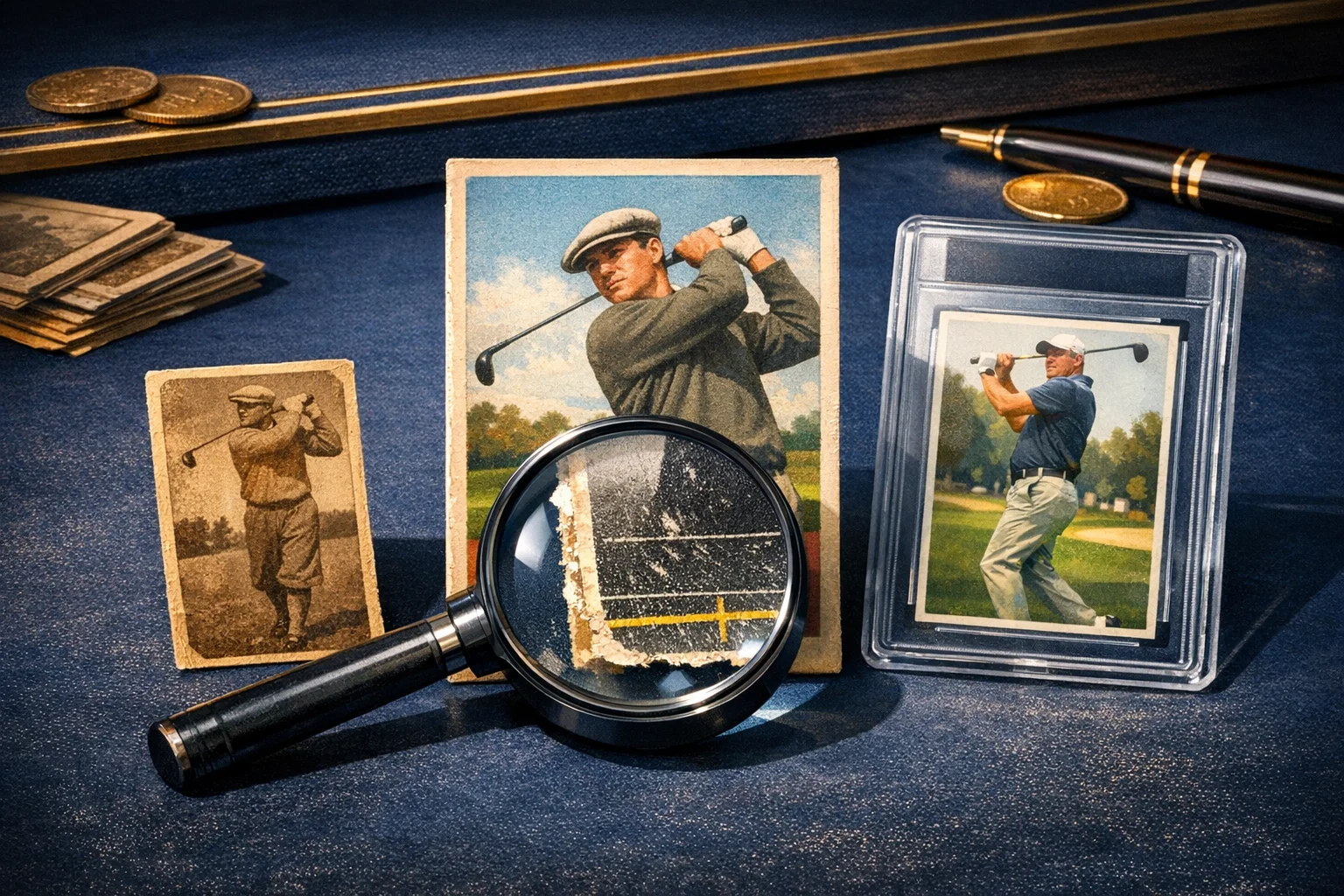
Illustration generated for this guide; not a photograph of an actual card, product or event.
Photo Gallery