Upper Deck hockey can look simple from a distance: flagship cards, Young Guns, a few premium brands, and another season of rookies to chase. In practice, the category is more structured than that. Licensing affects what can appear on a card. Rookie timing affects when a player can be printed as a true rookie. Product families split collectors across different card styles rather than funneling everyone into one universal rookie format.
If you collect hockey cards, it helps to think in layers. One layer is legal and visual: league marks, team uniforms, and player likeness rights. Another is calendar-based: whether a player has actually appeared in an official NHL game yet. A third is product identity: MVP, Series 1, Artifacts, SP Authentic, O-Pee-Chee Platinum, and newer high-end lines all frame rookies differently.
As of October 8, 2026, the clearest official picture is that Upper Deck’s modern NHL card business rests on a combined NHL and NHLPA structure, with early-season products often relying on rookie redemptions until players make their debuts. Once you understand that framework, product descriptions stop feeling like marketing noise and start reading like clues.
1. What a licensed NHL card actually requires
For mainstream Upper Deck NHL cards, “licensed” is not just a casual label. The official league and player-association statements point to a combined arrangement in which Upper Deck holds rights tied to both the NHL and the NHLPA. The league announcement from 2021 said the NHL and NHLPA each extended their licenses with Upper Deck, and described Upper Deck as the exclusive licensed manufacturer of physical trading cards. That matters because it shows the relationship is joint, not one-sided.
The rights split also explains why collectors usually see both league and player-association language attached to official NHL card products. The CBA language cited in the public NHLPA-hosted document distinguishes player images from club uniforms and logos. In collector terms, that means a full NHL card image featuring active players in team-branded presentation is not simply a matter of having a player photo. It involves the player side and the league-and-team identity side together.
Why does this matter when you are standing at a card show table or browsing an online listing? Because it helps you separate three different categories that collectors sometimes blur together: a licensed NHL card, a player-approved autograph item, and a card using player imagery without full NHL presentation. If your goal is to collect standard NHL releases with team branding and familiar pack-issued rookie lines, the combined NHL plus NHLPA framework is the key foundation.
- Practical check: look for product context that clearly places the card in an official Upper Deck NHL release, not just a generic hockey issue.
- If a seller says a card is “licensed,” ask licensed by whom: the league, the players, or a specific athlete for autograph use.
- Do not assume player imagery alone proves full NHL card licensing; team logos and uniforms involve a separate rights layer.
2. Why the history of exclusivity matters to collectors
Collectors often use the phrase “Upper Deck hockey” as if the company’s position has always been static. The official history is more precise. The NHLPA and NHL said in 2019 that Upper Deck had been the first exclusive trading-card partner of the NHL and NHLPA from 2004 through 2009-10, and that it had held similar exclusive rights again since 2014-15. The NHL’s 2021 announcement added that Upper Deck had maintained NHL and NHLPA trading-card licenses since the 1990-91 season.
That timeline matters because exclusivity changes how you interpret brand continuity. When collectors talk about Young Guns or flagship Upper Deck hockey, they are usually talking about brands that benefited from long continuity inside an exclusive modern NHL-card environment. That is different from saying Upper Deck was the only relevant hockey card company across every season of the last few decades. The official record is narrower and cleaner than hobby shorthand.
For buyers, the benefit of knowing the timeline is practical rather than academic. It helps when you compare eras, especially if you collect older rookies and newer ones side by side. A 2025-26 flagship rookie exists in a market environment shaped by exclusive modern licensing. An earlier-era card may come from a different rights landscape. Knowing that keeps you from making lazy apples-to-oranges comparisons when discussing brand importance or pack-issued status.
- Use era context when comparing older Upper Deck hockey rookies to modern ones.
- If you are explaining a card to a newer collector, specify whether you mean long-running brand recognition or current exclusive licensing status.
- Treat “exclusive” as period-specific, not eternal.
3. The rookie-card rule that shapes the entire release calendar
The most important official rookie rule for Upper Deck hockey is straightforward: Upper Deck has said the NHLPA rule is that a player cannot be featured on a rookie card until he has skated in an official NHL game. For collectors, that one sentence explains a surprising amount of the product calendar.
It explains why highly drafted players do not automatically appear immediately as pack-pulled live rookies the moment training camp hype begins. It explains why early boxes can contain placeholders, division-based rookie exchange cards, or other redemption structures instead of the exact player cards many buyers want most. And it explains why some collectors feel like flagship hockey unfolds in stages rather than all at once.
It also protects you from a common mistake: confusing prospect or pre-NHL cards with NHL rookie cards. A player can have cards before his official NHL rookie appears, but that does not make every earlier appearance the same thing. If you are building a rookie collection with clear rules, the official game-debut threshold is the line that matters in Upper Deck’s NHL ecosystem.
This rule does not tell you which brand’s rookie design you should prefer. That remains a collector choice. What it does tell you is when Upper Deck can move from pre-debut stand-ins to live rookie cards within its licensed NHL products.
- Before buying a so-called rookie, ask whether the player had already appeared in an official NHL game when that product was released.
- Do not treat draft-year excitement as proof that a true NHL rookie card should already exist.
- Separate prospect collecting from NHL rookie collecting in your budget and checklists.
4. Why MVP and Artifacts lean on rookie redemptions
Once you understand the debut rule, MVP and Artifacts make far more sense. These early-season products are not simply withholding rookie cards to be difficult. Their structure reflects timing. The 2025-26 MVP page says the collection starts there and includes Rookie Redemption cards. The 2025-26 Artifacts page likewise says the base set includes redemption cards for new-skating rookies.
For collectors, rookie redemptions are both useful and inconvenient. The upside is access. Early products still let you participate in the incoming class even when final live rookie cards cannot yet be packed in standard form. That keeps early boxes connected to the rookie race. The downside is obvious: you are often buying a process instead of the finished card, and that can complicate set building, resale planning, and display.
A practical way to approach MVP and Artifacts is to treat them as transitional products. If you enjoy being early, they have a role. If you only want cards that are already physically identifiable by player and design, these may not be the cleanest rookie-first boxes for your goals. That is not a knock on the products; it is simply using them for what they are built to do.
Analysis: a collector chasing certainty may prefer to wait for later releases with live rookie content. A collector who enjoys season-long engagement may like the puzzle and anticipation of redemptions. Neither preference is objectively superior. The important part is knowing you are choosing between timing and immediacy, not between “real” and “fake” products.
- Good fit for: collectors who enjoy early-season ripping and are comfortable with redemption mechanics.
- Less ideal for: buyers who want immediate player-specific rookie cards in hand.
- Before purchasing, check whether your goal is participation in the rookie cycle or completion of a player-specific rookie run.
5. Flagship Series 1 and the central place of Young Guns
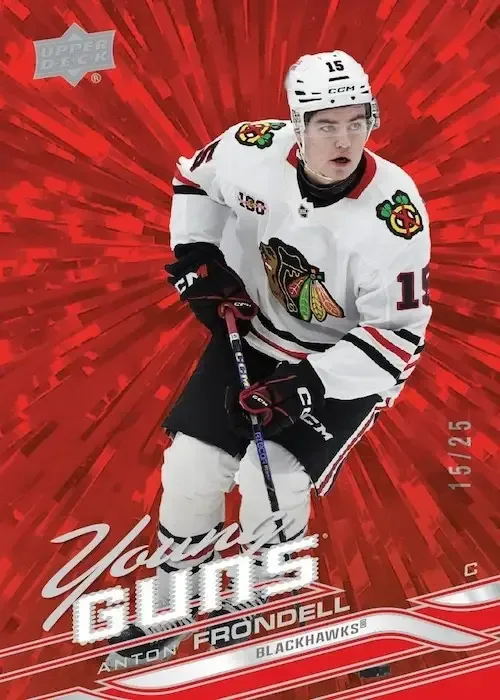
If MVP and Artifacts are part of the runway, flagship Series 1 is the main stage. Upper Deck’s 2025-26 Series One page says the product contains the first 250 cards of the base set and includes 49 Young Guns. That description reinforces what collectors already feel intuitively: Young Guns are the signature rookie identity inside flagship Upper Deck hockey.
There is a reason Young Guns hold such a strong place in hobby conversations. Flagship products are easy to explain, widely recognized, and built around a long-running visual identity. Even without claiming they are the only rookie cards that matter, you can say they are the rookie line many collectors use as a baseline reference when discussing a player’s mainstream Upper Deck NHL debut profile.
But collectors should keep two things in mind. First, Young Guns timing still depends on the debut rule discussed earlier. They are not merely “best prospects” cards inserted whenever demand spikes. Second, flagship recognition does not mean every collector should pursue the same strategy. A set builder might care about assembling all 49. A player collector may only need one clean example. A higher-end buyer may use Young Guns as the entry point, then look elsewhere for autographs or rarer finishes.
If you are shopping, ask clear questions. Is the card from flagship Series 1 or another flagship branch? Is it a base Young Guns card, a parallel, or a variation? Is the listing title relying on the brand name loosely, or does it match the exact set and checklist entry? Precision matters because “Young Guns” is famous enough that sloppy listings can create confusion even when the card itself is legitimate.
- Young Guns are the flagship rookie brand, not a synonym for every Upper Deck rookie card.
- Use exact set identification when buying: season, product, subset, and parallel if applicable.
- For budget collectors, one well-centered flagship rookie may be more satisfying than chasing every version.
6. Young Guns are iconic, but they are not the whole rookie story
One of the easiest traps in hockey collecting is acting as though Upper Deck has one universal rookie-card lane and everything else is a side quest. The official product pages do not support that simple story. They show a brand-family approach, where different releases carry their own rookie identities.
SP Authentic highlights Future Watch Rookies, including Autograph Future Watch Rookies and Future Watch Auto Patch cards. O-Pee-Chee Platinum highlights Marquee Rookies and Rookie Autographs, with a 100-card Marquee Rookie component in the 2025-26 base structure. Tableau introduces Dark Ice Rookies. Those are not minor technicalities. They are evidence that Upper Deck distributes rookie demand across multiple product lines instead of funneling all attention exclusively into flagship.
That matters for collectors because your buying plan should match your taste. If you prefer clean, broadly recognized flagship rookies, Young Guns may be your anchor. If you care most about autograph-centered rookie collecting, SP Authentic may deserve a larger slice of your budget. If you like chrome-style finishes, color, and parallel chasing, O-Pee-Chee Platinum may fit better. If you collect high-end concepts and newer subsets, lines like Tableau may be more interesting than repeating the same flagship chase every year.
The important correction is this: iconic does not mean exclusive in the logical sense. Young Guns are central to Upper Deck hockey culture, but the official pages do not say they are the only legitimate rookie format. Collectors can absolutely prefer them. They just should not erase the rest of the lineup when describing how Upper Deck structures rookie content.
- Flagship preference is a subjective collector choice, not a universal rule.
- Future Watch, Marquee Rookies, and newer rookie subsets are official product identities, not hobby afterthoughts.
- Build your rookie collection around card style and collecting goals, not only around the loudest brand name.
7. How to read Upper Deck’s product families before you buy
Upper Deck’s current hockey lineup is easier to navigate when you stop asking which product is “best” and instead ask what job each one is doing. MVP is the early, accessible entry point. Series 1 is the flagship backbone. Artifacts uses an early premium structure that still leans on rookie redemptions. SP Authentic is presented as a premium autograph-focused brand. O-Pee-Chee Platinum serves the chrome and parallel audience. Tableau pushes into a new high-end identity.
That framing helps you avoid category errors. If you buy SP Authentic expecting it to function like flagship, you may be paying premium pricing for a different kind of experience. If you buy O-Pee-Chee Platinum but do not care about chromium aesthetics or layered parallels, you may be chasing the wrong format. If you buy MVP and then complain that it is not loaded with live flagship rookies, you are really objecting to release timing, not mislabeling.
A practical shopping exercise can help. Before purchasing a box or a single, write down three things: the rookie subset you want, whether you care about autographs, and whether you are comfortable with redemptions. Then match those answers to the product family. For example, a collector who wants pack-fresh recognizable rookies without needing autos may land on flagship. A collector who values hard-signed rookie content may look to O-Pee-Chee Platinum or SP Authentic instead. A collector who enjoys seasonal speculation and participation may be happy earlier in the cycle with MVP or Artifacts.
Analysis: many collecting disappointments come from product mismatch, not bad products. Upper Deck’s segmentation is actually helpful once you read it as a menu instead of a hierarchy.
- Ask: Do I want flagship recognition, autograph focus, chromium visuals, or early-season access?
- Ask: Am I buying a set-building product, a hit-chasing product, or a player-collecting product?
- Ask: Would I rather wait for live rookie cards than manage redemption uncertainty?
8. Autographs add another rights layer, not just another checklist line
Autographs can look like a simple premium upgrade, but officially they are a separate layer of complexity. What is clear from Upper Deck’s own announcements is that the company signs at least some player-specific autograph and name-image-likeness deals beyond its broader NHL and NHLPA licensing. The June 2026 Gavin McKenna announcement is explicit: Upper Deck said it would be the sole producer of his NHL autographed trading cards and that it held rights to use his name, image, likeness, and autograph on Upper Deck cards.
That does not prove every NHL autograph card requires a separately announced exclusive player deal. The official evidence here is narrower than that, and collectors should stay disciplined. What you can say is that autograph content may involve rights considerations beyond the basic league-plus-player-group structure, especially when Upper Deck publicly highlights a prospect or star agreement.
Authentication is the other half of the autograph conversation. Upper Deck says its authenticity program includes witnessed signings, with an Upper Deck representative witnessing signatures for high-profile athletes. For collectors, that matters because it ties autograph trust not just to a facsimile statement on a box, but to a stated process. If you are comparing signed cards across eras or across products, that process language is worth understanding.
A practical buying rule is simple: separate the questions. First, is this an official licensed NHL card product? Second, is the autograph content tied to a specific Upper Deck autograph framework? Third, is the exact card on-card, sticker, redemption-based, or otherwise described in a way that changes how you value it? Those are different questions, and they deserve different answers.
- Do not assume league licensing alone answers every autograph-rights question.
- Read autograph cards as a separate collecting lane with its own rights and authenticity considerations.
- When shopping, distinguish on-card, sticker, and redemption autograph formats instead of treating “auto” as one category.
9. A practical checklist for collectors in 2026
If you want a cleaner way to collect Upper Deck hockey in 2026, start by replacing broad hobby slogans with a repeatable identification process. Begin with the exact product family. Then identify the rookie subset. Then confirm whether the player had debuted in an official NHL game at the relevant point in the card’s release cycle. Then decide whether you are dealing with a live card, a rookie redemption, or an autograph-specific chase.
That process protects collectors from several common errors. It reduces the chance of paying flagship prices for a non-flagship rookie. It keeps you from mislabeling a prospect card as an NHL rookie. It helps you compare Young Guns, Future Watch, and Marquee Rookies on their actual product terms instead of on vague reputation alone. And it prevents overconfidence when a seller throws around words like exclusive, licensed, official, or rookie without precision.
A realistic buying scenario illustrates the difference. Suppose you are deciding between an early-season MVP product and a later flagship single. If your goal is to feel involved in the rookie class as the season unfolds, the MVP route may suit you. If your goal is one widely recognized live rookie card for a player who has already debuted, a Series 1 Young Guns single may be cleaner. If your goal is a premium rookie autograph centerpiece, SP Authentic or O-Pee-Chee Platinum may be better aligned. None of those choices is universally correct; each is correct for a different collecting plan.
The broad lesson is that Upper Deck’s hockey lineup rewards readers more than guessers. Read the product page language. Read the subset names. Read the rookie timing implications. Once you do, the product families stop competing in your mind and start fitting together as parts of one coherent licensed NHL card ecosystem.
- Step 1: identify the product family.
- Step 2: identify the rookie subset name.
- Step 3: check whether the player had played an official NHL game.
- Step 4: determine live rookie card vs. redemption vs. autograph format.
- Step 5: buy based on your collecting goal, not just the loudest hobby narrative.
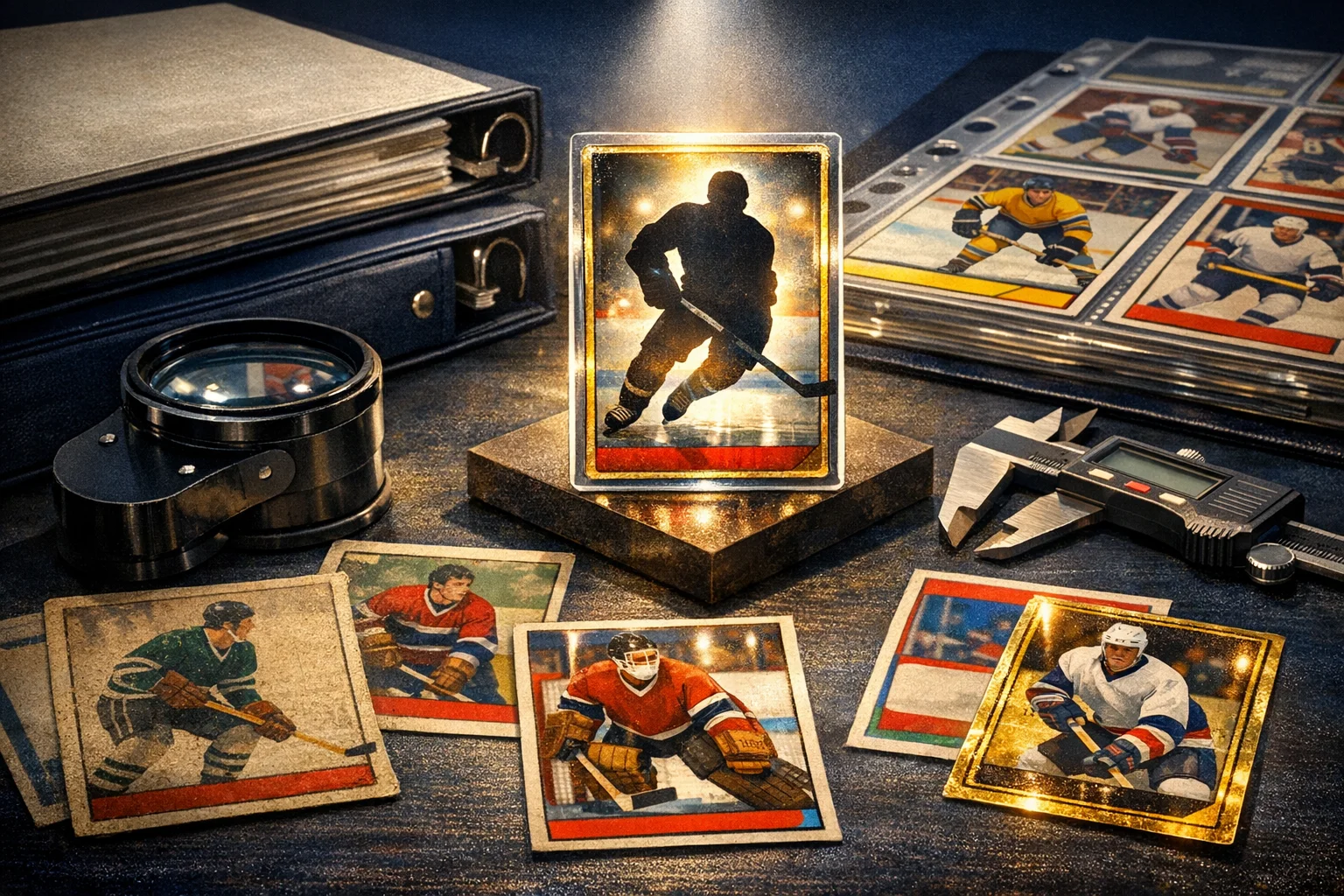
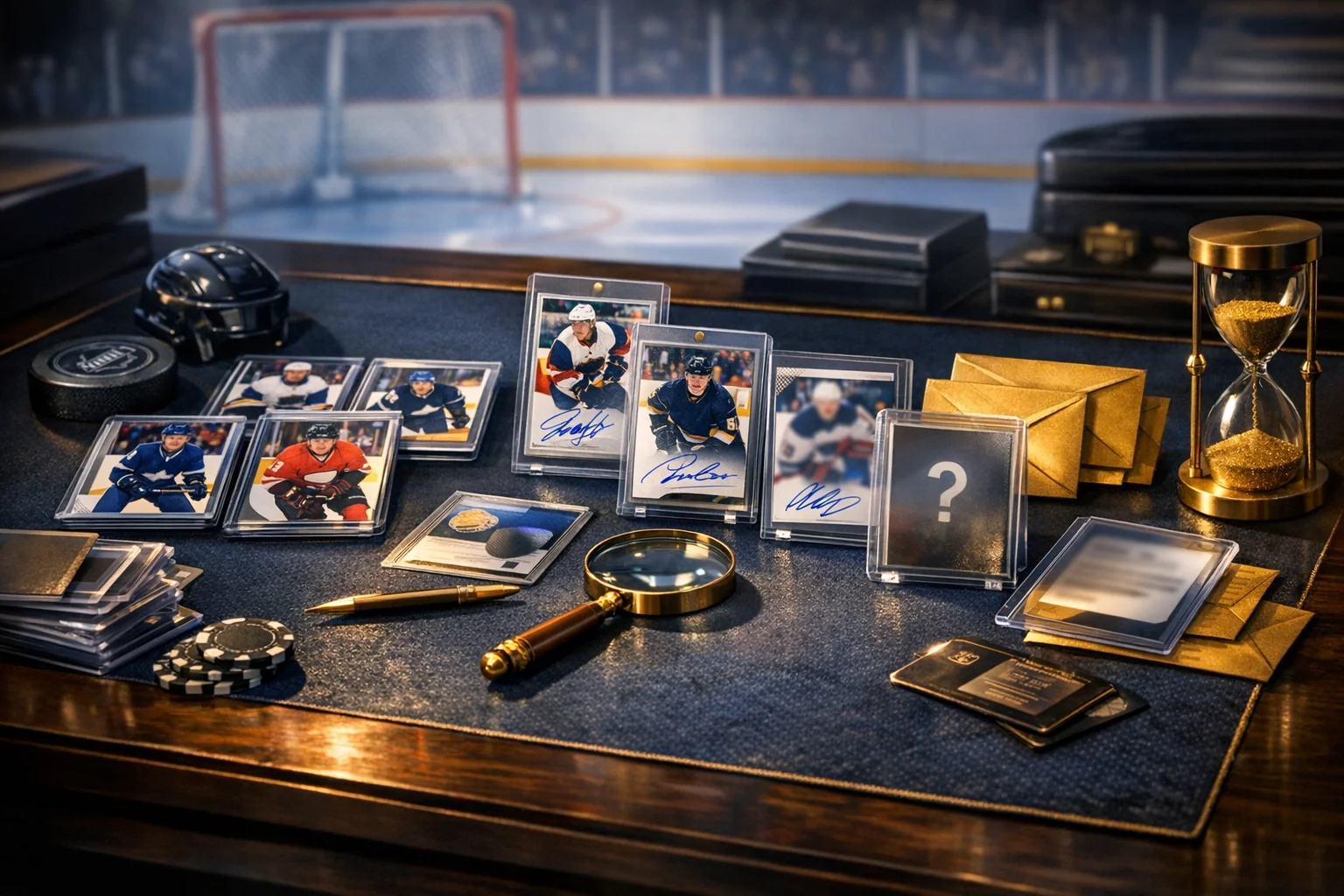
Illustration generated for this guide; not a photograph of an actual card, product or event.
Photo Gallery