The 1941 Play Ball baseball set remains one of the defining pre-war issues in the hobby, combining Hall of Fame star power, classic portrait-driven design, and the kind of condition scarcity that still shapes the market decades later. While many cards from the set can still be found raw at comparatively approachable prices, the market changes dramatically at the top of the grading scale.
That gap is especially clear when looking at PSA 10 examples from the set. Even cards with modest raw values can become major-condition rarities once they reach the highest grade, and the handful of known Gem Mint copies have produced eye-opening results in public sales. Recent market history for four 1941 Play Ball PSA 10s shows just how aggressively collectors continue to pursue elite examples from the set.
Why the 1941 Play Ball Set Still Matters
Issued by Gum, Inc., 1941 Play Ball is widely regarded as one of the hobby’s most recognizable early baseball card releases. The set is known for its player portraits and clean presentation, giving many cards a timeless visual appeal that continues to resonate with vintage collectors.
Its place in the pre-war conversation is strengthened by both its checklist and its difficulty in top condition. Surviving examples often show the normal wear associated with cards from the era, which means sharp, centered, high-grade copies remain exceptionally difficult to locate. That is a major reason why PSA 8, PSA 9, and especially PSA 10 examples can separate so dramatically from raw pricing.
For more collector background, read Manchester City Case Could Reshape the Soccer Card Market for Haaland, Doku and Future Releases.
For collectors, the set offers two very different entry points. On one side are raw cards and lower-grade examples that can remain attainable, depending on the player. On the other is the ultra-thin top-population segment, where even lesser stars can become serious trophies when the grade is high enough.
Joe DiMaggio Leads the Way
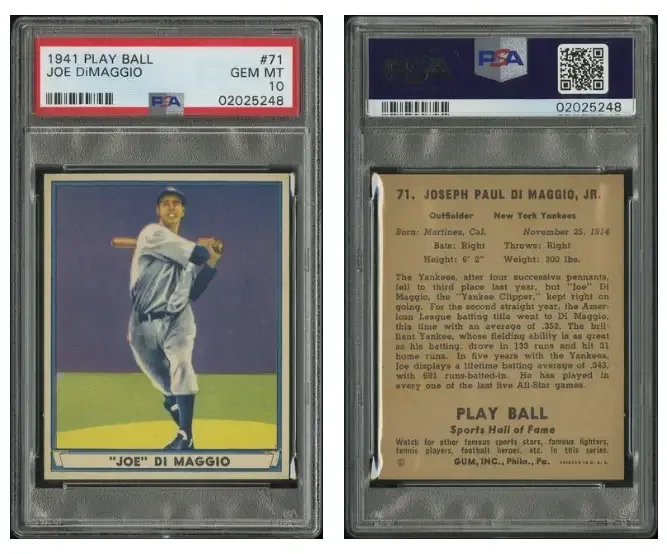
The headline card among the four reviewed sales is Joe DiMaggio’s 1941 Play Ball card No. 71. As expected, DiMaggio stands in a different financial tier from the rest of the group thanks to his status as one of the era’s signature stars and a perennial focal point in the vintage baseball market.
Raw examples of the DiMaggio typically sell in the $1,600 to $2,200 range, already a meaningful number for an ungraded copy. But that figure is only a starting point when condition enters the picture. PSA’s reported population for the card includes just one PSA 10, along with five PSA 9s and 31 PSA 8s. That single Gem Mint example represents the ultimate condition rarity for one of the set’s most desirable names.
For another perspective on this story, read 1941 Play Ball PSA 10s Show the Massive Value of Elite Preservation.
The highest public sale for the PSA 10 stands at $750,000, recorded on February 21, 2020 through Heritage. That result is a powerful reminder of how elite vintage pricing is often driven by a combination of three forces at once: player demand, historic set importance, and extreme population scarcity.
In practical terms, the DiMaggio market shows that a card does not simply move upward in a straight line as grade improves. Instead, there is a steep cliff at the highest levels. The leap from raw to PSA 8 is significant, but the leap from already scarce high grade to the lone PSA 10 can be enormous.
Condition Rarity Extends Beyond Hall of Famers
One of the most revealing aspects of the 1941 Play Ball market is that this premium structure does not apply only to marquee stars. It also appears on cards that would otherwise be inexpensive in raw form. That dynamic shows how vintage collectors often chase the finest known example, even when the player is not a headline Hall of Fame draw.
Three examples from the set illustrate that point clearly: Elden Auker, Cecil Travis, and Walt Judnich. None approaches DiMaggio’s raw value or iconic status, yet each has posted a substantial public number in PSA 10 because supply at that level is so limited.
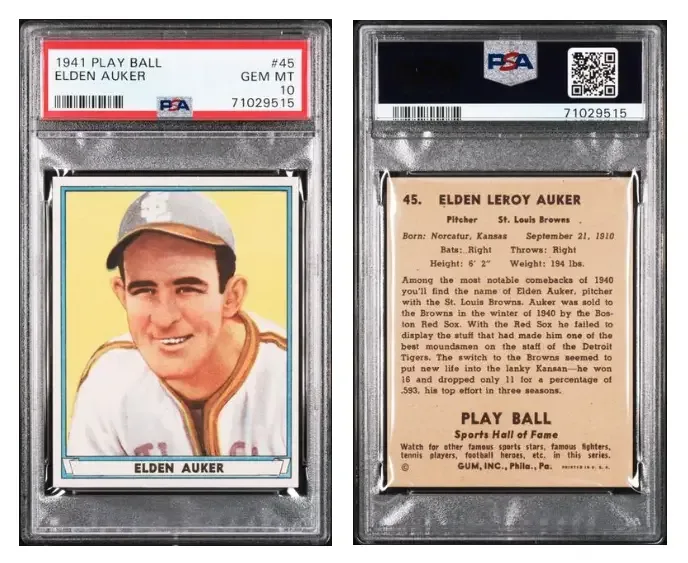
Elden Auker Card No. 45
Elden Auker’s 1941 Play Ball card No. 45 is a strong example of how grade can transform a card’s market profile. In raw form, the card generally trades in the $8 to $20 range, putting it among the more affordable singles in the release.
Once the card is viewed through the lens of population data, however, the story changes. PSA has just one PSA 10 on record for the card, along with four PSA 9s and 21 PSA 8s. That makes the Gem Mint copy a true top-pop rarity rather than simply a high-grade card.
The highest public sale for the PSA 10 came on May 12, 2023, when it sold for $15,000 through Heritage. That number is striking when compared with the raw range and underscores a core truth of the vintage market: scarcity at the top of the population report can create serious demand even for cards that are otherwise inexpensive.
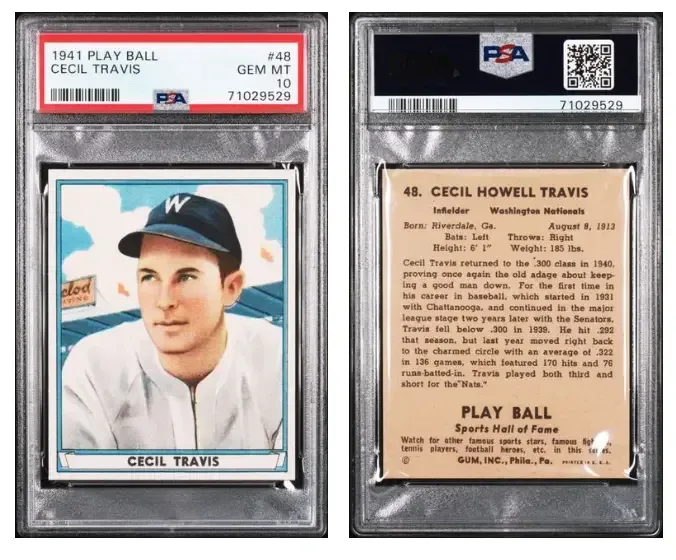
Cecil Travis Card No. 48
Cecil Travis’ 1941 Play Ball card No. 48 follows a similar pattern. Raw copies generally land in the $10 to $20 range, a price level that would not typically suggest a major five-figure upside.
But the PSA population tells a very different story. There is just one PSA 10, along with three PSA 9s and 21 PSA 8s. That combination of low supply and extreme grade rarity has been enough to elevate the best-known example far beyond the value of a typical raw card.
The highest public sale of the PSA 10 also came on May 12, 2023, reaching $15,000 through Heritage. Matching Auker’s result, the Travis sale reinforces that collectors in this segment are often paying for a title of ownership as much as the cardboard itself. Having the finest graded example of a pre-war issue can carry a premium that has little resemblance to the entry-level market for the same card.
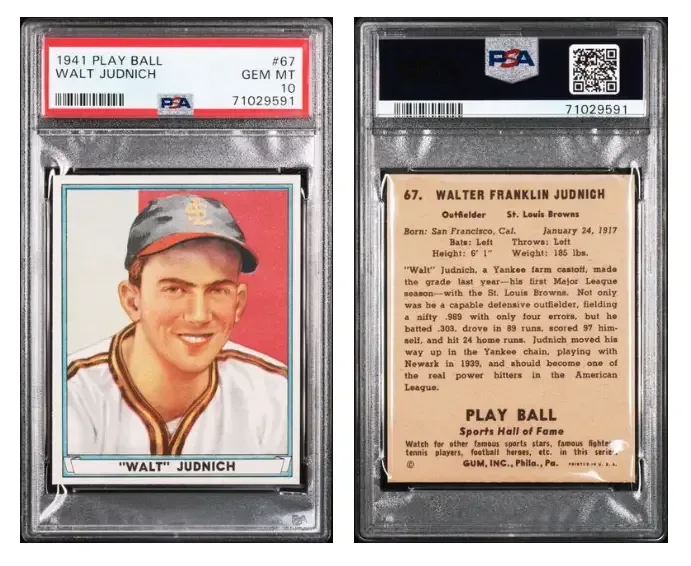
Walt Judnich Card No. 67
Walt Judnich’s 1941 Play Ball card No. 67 offers another variation on the same theme. Raw examples generally sell in the $10 to $30 range, making it affordable in ungraded condition relative to the top stars in the set.
Its PSA population is even tighter in some respects than the prior examples. The card has one PSA 10, one PSA 9, and 13 PSA 8s. That leaves exceptionally little supply for collectors seeking upper-tier copies, especially at the very top.
The highest public sale of the PSA 10 came on May 12, 2023, at $12,600 through Heritage. Though slightly below the Auker and Travis figures, it still reflects a massive condition premium over raw pricing. When just one Gem Mint copy exists, the collector who wants the best often has no substitute.
Snapshot of the Four Key Sales
- Joe DiMaggio, No. 71: raw value roughly $1,600 to $2,200; PSA population of 1 PSA 10, 5 PSA 9s, 31 PSA 8s; highest public PSA 10 sale of $750,000 on February 21, 2020.
- Elden Auker, No. 45: raw value roughly $8 to $20; PSA population of 1 PSA 10, 4 PSA 9s, 21 PSA 8s; highest public PSA 10 sale of $15,000 on May 12, 2023.
- Cecil Travis, No. 48: raw value roughly $10 to $20; PSA population of 1 PSA 10, 3 PSA 9s, 21 PSA 8s; highest public PSA 10 sale of $15,000 on May 12, 2023.
- Walt Judnich, No. 67: raw value roughly $10 to $30; PSA population of 1 PSA 10, 1 PSA 9, 13 PSA 8s; highest public PSA 10 sale of $12,600 on May 12, 2023.
What These Prices Say About the Vintage Card Market
These sales highlight an important divide in vintage collecting. The broad market for a set may appear stable and even affordable based on raw prices, but the top-end condition market can operate under a completely different set of rules. In that space, population reports, eye appeal, registry competition, and long-term scarcity matter just as much as player fame.
For a star like DiMaggio, demand is fueled by every major factor at once. For players such as Auker, Travis, and Judnich, it is the grade rarity that does the heavy lifting. The result is a market where a common or semi-common card in ordinary condition may be purchased for a modest amount, while the finest graded copy becomes a centerpiece-level asset.
This is one reason vintage collectors spend so much time studying population data. A PSA 10 with a population of one is not just another graded card. It is often a singular item in the marketplace, and when that copy surfaces publicly, bidders may be responding to years of scarcity rather than a recent price guide.
Why PSA 10s From 1941 Play Ball Are So Hard to Find
Cards from 1941 face all the expected challenges tied to age and preservation. Decades of handling, storage, centering issues, print defects, edge wear, corner wear, and surface problems all reduce the chances of a surviving example reaching Gem Mint status. For many pre-war issues, even near-mint and mint copies can be difficult to find in any quantity.
That helps explain why the population counts above are so low, especially in PSA 10. It is not just that collectors have not submitted enough copies. The bigger issue is that very few cards from that era plausibly meet the standard. A single PSA 10 can represent a level of preservation that is effectively impossible to replicate on demand.
That scarcity also supports strong premiums for PSA 8s and PSA 9s, though the source figures here show how much further the market can run once a card reaches the absolute top. In vintage collecting, the finest known examples occupy a category of their own.
Collector Takeaway for 1941 Play Ball
The 1941 Play Ball set continues to offer one of the clearest examples of how vintage baseball card markets can split into separate lanes. Raw copies remain accessible in many cases, giving collectors an entry point into an iconic pre-war release. At the same time, PSA 10s remain true condition trophies, with public sales showing just how steep the premium can become when a card combines visual appeal, historical importance, and an ultra-low population.
For anyone tracking the set today, the numbers around DiMaggio, Auker, Travis, and Judnich make the pattern unmistakable: elite examples from 1941 Play Ball are not priced like ordinary vintage cards. They are priced like scarce, best-in-class survivors from one of baseball collecting’s landmark issues.
Photo Gallery