Brock Purdy football cards are getting a fresh wave of attention as a midseason fantasy card competition tightens up and participants increasingly push their chips toward quarterbacks.
At the halfway point of the regular season, the biggest theme is not a dramatic shake-up in the standings. It is a growing consensus around quarterback cards, with Brock Purdy and Jordan Love emerging as two of the clearest targets during the latest round of roster moves.
That trend says plenty about how active collectors are reading the market right now. Purdy has become a popular buy tied to strong on-field expectations, while Love is drawing interest from buyers looking to capitalize on momentum and rising MVP chatter. In a competition built around card values and strategic roster construction, those are the kinds of moves that can define the second half.
Quarterbacks Are Taking Over the Strategy Board
The latest waiver activity showed a clear shift. After several quiet weeks, managers returned to the market and made multiple changes, with the strongest emphasis landing on signal-callers.
For more collector background, read 2026 Topps Chrome Football Adds PREM1ERE Patch Autographs From the 2023 and 2024 Rookie Classes.
Rather than trying to squeeze more upside out of running backs or lean into speculative non-quarterback plays, participants moved further into a QB-heavy approach. The format has increasingly rewarded that strategy, and the latest moves suggest many competitors now see five-quarterback builds as the clearest path to climbing the standings.
That does not mean there is no room for other positions. A player like Jahmyr Gibbs can still create opportunity, especially when a big sale gives an owner a chance to lock in gains. But when the market starts favoring quarterbacks and the playoff race begins to take shape, collectors tend to follow the most liquid, visible assets. That is exactly what appears to be happening here.
Brock Purdy Becomes a Focal Point
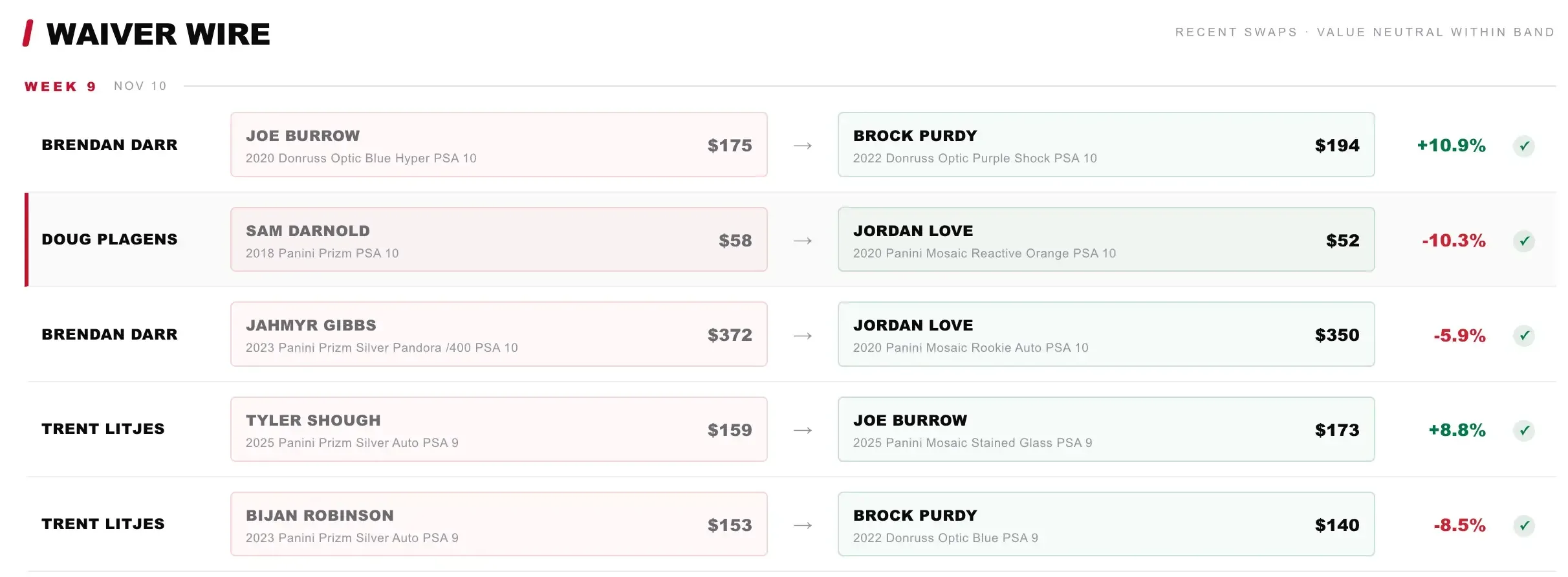
Purdy was one of the most notable names in the latest set of transactions. One of the headline swaps involved a move out of a 2020 Donruss Optic Joe Burrow Blue Hyper PSA 10 and into a 2022 Donruss Optic Brock Purdy Purple Shock PSA 10.
On its face, that is a meaningful statement about where some collectors believe near-term momentum sits. Burrow remains one of the hobby's most established quarterback names, but Purdy is getting a stronger push from buyers who want exposure to current performance and market upside.
The specific card in question, the 2022 Optic Brock Purdy Purple Shock PSA 10, also carries the kind of profile that makes sense in a contest format. It is a recognizable brand, a rookie-year Optic issue, a visually popular parallel, and a slabbed copy in a top grade. Those are all ingredients that can make a card easier to track and easier to move when demand rises.
There was also another move into Purdy from a different competitor, who exited both a Tyler Shough Prizm Autograph and a Bijan Robinson position to add a Brock Purdy card. That second Purdy buy matters because it reinforces the larger pattern. This was not a one-off purchase. Multiple participants reached the same conclusion at roughly the same time.
The $75 Sale That Turned Heads
One of the more interesting developments tied to the Purdy market was a sharply lower reported sale on the 2022 Optic Brock Purdy Purple Shock PSA 10. Recent sales had reportedly been in the $194, $200, and $220 range, making a confirmed $75 result stand out immediately.
For any collector watching modern football cards, that kind of print can create confusion in a hurry. A single outlier sale, especially one dramatically below the most recent range, can distort value tracking tools and affect how a card looks in the short term. In a competition where market values are central, that can become a problem even if broader demand remains strong.
It is also a reminder of one of the hobby's constant challenges. Not every sale reflects the true market. Pricing anomalies can emerge from listing errors, accepted offers that land far below public ask prices, timing issues, or other transactional irregularities. When a card routinely changes hands north of $190 and suddenly shows a $75 sale, collectors are naturally going to question whether that number represents the real market clearing price.
For Purdy holders, the key issue is whether the lower result proves sticky. If upcoming sales move back toward the prior range, the dip may end up looking like noise. If more low sales follow, then the market may be recalibrating. Right now, the stronger evidence points to that $75 print being an outlier rather than a new baseline.
Jordan Love Also Draws Serious Attention
Purdy was not the only quarterback gaining traction. Jordan Love also became a priority target during the latest round of roster management.
One manager moved out of a 2023 Prizm Jahmyr Gibbs Pandora /400 PSA 10 and into a 2020 Mosaic Jordan Love Silver Autograph PSA 10. Another competitor sold out of a Sam Darnold position and shifted into a Jordan Love card as well. That means Love, like Purdy, attracted multiple buyers during the same stretch.
The appeal is easy to understand. A card such as the 2020 Mosaic Jordan Love Silver Autograph PSA 10 checks several important hobby boxes. It offers an autograph, a recognizable chromium-era brand, and a quarterback profile with room for movement if the performance narrative continues improving.
Timing also matters. Collectors frequently try to get ahead of wider market recognition when a quarterback starts gaining serious buzz. Love appears to fit that mold right now. Once the market fully prices in a breakout, the best buying windows often shrink fast.
Midseason Standings Are Starting to Separate
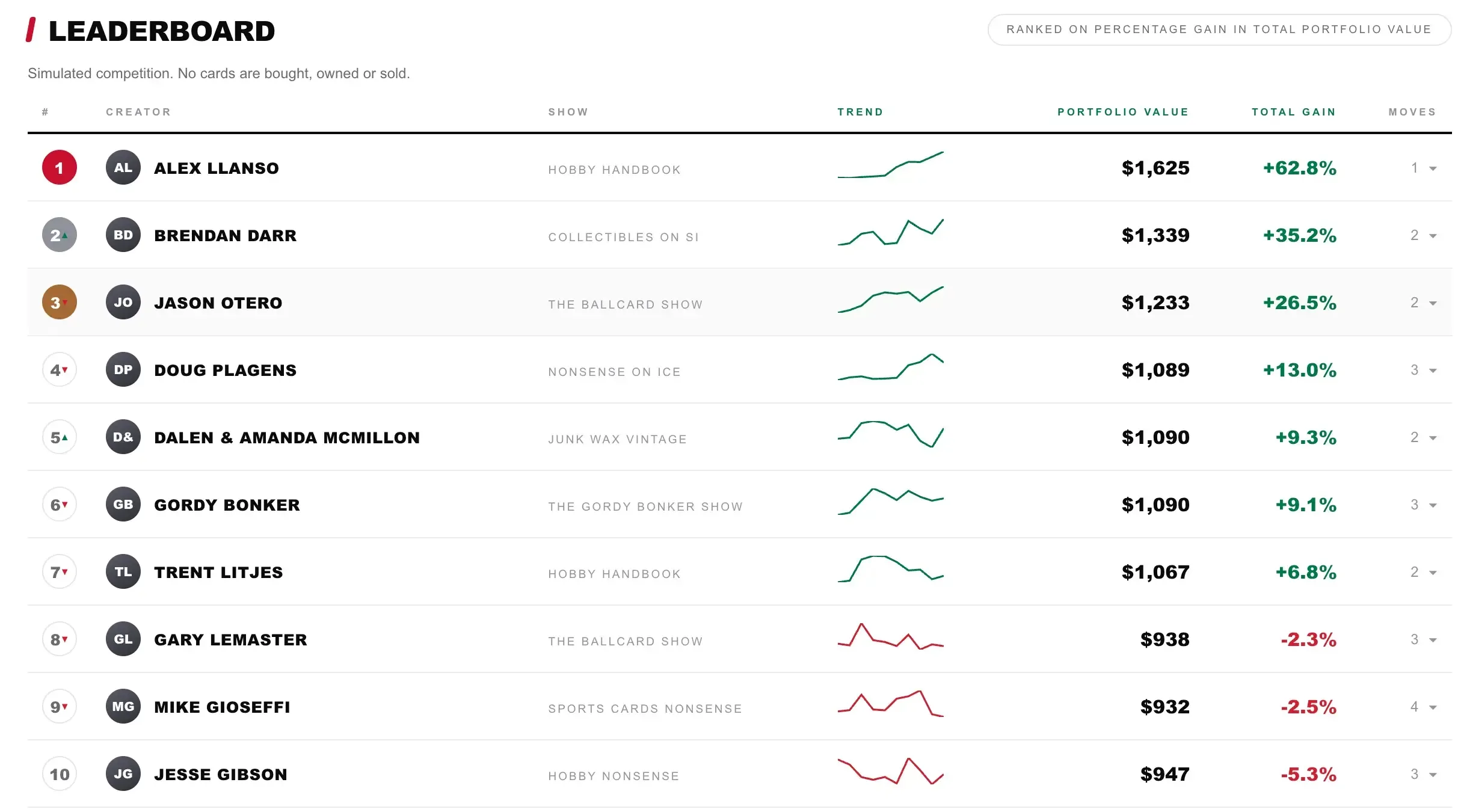
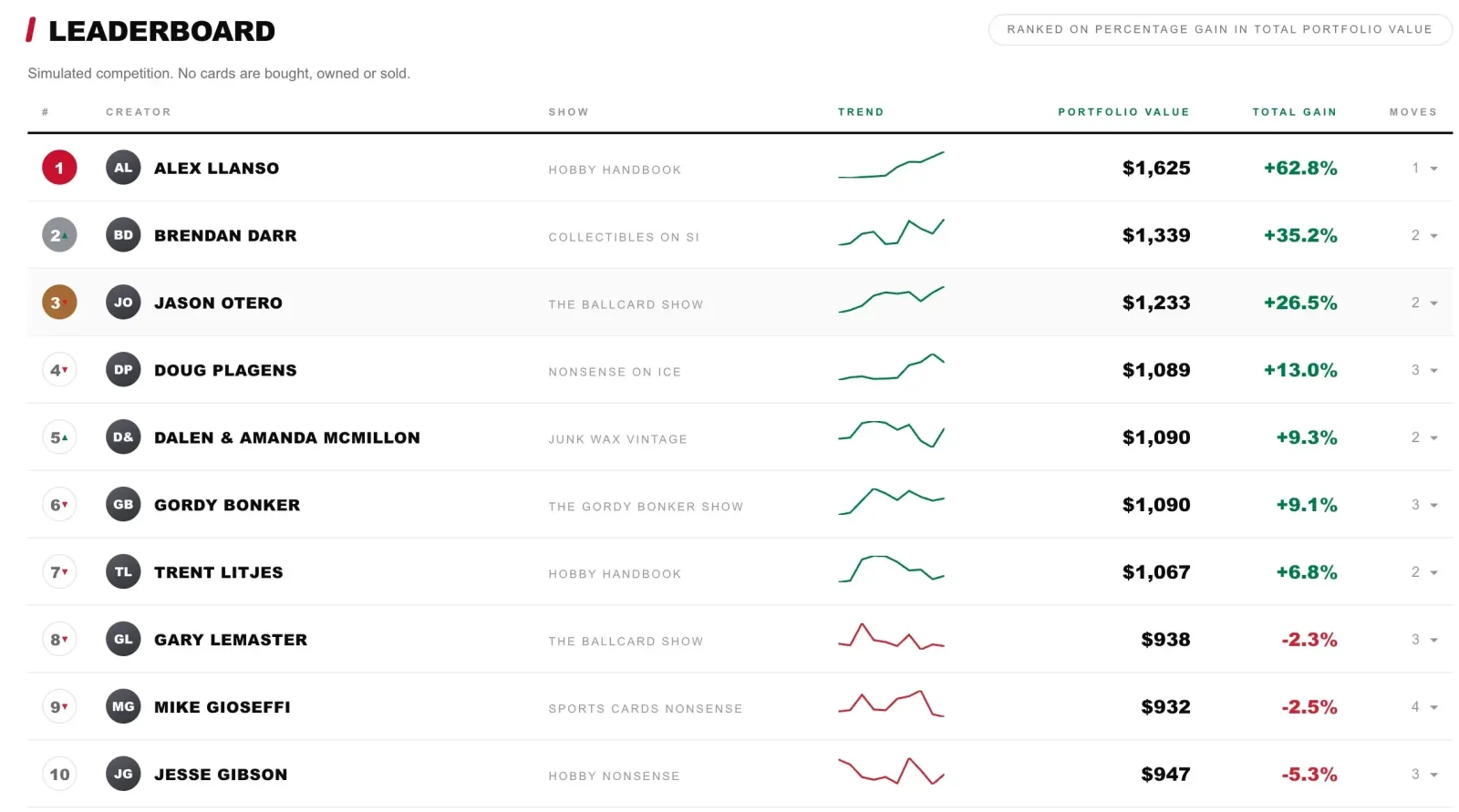
Even with the attention on transactions, the standings remain a major part of the story. The top of the table has not changed dramatically, but separation is becoming more noticeable.
The current leader still holds a commanding advantage, helped in part by an earlier Tyler Shough sale and a successful reinvestment into a Josh Allen card. Behind that, the next tier has started to solidify, while some competitors who were previously in stronger shape have slipped backward.
That matters because the second half of a fantasy card season tends to put more pressure on each move. Early in a competition, managers can absorb a miss. Later in the year, a poorly timed buy or a missed opportunity on a fast-rising quarterback can make it difficult to catch the leaders.
The same dynamic is visible at the bottom of the standings. The lower positions are beginning to separate from the middle, which increases the urgency for teams that need a turnaround. Standing still becomes much riskier once the table starts stretching out.
Notable Midseason Card Moves
The latest waiver period featured a handful of notable transactions that illustrate how the market thinking is evolving.
- 2020 Donruss Optic Joe Burrow Blue Hyper PSA 10 moved out for a 2022 Donruss Optic Brock Purdy Purple Shock PSA 10.
- 2023 Prizm Jahmyr Gibbs Pandora /400 PSA 10 was flipped into a 2020 Mosaic Jordan Love Silver Autograph PSA 10.
- A Tyler Shough Prizm Autograph position was sold in favor of a Joe Burrow card.
- A Bijan Robinson position was moved out as part of a shift into Brock Purdy.
- A Sam Darnold position was exited after a recovery in value, with proceeds moving into Jordan Love.
Taken together, those moves tell a simple story. Collectors in a competitive setting are narrowing their focus. They are leaning less on volatile prospects and more on quarterbacks with current momentum, stronger hobby visibility, and clearer week-to-week catalysts.
Why the Hobby Keeps Returning to Quarterbacks
Football card markets almost always circle back to quarterbacks, especially when competition formats or short-term value swings are involved. The latest activity is another example of that long-standing pattern.
Quarterbacks tend to offer the cleanest narrative for buyers. They dominate headlines, influence MVP conversations, and often see the fastest hobby reaction after big games. Even when elite skill-position players perform well, the cardboard market can be slower to respond or less aggressive in pricing the upside.
That appears to be why a profitable position in Jahmyr Gibbs was treated as an opportunity to cash out rather than hold. There may still be room for Gibbs cards later, particularly if fantasy football playoff buzz spills into collector demand, but the easier hobby bet right now appears to be under center.
The Purdy and Love moves also show how collectors often manage risk. Instead of chasing only one breakout name, they spread exposure across multiple quarterbacks with different pricing tiers and momentum profiles. In a market that can turn quickly, that approach can offer more flexibility than tying too much value to one non-quarterback card.
What Collectors Should Watch Next
For Brock Purdy cards specifically, the next important signal is whether the market reasserts the prior range on key graded rookie issues like the 2022 Optic Purple Shock PSA 10. If fresh sales climb back toward the recent run of roughly $194 to $220, confidence in the card's pricing structure should improve quickly.
For Jordan Love, the focus will be on whether rising demand broadens beyond a few headline cards and starts lifting other rookie-year issues as well. When momentum expands across multiple products and formats, it usually indicates deeper market buy-in rather than a temporary spike.
More broadly, the competition's midseason trade pattern offers a useful snapshot of how active football card buyers are thinking. They are rewarding liquidity, quarterback upside, and market narratives with immediate catalysts. Purdy is firmly in that conversation now, and if his play keeps matching the hobby's expectations, his cards may remain one of the most closely watched football segments over the next few weeks.
Photo Gallery