Manchester City’s legal and competitive uncertainty is no longer just a football story. It is also becoming a hobby story.
After the Premier League confirmed the club was found guilty of breaching financial regulations between 2009 and 2018, collectors were left to consider what comes next for one of the most visible teams in the global soccer card market. The findings centered on claims that City inflated revenue and reduced costs by roughly £900 million, or about $1.2 billion, through contracts that did not reflect the true nature of the agreements.
The club has maintained its innocence and still has the right to appeal. But if the process ends with severe sporting penalties, the ripple effects could reach nearly every corner of the market tied to Manchester City players, team sets, and future licensed releases.
For collectors, the biggest issue is not just whether City is punished. It is how any punishment changes card supply, release frequency, player visibility, and the demand profile of some of the hobby’s most collected names.
For more collector background, read Jalen Brunson’s Offseason Spotlight Could Add More Fuel to a Surging Card Market.
Why Manchester City matters so much in soccer cards
Manchester City has become one of the hobby’s strongest club brands over the last decade. Consistent Premier League contention, annual Champions League participation, and a roster stacked with stars have made City cards a regular part of high-interest products.
That matters because modern soccer collecting is deeply tied to league and tournament licensing. A club’s place in the Premier League and UEFA competitions helps determine how often its players appear in flagship releases and which cards become the most desirable. A team that is regularly featured in Premier League products and Champions League sets has a steady pipeline of fresh cards, parallels, autos, inserts, and image variations entering the market.
City has benefited from exactly that environment. Collectors have grown used to seeing Erling Haaland, Phil Foden, Jeremy Doku and other club stars in major annual releases. If that pipeline is disrupted, hobby behavior can change quickly.
For another perspective on this story, read Manchester City’s Case Could Reshape the Soccer Card Market, but Collectors Should Separate Risk From Rarity.
Relegation would shrink the number of major City cards
The most immediate concern is relegation. If Manchester City were removed from the Premier League, the club would no longer appear in the following year’s Topps Premier League products. That would instantly reduce the number of mainstream, high-visibility releases carrying City cards.
For collectors, that does not just mean fewer cards. It means fewer cards in the products that typically attract the broadest audience and strongest secondary-market attention.
Premier League releases have become key entry points for global soccer collectors, especially in the modern market. Losing that exposure would change the availability and visibility of new City cards across hobby shops, breakers, grading submissions, and auction platforms.
If City remained outside the top flight for more than one season, the effect would become even more pronounced. Instead of a short-term release gap, collectors would be looking at a multi-year drought in some of the hobby’s most important club-based products.
Champions League absence could be just as damaging
Even if City avoids relegation, a major points deduction or a ban from European competition could still hit the card market hard.
Manchester City has been a fixture in the UEFA Champions League since the 2011-12 season. That long run has made the club a staple in premium releases built around Europe’s top competition, including products like Topps Chrome UCC. For many collectors, Champions League cards carry a distinct prestige because they place players on an international club stage and often appear in some of the most chased soccer sets of the year.
If City were shut out of Europe, that would remove another major channel for new cards. Combined with any reduced domestic exposure, collectors could be left with far fewer fresh City issues than they have grown accustomed to seeing.
This matters most for players whose hobby strength depends partly on constant relevance. In modern cards, momentum is powerful. Frequent appearances in desirable sets help sustain that momentum. When those appearances slow down, attention often shifts elsewhere.
Scarcity is not always a good thing in the hobby
At first glance, fewer cards might sound bullish. Hobby logic often treats scarcity as a value driver. But with sports cards, scarcity only helps when demand remains strong or grows. If fewer Manchester City cards are produced because the club is missing from major licensed products, that does not automatically mean prices rise.
Collectors may instead treat the reduced output as a sign of weakened relevance. A lower-profile club situation can suppress interest, particularly with active modern players whose markets are tied to current performance, elite competition, and constant media visibility.
That creates a split scenario. Existing rare Manchester City cards could become harder to find, but the lack of new premium releases might also cool enthusiasm among buyers who want current content and regular hobby engagement.
In other words, reduced supply could be offset by reduced excitement.
Erling Haaland sits at the center of the conversation
No player is more important to this story than Erling Haaland.
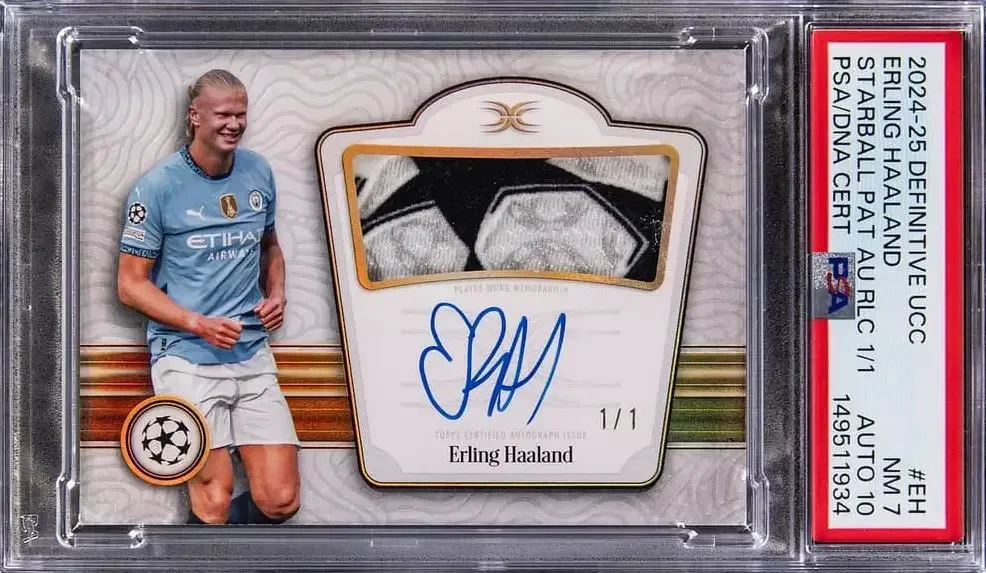
Haaland has been one of the most heavily collected soccer stars in the world, and his Manchester City cards are already established at the top end of the market. Earlier this year, his most expensive Manchester City card sold for $115,900, a reminder of how much value collectors place on premium issues tied to his City run.
If Manchester City falls out of major competitions or top-tier domestic products, Haaland collectors could face a different card ecosystem. There would likely be fewer opportunities to chase new club-uniform cards in the releases that normally generate the biggest hobby buzz.
That does not mean Haaland’s market would collapse. Elite players can sustain demand through talent, global popularity, and non-club-specific releases. But it would almost certainly change the makeup of his market. Instead of a steady stream of premium City cards, collectors could be working with a thinner release calendar and a more uncertain club context.
That shift could also alter which Haaland cards buyers prioritize. Established rookies, early key cards, low-numbered parallels, and major autographs could gain added importance if new City content becomes less frequent.
Jeremy Doku and other current City players face a tougher market
The pressure would not stop with Haaland. Players like Jeremy Doku and other current Manchester City names could see an even more direct impact because their card markets are more sensitive to situation and opportunity.
For rising or mid-career stars, the collecting case often depends on future upside. Buyers want to see strong club status, major trophies, Champions League exposure, and regular placement in top products. Any setback to those factors can cool speculation.
If City enters a period of lower visibility, these players may lose some of the premium attached to wearing one of Europe’s dominant club brands. Their cards would still exist, and standout on-field performances would still matter, but the surrounding hobby narrative could weaken.
That is especially important in the ultra-modern market, where prices often move on momentum, projectability, and collector confidence rather than long-term legacy alone.
EFL products would not fully replace the lost spotlight
If Manchester City were relegated to the EFL Championship, the club would not disappear completely from the card world. Panini produces EFL trading card products each season, which means there would still be licensed pathways for collectors to find City cards.
But that is not the same thing as staying in the Premier League or Champions League product mix.
EFL releases generally do not command the same hobby attention, box demand, or resale profile as flagship Premier League or UEFA products. Even with a massive club name involved, the market structure around those cards would be very different. Breaker interest, international demand, and high-end singles activity would likely sit well below the levels normally associated with Manchester City’s current status.
There could be a short-term novelty effect if a club of City’s stature suddenly appeared in Championship products. Even so, novelty rarely matches the sustained pricing power of elite top-flight and European competition releases.
Contract realities could leave players tied to the club
Another hobby complication is that top players may not be able to leave quickly.
Many player contracts do not include relegation clauses, especially at clubs that have spent the last decade competing for major trophies. If City were hit with a severe sporting penalty, some of its stars could remain with the club longer than collectors expect.
That would matter because player collectors often rely on movement between major stages to refresh market interest. A transfer to another top club can create a new run of flagship cards, new team branding, and a new wave of speculation. If City players are effectively stuck in a lower-profile environment, their card output and hobby narrative may stagnate.
For star collectors, that is a difficult setup. The player still has talent, but the card ecosystem around that talent becomes less dynamic.
Cavan Sullivan is one of the most intriguing names to watch
The uncertainty also reaches beyond the current first team. One of the most interesting long-term hobby angles involves Cavan Sullivan.
The 17-year-old American prospect is set to join Manchester City when he turns 18. He already carries major hobby heat, and his MLS debut patch sold for a record $324,000 last month. That sale underscored just how much appetite exists for his earliest and most significant cards.
If he follows the current plan and arrives at City during a period of competitive fallout, his first cards tied to the club could land in a much different environment than many collectors originally expected. A relegated City or a City side excluded from European competition would offer fewer premium set opportunities and less high-end club exposure.
For a prospect market built heavily on future narrative, that could act as a temporary brake. Collectors often want a clean runway: big club, top competitions, frequent spotlight, and strong product placement. Any disruption to that roadmap introduces uncertainty.
At the same time, Sullivan’s situation is not fixed. Interest from other major clubs has reportedly emerged, including Barcelona and Real Madrid. If his path changes, the hobby outlook could shift quickly. For now, though, his planned connection to Manchester City puts him squarely inside this developing card-market story.
What collectors may watch next
The next phase will likely be driven by process and timing as much as by punishment. Collectors should be watching three areas closely: the appeal, the specific sporting consequences, and the licensing calendar.
If the appeal changes or delays the final competitive outcome, card-market reactions could be more gradual. If the penalties are immediate and severe, the market may adjust faster, especially for players whose values are more speculative than established.
The licensing calendar matters because hobby impact does not happen in the abstract. It shows up when checklists are built and products release. A club missing from Premier League or European sets becomes a visible absence on release day, and that is when many collectors fully register what has changed.
For now, the most likely hobby response is a mix of caution and selectivity. High-end collectors may focus more on proven key cards of elite stars like Haaland, while prospectors and player collectors could become more hesitant on names whose value depends on uninterrupted Manchester City exposure.
As the case moves forward, the biggest question is not simply whether Manchester City cards become scarcer. It is whether the club can remain relevant enough in the hobby for that scarcity to matter in a positive way.
Photo Gallery