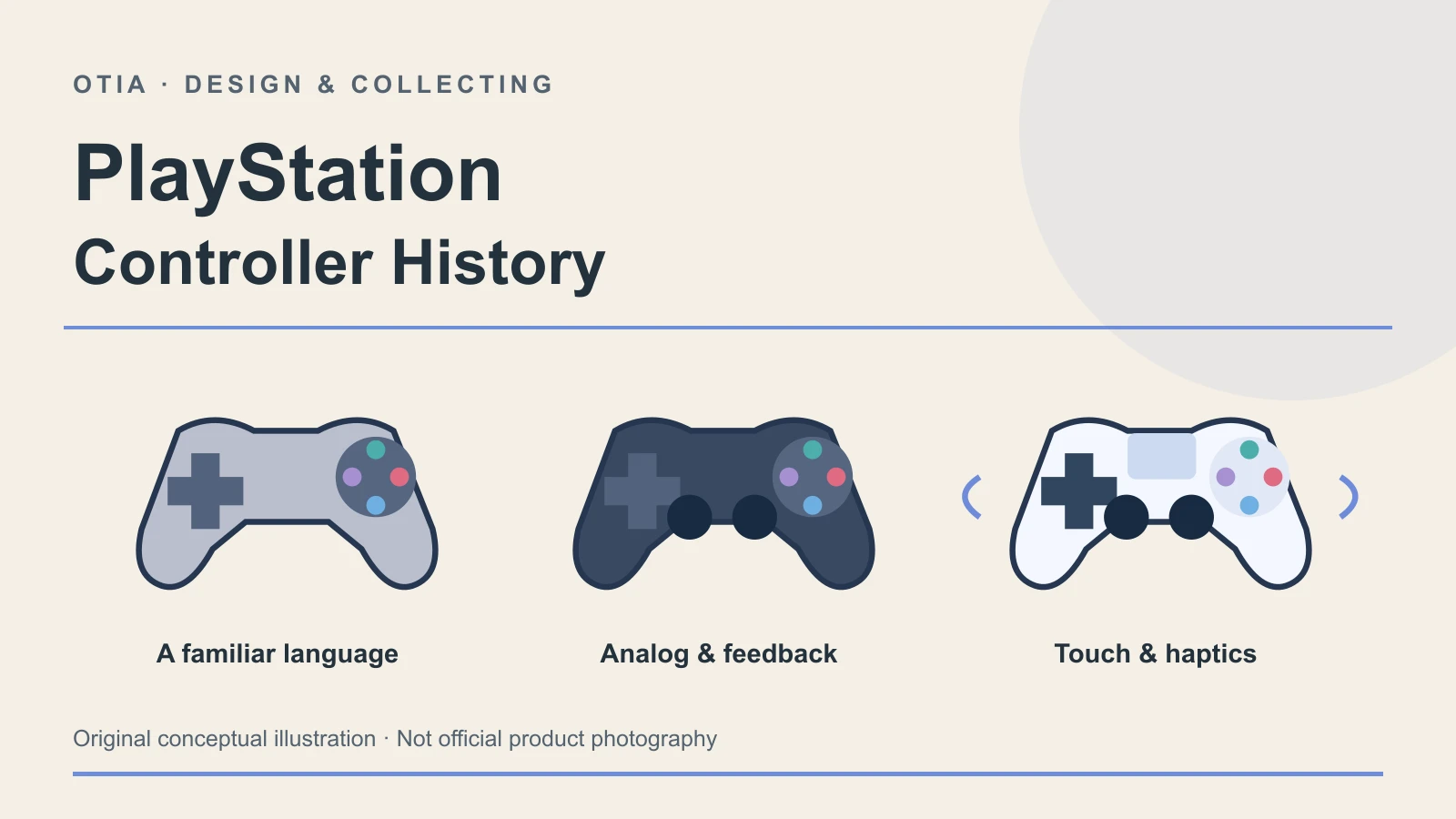
PlayStation controller history is a study in recognition. Across several generations, a player can find familiar grips, a directional control and the triangle, circle, cross and square symbols, even as the functions surrounding them change. The objects look related because continuity is part of the design. That continuity also makes the differences especially interesting when the controllers are viewed as a collection.
The longer history recently published by Joking Joystick treats this relationship as a recurring introduction between player and platform. A new controller does not have to teach everything again, but it can ask familiar hands to try something different. The result is a history of expanding possibilities, rather than a simple ranking from worst to best.
A visual language before analog sticks
The original PlayStation controller established a grip-based form and a set of face-button symbols that became closely associated with the platform. The symbols are useful precisely because they remain identifiable while software assigns their practical meaning. A shape is not a universal instruction. Players learn what it does through a particular game, menu or context.
For a collector, the original pad demonstrates how much of a platform's identity can reside in an accessory. Its outline, button arrangement and markings communicate a relationship to PlayStation independently of a disc case or television image. That is a design observation, not a promise about comfort, durability or what an individual example is worth.
The later Dual Analog controller added two analog sticks. The change expanded the way a player could describe movement through the hands: a stick could express degrees and directions rather than only discrete directional presses. Software still decided how to use that possibility. The presence of two sticks did not impose one mandatory control scheme on every game.
Input becomes a two-way exchange
DualShock connected the recognizable controller layout with vibration feedback. A controller could receive a signal from the game as well as send button presses to it. That exchange became an important theme in the family, even though the meaning and availability of feedback depended on the software and hardware involved.
Later generations continued adding channels of interaction. SIXAXIS brought motion sensing into the PlayStation 3 controller discussion, while DualShock 3 combined that motion capability with vibration. Those names should not be collapsed into one interchangeable object: their differences are exactly what a chronological collection can make visible.
The broader accessory history matters too. A motion controller or a specialized input device asks a different question from a conventional pad. It may change how a game is approached without replacing the standard controller for the whole platform. Keeping the intended software and supporting equipment in view makes these objects easier to understand.
More surfaces, more choices
DualShock 4 gathered several features into a familiar grip-based device, including a touch pad, light bar, speaker, headset connection and motion sensing. These additions gave developers more ways to communicate with players. They did not guarantee that every game would use every feature, or that each feature would matter equally to every person.
The collector's question is therefore more useful when it moves beyond a checklist. What could a designer do with a new input or output channel? Which familiar controls remained in place? How did the object preserve recognition while allowing a different kind of game interaction? These questions reveal a design strategy without inventing a universal user response.
DualSense extends that strategy through haptic feedback and adaptive triggers. A trigger can become part of how a supported game communicates resistance or action, while haptics offer another route for tactile information. Feature support varies by game, device and connection, so the existence of the hardware should not be turned into a blanket compatibility claim.
A family with room for different hands
Customization adds another branch to the history. DualSense Edge makes configurable controls part of its proposition, while the Access controller offers a different approach through layout and orientation options developed with input from accessibility experts. These are distinct design responses, rather than evidence that one arrangement will suit every player or every need.
A thoughtful collection can preserve those distinctions. Model identification, the correct associated equipment and the original documentation help explain what an accessory was intended to do. Cosmetic resemblance alone cannot settle compatibility, and a newer version should not automatically be treated as a historically identical replacement.
Seen together, PlayStation controllers show how a platform can remain recognizable while gradually widening its vocabulary. Symbols and grips provide continuity; analog movement, vibration, motion, touch, sound and configurable layouts supply different possibilities. The most compelling story is not that each generation made the previous one irrelevant. It is that familiar objects kept finding new ways to mediate the same conversation between a person and a game.
Read the complete PlayStation controller history on Joking Joystick for the longer generation-by-generation feature.
Illustration: original conceptual editorial artwork, not official product photography.