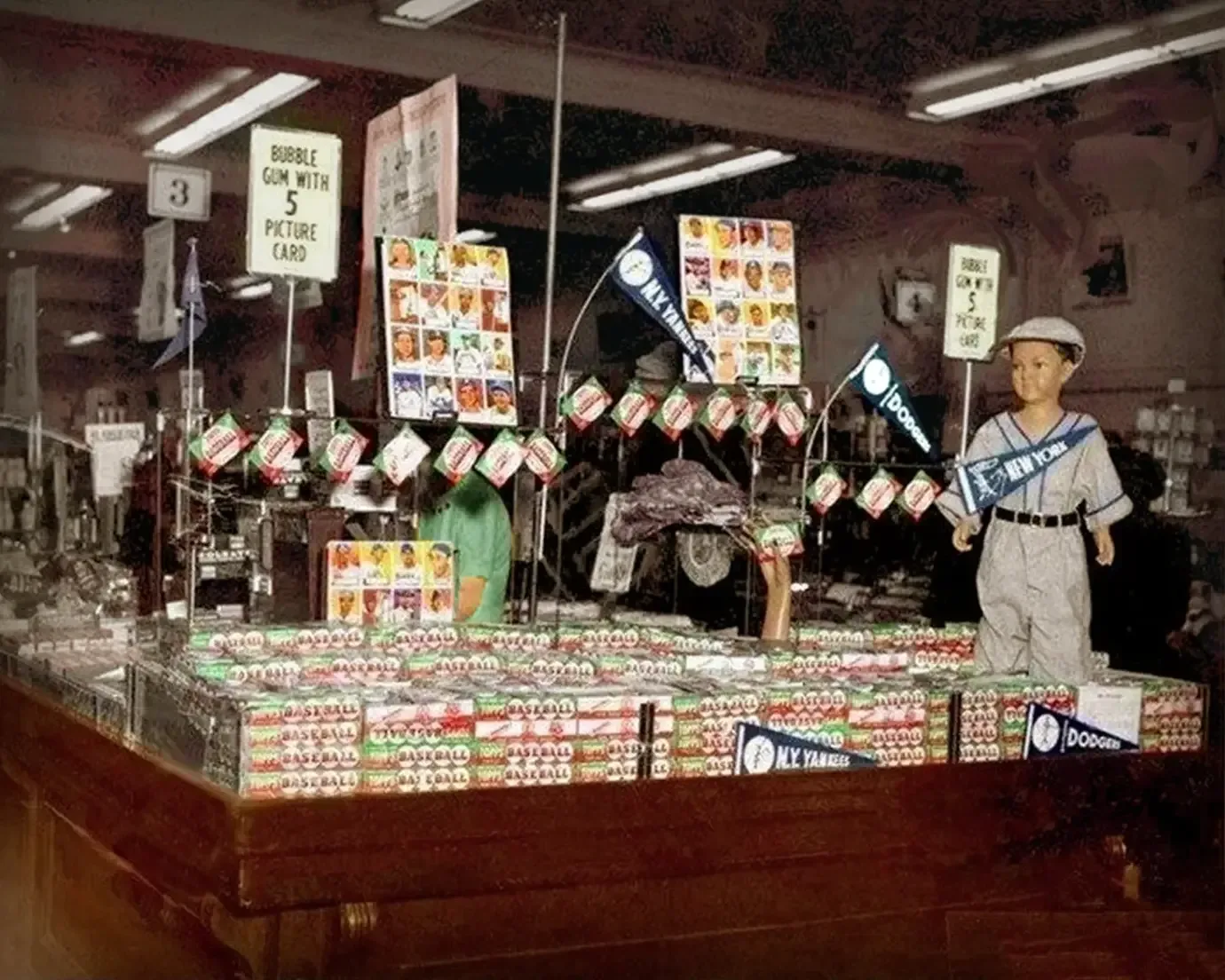
Vintage baseball cards from the 1950s were not created for slab cases and humidity-controlled storage. They were handled by kids, traded on sidewalks, flipped against walls, and clipped into bicycle spokes. That history is a big part of why true high-grade survivors from the decade command so much attention now.
For a modern ultra-premium card, collectors often focus on gem-mint grades. For 1950s cardboard, a PSA 7 can already represent an elite copy. That makes it a useful benchmark for comparing iconic rookie cards from the era, especially since condition rarity, eye appeal, and long-term hobby stature all matter in vintage.
The cards below are organized into five tiers based on recent PSA 7 sales, with one rookie card per player. Population counts show how many PSA 7 copies exist, how many examples have graded higher, and how many total copies PSA has encapsulated. Together, those numbers offer a strong snapshot of which 1950s rookie cards sit at the top of the market right now.
Why PSA 7 matters so much for 1950s rookie cards
In modern cards, collectors can often chase pristine copies because enough sealed product survived and enough cards were protected immediately. That is not the case with baseball cards issued more than 70 years ago. Centering problems, rough cuts, print defects, soft corners, and ordinary childhood wear all make truly sharp 1950s cards difficult to find.
For more collector background, read The Most Valuable 1980s Baseball Rookie Cards in PSA 10, Ranked by Recent Sales.
That is also why a straight numerical grade does not tell the full story. Vintage collectors regularly debate eye appeal, especially when one lower-graded card has superior centering, stronger color, or a cleaner overall presentation than a technically higher-graded example. A beautifully balanced card in a lower holder can attract more interest than an off-center copy with a stronger number on the label.
Even so, recent PSA 7 sales remain one of the cleanest ways to compare value across the decade. They sit high enough to reflect premium demand, but they are still realistic enough to include cards that almost never surface in true mint condition.
Tier 1: Holy Grail 1950s rookie cards
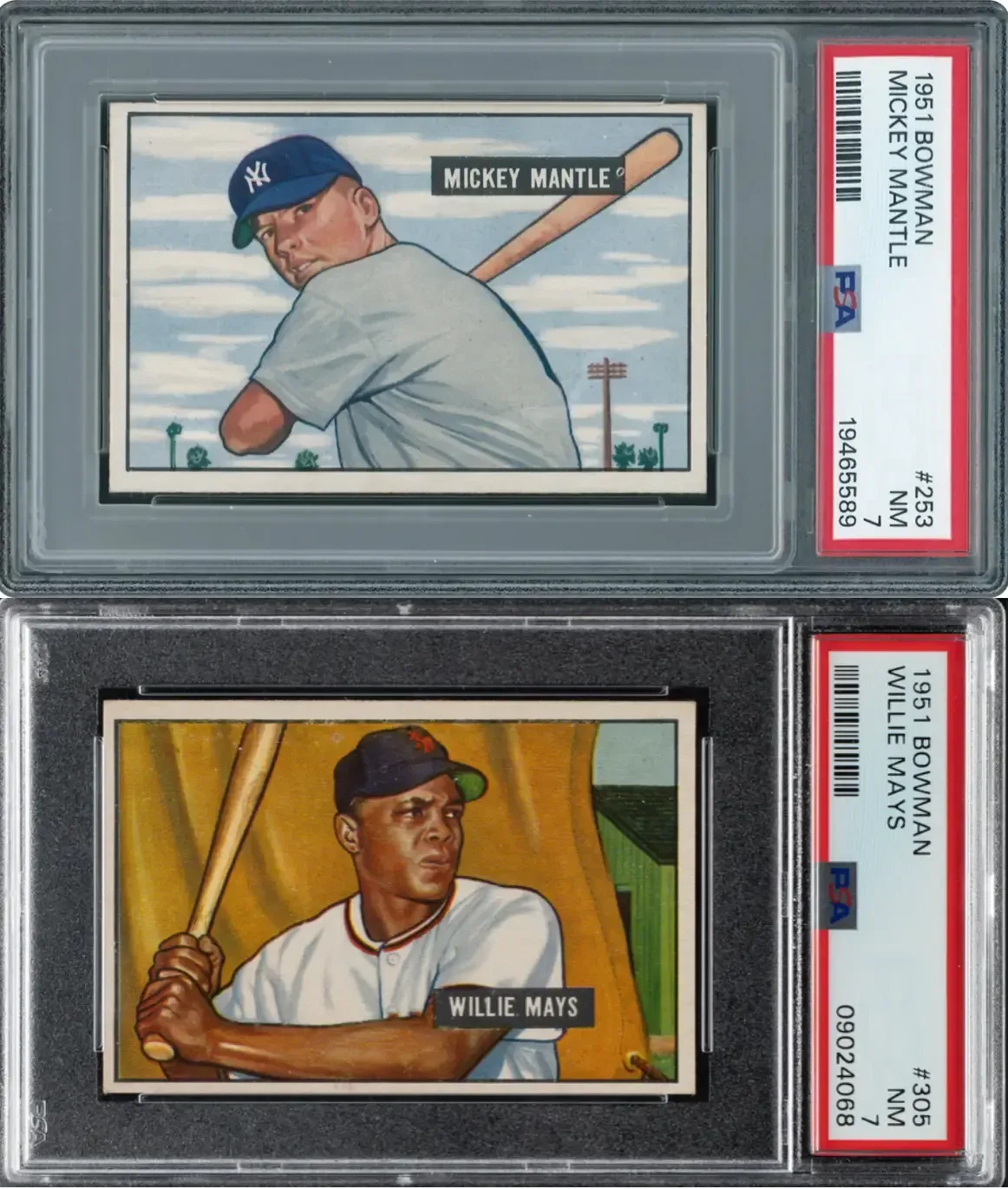
At the top of the decade, two 1951 Bowman rookies clearly separate from the pack.
- Mickey Mantle 1951 Bowman #253 - $125,800
115 PSA 7s, 93 graded higher, 2,988 total graded - Willie Mays 1951 Bowman #305 - $80,000
123 PSA 7s, 92 graded higher, 2,618 total graded
The Mantle rookie remains one of the most important cards in the entire hobby. While the 1952 Topps Mickey Mantle is the more famous card visually and culturally, the 1951 Bowman issue is his only true rookie. That distinction keeps it planted at the top of vintage baseball collecting.
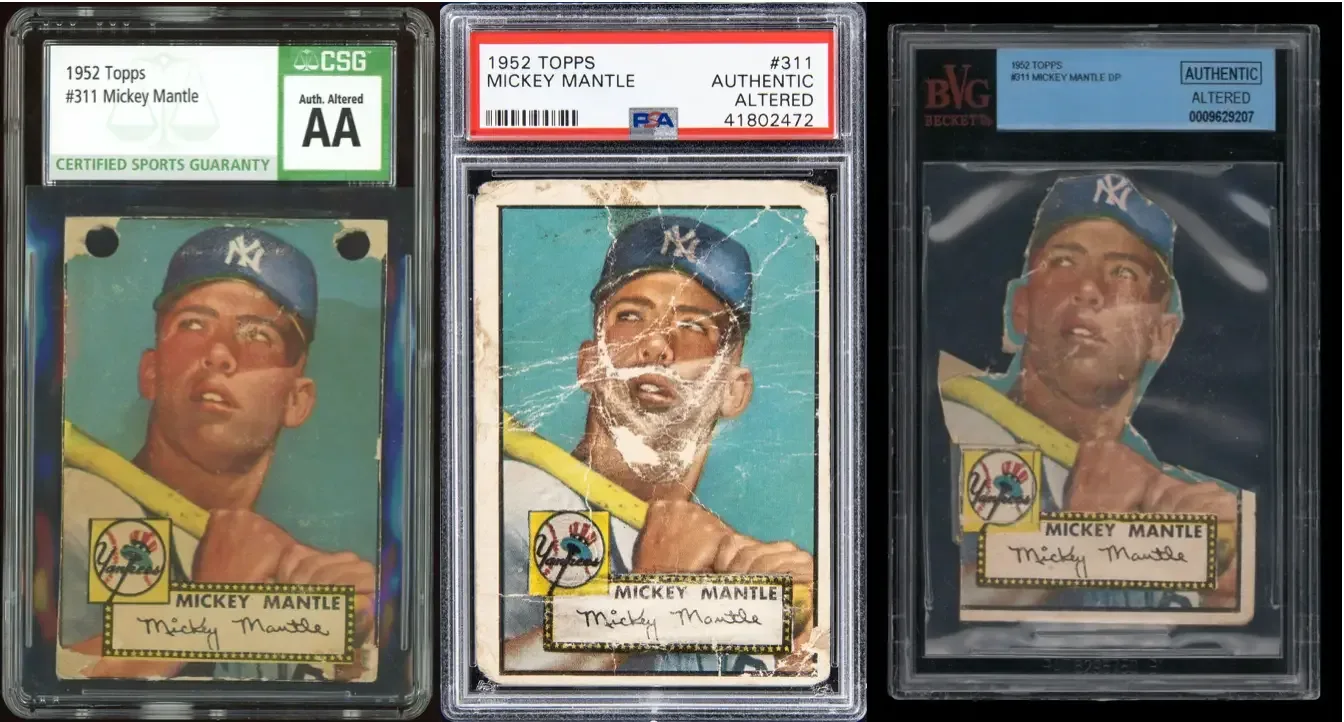
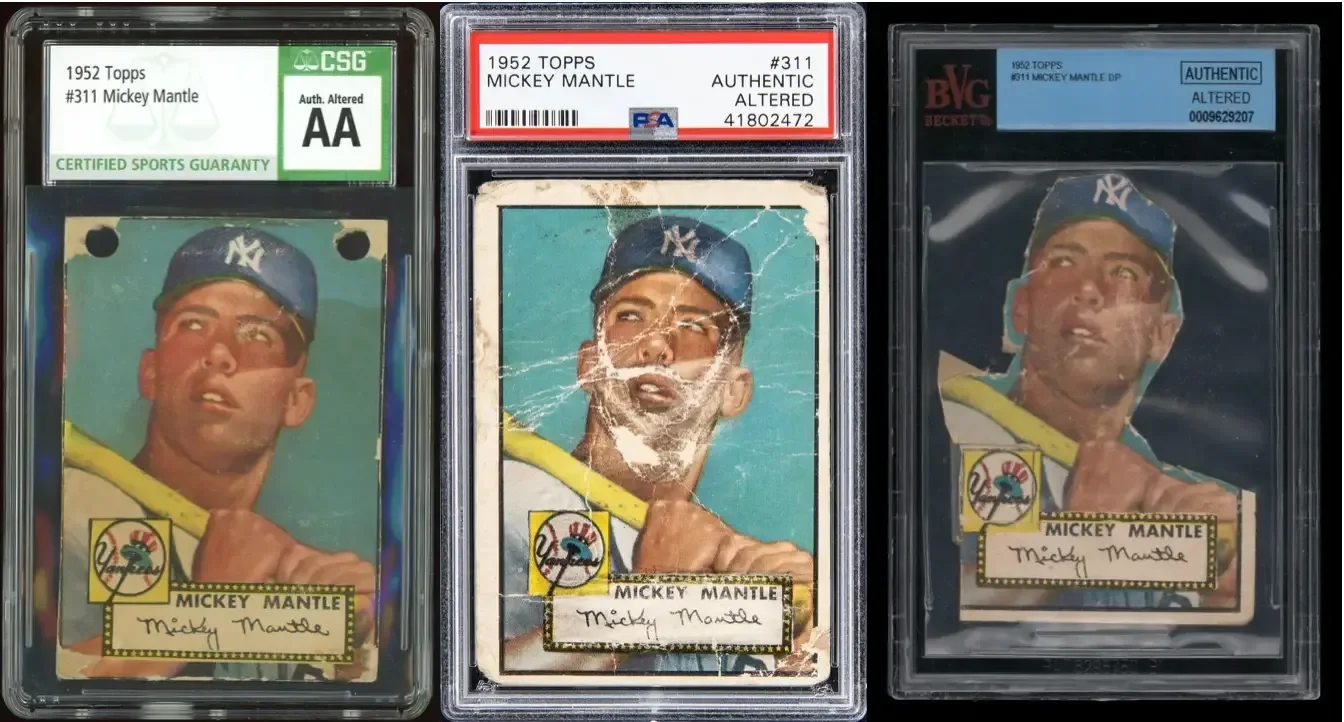
There is also a persistent hobby debate around whether the 1951 Bowman Mantle is still undervalued relative to the 1952 Topps card. A PSA 7 example of the 1952 Topps Mantle recently reached $716,800, a massive gap above the rookie despite the latter carrying the true first-card status. That gap continues to fuel collector interest in the 1951 Bowman.
Willie Mays sits right behind Mantle, and his 1951 Bowman rookie has posted dramatic growth in recent years. With only 123 PSA 7 copies and 92 graded higher, it combines legendary-player demand with real scarcity in collector-grade and above. Mays, like Mantle, is one of the foundational names in postwar baseball cards, and his rookie continues to act like blue-chip vintage cardboard.
Tier 2: Crown Jewel 1950s rookies
The next tier includes three hobby giants, with scarcity pushing one card above two more famous names.
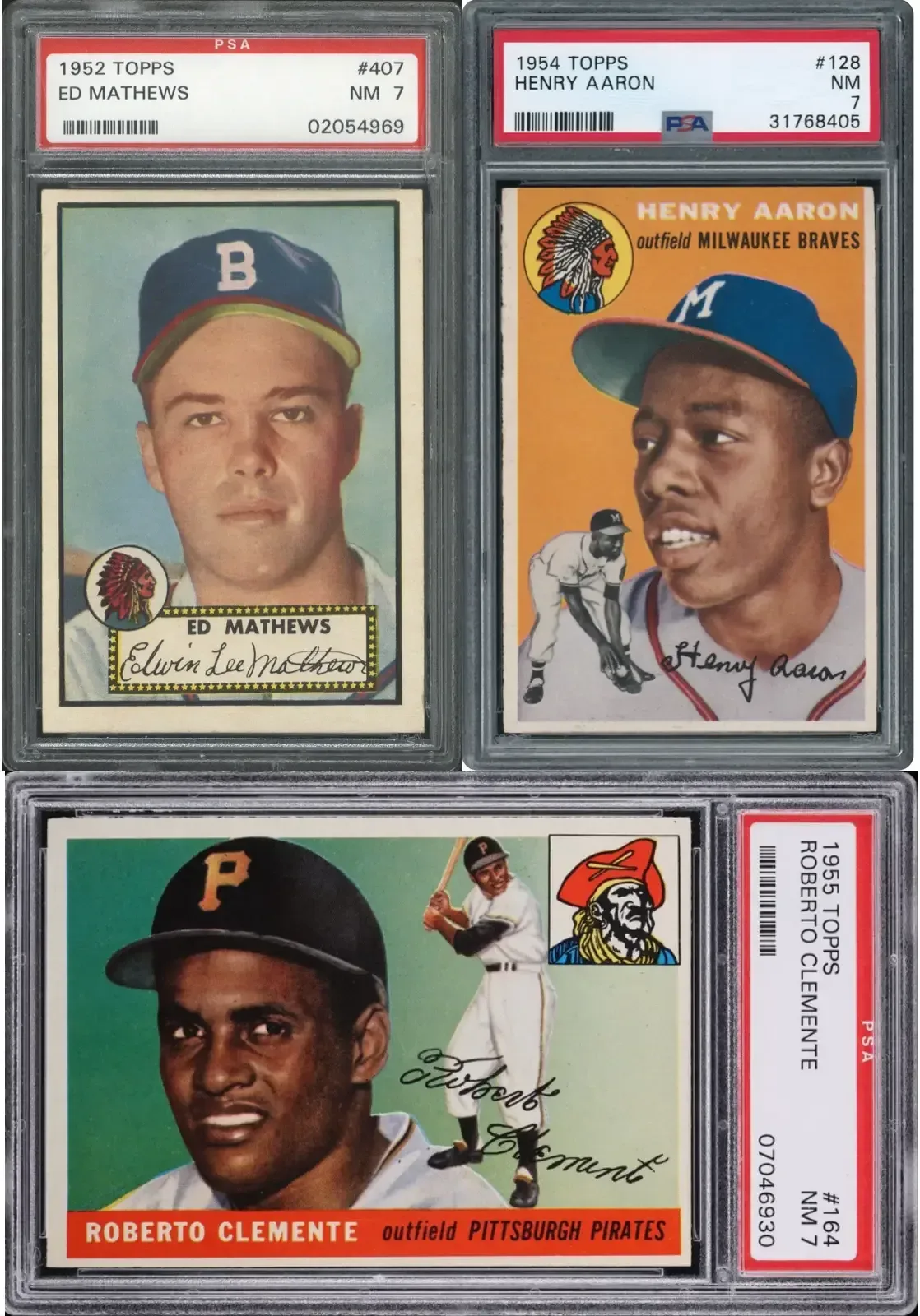
- Eddie Mathews 1952 Topps #407 - $34,800
29 PSA 7s, 19 graded higher, 1,038 total graded - Hank Aaron 1954 Topps #128 - $25,500
400 PSA 7s, 258 graded higher, 8,331 total graded - Roberto Clemente 1955 Topps #164 - $24,000
349 PSA 7s, 164 graded higher, 7,958 total graded
At first glance, seeing Eddie Mathews ranked ahead of Hank Aaron and Roberto Clemente may surprise some collectors. The explanation is simple: scarcity. Mathews is part of the 1952 Topps high-number run, one of the most difficult and celebrated sections of any vintage baseball set. With just 29 PSA 7s recorded, the card is far tougher than Aaron or Clemente at that grade level.
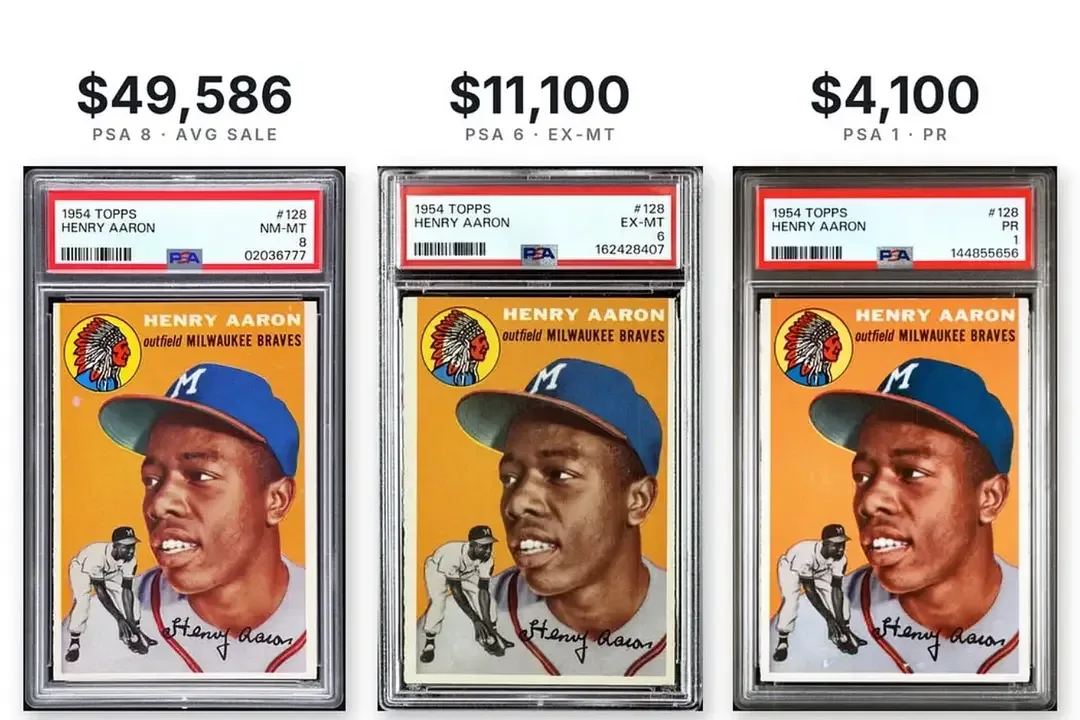
Aaron and Clemente, of course, remain among the most beloved rookie cards in the hobby. The 1954 Topps Aaron is one of the signature cards of the decade, and Clemente's 1955 Topps rookie carries immense crossover appeal thanks to both his Hall of Fame stature and the emotional connection collectors have to his legacy.
Still, the Mathews card shows how powerful set context can be. A Hall of Fame rookie embedded in the scarce high numbers of 1952 Topps gets an enormous boost, and recent PSA 7 pricing reflects that perfectly.
Tier 3: Premium 1950s rookies
This group remains highly collectible and firmly premium, even if the pricing is a step below the headliners above.
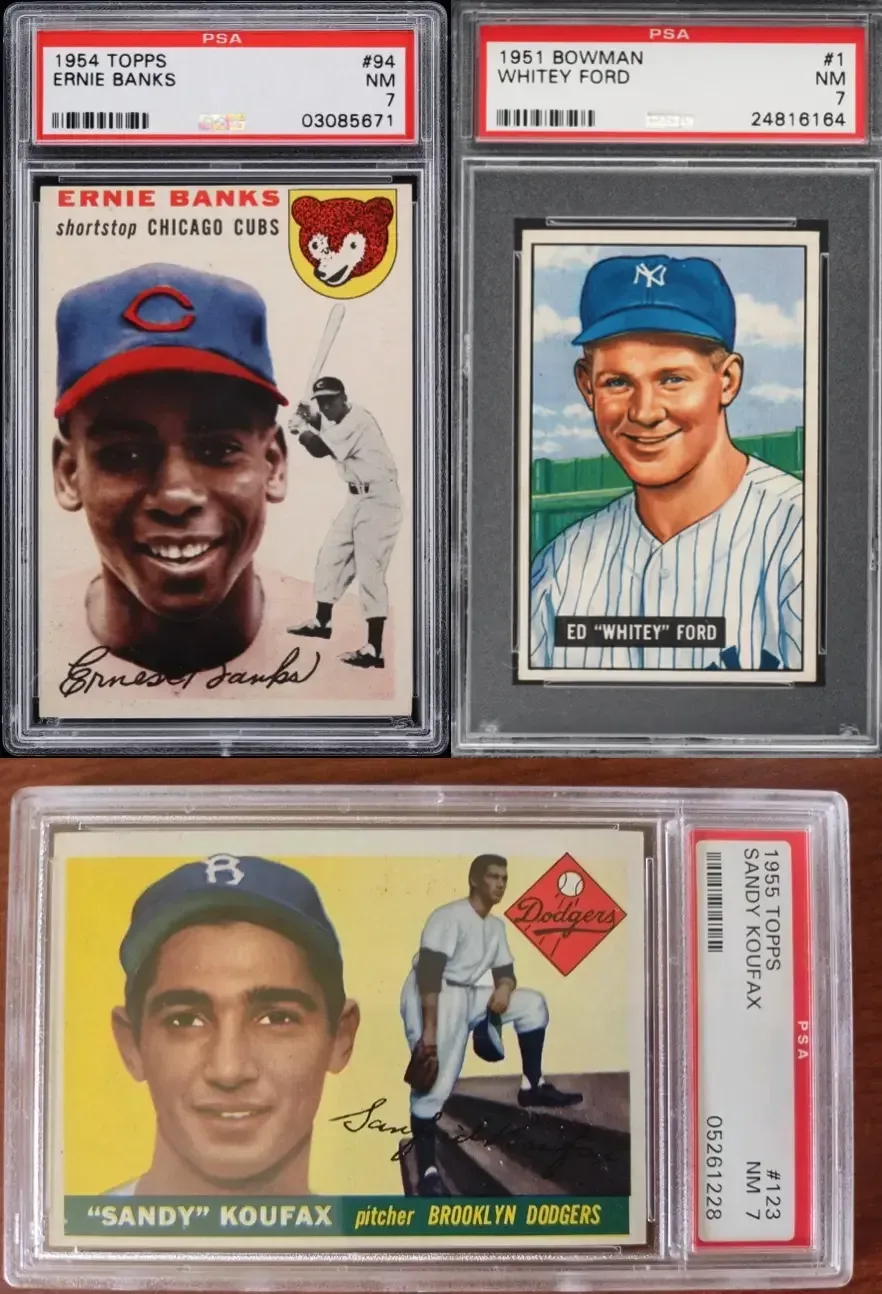
- Ernie Banks 1954 Topps #94 - $11,000
289 PSA 7s, 283 graded higher, approximately 4,202 total graded - Sandy Koufax 1955 Topps #123 - $10,500
910 PSA 7s, 325 graded higher, 12,922 total graded - Whitey Ford 1951 Bowman #1 - $5,700
101 PSA 7s, 62 graded higher, 2,290 total graded
Ernie Banks and Sandy Koufax are two of the most recognizable names of the era, and their rookie cards reflect that status. Banks carries powerful team-collector support as the signature Cubs legend, while Koufax remains one of the most revered pitchers in baseball history.
Koufax's market has shown especially notable movement. Even low-grade copies have seen a sharp rise, a reminder that all-time great pitchers with iconic rookie cards can still make large jumps when demand broadens beyond high-end vintage specialists. The 1955 Topps design also helps, giving the card strong visual appeal across generations of collectors.
Whitey Ford rounds out the tier with a card that may not receive as much national hobby spotlight, but remains significant. As one of the great Yankees pitchers, Ford benefits from both franchise prestige and the fact that his rookie appears in the landmark 1951 Bowman set.
Tier 4: High-end 1950s rookies with room to grow
The fourth tier features strong Hall of Fame names and one historically important pitcher whose rookie remains much scarcer than many collectors realize.
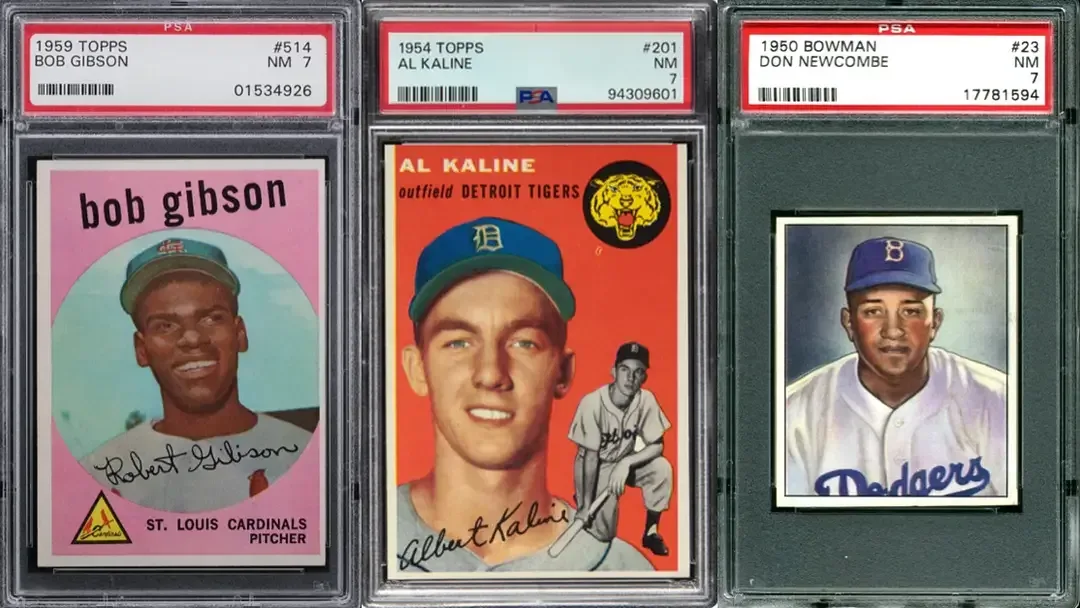
- Bob Gibson 1959 Topps #514 - $4,500
760 PSA 7s, 507 graded higher, 7,555 total graded - Al Kaline 1954 Topps #201 - $4,148
350 PSA 7s, 252 graded higher, 5,306 total graded - Don Newcombe 1950 Bowman #23 - $2,222
55 PSA 7s, 35 graded higher, 598 total graded
Bob Gibson's 1959 Topps rookie continues to gain strength. It is one of those cards that blends Hall of Fame talent with a memorable visual identity, even if the image on the card is much friendlier than the fierce persona collectors usually associate with Gibson. Recent PSA 7 pricing has risen significantly from levels seen just a year earlier.
Al Kaline's 1954 Topps rookie has long been respected for both its look and its condition sensitivity. The bold red-orange background makes wear and presentation stand out quickly, and elite copies are extremely difficult to find. Only one PSA 10 exists, a stat that underscores just how hard true top-condition examples are to locate.
Don Newcombe may be the most historically underrated card in this tier. His career accomplishments were remarkable, and his rookie from 1950 Bowman has a much smaller total population than many of the bigger hobby names around it. For collectors who care about both history and scarcity, Newcombe remains a fascinating value point.
Tier 5: Under-the-radar 1950s rookie cards
The final tier still includes major names, but the market gap between these cards and the bigger blue-chip rookies is notable.
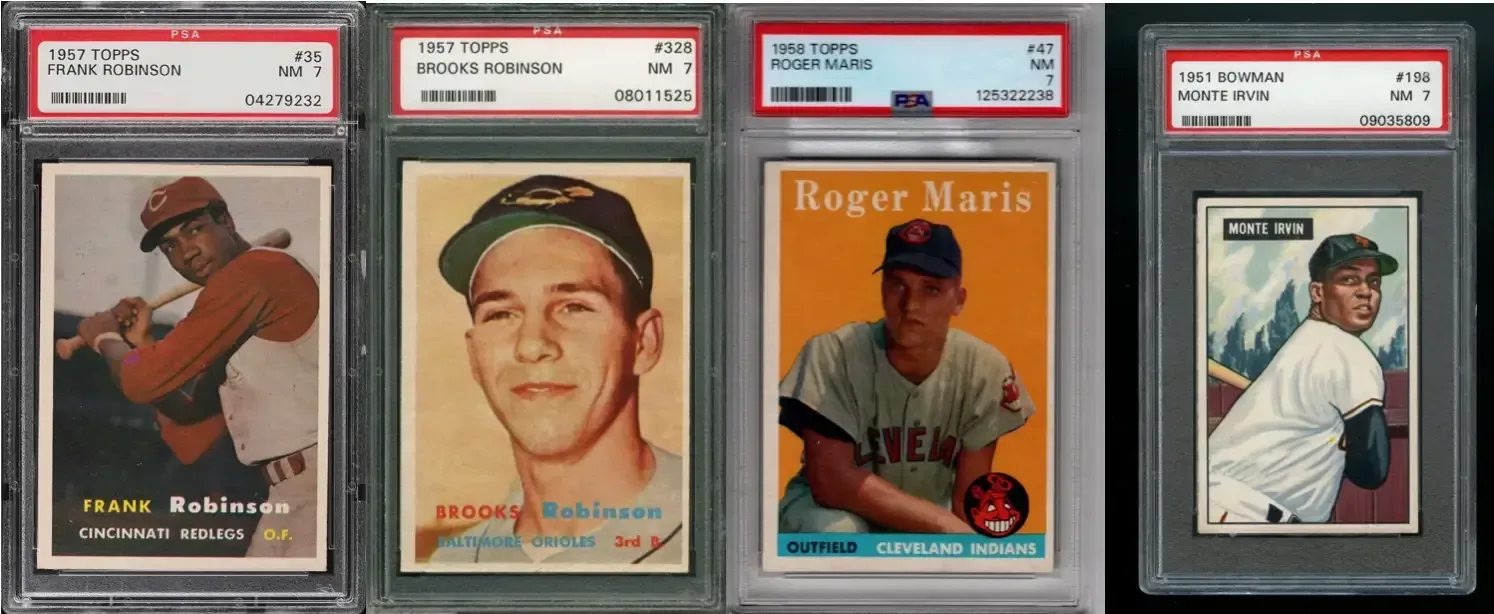
- Frank Robinson 1957 Topps #35 - $1,800
744 PSA 7s, 407 graded higher, 7,741 total graded - Brooks Robinson 1957 Topps #328 - $1,800
683 PSA 7s, 426 graded higher, 5,481 total graded - Roger Maris 1958 Topps #47 - $1,325
756 PSA 7s, 536 graded higher, 7,727 total graded - Monte Irvin 1951 Bowman #198 - $999
106 PSA 7s, 68 graded higher, 1,169 total graded
Frank Robinson and Brooks Robinson share the same recent PSA 7 value, which is fitting for two legends who later helped power Baltimore championship teams in 1966 and 1970. Frank Robinson's rookie also carries a unique historical footnote, listing the club as the Cincinnati Redlegs, the temporary name used during the Red Scare era.
Another notable detail for Frank Robinson collectors is that despite thousands of graded copies, no PSA 10 has been recorded. That helps explain why strong examples in the upper-middle grades maintain consistent demand.
Roger Maris remains one of the most famous players in baseball history because of his home run record chase and his tie to the Yankees dynasty years, but his rookie card is still comparatively accessible in this ranking. Monte Irvin is perhaps the most overlooked name of the group. A star from the Negro Leagues and an important figure in baseball integration history, Irvin has a rookie card that remains obtainable relative to his legacy.
The 1952 Topps effect on rookie card values
No discussion of 1950s rookie cards is complete without the gravitational pull of 1952 Topps. It is the most iconic baseball card set ever produced, and that status lifts nearly every important rookie found within it.
The set contains 407 cards, and roughly 125 are considered rookie cards. What stands out is how many of those rookies have real market power in PSA 7. At least 45 rookie cards from the set have recorded PSA 7 sales above $1,000. That is a remarkable number, especially when some of the players involved are far less famous than the Hall of Famers at the top of this list.
The explanation comes down to two forces working together. First is the unmatched popularity of 1952 Topps itself, a set that has become shorthand for vintage baseball collecting. Second is the scarcity of its high-number series, where limited survival has added lasting pressure to the market. In many cases, collectors are not just buying a player. They are buying access to one of the most important sets the hobby has ever seen.
That dynamic is exactly why the Eddie Mathews rookie performs so strongly and why even more modest names from 1952 Topps can reach price levels that would look surprising if those same players debuted in a less celebrated set.
What collectors should watch in this market
The vintage rookie card market is increasingly shaped by more than just straight technical grading. Eye appeal is becoming a bigger part of the conversation, particularly for 1950s cards where centering, registration, gloss, and color can vary wildly from copy to copy. A lower-grade card with exceptional visual balance can sometimes draw stronger bidding than a higher-grade example with noticeable flaws.
That does not mean the grade no longer matters. It still matters a great deal, especially for registry-level demand and liquidity. But the hobby is continuing to mature in how it values presentation, and that is especially important in vintage where perfect cards are largely unrealistic.
For collectors entering this corner of the market, the biggest lesson may be that not all PSA 7s are equal, and not all stars are priced purely by fame. Scarcity within a specific set, especially 1952 Topps high numbers, can change everything. So can broader set prestige, true rookie status, and the emotional pull of a player whose card sits at the center of baseball history.
If recent sales are any guide, the 1950s remain one of the strongest areas in the hobby for collectors who want a mix of rarity, legacy, and enduring demand, with the 1951 Bowman Mantle and Mays rookies still setting the pace for the entire decade.
Photo Gallery