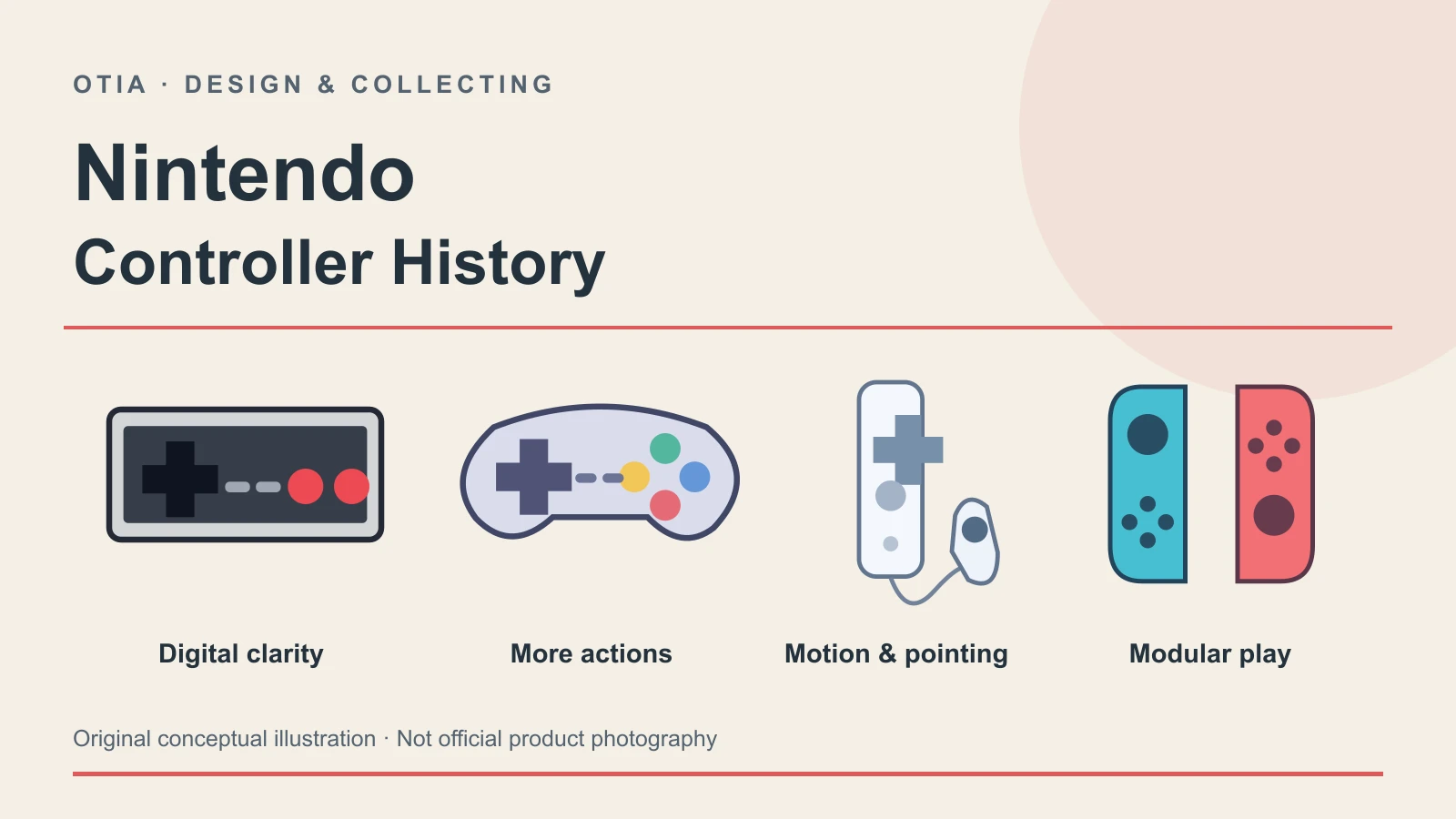
A Nintendo controller can identify an era before a console is even switched on. The rectangular NES pad, the three-gripped Nintendo 64 controller, the Wii Remote and the detachable Joy-Con each suggest a different relationship between a player and a game. For collectors, that makes the controller more than an accessory. It is a small piece of design history that explains what its system expected people to do.
Joking Joystick's recent Nintendo controller history follows that changing relationship across generations. Its strongest idea is that Nintendo did not simply add buttons until it reached a perfect design. It repeatedly reconsidered the question: who is playing, what does the game ask of their hands, and how does the room become part of the experience?
A small vocabulary grows
The NES pad offered a directional cross, two principal action buttons and Start and Select. Its layout made a compact distinction between movement, action and system commands. The physical arrangement was easy to recognize even though individual games assigned different meanings to the buttons. Simplicity was useful because software could build varied challenges around a limited, repeatable set of inputs.
The Super NES controller expanded that vocabulary with four face buttons and shoulder controls. L and R gave the index fingers a role while the thumbs remained responsible for the directional pad and face-button cluster. The change was about distributing actions across the hand, rather than merely increasing the number of commands a player had to remember.
Placed beside each other, the two pads show continuity as clearly as change. Direction remains on one side and actions on the other, but the later design gives developers more combinations. Neither arrangement proves that every player will find it comfortable. Each reflects a different balance between familiarity, reach and the demands of its games.
Movement changes the object
The Nintendo 64 controller made the analog stick a conspicuous part of the interface. Its three-grip form looks unusual today because it exposes a transitional problem: a controller had to make room for different approaches to movement as three-dimensional games became central to the console experience. The shape is a record of that problem, rather than an oddity that needs to be explained away.
The GameCube controller settled into two grips while making the A button visually prominent. Its layout can be read as a hierarchy: one action has a clear home position, with neighboring controls arranged around it. The analog triggers and sticks offered other forms of input without making every control look identical.
WaveBird introduced a different kind of freedom through a wireless controller and receiver. The receiver matters to its historical identity; it belongs to a particular accessory system, rather than to an assumption that every wireless controller works the same way. A collector preserving the object benefits from preserving that surrounding context too.
The living room becomes part of play
Wii changed the conversation again. The Wii Remote supported pointing and motion, while the Nunchuk and other controller options served different game requirements. It was no longer enough to describe a controller only by the buttons under the thumbs. Posture, orientation and the relationship between a person and the screen became visible design choices.
That did not make conventional controls disappear. The existence of different Wii control options is part of the story. A particular game could favor one arrangement, and an accessory's presence did not establish universal compatibility. The controller family was a menu of possibilities shaped by software, rather than one replacement for every earlier habit.
Joy-Con made flexibility visible in the hardware itself. Controllers could attach to the Switch, separate into two pieces or serve different supported play arrangements. A pair held apart and one controller held sideways are physically different experiences, even when they belong to the same system. Modularity creates options, but the game still determines which options are available.
What a collection can preserve
A controller collection can therefore tell a richer story than a row of matching console accessories. It can show how Nintendo moved actions between thumbs and fingers, experimented with motion and allowed the same hardware to change form. Manuals, receivers, straps and other associated pieces can help explain those choices when they belong to the specific model being documented.
This is also a reason to distinguish an original accessory from a modern recreation. A newer controller may preserve a familiar silhouette while changing charging, wireless communication or system functions. That does not erase its usefulness; it changes the historical question it answers. The most interesting comparison asks what was retained, what was translated and what the player was expected to learn.
Read the complete Nintendo controller history on Joking Joystick for the longer generation-by-generation feature.
Illustration: original conceptual editorial artwork, not official product photography.