Collectors often speak in grading shorthand. A card is “a PSA 10,” “a BGS 9.5,” or “an SGC 10,” and the conversation moves on as if the number alone settled the question. That shortcut is convenient, but it can also flatten away the most important part of the slab: which company assigned the grade, under what scale, and on what kind of label.
If you buy, sell, trade or simply compare cards across holders, the safest habit is to read the company name before the number. PSA, SGC, BGS and CGC all publish grading information that shows their labels are not interchangeable units. They use different grade ladders, different top-end terminology, different disclosure on the front of the label, and in some cases different mappings for older labels versus current ones.
That does not mean one company is automatically right and the others are wrong. It means the slab is a piece of information, not a universal conversion chart. If you want fewer buying mistakes and more confidence when comparing graded cards, learn to decode what each label is actually saying rather than assuming all 9s and 10s mean the same thing.
Start with the company name, not the number
The most useful mindset shift is simple: treat the grading company as part of the grade itself. A PSA 10 is not merely “a 10.” It is a PSA 10, defined by PSA’s own published standards. An SGC 10 is defined inside SGC’s scale. A BGS 10 is shaped by Beckett’s scale and its label structure. A CGC 10 depends on CGC’s current scale and, in some cases, the era of the label.
That sounds obvious, but it changes how you shop. If two listings show the same card in different holders with the same headline number, you should not jump straight to price comparison. First ask what the company means by that number, what else the label does or does not disclose, and whether the card is in a current or legacy label style. Those questions are not technical trivia. They are part of the object you are buying.
A practical way to slow yourself down is to read any slab aloud in the same order every time: company, label generation if obvious, grade word, grade number, qualifiers or subgrades if present, then certification details. That habit keeps you from collapsing four grading systems into one mental spreadsheet. It also helps when you are scrolling quickly through auction results, where the image may tempt you to focus on the big number and ignore the smaller clues around it.
This matters even more at the top of the scale, where collectors often assume that a 10 is a universal badge of elite condition. The published standards do not support that shortcut. They support reading each company on its own terms.
- Ask “graded by whom?” before “graded what?”
- Compare slabs only after identifying the grading vocabulary being used
- Treat the label itself as part of the collectible, not just packaging
Why the same number can mean different things
The cleanest example is the number 10. PSA uses a 1-to-10 numeric scale and publishes grade definitions under that system, including centering guidance within its standards. In PSA’s framework, a PSA 10 is PSA’s Gem Mint definition, not a generic hobby-wide unit that automatically matches every other company’s 10.
SGC makes the difference even more visible because it publishes two distinct 10-level labels at the top of its scale: 10 PRI and 10 GM. In other words, even inside one company, a 10 can carry more than one meaning depending on the word attached to it. If a collector ignores that word and logs both cards as simply “SGC 10,” important information has already been lost.
CGC also separates its top-end labels. Its current scale uses Pristine 10 as the top current numeric card-condition designation and defines Gem Mint 10 as something different. CGC explains that a Gem Mint 10 can be a 10 overall while one criterion falls short of Pristine 10 requirements. That means the word before the number is doing real work on the label.
Beckett adds another twist. A BGS 10 is not just a number floating on its own; its meaning is tied to visible subgrades and to Beckett’s own label conventions. Beckett’s published materials also distinguish its black label at the top end. Once you line these systems up side by side, the idea of a universal 10 starts to fall apart. The number may look familiar, but the grading language around it is not standardized across the four companies.
For buyers, the takeaway is practical rather than philosophical. Do not inventory high-grade slabs from different companies as if the shared number alone captures equivalent information. When you compare cards, write down the complete label description, not just the final digit.
- Read the adjective before the number: Pristine, Gem Mint, Mint+ and similar terms matter
- Do not compress distinct labels into one spreadsheet field called “grade”
- At the top of the scale, wording differences often matter most
PSA labels: simple at a glance, but still company-specific
PSA is often treated as the hobby’s easiest label to read because its core card scale is straightforward: 1 through 10. That simplicity can make collectors overconfident. PSA’s published grading standards show that its grades are still defined by PSA-specific tolerances and language, including issue-specific grading details such as centering allowances for a PSA 10. If you are using PSA as your baseline for all cross-company comparison, you are still relying on one company’s rulebook, not a universal standard.
PSA’s half-grade history is another reason to avoid lazy assumptions. PSA officially introduced half grades effective February 1, 2008, and described them as a way to identify an exceptional example within a grade rather than the midpoint between two whole grades. That means a PSA 8.5 should not be treated as a generic halfway stop between an 8 and a 9 across all grading systems. The label is making a PSA-specific statement about placement within PSA’s own framework.
The holder and label also communicate security information, not just condition. PSA’s current security page says the company uses the PSA LightHouse Label, along with a QR code for certification lookup and tamper-evident holder features. For a buyer, that means reading a PSA slab includes more than glancing at the grade. You should also verify that the holder style, label features and certification tools match what PSA says it currently uses.
A realistic buying scenario: you see two copies of the same card, one in PSA 9 and another in another company’s 9 with a lower asking price. If you only think in numbers, the second copy may look like the bargain. If you think in labels, you will pause and ask whether the two 9s are disclosing the same information, defined by similar standards, and housed in comparable label generations. That pause is exactly what prevents avoidable mistakes.
- PSA half grades are not published as generic midpoints
- Use PSA’s certification and security tools, not just the seller’s title
- Read a PSA grade as a PSA result, not as a hobby-wide translation key
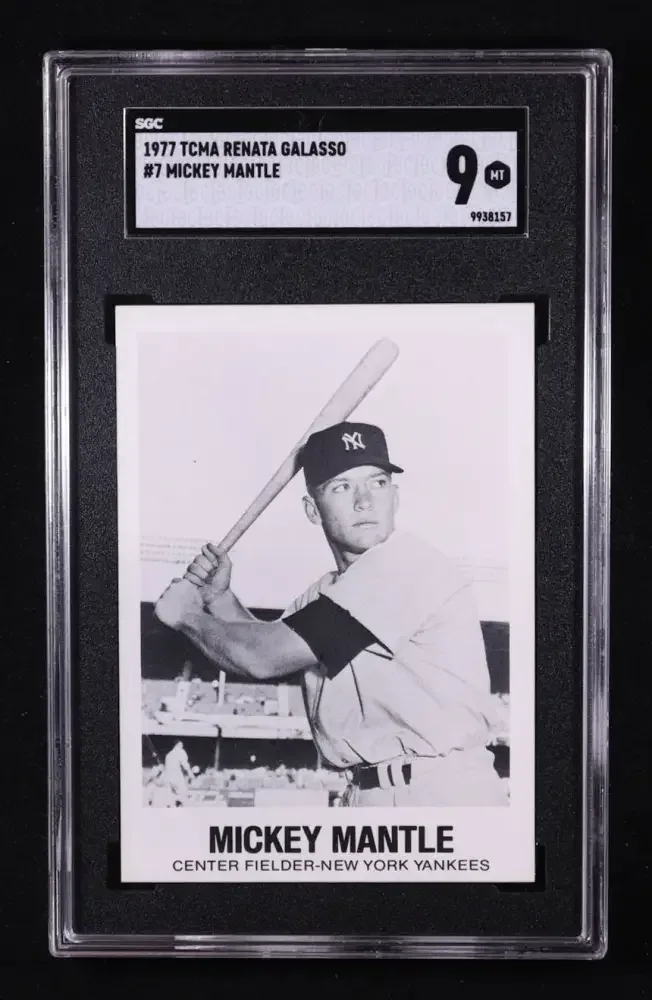
SGC labels: the word on the flip matters as much as the number
SGC’s published scale gives collectors a helpful reminder that numbers do not tell the whole story. SGC says its scale eliminates grades known as tweeners and lists a ladder that includes both 10 PRI and 10 GM. That alone should stop any collector from treating an SGC 10 as a single undifferentiated bucket.
The company’s certification tools also show that label generation matters. SGC’s cert-verification page distinguishes black labels from older green and white labels by requiring different certification-code formats. That is not cosmetic trivia. It is direct evidence that an SGC slab should be read with attention to era and format, because the label style is part of how the company organizes and authenticates the holder.
SGC’s terms and conditions add one more clue by referencing custom modifications to the black insert component in SGC’s holder. For collectors, that underscores something you can already sense visually: the insert and presentation are part of the slab’s identity. Even if you personally like or dislike the look, it is worth recognizing that the holder presentation is an intentional element of the product.
In practice, SGC demands careful listing descriptions. If you are documenting your own collection or posting a want list, “SGC 10” may be too vague for some cards. Writing “SGC 10 GM” or “SGC 10 PRI” preserves meaningful information. The same goes for shopping old inventory, where label style can affect how you verify the cert and how you interpret the slab’s place in the company’s history.
Subjective design preference belongs in a separate category. You may prefer the contrast of SGC’s presentation for vintage cards, or you may not. That is analysis, not a condition fact. The factual point is narrower and more important: the SGC label carries company-specific grading language, and its generation can matter.
- Record SGC 10 PRI and SGC 10 GM distinctly
- Use the correct certification format for black versus older green/white labels
- Treat holder generation as part of the slab description
BGS labels: more condition data on the front, but not necessarily easier decisions
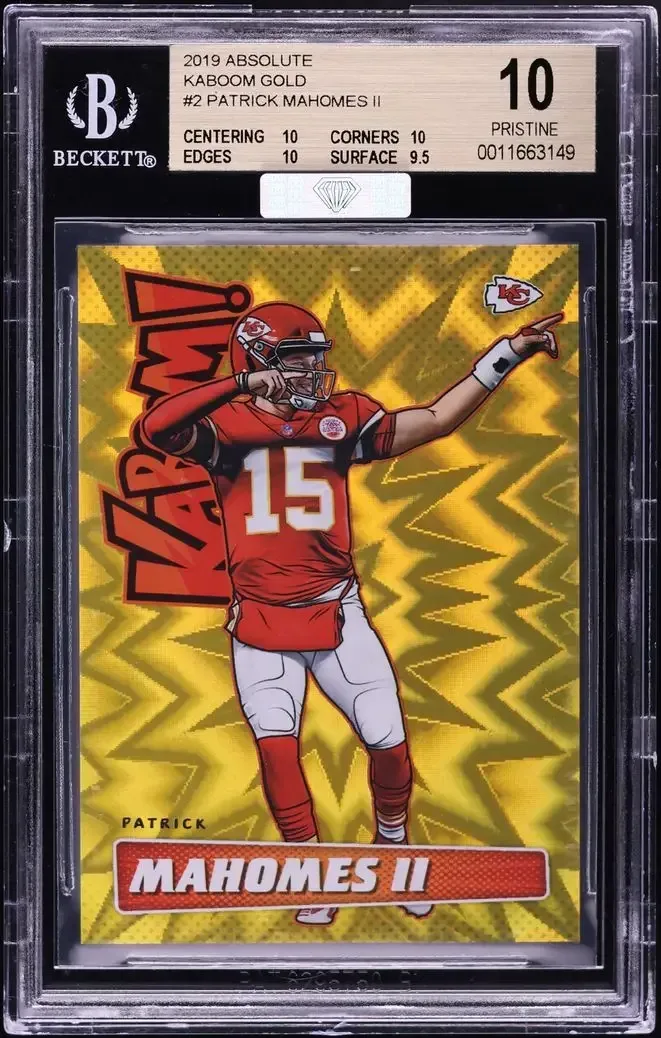
Beckett’s labels are different in a way that is immediately visible: Beckett says it is the only grading company to place all four condition scores, centering, corners, edges and surface, directly on the label. That means a BGS slab usually tells you more on the front than a standard PSA, SGC or current CGC card label does.
Beckett also says cards are evaluated across those four categories and then assigned an overall grade, with final grades given in half-point increments. For collectors, that extra transparency can be genuinely useful. A BGS 9.5 with one weaker subgrade may appeal differently from another BGS 9.5 with a different subgrade profile, even though the headline number is the same. If you care about a specific flaw type, the label may help you make a more informed choice before you even inspect high-resolution scans.
But more information does not erase judgment calls. It creates new ones. A buyer has to decide how much weight to give a weaker centering subgrade versus a weaker surface subgrade, or whether a particular subgrade mix matters for that card’s eye appeal. Those are collector decisions, not automatic answers supplied by the slab.
Beckett’s label colors also carry meaning. Its current product page says black is used for perfect 10s, gold for Gem Mint, and silver for all others, while Beckett’s 2014 announcement states that a black label is awarded to a card with four 10 subgrades. In other words, color is not merely decorative in the Beckett system. It is part of the grading message.
A practical example: two sellers each offer a BGS 10 of the same card. Before assuming they are equivalent, check whether one is a black label and the other is not. Then check the subgrades. With BGS, the headline grade can hide useful distinctions in plain sight, because the label itself is designed to show them.
- Always read BGS subgrades before comparing prices
- Label color in BGS is part of the grade meaning
- Two BGS cards with the same overall grade may still present very different condition profiles
CGC labels: current scale, legacy mappings and retired grades all matter
CGC may be the clearest warning against assuming that even one company’s labels mean the same thing across time. Its current grading scale uses Pristine 10 as the top current numeric designation and distinguishes that from Gem Mint 10. It also includes Mint+ 9.5 on the current ladder. So a modern CGC 9.5 is already a specific current-label statement, not a blank check for comparison with older 9.5 labels from other systems or earlier CGC-related products.
The company’s published legacy grade key makes the historical issue even more explicit. CGC says older CGC Trading Cards Gem Mint 9.5 and CSG Gem Mint 9.5 map to current CGC Cards Gem Mint 10 in its online tools, while Perfect 10 is a retired grade that retains its status. That means a collector can run into labels whose original printed grade language and current database mapping are not identical in obvious ways. If you ignore label era, you can misunderstand what you are seeing.
CGC’s FAQ adds another point of contrast with Beckett: sub-grades are no longer offered. That matters because a modern CGC label does not communicate the same front-label condition breakdown that a BGS slab typically does. A buyer comparing CGC and BGS side by side should recognize that the labels are disclosing different kinds of information, not just different grade numbers.
This is a situation where disciplined cataloging helps. If you own or are considering CGC cards, note whether the slab is a current CGC Cards label or a legacy CSG or CGC Trading Cards era label, and avoid compressing them into a single undifferentiated field. That extra line in your notes can save confusion later when you revisit a card, consider a sale, or compare listings.
CGC’s system does not need to be simplified to be useful. You just need to read it as CGC presents it, including the possibility that older labels and current online equivalents may interact in ways that are unique to that company.
- Do not assume every CGC 9.5 means the same thing across label eras
- Separate current CGC labels from legacy CSG or CGC Trading Cards labels in your notes
- Remember that modern CGC labels do not offer sub-grades
Legacy labels are not side notes; they are part of the grade
Collectors sometimes talk about “old label” and “new label” slabs as if the issue were mostly visual. The published evidence says the distinction can be functional. PSA’s half grades began on a specific date, February 1, 2008, which means label-era context can matter when you interpret older PSA cards. SGC’s cert-verification process distinguishes black labels from older green and white labels. CGC’s legacy grade key formally maps some older 9.5 gem-mint labels to current gem-mint 10 equivalents in its tools while preserving retired Perfect 10 status.
Those are not small details for specialists only. They directly affect how you verify the slab, how you describe it in a listing, and how you compare it with current examples. When a collector says two cards are “the same grade,” the first follow-up question should sometimes be “same company and same label era?” Without that, you may be comparing products that the grading company itself does not present as identical in format or meaning.
If you buy older slabs, create a simple routine. Save a photo of the front and back of the holder. Record the full printed label text, not just the number. Verify the cert using the correct company tool for that label generation. Note anything the company says about legacy-grade mapping or changed grading options. This is not busywork. It is how you keep a neat spreadsheet from becoming a misleading one.
There is also an honest tradeoff here. The more precisely you catalog label generation, the less tidy your collection tracker may look. You will have more fields and more distinctions to maintain. But that extra precision gives you a much clearer picture of what you actually own and what you are actually considering when you shop.
- Track label era alongside grade
- Photograph both sides of older slabs
- Use full label text in your records, not shorthand alone
Why crossover policies are a reality check
If graded numbers were truly interchangeable, crossover submissions would be mostly administrative. CGC’s published CrossOver policy points in the opposite direction. The company says cards from PSA, Beckett or SGC cross only if CGC determines they will receive the same or higher CGC grade; otherwise they remain in the original holder. That is a direct operational reminder that the source slab is not treated as an automatic equivalent.
For collectors, that policy is more revealing than many hobby arguments about strictness. It does not claim that one company is universally stricter than another in every era and every category. It simply shows that the receiving company relies on its own graders and its own scale. In plain English, a number printed by one company does not bind another company to match it.
This is especially important when evaluating cards marketed as “crossover candidates.” That phrase can be useful as seller analysis, but it is not the same as a published promise. A slab from one company may look like it has a shot at a certain result elsewhere, yet the other company’s own standards still control the outcome. Collectors should price that uncertainty honestly.
A practical question set helps here: Is the seller describing the card’s current label accurately? Are they presenting crossover hopes as certainty? Is the target company’s current scale materially different at the top end or in the use of subgrades? Could label generation complicate the comparison? Those questions turn crossover talk back into what it really is: a possibility, not a conversion formula.
- Treat crossover language as speculative unless the receiving company has already graded the card
- A source grade is evidence, not automatic equivalence
- Use published crossover policies to calibrate expectations
A practical slab-reading checklist for buyers and traders
When you are looking at a graded card online or in person, follow a fixed sequence. First, identify the company. Second, read the grade word and number together. Third, look for subgrades or qualifiers. Fourth, note whether the label appears current or legacy. Fifth, verify the certification using the company’s tools and security features where available. Only after that should you move to price, eye appeal and fit for your collection.
That process sounds methodical because it is. Graded cards are information-dense objects, and the label is a summary, not a universal decoder ring. A BGS slab may immediately show you subgrades that help explain the overall result. A modern CGC slab will not, because CGC says sub-grades are no longer offered. An SGC cert may require a different format depending on black versus older green and white labels. A PSA holder includes current security features such as the LightHouse Label and QR-based certification lookup. These are not interchangeable user experiences, so they should not produce interchangeable assumptions.
Here is a useful buying exercise. Before making an offer on any graded card, write one sentence that describes the slab without using shorthand. Instead of “It’s a 10,” write something like, “It is a current-label company X Gem Mint 10 with or without subgrades, verified cert, and no obvious label-era confusion.” If you cannot write that sentence clearly, you probably do not understand the slab well enough yet.
The same approach improves trades. If you are negotiating across brands, speak precisely. Say the full company and label description instead of just the number. That reduces misunderstandings and keeps both sides focused on the actual object rather than hobby folklore about equivalent grades.
None of this tells you which holder should be worth more for a specific card. That is a separate market question. What it does do is give you a disciplined way to read what the slab is actually communicating before you decide what the market should pay for it.
- Use a five-step read order: company, grade word/number, subgrades, label era, cert verification
- Avoid listing shorthand when full label wording matters
- Separate condition interpretation from market-price debates
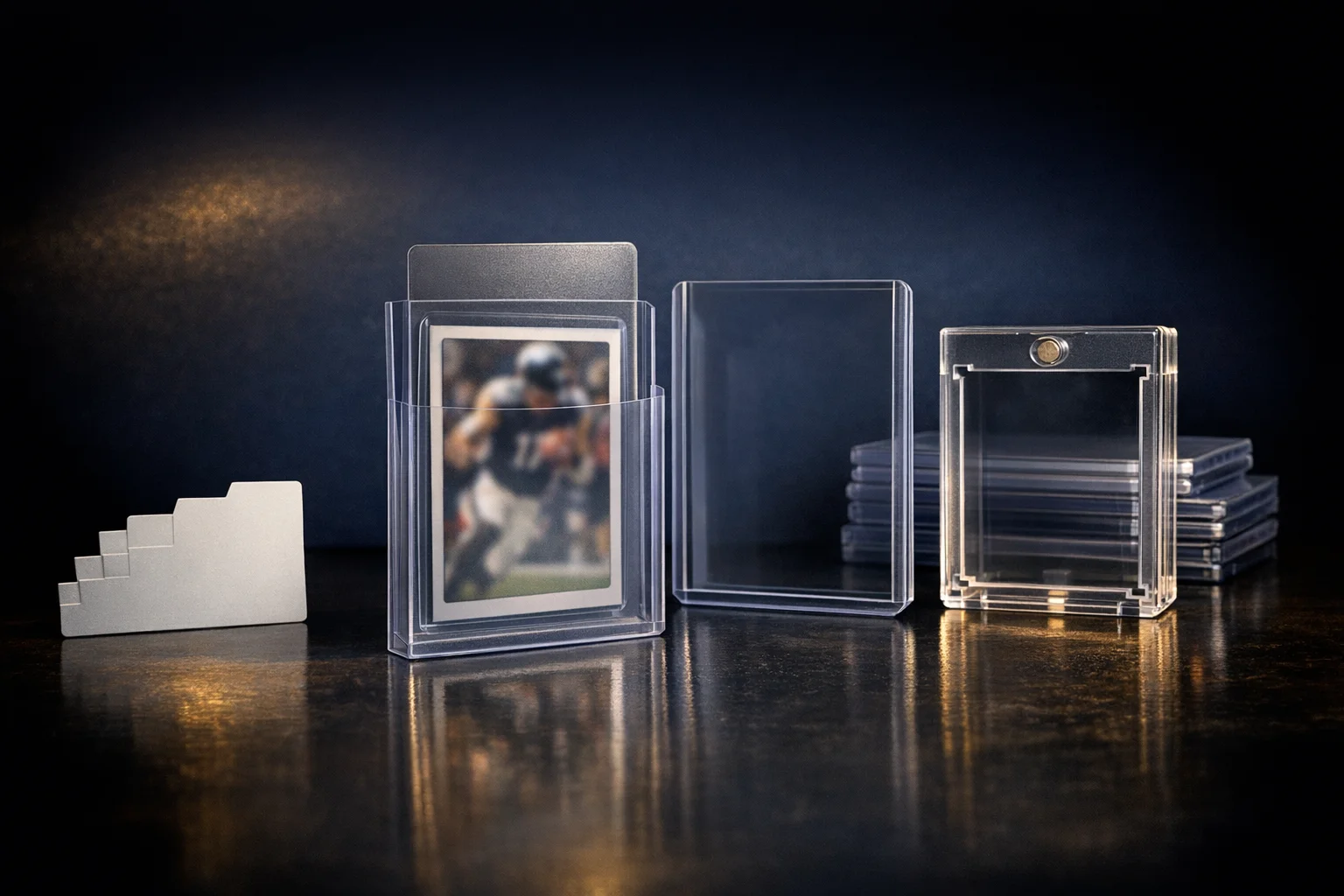
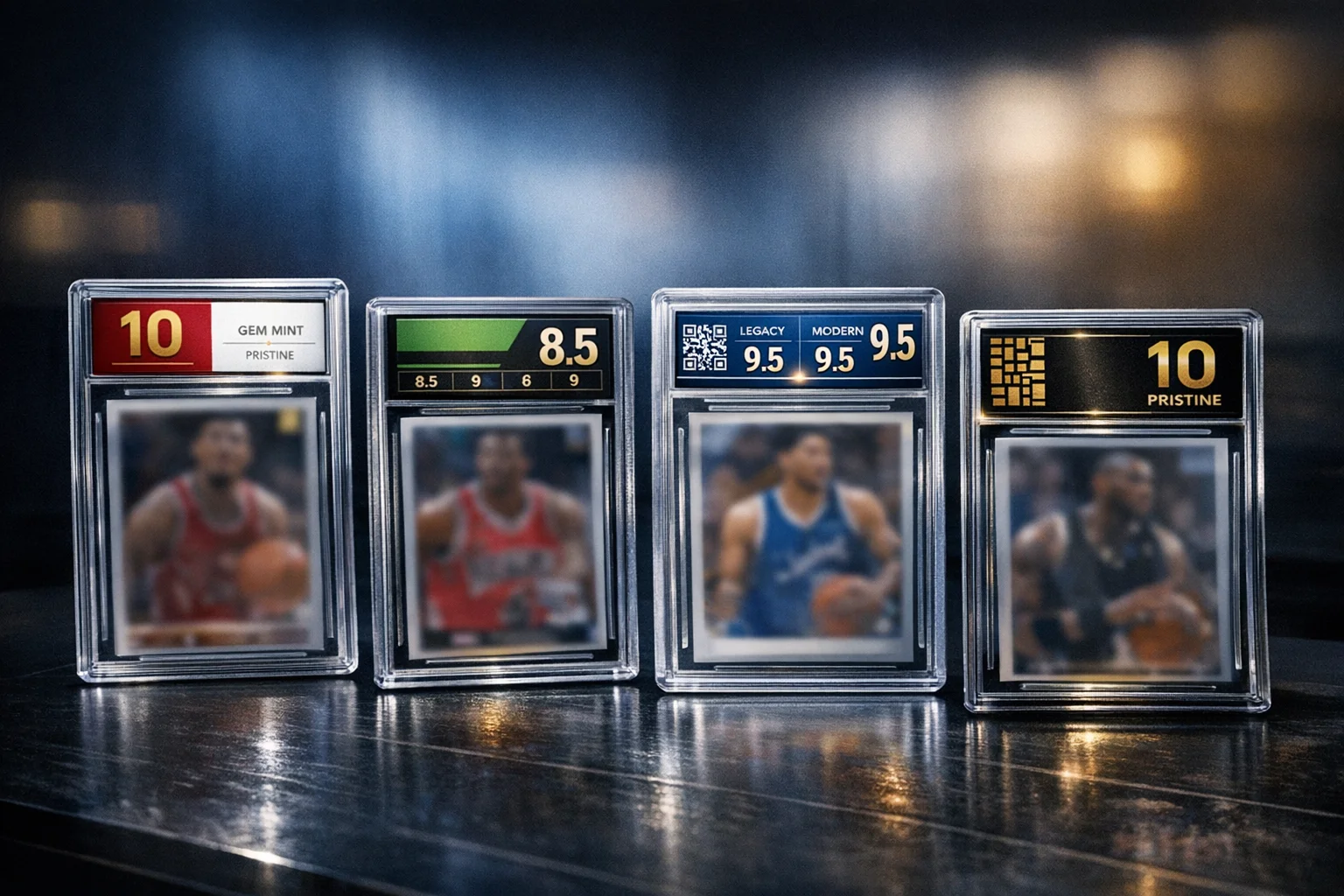
Illustration generated for this guide; not a photograph of an actual card, product or event.
Photo Gallery