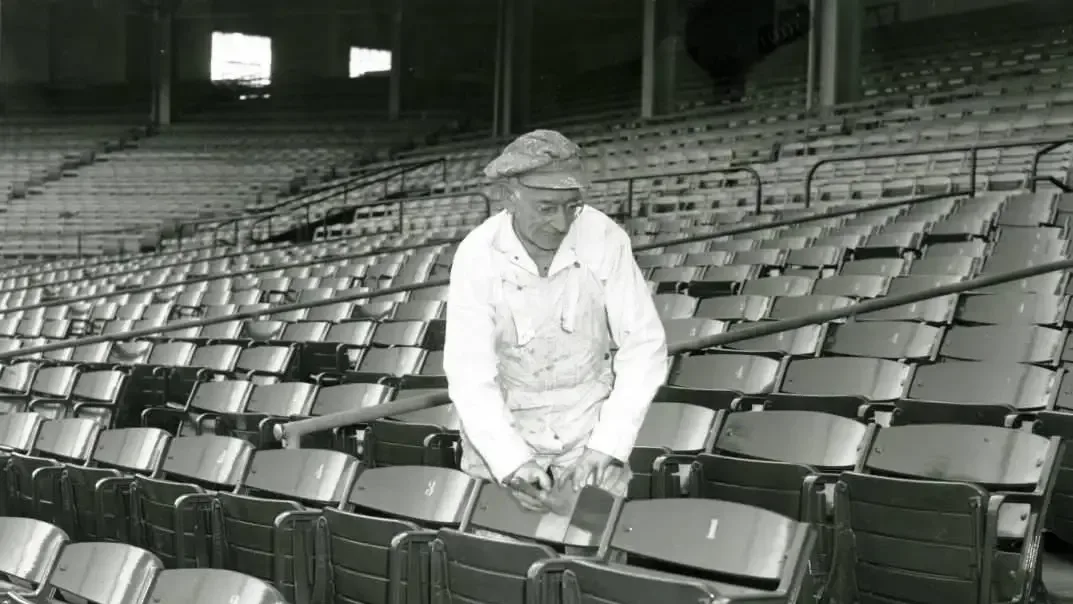
Historic stadium seats occupy a unique corner of the sports memorabilia world. For many collectors, they offer something few other items can match: a direct physical link to a ballpark, the fans who sat there, and the games those seats witnessed over decades of use.
That appeal has helped old seats from venues such as Comiskey Park, Shibe Park, and Connie Mack Stadium remain desirable display pieces for homes, offices, and memorabilia rooms. But interest in the category comes with a challenge that has only grown in the online era: proving that a seat is exactly what it is claimed to be.
Unlike a modern signed baseball or a slabbed trading card, a stadium seat often carries a more complicated chain of custody. Seats were sold off to the public, moved to minor league parks and fairgrounds, repainted, restored, or salvaged without much paperwork. As a result, a piece can be authentic to a venue in some sense, but still raise questions about originality, alterations, or even whether it was ever used in the specific section or period being advertised.
For collectors considering a stadium seat purchase, the biggest lesson is simple: authenticity in this niche usually depends on research, comparison, and context rather than a single label or sales pitch.
For more collector background, read Why Graded Sports Magazines Are Suddenly Drawing Big Money From Collectors.
Why stadium seats remain so collectible
Collectors are drawn to stadium seats for obvious reasons. They are instantly recognizable, highly decorative, and deeply tied to fan experience. A seat is not just memorabilia in the abstract. It is part of the actual infrastructure of a venue that hosted generations of baseball history.
That connection helps explain why old ballpark fixtures continue to surface in the hobby. Some were removed and sold directly when a stadium closed. Others were repurposed in different venues before eventually returning to the collectibles market. Some stayed in private hands for decades before being offered again.
When provenance is solid, the appeal is easy to understand. A documented Comiskey Park box seat, for example, can be both a conversation piece and a meaningful display item for a White Sox collector. But that same emotional appeal also makes the category vulnerable to confusion and overconfident listings, especially when sellers rely on family stories, old tags, or assumptions rather than verifiable evidence.
For another perspective on this story, read How to Authenticate Historic Stadium Seats: What Shibe Park Collectors Should Know Before Buying.
Why authentication is harder than many buyers expect
The difficulty starts with a simple fact: long-running ballparks often used multiple seating styles over time. Seats could come from different manufacturers, appear in different colors, and be installed in specific levels or sections. A collector looking at one old metal-and-wood chair may assume it is easy to identify, but the reality can be far more complicated.
Even when a seat truly traces back to a famous stadium, that does not always mean it remains fully original. Paint may have changed. Boards may have been replaced. Numbers may have been reapplied. The seat may have spent years in another venue after being removed from the original park.
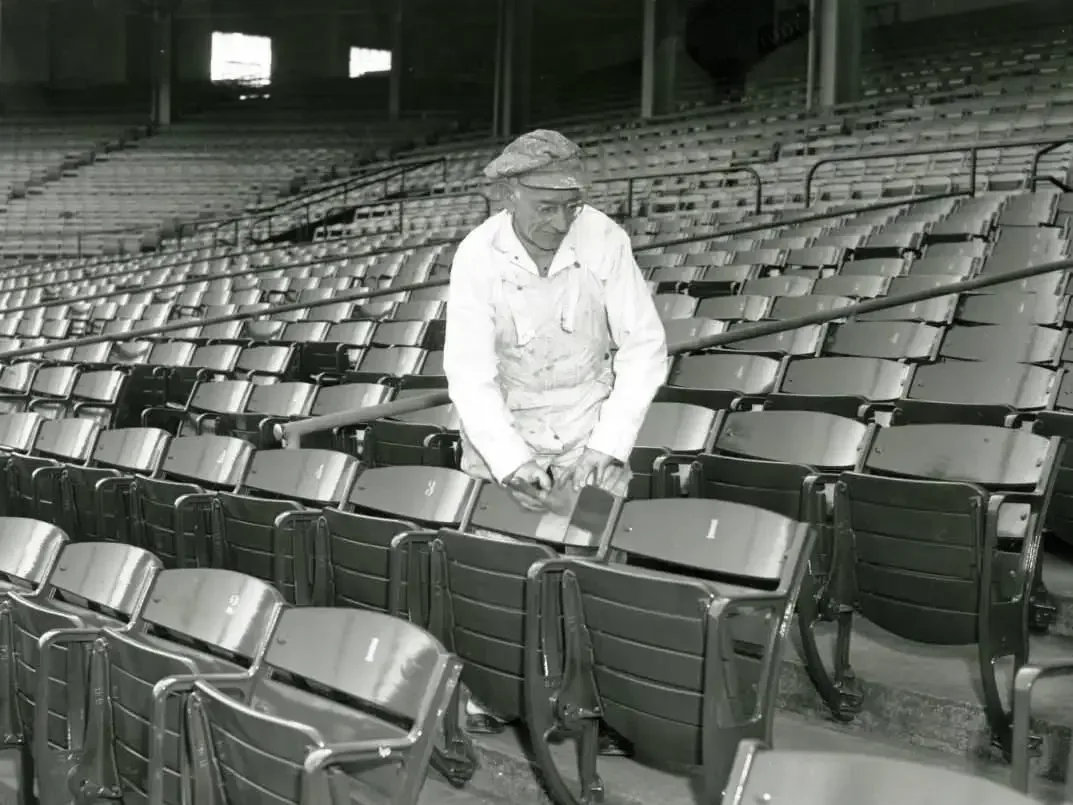
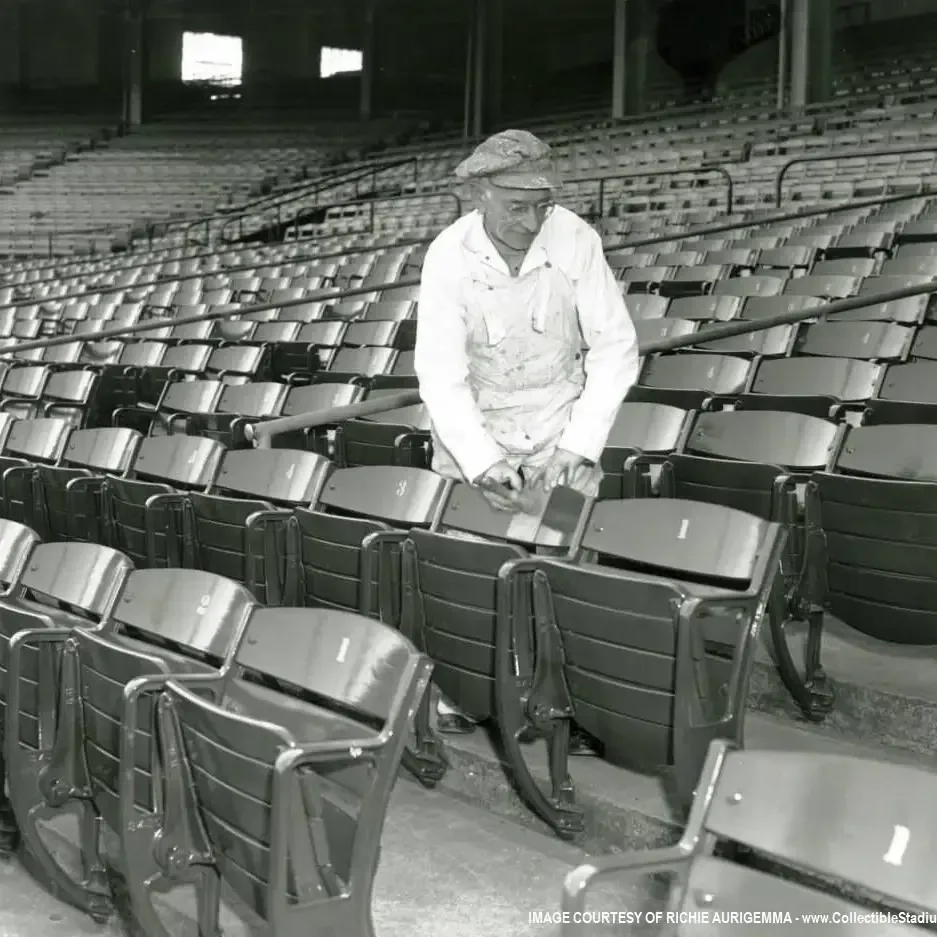
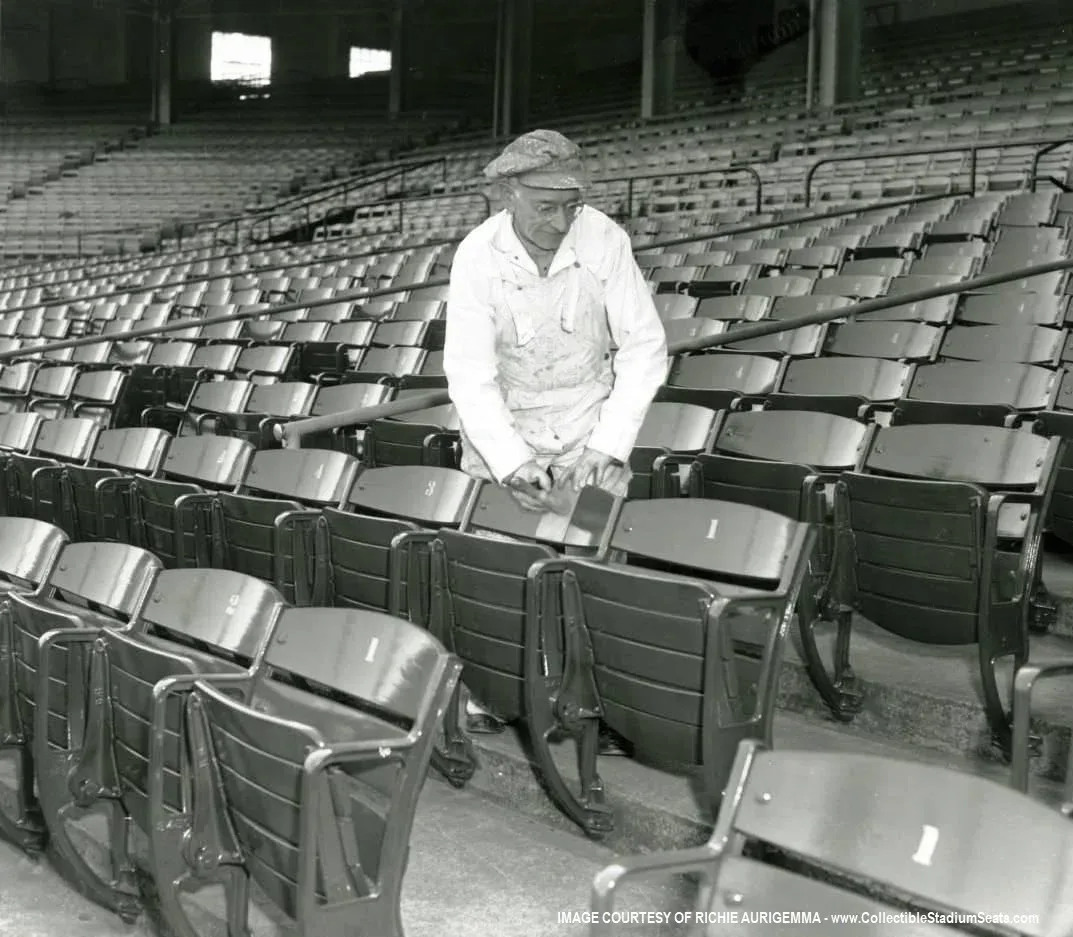
That is why photo-matching has become one of the most valuable tools in the category. Collectors and dealers often compare surviving seats against period photos, archival images, stadium publications, advertisements from manufacturers, and newspaper coverage of stadium renovations or salvage sales.
In short, buyers should think like researchers. If a seat cannot be tied to documented visual evidence or a convincing chain of movement from one venue to another, caution is warranted.
Shibe Park shows how complex the category can be
Few examples illustrate the issue better than Shibe Park, later known as Connie Mack Stadium. Opened in 1909, the Philadelphia venue used several distinct seating styles over its long history. That makes it one of the more interesting and challenging case studies in ballpark-seat collecting.
Veteran dealer and stadium-fixture specialist Richie Aurigemma has spent years tracing the park's various seat types through reference books, newspapers, archival material, and period imagery. His work highlights just how much detail is required to separate a strong attribution from a questionable one.
Collectors often associate Shibe Park most strongly with its earliest and most distinctive seating models, but those were only part of the venue's seating story. Different models appeared over time, some with stronger documentation than others.
Two of the most desirable early Shibe Park seat styles
The two classic Shibe Park designs that tend to attract the most collector attention both date to Opening Day 1909 and were manufactured by Royal Metal Manufacturing Company.
One is the Slant Arm model. The other is the more celebrated Double Ribbon, also called the Heart Shape model. These chairs stand out for their early 20th-century design and their strong visual identity, qualities that make them especially appealing in the hobby.
They were originally painted dark green, though later repainting created additional known versions. Slant Arm seats were often finished with a peach topcoat and yellow numbers, while Double Ribbon seats commonly appeared in red with yellow numerals. Peach Double Ribbon examples are also known.
Because of their look and relative importance in the history of the ballpark, these models sit near the top of many collectors' want lists. Aurigemma's retail estimates place Slant Arm examples in roughly the $500 to $1,000 range, while Double Ribbon seats can run about $600 to $1,500, depending on originality, paint, damage, and completeness.
The Double Ribbon model has an added advantage in the marketplace: it is easier for many collectors to recognize quickly. That can support demand, but it also means buyers should examine examples carefully for restoration, replaced components, or claims that extend beyond what can actually be documented.
The role of relocation and reuse in stadium-seat provenance
One of the biggest complications in this niche is that old seats were often moved after leaving their original homes. That can preserve important artifacts, but it can also blur provenance.
Aurigemma previously acquired a group of Double Ribbon seats from Greensboro's War Memorial Stadium during a renovation. Those seats were believed to have arrived there in the 1970s from Duncan Park in South Carolina, which had ties to the Phillies system and had reportedly received them after Shibe Park closed.
Stories like that are common in the category. A seat may indeed have originated at a major league venue, then spent years or decades serving in a minor league park, fairground, or other local facility. In such cases, the object can still be authentic to the original stadium, but details about paint, numbering, wear patterns, and exact period of use may be less straightforward.
For collectors, that means provenance should be viewed in layers. There is a difference between a seat that is documented to have been installed at Shibe Park in 1909, a seat that later came from another venue after being transferred there from Shibe, and a seat merely believed to resemble those used at Shibe.
Other documented Shibe seat variations
Shibe Park also used a Heywood Wakefield free-standing two-slat curved back seat style, another design that dates to 1909. Red box-seat versions and peach reserve-seat versions have been associated with upper-level sections.
This version is considered much tougher to locate than the more famous Royal Metal models. Aurigemma has noted that unrestored examples he has encountered were red, with peach versions potentially carrying added rarity. The model is notable because the two-slat configuration appears to have been uncommon in major league use, even though Heywood Wakefield produced related three-slat styles for other sports venues.
There is also a grey-painted two-slat variation with green stenciled numbers that appears to trace back to Shibe seating later diverted to the Bloomsburg Fairgrounds in Pennsylvania. These are viewed as genuine stadium fixtures in the sense that they likely originated from Shibe Park, but not fully original in finish because they were repainted after relocation. Values for these examples have been estimated in the $400 to $800 range.
That distinction matters. In memorabilia, authenticity and originality are not always identical. A seat can be real, but altered. Knowing the difference can have a major impact on value.
Where the biggest provenance problems appear
One of the more debated examples tied to Shibe Park involves light grey, three-slat free-standing seats with green numbers, believed to date to the late 1930s or early 1940s and attributed to American Seating.
Thousands of similar seats were reportedly sold from the Bloomsburg Fairgrounds, where they had allegedly been installed after removal from Shibe Park. Newspaper coverage from 1991 referenced the sale of more than 5,000 so-called battleship grey seats and described them as having come from Shibe in the 1940s.
Even with that history, the attribution remains less secure than collectors may want. The core issue is visual documentation. If period images showing these exact seats in service at Shibe Park cannot be located, collectors are left weighing circumstantial evidence rather than firm photographic proof. The fact that surviving examples tend to appear only in grey, which is not widely accepted as a Shibe Park section color, adds to the uncertainty.
That makes these seats a useful reminder that a plausible backstory is not the same thing as a fully settled provenance record. In categories built on architectural salvage and venue reuse, gaps in documentation can persist indefinitely.
Less common seating and stadium furniture also draw interest
Collectors who focus on stadium pieces do not stop at grandstand and reserve seats. Other seating forms from Shibe Park have their own following, especially because many are harder to find and easier to display in smaller spaces.
One example is the 1950s field box folding chair used at Shibe Park. These chairs featured silver frames with padded red leather armrests and bottoms. They were also used as locker-room seating and may have been made by American Seating, based on construction details found on comparable chairs.
Because these folding chairs are portable and functional, they fit easily into homes and memorabilia rooms. They are also considered scarce, with estimated value in the $500 to $1,000 range.
Even tougher are circa-1940s locker room or ball boy stools. They take up very little space and pair especially well with larger display pieces such as vintage lockers. Estimated values for those stools have been placed around $300 to $500, though actual prices can vary significantly based on documentation and condition.
What collectors should check before buying a stadium seat
For anyone entering the category, a careful review process is essential. A few steps can help reduce risk:
- Study period photos. Match arm shapes, slat counts, frame construction, numbering style, and paint colors to known in-service images.
- Ask about the chain of ownership. Find out whether the seat came directly from a stadium sale, a later venue, an estate, or a long-held private collection.
- Inspect restoration closely. Replaced boards, new hardware, or repainted frames do not automatically ruin a piece, but they should be disclosed and reflected in the price.
- Check manufacturer details. Royal Metal, Heywood Wakefield, and American Seating all produced different styles that can help narrow identification.
- Be careful with plaques and tags. Old dealer plates and descriptive labels can be useful, but they are only part of the evidence.
- Compare with known examples. Auction archives, museum displays, and advanced collectors' references can be valuable points of comparison.
Collectors who do that work are usually in a stronger position to judge whether a stadium seat is a premium artifact, a restored display piece, or a questionable attribution best left alone.
Why buyer caution matters more than ever
The market for stadium seats remains driven by nostalgia, eye appeal, and the thrill of owning a real piece of sports architecture. Those qualities are exactly what make the category rewarding. They are also why overstatements can travel quickly in online listings and secondary sales.
Old ballpark seats can absolutely be legitimate and important collectibles. Some are well documented, visually distinctive, and backed by strong provenance. Others sit in a grayer area where parts of the story make sense, but the documentation is incomplete. Knowing where a specific example falls on that spectrum is the real task.
For advanced collectors, that challenge is part of the appeal. In many cases, the best buys are not just the most attractive seats, but the ones whose history can be convincingly traced through archival photos, venue records, and long-established hobby knowledge.
That detective work may take more time than a typical memorabilia purchase, but in a niche built on salvaged history, it is often the difference between owning a decorative chair and owning a genuine piece of a lost ballpark.
Photo Gallery