Anfernee Hardaway remains one of the most fascinating stars in the basketball card market. His prime did not last as long as collectors once expected, but the impact he made in Orlando still resonates across the hobby. For many 1990s basketball fans, Penny represented the ideal modern guard before the league fully shifted in that direction: oversized, creative with the ball, explosive in transition, and capable of making a pass or finish that felt a step ahead of everyone else on the floor.
That short but brilliant peak continues to power demand for his cards. The market for Hardaway is built on equal parts production, style, nostalgia, and scarcity. His early career cards capture a player who made multiple All-NBA First Teams before turning 25 and looked like a long-term face of the league. Even though injuries changed the course of his career, collectors have not let go of that early image. As a result, several of his key cards, especially from the mid and late 1990s, still post eye-catching prices.
From his 1993 Finest rookie to some of the decade’s most recognizable inserts and parallels, Hardaway’s cardboard legacy remains much larger than the length of his peak might suggest.
Why Penny Hardaway Still Connects With Collectors
Hardaway’s hobby appeal starts with the way he played. At 6-foot-7, he operated like a point guard with wing size, smooth athleticism, and unusual control. During his first few seasons with the Magic, he quickly developed into one of the most exciting young players in basketball. Paired with Shaquille O’Neal, he helped make Orlando one of the league’s most watchable teams, and his early resume backed up the hype.
For more collector background, read Wayne Gretzky Named an Upper Deck Legacy Partner as New Exclusive Collectibles Arrive.
For collectors, that matters because card demand is often strongest when a player’s image in the hobby was established during a moment of real excitement. Hardaway checked every box. He was a top draft pick, a standout in premium 1990s sets, a featured star in insert-heavy products, and a player whose style translated perfectly to flashy card designs. His popularity also extended beyond the box score, with signature shoes and memorable ad campaigns making him a major pop culture figure of the era.
That combination helps explain why Hardaway’s market still compares favorably with many players from his generation who finished with longer careers or fuller award shelves. Collectors are buying into a peak and a personality that felt larger than the final statistics.
1993 Finest Rookie Cards Remain the Foundation
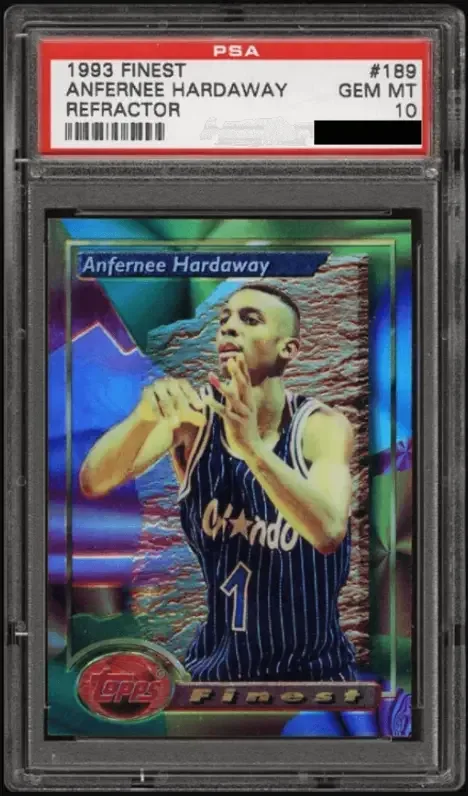
Any discussion of Hardaway’s cardboard market starts with 1993 Finest. His 1993 Finest #189 rookie remains his signature mainstream rookie issue, and the Refractor version stands as one of the most important cards in his catalog.
When the product was new, the card already had notable hobby attention. The base rookie and the short-printed Refractor both carried strong early values, reflecting just how much excitement there was around Hardaway entering the league. That enthusiasm has held up well over time, especially as collectors continue to chase iconic 1990s chromium rookies.
Current pricing underscores that staying power. A PSA 10 copy of the base 1993 Finest rookie is valued around $400, while a PSA 9 has moved from roughly $25 to $58 over the past year. Those are healthy gains for a widely recognized rookie card from a player whose peak was relatively brief.
The Refractor is where things really accelerate. With a PSA 10 population of only 33, the card has become one of the hardest Hardaway rookies to land in elite condition. The last PSA 10 sale reached $4,440, representing an 83.09 percent year-over-year increase. That kind of movement shows how much demand still exists for cornerstone 1990s parallels when the player, set, and condition rarity all align.
Collectors looking for the cleanest summary of Hardaway’s place in the hobby can find it in this card. It is a true rookie from an important set, tied directly to the surge of excitement around his arrival in Orlando, and it carries both nostalgia and scarcity.
1995 Skybox E-XL Natural Born Thrillers Captures Peak Penny
By the 1994-95 season, Hardaway had evolved from prized young talent into a full-fledged star. He became an All-Star starter, helped push Orlando to 57 wins, and played a central role in the Magic’s run to the NBA Finals. In hobby terms, that season produced some of the best representations of Penny at his athletic and stylistic peak.
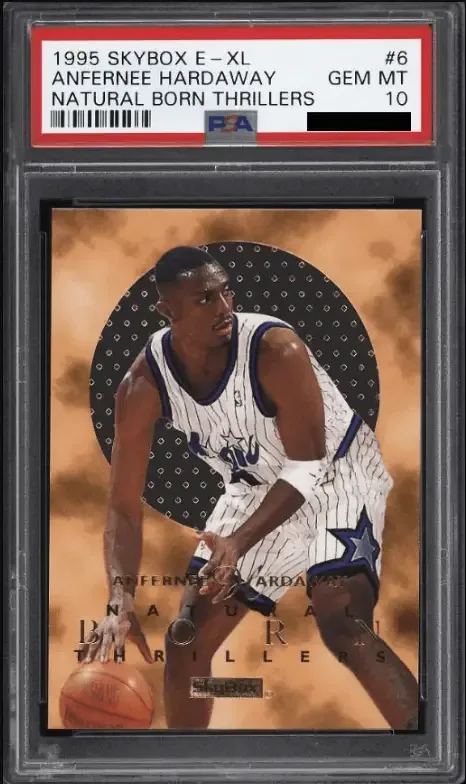
One of the most appealing is 1995 Skybox E-XL Natural Born Thrillers #6. The insert is a classic 1990s die-cut and gold-foil design, and Hardaway fits the theme perfectly. He was exactly the kind of player collectors and manufacturers wanted to feature in a set built around star power and highlight-reel appeal.
The market has responded accordingly. A PSA 9 copy has climbed 236.62 percent over the last 12 months, with the latest sale at $225 setting a new high for that grade. While it is not his most expensive card, it is one of the clearest examples of how collectors continue to reward strong visual design paired with a memorable moment in a player’s career arc.
For many Penny fans, this card reflects the version of Hardaway they remember most vividly. He was not just productive. He was a basketball attraction, and the card feels like a period-correct celebration of that status.
1996 E-X2000 A Cut Above Shows the Power of 1990s Design
Few eras produced more inventive basketball inserts than the 1990s, and Hardaway sits at the center of many of them. A standout example is 1996 E-X2000 A Cut Above, one of the hobby’s most memorable die-cut designs.
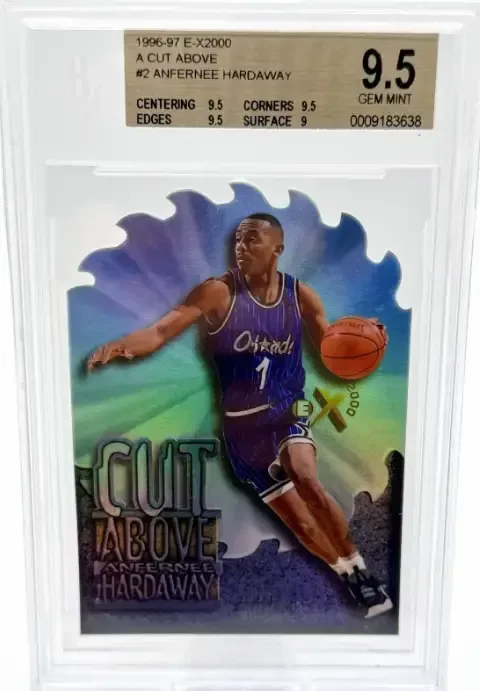
The card is unmistakably of its time, using a circular saw-blade shape and reflective foil to create a dramatic presentation. It is bold, unusual, and instantly recognizable, which is exactly why many collectors continue to chase it. Hardaway is pictured attacking the basket in his Magic uniform, making the card feel tied directly to the final stretch of his elite Orlando years.
The market numbers are strong here as well. The last raw copy sold for $609, up 35.89 percent year over year. Because the shape and edges can make condition especially difficult, higher-grade examples attract serious attention. A BGS 9.5 copy sold for $2,500 on September 21.
That premium illustrates an important point about Hardaway’s card market. Condition sensitivity matters a great deal with his most desirable inserts. Cards from this era often feature foil surfaces, unusual cuts, and edges that do not forgive handling. When a high-grade example surfaces, especially of a design collectors already love, prices can jump quickly.
Precious Metal Gems Sit Near the Top of the Penny Market
If the 1993 Finest Refractor is Hardaway’s foundational star card, his Precious Metal Gems are among his most coveted high-end chase pieces. PMGs have become one of the defining parallel lines of 1990s basketball collecting, and Hardaway’s examples have risen into elite territory.
The irony is that these cards were issued as Hardaway’s career trajectory was beginning to change. By 1997-98, knee injuries had already interrupted the dominance many expected from him. Yet scarcity and long-term hobby appreciation for the Metal Universe brand have elevated these cards far beyond what many collectors at the time could have predicted.
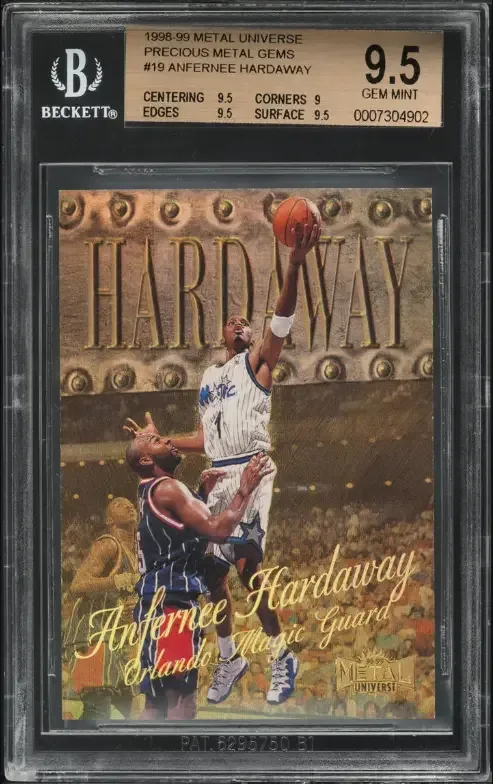
His 1998 PMG has produced some of the biggest public sales in his market. A PSA 7.5 copy sold for $15,600 on September 25, while a BGS 9.5 example reached $43,200 in auction last February. That result ranks among the highest prices recorded for any Hardaway card.
The 1997 PMG issues have also posted major numbers. A 1997 Metal Universe Precious Metal Gems Red /100 in PSA 6 sold for just under $27,000 last October. The /50 Metal Universe Championship version has traded in the $13,000 to $15,000 range depending on grade.
These are not casual collector cards anymore. They occupy a premium tier, fueled by extreme scarcity, strong crossover appeal with broader 1990s basketball collectors, and the enduring visual identity of the PMG line. Hardaway may not have the career resume of some Hall of Fame contemporaries, but in the PMG market, iconic player image and set prestige can matter just as much.
The Phoenix Era Has Its Own Niche Appeal
Hardaway’s move to Phoenix marked a very different stage of his career. He was no longer the relentlessly explosive Orlando star who seemed destined for yearly All-NBA consideration, but he was still a major enough name to headline cards tied to a new chapter.
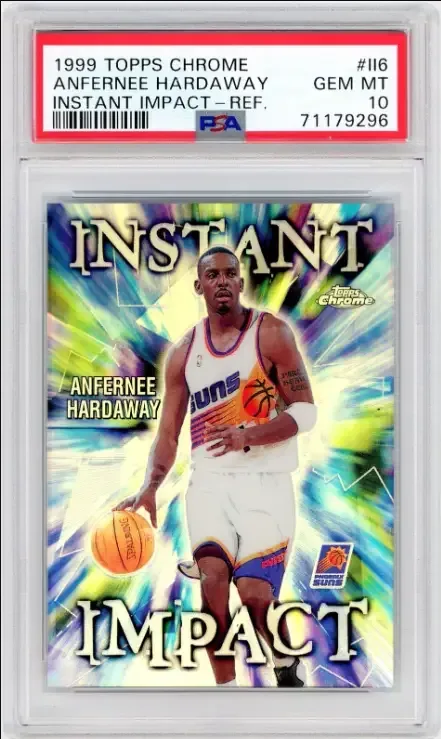
That is where 1999-00 Topps Chrome Instant Impact enters the picture. The insert set focused on players joining new teams, and Hardaway was an obvious fit after his departure from the Magic. In hobby terms, it now serves as a useful time capsule of a transition collectors once hoped might revive his trajectory.
The card remains comparatively accessible. A PSA 10 most recently sold for $150 on September 9, while PSA 9 examples can be found for under $40. It is not a centerpiece card on the level of his best Orlando-era issues, but it still has appeal for player collectors and fans who want a broader timeline of Hardaway’s career represented in their collection.
Cards like this also help show the layered nature of his market. The biggest money is concentrated in rookie cards, iconic inserts, and ultra-scarce parallels, but there is still room for affordable Hardaway cards with strong design or historical relevance.
Late-Career Memorabilia Cards Still Offer Interesting Angles
Not every notable Hardaway card needs to be a rookie or a shiny 1990s insert. Some later issues have a different kind of appeal, especially when they tie him to significant peers or draft history.
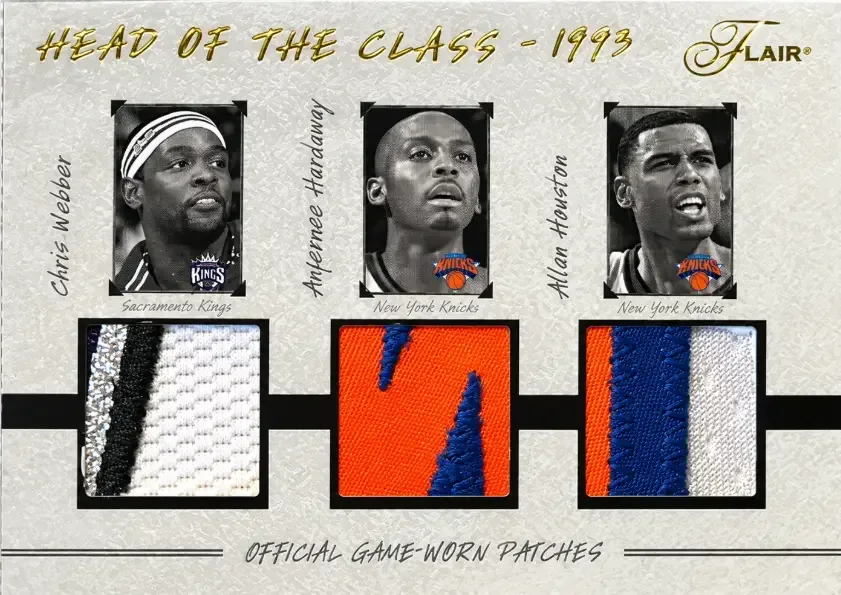
One example is the 2004 Flair Head of the Class Patches card numbered to 33. The card features a Hardaway jersey swatch alongside pieces from Chris Webber and Allan Houston, bringing together three notable members of the 1993 draft class. While this is a late-career release and does not carry the same demand as his Orlando-era highlights, it offers a useful blend of scarcity, memorabilia content, and draft-era nostalgia.
There have been only two recorded sales over the past five years, and the latest was a jersey-number match copy numbered 1/33 that sold for $160 in October 2023. Those numbers are modest compared with his top inserts and parallels, but the card illustrates how Hardaway’s hobby footprint extends beyond the years when he was at his best on the court.
Key Anfernee Hardaway Cards and Recent Price Points
- 1993 Finest #189 Rookie - PSA 10 value around $400, PSA 9 recently moved from about $25 to $58 over the last year.
- 1993 Finest Refractor #189 - PSA 10 population of 33, last sale at $4,440.
- 1995 Skybox E-XL Natural Born Thrillers #6 - PSA 9 last sold for $225 after a 236.62 percent rise over 12 months.
- 1996 E-X2000 A Cut Above - Raw copy last sold for $609, BGS 9.5 sold for $2,500.
- 1997 Metal Universe Precious Metal Gems Red /100 - PSA 6 sold for just under $27,000.
- 1997 Metal Universe Championship PMG /50 - Sales have landed between $13,000 and $15,000 depending on grade.
- 1998 PMG - PSA 7.5 sold for $15,600, BGS 9.5 sold for $43,200.
- 1999-00 Topps Chrome Instant Impact Refractor - PSA 10 sold for $150, PSA 9 copies available under $40.
- 2004 Flair Head of the Class Patches /33 - Most recent sale was the 1/33 jersey-number match at $160.
What the Market Is Really Buying
The continued strength of Hardaway’s best cards says a lot about how the basketball card market values greatness. Collectors are not always buying career length or cumulative accolades. Sometimes they are buying a feeling, a moment, or a version of a player that burned brightly enough to stay relevant for decades.
In Hardaway’s case, the market is clearly buying the memory of a superstar who looked like he might define an era. It is buying one of the most stylish and collectible player profiles of the 1990s. It is buying into cards that happen to sit inside some of the hobby’s most beloved brands, from Finest to E-XL, E-X2000, and Metal Universe.
That is why his best cards continue to command real money. Whether the target is an iconic rookie, a condition-sensitive insert, or a scarce PMG parallel, Penny Hardaway remains one of the clearest examples of how hobby legacy can stay strong long after a player’s peak has passed.
Photo Gallery