A first card show can feel like every part of the hobby arriving at once: bargain boxes, showcase grails, grading booths, trade chatter, and more decisions than you expected to make in a single afternoon. That is exactly why preparation matters.
If you walk in with a plan, the show becomes easier to enjoy. You do not need to know everything. You just need to know what you are trying to accomplish, what you can spend, and which risks are worth taking for your collection.
Start with the boring details, because they save the most trouble
Before you think about cards, think about logistics. A show listing is a starting point, not a guarantee. Dates, hours, venue details, and featured services can change, so one of the smartest first-show habits is simply confirming the event before you leave home. That sounds basic, but it protects you from the kind of avoidable mistake that can sour the whole day before you even enter the room.
A useful planning checklist is short: confirm the exact date, opening hours, location, admission cost, parking expectations, and whether the show includes the services you care about. If you hope to submit cards for grading, drop off items for vaulting, or ask about consignment, check whether those services will actually be on site at that show rather than assuming every major event works the same way.
This matters because some events function more like large trade shows than casual local meetups. Admission may be required. Certain booths may have limited hours or cutoffs. A first-time collector often underestimates how much smoother the day feels when those variables are settled in advance instead of discovered at the door.
A practical example: if your main goal is to buy one vintage card and drop off three modern cards for grading, your trip planning should look different from someone who just wants to browse bargain boxes. The first collector should prioritize confirmed show hours, grading presence, submission rules, and early arrival. The second may care more about admission price, floor size, and whether the vendor mix is broad enough to make browsing worthwhile.
- Confirm date and hours shortly before traveling.
- Check whether admission is required.
- Look up parking, line expectations, and venue rules.
- Verify whether grading, vaulting, or consignment services will be available.
- Match your arrival time to your goal, especially if a service booth matters to you.
Build an all-in budget, not just a card budget
Many first-time attendees think budgeting means deciding how much cash to bring for cards. That is only part of it. A better approach is to create an all-in number for the day, then divide it into categories before you go. This keeps you from overspending early and then talking yourself into extra costs later because they feel separate.
The easiest way to do this is to think in four buckets. First, show cost: admission, parking, food, and travel. Second, purchase budget: the amount you are genuinely willing to spend on cards, boxes, or supplies. Third, service budget: grading, vaulting, or consignment fees if the event offers them. Fourth, protection and follow-up cost: sleeves, semi-rigid holders, shipping, or insurance if you plan to send cards later or protect purchases properly after the show.
That fourth bucket gets overlooked all the time in hobby conversations, but it matters. If you buy cards that need better storage or bring items for submission, your total cost is not complete at the moment of purchase. Planning for supplies and shipping in advance gives you a more honest picture of what the day may actually cost.
Analysis: a first-show budget often works better when you intentionally leave a small reserve unspent at the start. That reserve is not a signal to buy more later no matter what. It is a decision buffer. If you find the one card you came for, you have room. If you do not, you go home without feeling pressure to force a purchase just because money is left in your pocket.
- Bucket 1: admission, parking, food, travel
- Bucket 2: cards and boxes
- Bucket 3: grading, vaulting, consignment, or other services
- Bucket 4: sleeves, semi-rigids, shipping, insurance, or storage follow-up
Load your research tools before you walk in
A card show moves faster than browsing at home. Cases are crowded, impulse buys happen, and it is easy to talk yourself into a card because it feels scarce in the moment. The cure is not perfect discipline. It is preparation. Have your research tools ready on your phone before you arrive so you are not scrambling for basic information while someone else is already asking to see the same card.
Current PSA resources highlight that the PSA app can provide estimated values, population reports, recent sales history, and live eBay listings. Whether you rely on that mix or another set of tools, the point is the same: bring price context with you. You do not need to comp every two-dollar card in a value box, but you should absolutely know how to check a meaningful purchase before making it.
There is a tradeoff here. If you stop to research every card, you may miss opportunities and spend the day staring at your phone instead of learning the room. On the other hand, buying entirely from instinct is one of the easiest ways to overpay, especially when a card looks cleaner under bright show lighting than it might at home. For most collectors, the best middle ground is to pre-build a target list with rough price bands. Then you only need to verify when a card lands near your decision zone.
Try a simple worksheet on your phone: player, card, preferred condition range, maximum comfortable price, and backup alternatives. If your first-choice card is overpriced at every table, you can pivot without frustration. That keeps the day productive instead of turning it into a single-card hunt that ends with a forced compromise.
- Put research apps and saved searches on your home screen.
- Make a target list with price bands before the show.
- Use comps more carefully on bigger purchases than on low-end box finds.
- Write down backup targets so one missed card does not wreck the day.
If you plan to submit cards, treat that like a separate mission
For a first-timer, grading drop-off can sound simple: bring cards to the booth and let the company handle the rest. In practice, show submissions work best when you arrive prepared. PSA advises collectors to prepare submissions online before arrival, and its show guidelines are specific about holder preferences and timing. Cards meant for submission should be organized in the requested format rather than brought loose in whatever storage you already use at home.
That format detail matters. PSA's show guidance says cards should be in Card Saver-style holders and advises against top loaders, hard acrylic cases, and screw-down holders for submissions. The issue is not hobby style points. It is processing efficiency and handling standards. If you bring cards in the wrong holders, you may create delays for yourself and for the booth staff, and some holders will not be returned with the submission.
Timing matters too. PSA states that show capacity can fill and that it reserves the right to cut off submissions at any point. It also notes that a submission is not official until PSA representatives physically receive it at the booth. For a collector attending primarily to submit cards, that means showing up early is more than a convenience. It is risk management.
The honest tradeoff is that combining submission goals with buying goals can divide your attention. If submission is your priority, handle that first. Finish the paperwork mission, then relax and browse. If you try to do the shopping first, you may end up watching the clock, rushing decisions, and then missing the service you traveled for.
- Prepare the submission before you arrive when possible.
- Use the holder type requested by the grading company.
- Do not assume late-day availability for show submissions.
- Separate your submission stack from your shopping budget and shopping focus.
Preparedness is the clearest etiquette rule you can actually count on
Card-show etiquette is often discussed as a long list of unwritten rules, but strong universal sourcing for many of those customs is surprisingly thin. What is better supported is a simpler idea: arrive prepared, know what you are trying to do, and respect the process at service booths. That may sound modest, but it is the most defensible first-show etiquette standard because it is grounded in actual event and submission guidance rather than hobby folklore.
In practical terms, preparedness means not using a grading line, check-in counter, or crowded booth as the place where you first sort your cards, decide whether you can afford a service, or figure out what form to fill out. When companies publish submission instructions and recommend online preparation beforehand, they are effectively telling you that readiness helps the whole room move better.
This same principle works well at dealer tables, even without pretending there is one official code for every show. If you know your target list, your budget, and your questions, your interactions tend to be clearer and more respectful. You do not need to perform confidence. You just need to avoid turning every conversation into a long improvisation because you arrived without a plan.
Analysis: for a first show, good etiquette is less about memorizing invisible rules and more about reducing friction. Organized cards, organized questions, and organized spending are not just efficient. They make the event better for you and easier for the people helping you.
- Bring cards and paperwork organized if you want a service handled.
- Know your spending limit before you start serious conversations.
- Use preparation to reduce stress rather than trying to look experienced.
Safer deals start with understanding what a cert can and cannot do
One of the most important lessons for a first show is that authentication tools reduce risk, but they do not erase it. PSA's cert verification guidance is especially useful here because it states the limitation plainly: a valid certification number alone does not eliminate the possibility of fraud. Counterfeiters can reuse real cert numbers. That means cert lookup is a checkpoint, not a finish line.
The next step is learning what a genuine holder and label should look like. PSA's security materials explain that its holders are tamper-evident, not tamper-proof, and that security features have evolved over time. For a buyer, that means two things. First, do not assume every slab from every era should look identical. Second, do not treat the existence of plastic as proof that everything about the package is beyond question.
A practical buying flow is straightforward. Start by matching the card in front of you to the certification record. Then examine the holder and label for consistency and signs of tampering. If anything seems off, slow down. A card show is not a timed exam. Walking away from a questionable deal is a successful outcome, not a failure to be bold.
This matters even more with expensive purchases because show-floor excitement can create false urgency. Analysis: if you feel pushed to decide before you can complete your basic checks, that pressure itself is useful information. In collecting, the safest deal is often the one that still looks good after you stop, compare, and think.
- Use cert verification as one step, not the only step.
- Match the card to the record, then inspect the holder and label.
- Remember that tamper-evident does not mean impossible to tamper with.
- If the details do not line up, pause or pass.
Raw cards and excluded categories demand extra caution
Not every card or product gets the same safety net, and first-time collectors should understand that before comparing a show purchase with an online fallback. As of the research date, eBay's Authenticity Guarantee for trading cards in the U.S. applies to eligible single cards priced at $200 and above. It does not apply across the board to every collectible format. Sets, lots, boxes, packs, decks, kits, art cards, and raw redemption cards are among the excluded categories listed on the policy page.
That does not mean those categories are bad buys. It means the burden on your own judgment is higher. A raw single at a show may still be exactly the right purchase for your collection. A sealed box may still be what you came to buy. But you should not assume that every item carries the same level of post-purchase verification or recourse simply because some online card sales do.
There is a useful mental model here. Think in layers of uncertainty. A graded card with a verified cert and an intact-looking holder may present one kind of risk. A raw vintage card presents another. A sealed box or multi-card lot presents yet another because condition, contents, and reseal questions can be harder to resolve. The right response is not panic. It is adjusting how much homework you need before spending serious money.
A practical example: if you are choosing between one slabbed single and an equivalent-dollar sealed product you know less about, the safer option for a first show may be the item you can inspect and verify more directly. That is not a universal rule. It is a reminder that your comfort level should change with the category.
- Do not assume all card categories receive the same authentication treatment.
- Treat raw singles, lots, packs, and boxes as different risk profiles.
- Scale your spending to your confidence in what you can verify.
Payment method matters more than many collectors admit
Transaction safety is not only about whether the card is genuine. It is also about how the money moves. eBay's safety and fraud guidance warns against unusual payment methods, overpayment schemes, and requests to move deals off the normal platform process. Even though those pages are written for marketplace transactions, the red flags are useful more broadly because the underlying risk is the same: fewer protections, less documentation, and more room for manipulation.
For a first card show, the practical lesson is simple. If a payment request feels unusual, complicated, or designed to bypass ordinary protections, stop and reassess. A collectible purchase should not require you to improvise around warning signs. The more a seller wants a method that is hard to document or reverse, the more cautious you should become.
This is also where first-time buyers can get tripped up by emotion. You find a card you have wanted for months, the conversation is going well, and your brain starts treating friction as a problem to solve instead of a signal to read. That is backwards. Friction can be useful. It gives you time to notice whether the terms of the deal still make sense.
Analysis: a clean transaction usually feels boring. The card is what it says it is, the price is what you agreed to, and the payment does not require creative workarounds. For expensive purchases, boring is a feature.
- Be wary of unusual or hard-to-document payment requests.
- Treat pressure to bypass normal protections as a warning sign.
- Do not let excitement make a messy transaction feel acceptable.
Have a post-show plan before the show ends
A first card show often feels finished once you walk out with your purchases, but some of the best decisions happen after the buying stops. If you made a major purchase, take time to review what you bought, how it compares with your original plan, and what needs immediate protection or documentation. That simple pause can prevent small handling mistakes and help you decide whether the card still fits your goals once the show-floor adrenaline fades.
This post-show review matters online too. eBay's policies around authenticated trading cards are helpful for understanding a broader truth: buyers should not assume every purchase is easily reversible. Depending on the listing terms and timing, some authenticated-card purchases may effectively function as final sale. Even if you are not buying online that day, that principle is a good discipline for show attendees. Make purchases you can defend to yourself without relying on the fantasy of an easy undo button.
If you bought cards that may need better storage, submission prep, or insurance consideration, do that work promptly. If you learned that your target card was consistently overpriced, note that too. A productive first show is not measured only by what you bought. It is also measured by what you learned about pricing, categories, and your own collecting habits.
The best first-show outcome is often modest: a few good pickups, no preventable mistakes, and a clearer idea of how you want to approach the next event. That is not a consolation prize. That is how sustainable collecting usually begins.
- Review purchases once you are out of the show environment.
- Protect cards properly as soon as you get home.
- Do not assume every purchase will be easy to unwind later.
- Write down what you learned for the next show.
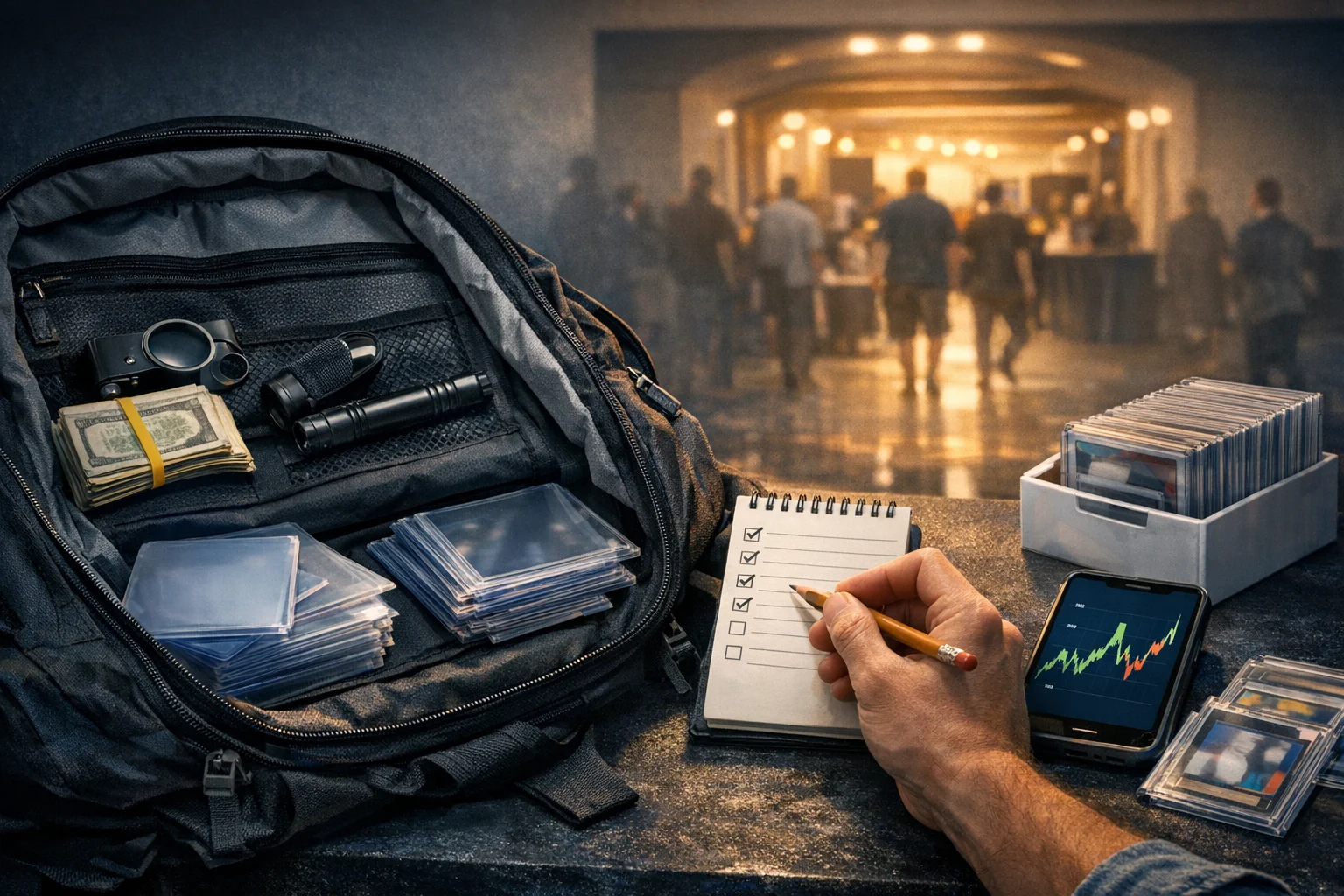
Illustration generated for this guide; not a photograph of an actual card, product or event.
Photo Gallery