“Marvel Masterpieces” is not one fixed set. It is a product lineage whose name has covered painted base cards, multi-artist follow-ups, premium inserts, sketches, printing plates, buybacks, and later returns to earlier imagery. For a collector considering an acquisition, the first task is therefore identification: determine exactly which release and which object category the lot contains before judging completeness or condition.
Start with the 1992 SkyBox release
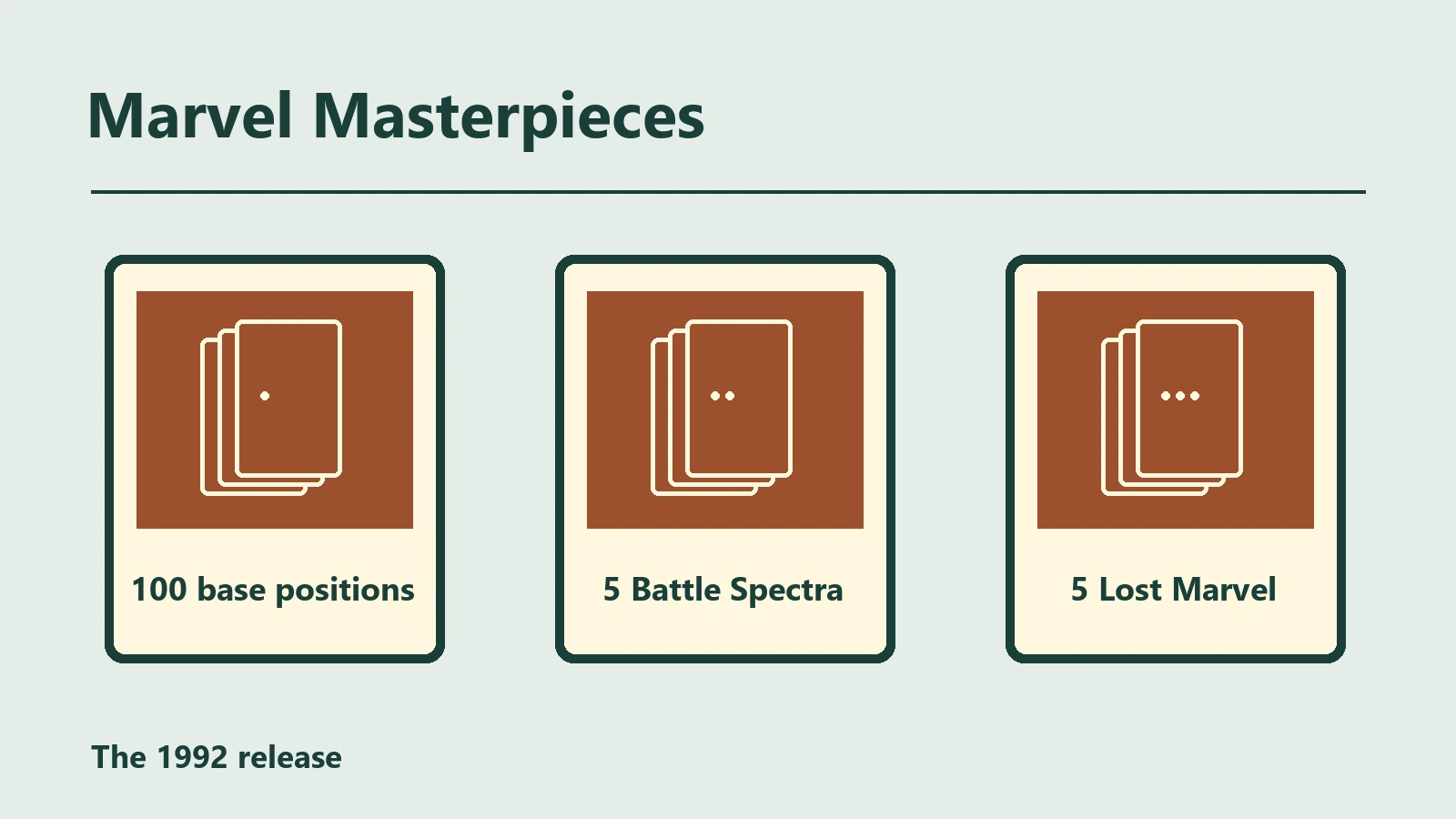
The 1992 SkyBox Marvel Masterpieces product is the key reference point. Collector checklist records identify a 100-card base set credited to Joe Jusko, with card 100 serving as the checklist. The same references identify five Battle Spectra cards and five Lost Marvel cards, the latter associated with a factory tin. Dealer prototypes and promotional cards create additional layers beyond the numbered base sequence.
That distinction matters when a seller describes a “complete set.” Ask whether the phrase means the 100-card base run only, the base cards plus Battle Spectra and Lost Marvel, or a broader master set that includes promotional and prototype material. Photograph the lot as received, then create an inventory by card number and subset. Do not rely on a box label or a seller’s title alone.
Joe Jusko’s name is central to identifying the 1992 program, but a printed card is still a reproduction of artwork, not the original painting. A card can document the image’s use in the set; it does not, by itself, establish where the physical painting is today. When examining a 1992 lot, record card numbers, surface condition, centering, foil wear, corner damage, and any evidence of trimming or alteration. Card-level conclusions about cropping, color separation, or reverse-side design should be based on identified examples or high-resolution scans, not assumptions about the production process.
The name continued, but the visual system changed
The Smithsonian’s Ronald S. Korda Collection independently documents SkyBox Marvel Masterpieces products from 1992 and 1993, as well as Fleer’s 1994 Hildebrandt Brothers Marvel Masterpieces. These entries are useful evidence that the releases existed as collected objects, while checklist references help identify their contents. The 1993 product should not automatically be treated as another Jusko-only set; it represents a successor structure with a broader artist identity.
The 1994 product is likewise a distinct release, associated with the Hildebrandt Brothers. In 1995, checklist references describe a 151-card Fleer base set with E-Motion Signature parallels, 22 Canvas cards, eight Holoflash cards, two Mirage lenticular cards, and a four-card Wolverine promotional panel. Because the retrieved evidence for 1995 is checklist-based rather than a verified Fleer sell sheet, treat those details as identification aids and preserve scans of the actual cards and packaging in your purchase file.
Checklist references describe the 1996 Fleer/SkyBox set as a 100-card series credited to Boris Vallejo and Julie Bell, with Double Impact, Gallery, oversized Masterprints, and nine original-art redemption cards. The wording “original art” requires care. A redemption card may promise access to physical artwork, but the checklist does not prove that a particular redemption was fulfilled, delivered, retained, or still survives. Request a redemption record or chain of custody before treating such an object as documented original art.
Account for the 2007–2008 continuation
Upper Deck also issued Marvel Masterpieces products in 2007 and 2008. Surviving collector-maintained checklist records establish those releases as part of the lineage, but the available evidence does not support detailed claims here about their artist rosters, print quantities, or insertion rates. In a lot containing these years, photograph wrappers, boxes, and checklist cards before assigning a configuration. Do not describe 2016 as the first post-1990s return.
What changed in the Upper Deck revival?
The 2016 Upper Deck release introduced a more elaborate chase ecosystem, including serial-numbered cards, 1992 stamped buybacks, Holofoil and Gallery parallels, lenticular cards, autograph material, sketch cards, and uncut-sheet redemptions. Manufacturer sell-sheet language and artist material identify sketch-card participation, but published odds are declared insertion rates, not guarantees about the distribution of particular artists in a box or case.
The 2018 product was presented by Upper Deck as a Simone Bianchi program. Its sell sheet advertised more than 135 original pieces of artwork and described original-art sketches, layouts, and redemptions. The checklist contains 100 numbered base-program entries: cards 1–90 are the principal base tiers, while cards 91–100 form the ten-card Canvas Gallery subset. This is not a 100-card Canvas Gallery.
The 2020 checklist further separates object types. It lists printed Preliminary Art cards, Preliminary Art Originals by Dave Palumbo as redemption cards, and Dave Palumbo Sketch Comic Covers marked “Original Art” and planned for hobby and e-Pack redemptions. These categories should be recorded separately in a lot inventory. A printed preliminary-art card is not the same object as a redeemed original.
Inspecting 2023 XL and 2024 ’92 Platinum
Marvel Masterpieces XL changes the presentation through oversized cards and includes base, Gold Foil, Epic Purple, Red Foil Canvas High Series, Silver Spectrum, What If, printing plates, Battle Spectrum, and Battle Spectrum Gems. Check the exact configuration against the official product checklist and note whether the lot is hobby, retail, or another stated format.
Upper Deck marketed 2024 Masterpieces ’92 Platinum as a way to rediscover the original artwork of the 1992 set. That establishes the advertised relationship to the earlier image library; it does not prove that cards were scanned from surviving paintings or that the original printing process was recreated. For a useful visual overview of the lineage, see the collecting guide to Marvel Masterpieces, then verify every lot against physical evidence.
Build a defensible purchase record
Before committing to a lot, photograph every card group, wrapper, tin, redemption, autograph, sketch, plate, and promotional item. Record set year, card number, subset, serial number, stated condition, visible defects, and the seller’s description. Save screenshots of the listing and write down which claims remain unverified. The most reliable acquisition is not necessarily the largest lot; it is the one whose objects, categories, and provenance you can clearly document.