Picture two listings for the same NFL player. One shows a gold-patterned card stamped 07/25; the other calls an unnumbered insert a tougher pull. Which is rarer? The first listing gives you a count for one edition. The second makes a claim about what comes out of packs. Until you know exactly what each seller is counting, the claims aren’t comparable.
Start by identifying the card, then decide what you actually want to know: how many were numbered, how often the card appears in packs, how many a grading company has recorded, or how easily you can buy one. Each question calls for different evidence.
Identify the card before you count it
Start with the main checklist. A base card belongs to that list; a parallel is another version of a checklist card, often distinguished by color, foil or a surface pattern. An insert belongs to a separate themed subset. Those terms can overlap: a gold version of a themed insert can be both an insert and a parallel. Meanwhile, a manufacturer may list a visual change as a variation rather than a parallel. None of those labels, on its own, tells you how many copies exist.
The 2025 Topps Chrome Football checklist shows why the distinction matters. Topps lists a 400-card base set, puts Team Camo and Lightboard Logo under base variations, and identifies Kaiju and Radiating Rookies as inserts. If you’re trying to identify a Radiating Rookies card, looking only through the base list can send you toward the wrong match. And if a listing describes a card as a color parallel but Topps files it as a variation, use the manufacturer’s wording when you search for another copy.
Ask for front and back photos when a listing leaves room for doubt. Record the player, product year, set, card number and exact version. Treat the year printed in the product name as part of its identity, not necessarily its release date: 2025 Topps Chrome Football arrived on April 15, 2026. If you search only by the calendar year it went on sale, you may start with the wrong checklist.
Read the denominator, then name the edition
On a card stamped 07/25, the 07 identifies the numbered copy and the 25 gives you the size of that numbered edition. The edition is the exact issue, not all the cards featuring that player or even all the versions of the same checklist entry. On a listing, the useful description isn’t just ‘numbered to 25.’ It’s the full card name with ‘numbered to 25’ attached. A clear photo of the stamp and a matching manufacturer listing give you two ways to check whether that description holds up.
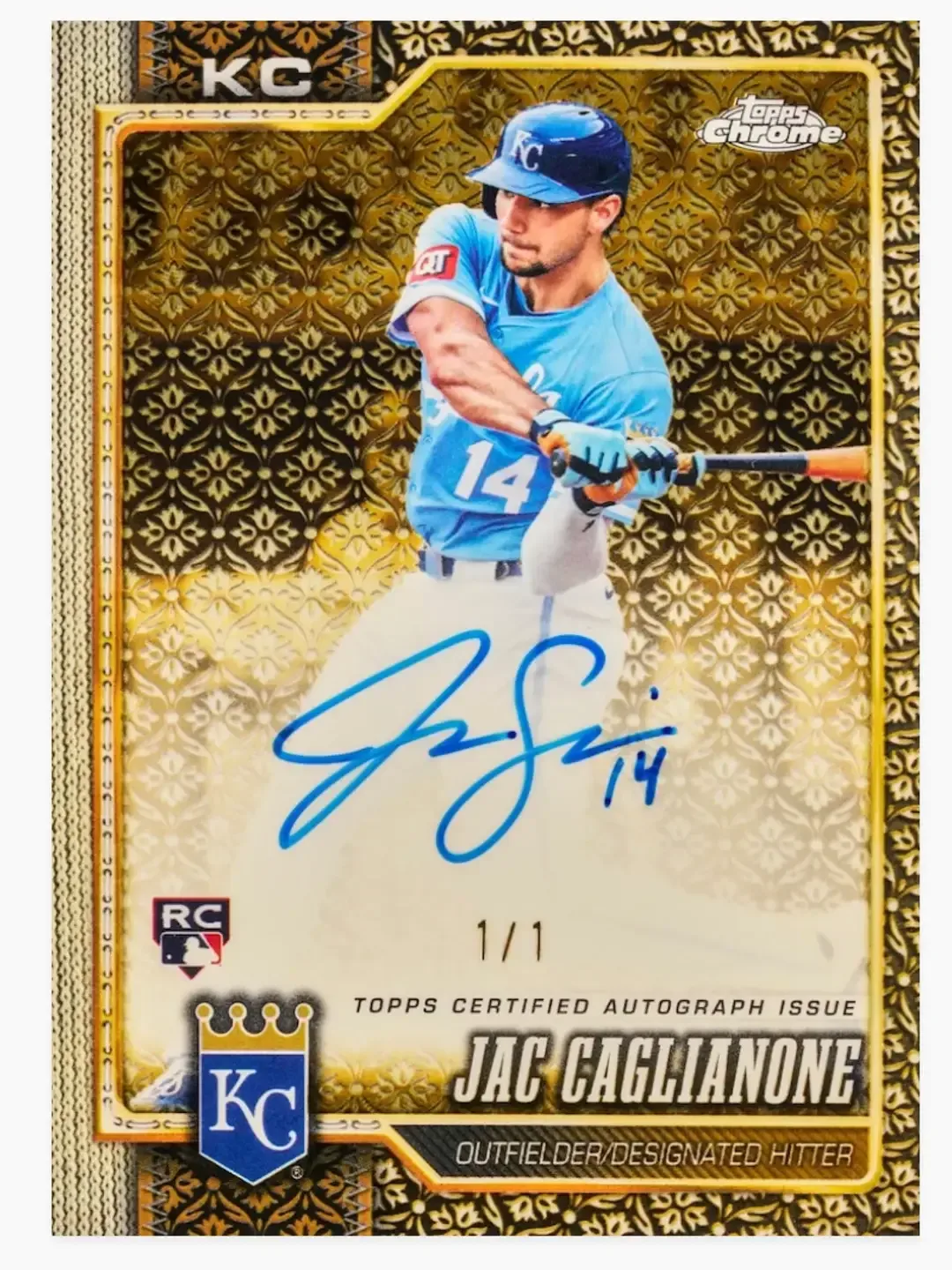
Even a 1/1 needs a full name. Fanatics announced both one-of-one Rookie PREM1ERE Patch Autographs and one-of-one NFL Honors Gold Shield Autographs for 2025 Topps Chrome Football. The stamp means one of that exact issue; it doesn’t mean the release has only one one-of-one, or that other cards with a similar description don’t exist. If you’re comparing sales, ‘Topps Chrome 1/1’ leaves out the information you need to tell whether two cards are comparable.
The numerator can still matter to you. Suppose the player wears No. 7 and you’re choosing between 07/25 and 25/25. You might prefer the jersey match, or you might like owning the last number in the run. That’s a reason to choose one copy, not a reason to describe either edition as smaller. Decide how much the specific stamp means to you before comparing asking prices.
Don’t carry a color’s print run from one set to another
Panini’s announcement for its 2024 NFL Prizm customer-service Sparkle packs gives you a concrete example of why the full name matters. Panini listed Blue Sparkle at /96, Gold Sparkle at /24 and Green Sparkle at /8, alongside an unnumbered Red Sparkle. In that group, Green Sparkle has a smaller disclosed edition than Gold Sparkle. What the announcement doesn’t give you is a rule that a green Prizm card is always numbered to eight or a gold one is always numbered to 24.
Imagine a seller titles a listing ‘Gold Prizm /24,’ but the photo mainly shows a gold reflection. Before treating it as Gold Sparkle, ask for a photo that shows the surface pattern and another that makes the serial stamp legible. Then check whether the year and exact parallel name match Panini’s description. Color is a useful clue for narrowing a search, but it can’t substitute for the pattern, stamp and product details.
Treat the Red Sparkle differently. Panini identifies it as unnumbered, and the announcement does not disclose a count that lets you rank it against Green Sparkle /8. ‘Undisclosed’ doesn’t mean common, and it doesn’t mean secretly scarcer. If you prefer the red design, that’s a perfectly good reason to buy it. If a seller wants a premium specifically because it’s supposedly scarcer than the green, ask what supports the comparison.
Use pack odds for pull difficulty, not production totals
When a listing says ‘tough pull,’ ask which packs and which cards the odds describe. The 2025 Topps Chrome Football hobby product page links its odds sheet separately from its checklist. The checklist helps you name the issue; the odds sheet is where you look for the frequency of the relevant category in the relevant format. If someone cites hobby odds, don’t apply them to another format without checking that format’s own figures.
Take a hypothetical odds line of 1:100 packs for a named insert set. That describes an average frequency for the stated category. It doesn’t guarantee one insert if you open 100 packs, and it doesn’t tell you the odds of pulling a specific player from that set. It also doesn’t imply that 100 copies exist. Before quoting a figure, check whether the row covers the whole insert set, a particular parallel of that insert, or the individual card you’re after.
This distinction matters when you’re deciding between opening packs and buying a single. If what you want is the experience of opening the product, category odds give you some context for the chase. If what you want is a particular player’s card, don’t use the category odds as a cost estimate for finding that player. Compare the cost of the available single with what you’re comfortable spending on packs that might never produce it.
Make ‘short print’ earn its place in the listing
A seller can use ‘short print’ to mean a manufacturer-designated card, a card with long published odds or simply one the seller doesn’t see often. Ask what the term means in that listing. A manufacturer disclosure can establish how the maker describes a version even if it doesn’t supply a count. Published odds can show that a category appears infrequently in a specified format. Neither gives you permission to invent an edition size.
Suppose you’re choosing between an unnumbered insert advertised as a short print and a numbered parallel of a base card. Look up the insert by its exact name. If you find a manufacturer description calling it limited but no figure, write down ‘count undisclosed.’ If you find odds for the insert group, record the group and pack format. If all you find is the seller’s claim, leave it unverified. The numbered parallel has a known edition size; the insert might have the design you want or a better documented claim to being a tough pull. You don’t need to manufacture a print-run ranking to choose between them.
Read ‘pop 1’ as a grading claim
A ‘pop 1’ headline is incomplete without the grading company, the exact variety, the grade and the date checked. ‘PSA 10 population of one’ tells you that PSA records one example under that entry at that grade when you look it up. It doesn’t count raw copies, copies graded elsewhere or copies in other PSA grades. PSA also warns that it recognized some varieties after earlier examples had already been graded, so the exact variety entry may not capture all earlier grading activity.
If a hypothetical listing says ‘/25, pop 1,’ verify those claims separately. Read the stamp and match it to the maker’s description, then search PSA using the product, card number, player and variety on the label. Check that the population figure is for the grade in the listing, not a neighboring row for a similarly named parallel. If the match is uncertain, don’t pay extra on the assumption that the relevant count is one. And if the numbers do match, describe what you found accurately: a card from a numbered edition of 25 with one example recorded by that grader in that grade at the time you checked.
Separate availability from the edition size
If you’re buying this week, the practical question may be whether a copy you want is available at a price you’ll pay. The serial stamp can’t tell you that. In a hypothetical search for a /25, you might find three active listings but notice that two show the same serial number. Don’t automatically count those two listings as two distinct copies. By the same token, finding no active listings doesn’t reduce the numbered edition to zero. It tells you what your search turned up at that moment.
Search with the full checklist name first, then try a shorter version with the card number and parallel name in case a seller left out part of the title. If you find sales, check the photos and descriptions before using them as price comparisons. A raw copy, a graded copy and a different parallel can all show up in the same search, but they aren’t interchangeable. If you can’t find an exact match, a nearby version may help you decide what else you’d be happy to own; it’s not proof of what the target card should cost. Waiting is a reasonable choice when the only available copy is priced above your limit.
Verify logos and autographs separately
As of November 25, 2026, the licensing announcement to know for this example is dated April 2, 2026: Fanatics, the NFL and the NFLPA announced Topps’ return as the exclusive trading-card licensee of the NFL and NFLPA, with the first product arriving April 15. The NFL side concerns league and team branding; the NFLPA side concerns group player licensing. Neither tells you whether a specific card is signed or whether the player’s individual autograph rights are exclusive. Fanatics named select exclusive athletes, but the announcement does not establish terms for every player.
If a seller describes a card as a ‘licensed rookie auto /25,’ treat that as several claims, not one. Identify the product and card, find the autograph entry on the checklist and confirm that the stamp belongs to that exact signed version. If you care about the team marks, check the card images as well. For older products, use documentation tied to the release in question: Panini’s May 2025 Sparkle announcement describes those packs, not the licensing status of later releases. Licensing helps you understand what you’re buying; it doesn’t tell you how rare the card is.
Decide which kind of scarcity is worth paying for
Go back to those two listings: the card stamped 07/25 and the unnumbered insert advertised as the tougher pull. If your goal is a player collection built around explicitly numbered editions, the first card meets that requirement once you verify its identity. If you’re building the themed insert set, the second may be the one you’re missing, no matter how many copies were made. And if your goal is a specific grade, look at the grading record for that exact card instead of assuming the smaller edition will be harder to find in the grade you want.
Before making an offer, try writing two sentences. The first should say what you can verify: ‘This is the manufacturer-listed parallel numbered to 25,’ or ‘These are the published hobby odds for the insert category, and the edition size is undisclosed.’ The second should say why you want that copy: the design, the number, the grade or a space it fills in your collection. If you can write the second sentence but not the first, you can still buy a card you like. Just don’t pay extra for a scarcity claim you couldn’t verify.
Illustration generated for this guide; not a photograph of an actual card, product or event.
Photo Gallery