For a collector considering a Marvel Universe Series IV acquisition, the first task is not counting cards. It is identifying what kind of object is in front of you. The release commonly identified as 1993 SkyBox Marvel Universe Series IV combines a 180-card base checklist with page-building artwork, a Marvel 2099 foil insert set, a Spider-Man hologram, and several peripheral items that can easily be misfiled as part of the main set.
The Smithsonian’s Korda Collection finding aid places SkyBox Marvel Universe material in 1993 and distinguishes it from the 1992 Series III release. That is useful chronological evidence, but a collector should still verify the cards, backs, wrapper, box, or production object in the lot. For a broader checklist and visual orientation, the collector reference for Marvel Universe Series IV can be used alongside direct inspection rather than as a substitute for it.
Start with the 180-card base structure
The defensible base-set structure is cards 1–135, followed by nine Unsolved Mysteries cards numbered 136–144, 35 Famous Battles cards numbered 145–179, and checklist card 180. This numbering is the most useful first test when examining a mixed lot. A seller’s phrase such as “complete set” should be clarified: it may mean the 180 numbered base cards, or it may include inserts and promotional material.
Check both fronts and backs for numbering, titles, subset labels, and surface condition. Do not rely on a handwritten inventory or database export alone. Collector checklists can contain transcription differences, and card 133 is described in checklist sources as “Die-Cut,” making physical inspection especially important. Photograph the front and back of any unusual card before assigning it to a chase or variant category.
The nine-card pages are base cards, not puzzle inserts
Cards 1–135 are arranged in fifteen sequential groups of nine: 1–9, 10–18, and so on through 127–135. Each group is designed to form a three-by-three image when placed in numerical order. This is the central object-identification feature of Series IV.
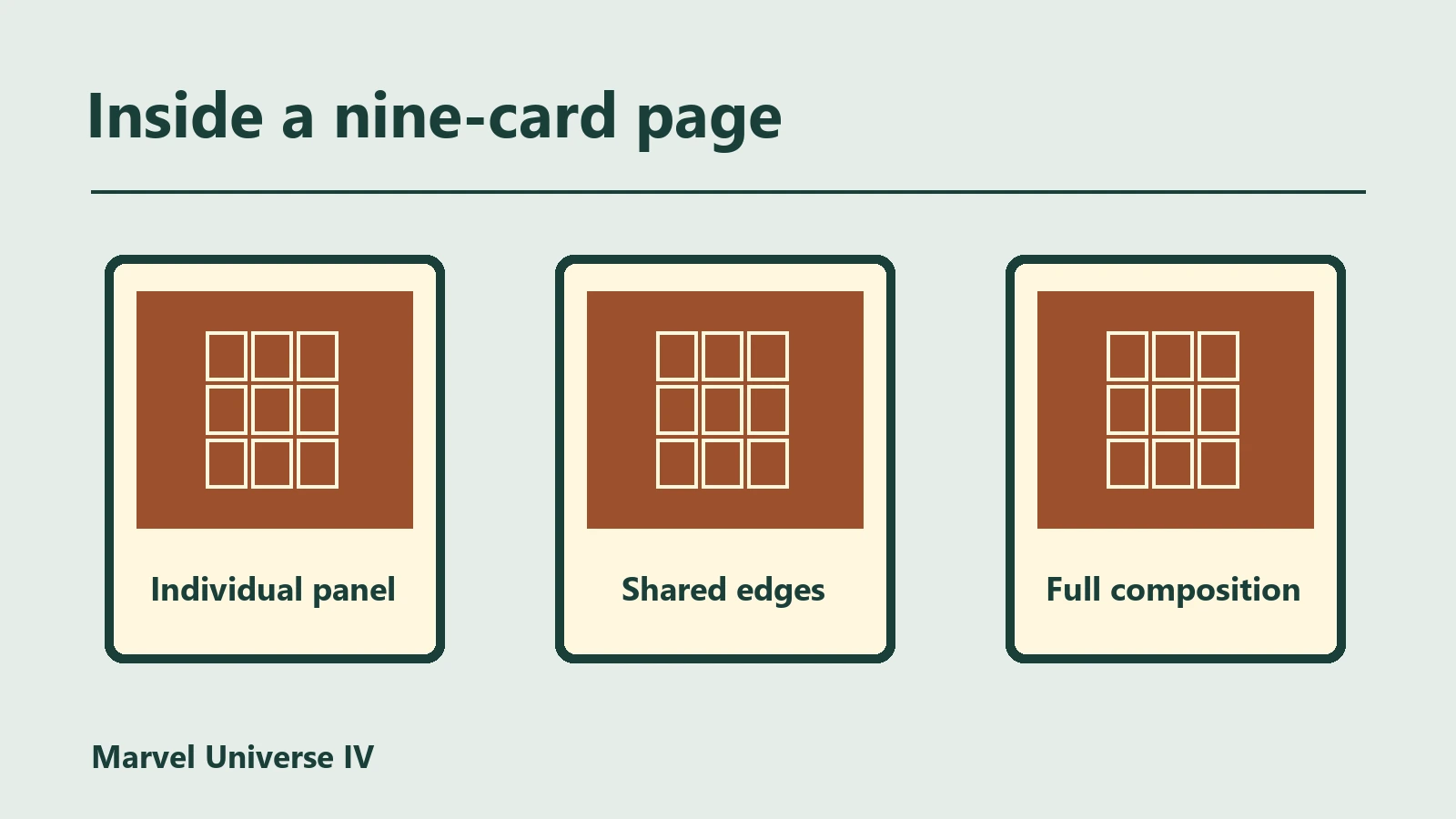
When inspecting a lot, lay each group on a clean surface in a three-by-three grid. Look for continuous backgrounds, repeated borders, connected figures, and artwork that crosses card edges. A binder page can reveal the intended composition more clearly than a loose stack. The nine-card construction does not make these cards a separately numbered insert. They remain part of the base run, so a lot containing one or two cards from each page is not a complete page set.
Surviving production material supports the page concept without proving every detail of every layout. A Heritage Auctions catalog describes a 90-card Series IV uncut sheet as a press-proof or production artifact. Separate original-art listings identify particular nine-card boards, including cards 55–63 attributed to Ron Lim and Terry Austin by ComicLink, and another board attributed to Tom Morgan by Panel Page Art. These are object-specific attributions, not evidence that one artist created all 135 page cards.
Keep the two numbered subsets separate
Cards 136–144 form Unsolved Mysteries. Their subjects include Wolverine’s origin, Cable’s origin, Darkhawk’s face, Ghost Rider’s origin, the fate of the X-Men, Doctor Doom’s face, the sixth Infinity Watch member, Spider-Man’s parents, and Nightcrawler’s origin. Examine the printed question or title on the front and the explanatory text on the back. These cards present period story questions; do not silently update them with later Marvel continuity.
Cards 145–179 form Famous Battles. They should not be treated as a second page-building system. The subset includes individual confrontations and broader event references such as Infinity War, X-Cutioner’s Song, and Spirits of Venom. Preserve the printed wording when documenting a purchase, even if a modern checklist uses a different character name or matchup.
Identify the principal inserts by physical evidence
The principal foil insert is a nine-card red-foil Marvel 2099 lineup: Doom 2099, Vulture 2099, Ravage 2099, Fearmaster, Spider-Man 2099, Punisher 2099, Specialist, Dethstryk, and Tiger Wylde. These are not part of the 180-card base checklist. Record any numbering printed on the backs, since collector databases do not always use the same prefix or naming convention.
Series IV also included a Spider-Man 3-D hologram commonly identified as H-IV Spider-Man versus Venom. Inspect the holographic effect under controlled light and photograph the reverse. Collector records describe several observed background or color appearances, but those descriptions should not automatically be treated as official parallel names. Surface scratches, handling marks, and lighting can make apparent color differences difficult to classify.
Separate promos, samples, and panels from a normal set
Mixed lots may contain a Deathlok promo marked “0,” an unnumbered Silver Sable promo, blank-backed red-foil samples with production-sample stickers, or promotional panels displaying Marvel 2099 images. These objects should be cataloged separately from the base cards and nine-card insert set.
Collector documentation reports three promotional panels, each showing a three-card grouping from the nine-card Marvel 2099 lineup. They should not be described as three complete nine-card panels, nor should the reported quantity or conference distribution be treated as manufacturer-confirmed without an original panel reverse, handout, or contemporary company document.
Document the acquisition decision
Before purchase, photograph the complete lot as received, then make a numbered inventory. Note missing base cards, page groups, foil cards, holograms, promos, samples, and panels in separate columns. Record whether cards are loose, sleeved, binder-mounted, or sealed, and flag trimming, adhesive residue, curling, foil scratches, hologram scuffing, and inconsistent backs.
Finally, write down what is confirmed and what is only reported. A strong acquisition record might state: “180-card base checklist verified,” “nine-card pages checked for groups 1–9 through 127–135,” “red-foil 2099 cards present,” or “artist attribution supported only for identified production art.” That precision protects the collector from paying for an assumed complete set when the lot is actually a mixture of base cards, inserts, and interesting but separate production material.