Precious Metal Gems are easy to recognize in conversation and surprisingly easy to misidentify in a mixed Marvel lot. “PMG” can describe a documented parallel, but a metallic finish, a Metal design, or a one-of-one marking does not by itself establish a card’s product family. For an acquisition at OTIA, begin with the printed year, set name, subset or prefix, card number, character, color, and serial limit. Then compare those details with a checklist record.
The most useful distinction is between Fleer Retro Marvel releases and later Marvel products that continued the PMG idea under different brands. The core Fleer Retro chronology is 2013 and 2015. The 2017 Fleer Ultra Spider-Man and 2018 Fleer Ultra X-Men issues are relevant comparison points, not additional Fleer Retro Marvel years. Later Metal Universe and Skybox Metal Universe products belong to still different families. For a broader checklist framework, see the year-by-year PMG feature.
2013: the first checkpoint in this product lineage
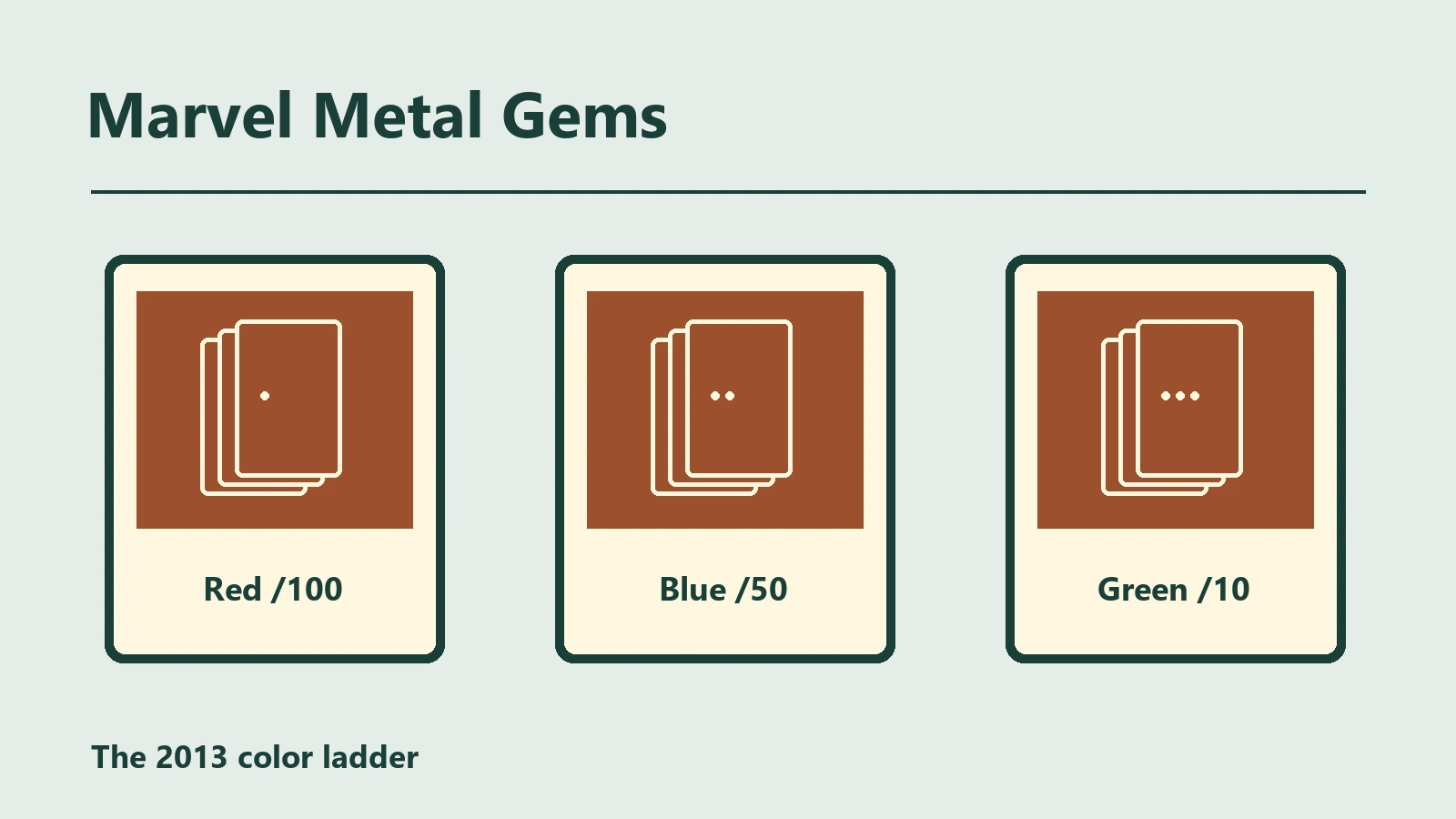
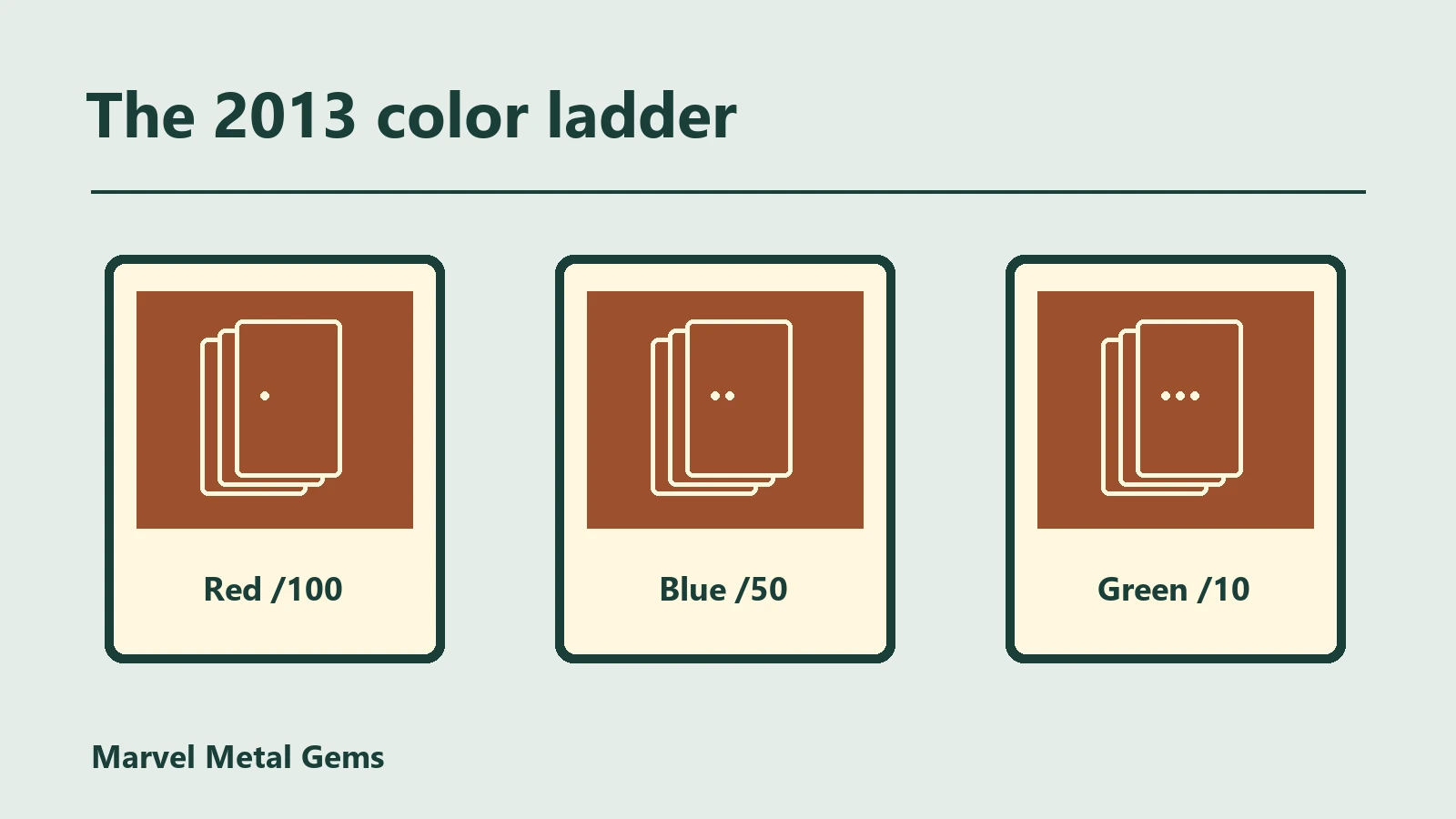
Available research records identify 2013 Marvel Fleer Retro as an early documented modern Marvel PMG release in this lineage. The Metal insert is recorded as a 42-card sequence, with the same character order used for the Red, Blue, and Green versions. The available checklist records list Red to /100, Blue to /50, and Green to /10. Those figures describe the card’s stated serial ceiling; they do not prove that every number was manufactured, distributed, or still exists.
The 2013 roster begins with Mr. Fantastic, Invisible Woman, Thing, Human Torch, and Spider-Man. It continues through characters including Domino, Iron Man, Captain America, Ms. Marvel, Emma Frost, Psylocke, Nova, Silver Surfer, Deadpool, Phoenix, Doctor Doom, Thanos, Mystique, Apocalypse, and Galactus. This is not formally a “Spider-Man and Avengers” checklist. That phrase is collector shorthand for a roster spanning Fantastic Four, Avengers-associated heroes, X-Men, cosmic characters, street-level characters, and villains.
For evidence control, treat the exact 2013 roster as a secondary checklist transcription unless an original Upper Deck checklist, sell sheet, or authenticated manufacturer scan is available. The current accessible research does not provide a primary Upper Deck checklist for this historical release. A Gold 1/1 tier should not be added to a 2013 catalog entry merely because a database or marketplace description mentions it.
2015: a second Fleer Retro PMG program
The 2015 release again records a 42-card PMG checklist, this time based on the 1995 Metal Blaster-derived character lineup. It is a modern 2015 card, not an original 1995 PMG. The available checklist transcription begins Ant-Man, Black Panther, Apocalypse, Black Widow, and Captain America, and ends Storm, Thor, Ultron, Vision, Wolverine, and Venom. Vision’s position matters when checking a lot against a checklist, because abbreviated online lists sometimes omit him or misplace the final sequence.
The color evidence needs special care. A product summary identifies Red, Blue, and Green parallels, while the accessible checklist record additionally lists Gold 1/1. Report this as a documentation conflict rather than silently treating all four tiers as equally established. The safest catalog language is: Red /100, Blue /50, and Green /10 are recorded in the available product and checklist evidence; Gold 1/1 appears in the secondary checklist record but is not consistently reflected in the accessible product summary. Do not describe Gold as definitely pack-inserted without stronger primary documentation.
2017 and 2018: useful boundaries, not Fleer Retro years
2017 Fleer Ultra Spider-Man is a separate product. Its Marvel Metal checklist is recorded as MM1–MM50, with MM0 associated with an e-Pack achievement. The reported PMG tiers are Bronze /199, Red /99, Blue /49, Green /10, Purple /5, and Gold 1/1. These details should be rechecked against the cited checklist record before publication or purchase attribution; they are not evidence that the product belongs in the 2013–2015 Fleer Retro set.
2018 Fleer Ultra X-Men is another adjacent release. Its Metal Blasters/PMG checklist is recorded as MB1–MB49, with Bronze /199, Red /99, Blue /49, Green /25, Purple /10, and Gold 1/1. The different Green and Purple limits demonstrate why color names cannot establish scarcity across products. Confirm the prefix and product title before treating a card as a Fleer Retro Marvel PMG.
How to inspect an OTIA lot
Start with a written inventory rather than a visual impression. Record each card’s front and back, card number, character, color, serial number, and any e-Pack or achievement notation. Photograph the complete card, then take close images of the numbering, surface, corners, edges, and back text. Keep the file name tied to the lot number and card position so your notes remain auditable.
Check whether the observed character matches the correct year’s sequence. A 2013 Galactus should not be cataloged from a 2015 roster, and a 2017 MM prefix should not be entered as a 2013 or 2015 PMG. Compare the printed serial format with the documented limit, but do not infer a total print run from the limit alone. Note missing cards, duplicate serials, inconsistent fonts, suspiciously clean edges, surface scratches, color variation, and any mismatch between the card and its stated product.
Finally, separate condition observations from authenticity conclusions. Photographs and visible defects can document corners, edges, surface wear, or possible alteration, but they cannot authenticate a card or prove trimming. If a high-value or unusual card has an uncertain stock, numbering style, altered edge, or disputed Gold designation, record the uncertainty and seek specialist review rather than presenting a marketplace description as proof. A disciplined purchase file should show what was identified, which source supported it, what remained unresolved, and why the card was or was not included in the acquisition.