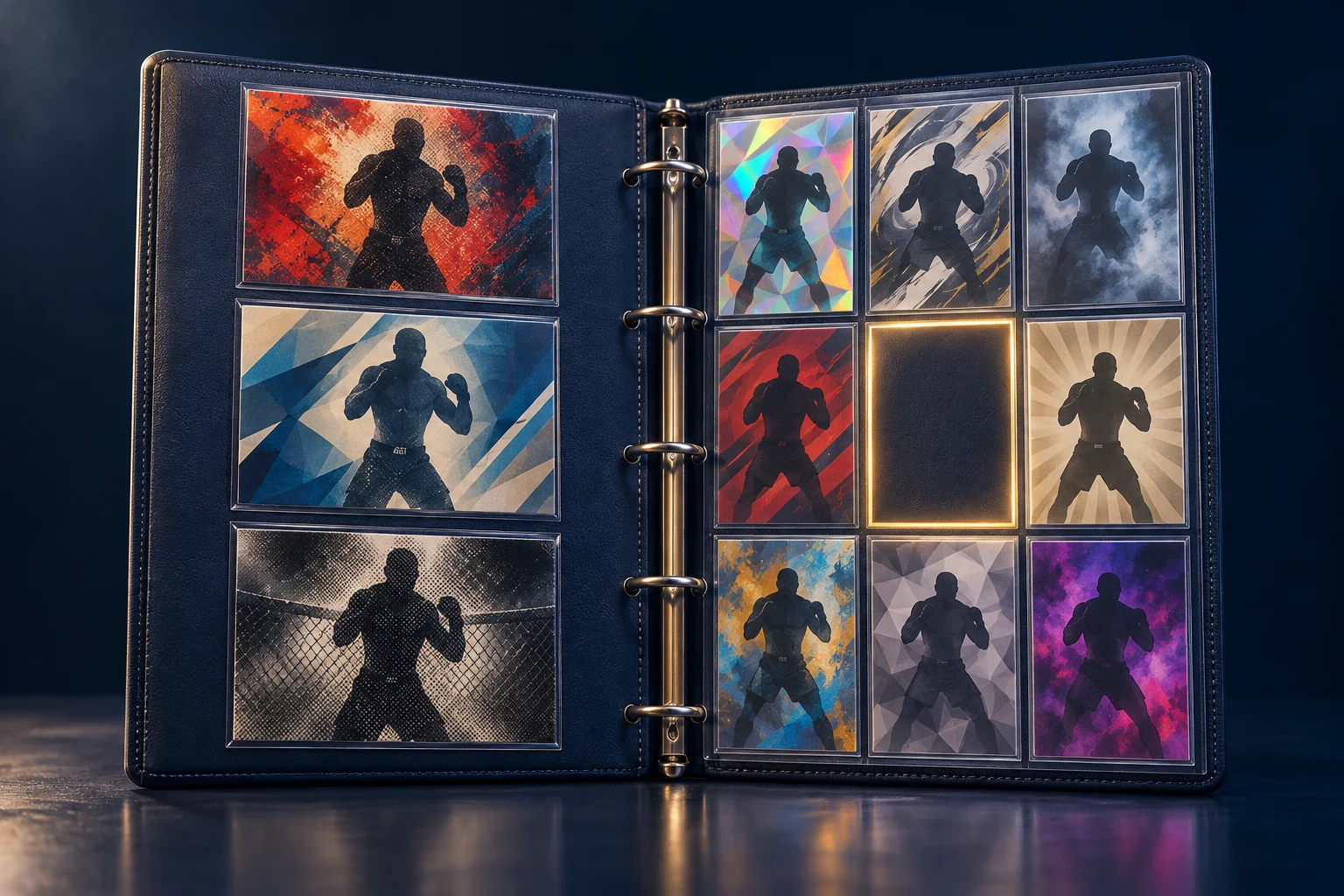
Picture two cards at the same price. One is another version of your favorite UFC fighter, in a design you already own. The other features someone you don’t follow, but it fills the last empty pocket in your binder. Which would you rather take home?
A fighter collection lets you decide which cards tell the story you want. A base set gives you a finish line you can count. Both are satisfying for different reasons, and the distinction matters most when the easy purchases are behind you.
Decide What Counts Before You Shop
Write a one-sentence rule for either project. For a fighter collection, it could be: “I want six cards of one fighter across three releases, with no repeated images.” For a base set: “I want one standard base card of every number from this release, with no parallel substitutions.” The first rule leaves room to choose between cards you like. The second makes the buying decision more objective: either a card fills an empty slot or it doesn’t.
Imagine finding an inexpensive card of your favorite fighter that uses the same photo as two cards you own. Under your fighter rule, you can walk away even if the price is tempting. Now imagine finding a fighter you barely recognize on the checklist for your set. If that number is missing, it still matters. If the first choice feels freeing, start with a fighter. If the second feels like solving a puzzle rather than doing a chore, you’re likely to enjoy a base build.
Give a Fighter Collection a Point of View
Try picking the binder page you want to look at before picking the rarest card you can afford. An Alex Pereira page could begin with his 2024 Topps Gold Label UFC Class 1 base card, listed at No. 2 on the Topps checklist. You could then look for cards from other releases that offer a different image or a design you prefer. The Class 1 label belongs on your want list: “Gold Label Pereira” alone doesn’t tell you which version a seller is offering.
If you’d like a signature as the centerpiece, UFC’s 2024 Topps Chrome write-up names Pereira among the product’s signers. That gives you a release to investigate, not a reason to buy a box in the hope of pulling his card. It doesn’t establish your odds of hitting a Pereira autograph or tell you what a single should cost. Look for the exact autograph subset and version, and compare the seller’s photos with the product information before you buy.
A simple stopping rule is one base card per chosen release, with an autograph as a separate, optional purchase. That lets you finish the page without waiting on one expensive card. If what you really like is seeing the same design in different colors, make that the project instead. A deliberately narrow parallel run is a different goal from documenting a fighter across products, and neither needs to turn into the other.
For a Set, Define Exactly What Goes in the Binder
Topps describes 2026 Topps Chrome UFC as a 200-card base set and lists parallels, inserts and autograph subsets separately. If you choose a standard base build, those 200 base numbers are the job. A flashy insert doesn’t move the count. Neither does a parallel of a missing card unless you decided ahead of time that a parallel could take its place. Substitutions can make for a binder you enjoy more; they just aren’t the same goal as owning all 200 standard base cards.
Start a checklist with three columns: card number, owned and condition issue. Record a card as owned when you receive and inspect it. Put a note next to anything you might replace later, rather than letting condition upgrades get mixed up with actual holes. A binder with 200 numbers and a handful of cards you’d eventually like to upgrade is in a different state from a binder that’s still missing five numbers.
When you’re buying, match the year and release first, then the card number and version. Ask for a clear photo of the back if the listing title is vague or the lot photo doesn’t show enough detail. If a seller calls a lot a “starter set,” ask for the included numbers. That list tells you more about its value to your project than the total card count does.
Shop for Progress, Not for the Biggest Stack
For a base set, compare purchases by delivered cost and the number of acceptable missing cards each one fills. In a hypothetical example, a $20 lot that fills five holes costs you $4 per useful card if you assign no value to the duplicates. A $12 order that fills those same five holes costs $2.40 per useful card. But if the lot fills ten holes, the math changes. You don’t have to assume the extras are worthless; just don’t count on trading or selling them to make an otherwise poor purchase work.
A fighter collection calls for a different comparison. Suppose you can buy five inexpensive cards of your fighter or spend the same amount on one card with a design you’ve wanted from the start. If only one of the five would make the binder, the bundle isn’t automatically the better buy. Try sorting your want list into cards that belong in the project, cards you’d consider at the right price and cards you can skip. A seller’s bundle shouldn’t determine what belongs on the first list.
If opening packs is part of the fun, give it a separate entertainment budget. You can enjoy a box that adds little to either project without pretending it was an efficient way to fill holes or target one signer. Once your remaining list is short, price out the singles or check what you can trade for before spending again. Compare offers you can actually buy, including shipping, rather than deciding that one route is always cheaper.
Keep Rare Versions From Rewriting the Project
Panini’s 2021 UFC Prizm preview listed base parallels down to Black 1/1s and separate numbered autograph parallels. That’s a useful reality check for anyone tempted to write “every version” on a fighter want list. It’s one thing to want a selection of colors and another to make completion depend on finding a particular one-of-one and being willing to meet the seller’s price. A card can be worth watching for without being a requirement.
Set builders can run into a quieter version of the same problem. Say you find a parallel of a missing number and like it enough to buy it. If your rule is standard base only, put it on a display page rather than ticking the number off. If you want to allow substitutions, decide how that rule applies to the whole set. Otherwise it’s easy to end up with a binder you like but a checklist that no longer tells you what you own.
Keep optional purchases visible but separate. On a fighter list, you might give the autograph its own spending limit and reserve the rest for the cards that make up the page. On a set list, you might set aside nothing for parallels until the base run is done. The point isn’t to ban an impulse buy. It’s to know whether making it will delay the part of the project you care about more.
Check the Release, the Fighter and the Signature Separately
A fighter collection can span manufacturers. UFC’s January 31, 2024 announcement says Topps previously partnered with UFC from 2009 through 2020. Panini’s January 2021 announcement named it the exclusive UFC trading-card partner and said the collaboration would launch that April with Prizm. UFC’s January 2024 announcement introduced a new exclusive multi-year agreement with Fanatics Collectibles and gave February 28, 2024 as the retail and hobby release date for Topps Chrome. Those announcements establish partnership and launch milestones, not precise contract expiration dates. The later deal doesn’t change the licensed status of a 2021 Panini Prizm UFC card.
Use that history to orient yourself, then verify the purchase at the card level. Ask three different questions: Was this an officially branded UFC release? Does the exact checklist include my fighter? Is the card in the listing the autograph issue I want? A partnership announcement helps answer the first question. It doesn’t establish blanket signing rights or prove that every fighter in a base set has an autograph in the product.
If an autograph listing is ambiguous, ask for front and back photos and compare them with the relevant subset before paying an autograph price. Apply the same skepticism to a seller’s claim that a card is a fighter’s first. A rookie label on a UFC card doesn’t by itself establish that the fighter never appeared on a card from another promotion. Unless first appearances are part of your project and you can verify the claim, you don’t need it to justify a card you already like.
Try Both Without Funding Two Full Projects
If you’re torn, start with a single fighter page and a numbered base-set want list. Give each a small, separate allowance. Buy a couple of fighter singles you chose for specific reasons, then try filling several set numbers through a lot, singles or a trade. You don’t need to commit to a full 200-card build to find out whether checking off numbers is satisfying. Nor do you need an autograph to learn whether you like seeing one athlete across different releases.
After the first round, pay attention to the next purchase you want to make. Would you rather track down two ordinary base cards to close a gap, or spend the same money on another image of your fighter? Also notice which work you’re willing to do: sorting and cross-checking card numbers, or comparing releases and deciding which versions earn a slot. The work doesn’t disappear near the end; it becomes a larger share of what’s left.
You can keep both projects, but decide which one gets the next dollar before you browse. A fighter page can be finished even if you add to it later. A base set can be complete even if you never touch its inserts. The better next project is the one whose final purchases you’re looking forward to, not just the one with the most exciting first card.
Sources
- www.topps.com - BASE BASE CARDS CLASS 1 1 Merab Dvalishvili 2 Alex
- www.ufc.com
- www.topps.com - Topps Chrome® UFC Hobby Boxes | Official Topps Store
- ripped.topps.com
- blog.paniniamerica.net - Panini America Set to Make Octagon Debut with Power-Packed 2021 UFC Prizm – The Knight's Lance
- jp.ufc.com - UFC And Fanatics Collectibles Announce Exclusive Trading Card Deal | UFC
- blog.paniniamerica.net
Illustration generated for this guide; not a photograph of an actual card, product or event.
Photo Gallery