Derek Jeter remains one of the most collected players of the modern baseball era, but his market has not surged at the same pace as several fellow stars from the 1990s. Over the past year, card indexes tied to names like Ken Griffey Jr., Frank Thomas, Mark McGwire, and Barry Bonds have climbed far more sharply, while Jeter’s index has posted a much smaller gain.
That gap is what makes this part of the market interesting. Jeter is not an overlooked player in any broad sense. He is a Yankees icon, a Hall of Famer, a five-time World Series champion, and one of the most recognizable figures of his generation. But in a hobby environment that has recently rewarded power-driven stars and ultra-flashy late-1990s inserts, some Jeter cards still appear to have more room than the market has fully priced in.
For collectors hunting for strong long-term candidates, the best opportunities are not necessarily the biggest-ticket Jeter cards. Some of his most expensive inserts already trade at elite levels. Instead, the more compelling targets are cards that combine brand importance, true collector appeal, manageable populations, and a price point that still feels accessible compared with comparable stars.
Here are the Top 3 Derek Jeter cards that stand out most right now.
For more collector background, read The Most Iconic and Valuable 1954 Topps Baseball Cards to Know.
Why Jeter’s market still feels behind
Jeter’s resume is secure, but his hobby profile has always been a little different from some of his contemporaries. He was not a massive home run hitter, and he never won a regular-season MVP award. That has allowed a certain debate about his peak to linger longer than it has for some other all-time greats.
At the same time, his value to collectors goes well beyond traditional counting stats. Jeter spent his entire 20-year career with the Yankees, served as team captain, produced year after year, and built a postseason legacy that few players can match. His appeal is tied to consistency, championships, iconic moments, and the scale of his fan base.
That makes the current pricing disconnect worth watching. In a market where late-1990s inserts, rookie-era chromium cards, and scarce PSA populations often drive upside, Jeter has several cards that fit the profile of a breakout candidate without already sitting at the highest tier of his catalog.
For another perspective on this story, read Five Derek Jeter Cards With Room to Gain Attention.
1. 1996 Topps Chrome #80 Derek Jeter PSA 9
If there is one Jeter card that checks the most important hobby boxes at once, this is it. The 1996 Topps Chrome #80 Future Stars card comes from the debut year of Topps Chrome baseball, one of the most important product launches of the modern era. For brand significance alone, it already carries a built-in advantage that many other Jeter cards do not.
Jeter’s 1996 season adds another layer. It was his first year in the majors, he won American League Rookie of the Year, and he also captured a World Series title. Because of that timing, this card remains a key early-career issue with real historical weight in his catalog.
A recent PSA 9 sale landed at $250 on September 2, 2026. In the current market, that number stands out as relatively modest for a player of Jeter’s stature paired with a foundational brand like Topps Chrome. Collectors who are priced out of the Refractor version can still chase the same image and the same first-year Chrome status at a far lower cost.
That affordability matters. When iconic brands become central to hobby nostalgia, standard versions of important cards often get dragged upward by the strength of their premium parallels. Jeter’s Refractor already occupies a much more expensive lane, which naturally creates more interest in the base Chrome card as the accessible entry point.
The comparison point is useful here too. A 1996 Topps Chrome Kobe Bryant PSA 9 recently sold for $5,000. Baseball and basketball do not trade in identical demand environments, and Jeter is not expected to mirror Bryant’s market. Still, it highlights how powerful a legendary player’s first-year Chrome card can become when the hobby fully embraces the card’s place in brand history.
Among the three cards on this list, this may be the cleanest blend of recognizability, hobby importance, and broad collector appeal. It does not need a niche audience to move. It only needs more collectors to decide that an early Jeter from the first Topps Chrome baseball set should not remain this inexpensive.
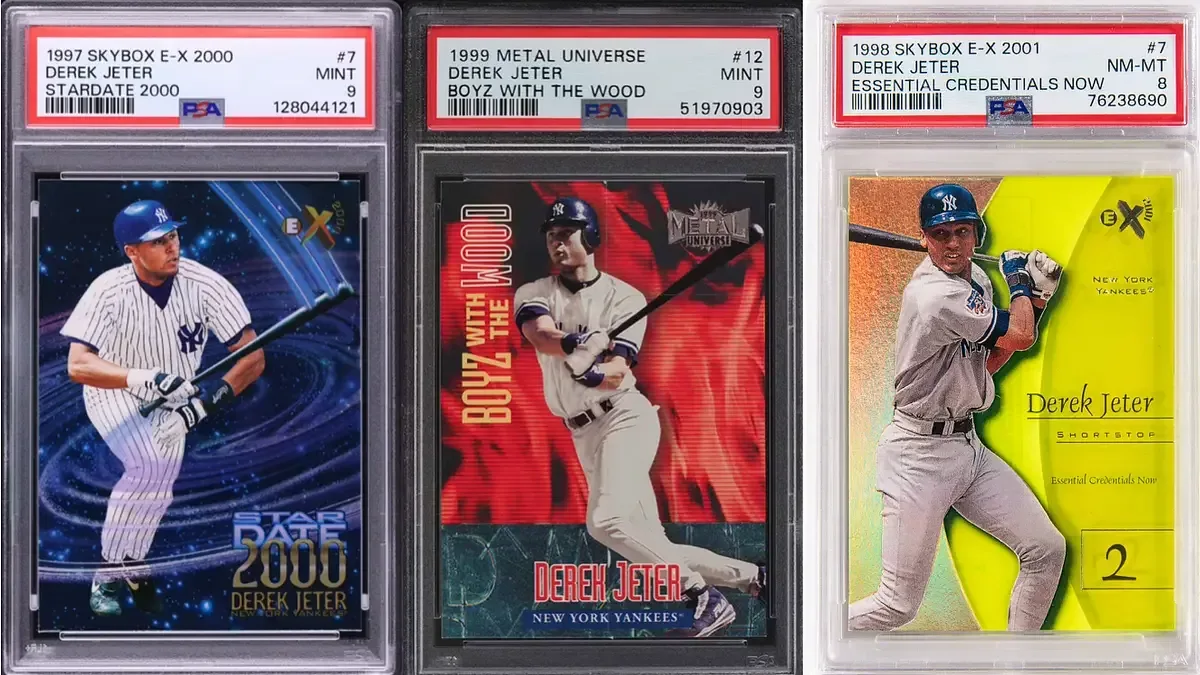
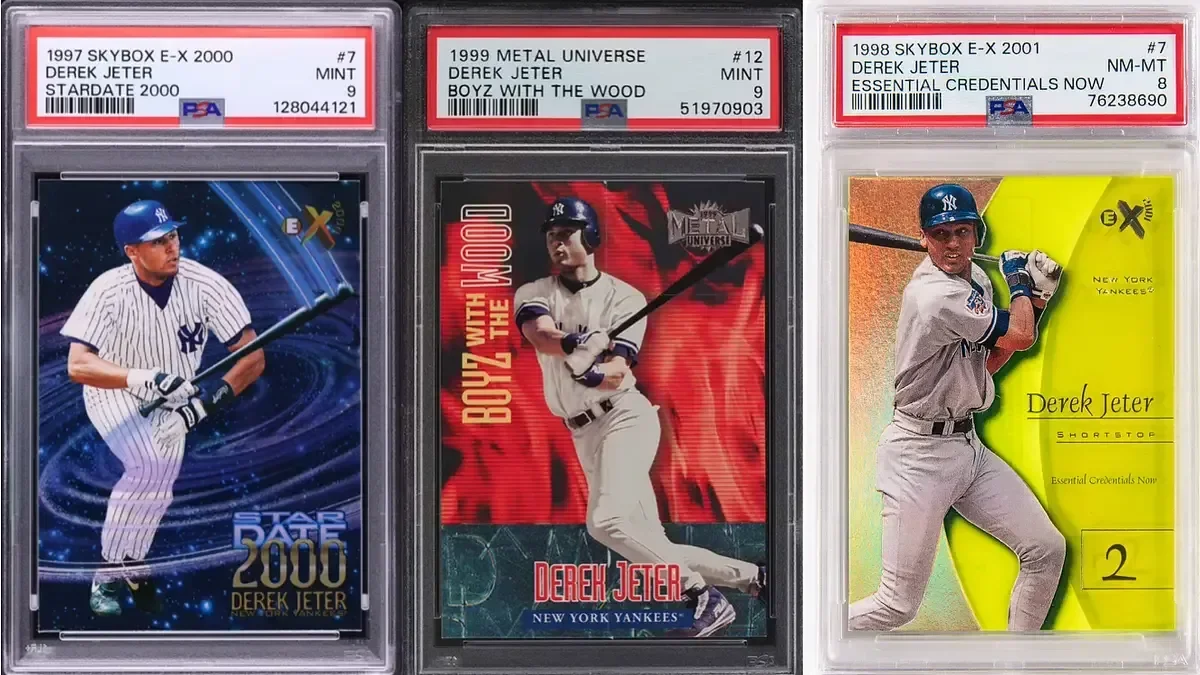
2. 1997 SkyBox E-X2000 Star Date 2000 #7 Derek Jeter PSA 9
The late 1990s produced some of the hobby’s most memorable designs, and Star Date 2000 sits comfortably in that conversation. The 1997 SkyBox E-X2000 insert set featured 15 young stars and fell about one per nine packs, giving it a meaningful level of scarcity without pushing it entirely out of reach.
Jeter’s card from the set combines a futuristic 1990s aesthetic with an early-career version of one of the era’s biggest names. That is exactly the kind of formula that has drawn renewed attention across the hobby, especially as collectors continue to revisit inserts from the period for their visual identity and lower surviving high-grade supply.
Recent PSA 9 sales came in at $200 on August 24, 2026 and $125 on August 14, 2026. That range alone suggests there is still price discovery happening here. When a card has strong design appeal, a notable player, and a relatively thin population, fluctuations like that can sometimes create an opening before a firmer market level is established.
The PSA population numbers support the intrigue. Only 40 copies have been submitted to PSA, with six PSA 10s and 19 PSA 9s. Those are not ultra-massive population figures by any modern standard, and they help separate this card from more common Jeter issues that already have a well-defined market ceiling.
Another reason this card stands out is the balance between scarcity and accessibility. Some of Jeter’s scarcer late-1990s inserts already trade for thousands of dollars, making them difficult for a larger share of collectors to pursue. Star Date 2000 still offers the look and feel of a premium 1990s insert while living at a price point that leaves more room for the market to expand.
There is also a wider hobby trend working in its favor. Collectors have shown they are willing to pay aggressively for standout 1990s designs, especially when those cards belong to all-time names and come with limited high-grade supply. A Jeter card like this sits right in the middle of that demand pattern.
3. 1999 Metal Universe Boyz With the Wood #12BW Derek Jeter PSA 9
Of the three cards on this list, this may be the most unusual. The 1999 Metal Universe Boyz With the Wood insert is not just visually distinctive, it is also one of those late-1990s concepts that feels especially tied to the era. The 15-card insert set was seeded at roughly one in every 18 packs and was designed to change appearance when folded, giving it a gimmick that collectors still remember.
That novelty can matter more than it first appears. The hobby has increasingly rewarded cards that stand out from the standard release structure, particularly colorful inserts with memorable names, odd production ideas, or unmistakable design cues. Boyz With the Wood checks several of those boxes at once.
A recent PSA 9 sale reached $69 on August 18, 2026, which immediately puts this card into bargain territory relative to the level of scarcity involved. PSA has graded only 24 copies total, with one PSA 10 and six PSA 9s. Those are extremely light numbers for a Derek Jeter insert from a heavily collected era.
Population alone does not guarantee growth, but low-pop cards tied to a major star can move quickly when collector attention finally arrives. This is especially true in the 1990s insert category, where aesthetics and nostalgia often drive a sharp re-rating once a card gains visibility.
The internal Jeter comparison is also compelling. A 1998 Metal Universe All-Galactic Team PSA 9 with a similar population profile recently sold for $500 in August. That does not automatically mean Boyz With the Wood should close that gap, but it does show that Jeter inserts with scarce graded supply and strong visual identity can command a much higher price point than this card currently does.
For collectors who want a lower-cost Jeter play with real scarcity, this is arguably one of the most interesting cards in the market. It has the kind of late-1990s personality that can shift from overlooked to hot very quickly if more collectors decide to chase it.
What makes these three the strongest upside plays
Each of these cards offers a different path to potential growth.
1996 Topps Chrome #80 brings flagship brand strength, rookie-year relevance, and broad collector familiarity.
1997 SkyBox E-X2000 Star Date 2000 delivers a classic late-1990s insert design with a modest graded population and room for market discovery.
1999 Metal Universe Boyz With the Wood offers true niche scarcity and the kind of eccentric visual appeal that can become a hobby favorite.
That variety is important because Jeter’s market does not need to move in only one way. Some collectors will continue to prioritize iconic mainstream issues, while others will target scarcer inserts from the most creative years of the hobby. These three cards line up well with both styles of demand.
Jeter also benefits from long-term collector stability. His place in the sport is not being debated in the way some steroid-era stars still are, and his Yankees connection gives him one of the deepest built-in fan bases in baseball cards. If more buyers decide they want an early Chrome cornerstone, a scarce 1990s insert, or both, these cards already have the framework to respond.
Recent market context around Derek Jeter cards
The broader Jeter market is not dormant. Elite examples and premium inserts continue to command major money. A 1998 SkyBox E-X2001 Essential Credentials Now #7 numbered to seven sold for $500,200 in a PSA 10 in February 2026, showing just how powerful the high end of his 1990s insert market can be. Elsewhere, a one-of-one 2021 Topps Tier One game-used bat barrel card sold for $5,001 in May 2025.
Those results matter because they establish that serious demand for Jeter has never disappeared. Instead, the more interesting question is where value still exists underneath the trophy-card layer. The three cards above all sit in parts of the market where collectors can still enter without crossing into elite auction territory, while still owning cards with strong stories, strong aesthetics, or strong hobby importance.
For buyers looking at Jeter through a value lens rather than a pure nostalgia lens, that is where the case becomes stronger. He remains one of the defining players of his era, but some of his cards still trade as if the market has not fully caught up to that reality.
Photo Gallery