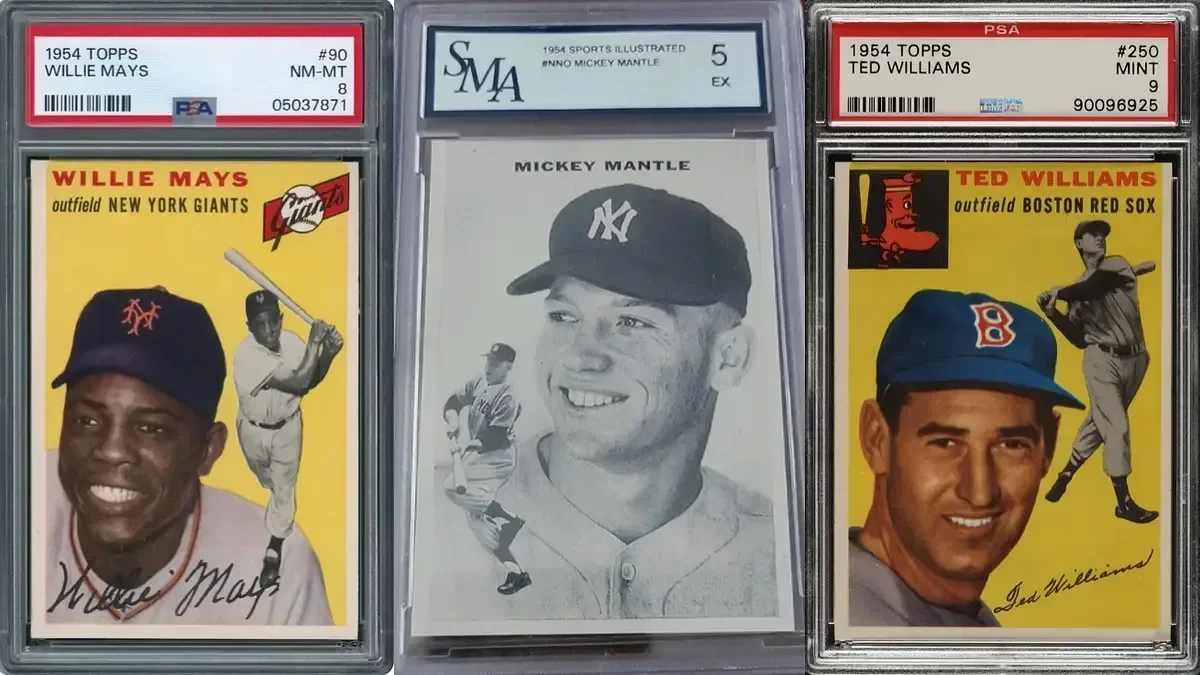
The 1954 Topps baseball set remains one of the hobby’s signature vintage releases more than 70 years after it first reached collectors. Even without a standard-issue Mickey Mantle card in the checklist, the 250-card set still stands as one of the defining baseball products of the decade thanks to its Hall of Fame depth, famous rookie class, and unmistakable design.
This release is especially important in hobby history because it paired bold color backgrounds with a dual-image front, giving collectors both a portrait and an action pose on the same card. The missing top border, a well-known visual trait of the set, helped give the cards a clean look while also serving as a practical printing choice.
Star power drives the set’s long-term appeal. The checklist includes 20 Hall of Famers, anchored by rookie cards of Hank Aaron, Ernie Banks, and Al Kaline, plus standout veteran cards of Jackie Robinson, Willie Mays, Yogi Berra, and Ted Williams. For many collectors, that combination is enough to place 1954 Topps among the greatest vintage baseball sets ever made.
Below is a closer look at the cards that continue to define the set’s legacy and lead the way in value.
For more collector background, read The 7 Most Iconic and Valuable 1975 Topps Baseball Cards Still Driving the Hobby.
Why 1954 Topps Still Matters
Collectors often talk about 1952 Topps for its place in the company’s early rise, but 1954 Topps carries a different kind of importance. It is compact, star-heavy, and visually memorable. The set did not need massive size to build prestige. Instead, it delivered one of the strongest Hall of Fame and rookie combinations of the vintage era.
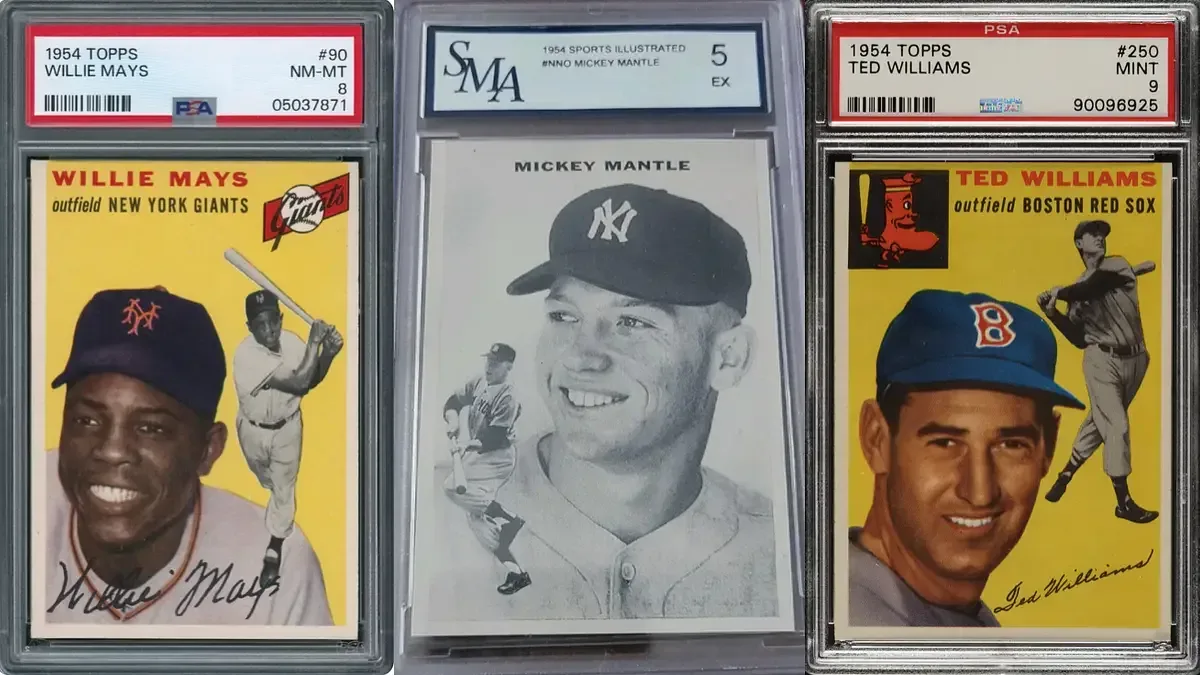
It also carries an unusual historical twist. Mantle was absent from the regular checklist because he was under an exclusive contract with Bowman. There is a well-known 1954-style Mantle image tied to a magazine insert from that year, created in the same design style, but it is not a standard cardboard Topps card from the set. That detail has only added to the mystique of the release, which remains highly sought after despite lacking one of the hobby’s biggest names.
What 1954 Topps does have is remarkable depth. From cornerstone rookie cards to some of the most beloved stars in baseball history, the set offers a concentrated run of cards that are both visually strong and historically significant.
8. Tommy Lasorda Rookie Card #132
Tommy Lasorda is one of the most recognizable figures in Dodgers history, though his fame was built much more as a manager than as a player. That is part of what makes his 1954 Topps rookie card so interesting. It is his only mainstream card from his playing days, giving it a niche appeal that extends well beyond Dodgers collectors.
Lasorda appeared in only 26 major league games as a pitcher, and his long-term legacy came later as the fiery leader of two World Series championship teams. In the card market, that unique career arc keeps this card relevant. It is not in the same value tier as the set’s biggest Hall of Fame stars, but high-grade examples still attract strong attention.
A PSA 9 reached $13,000 on September 2, 2026. A more recent PSA 7 sold for $750 on September 8, 2026. PSA reports a population of 4,117 copies, including 20 PSA 9s and one PSA 10.
7. Yogi Berra #50
Yogi Berra’s 1954 Topps card remains one of the most attractive catcher cards of the era and an important piece for collectors building around Yankees legends. Berra was at the height of his career in the mid-1950s, and this card lands right in that peak period.
His resume speaks for itself: three American League MVP Awards and 10 World Series rings as a player. That kind of accomplishment has led many vintage collectors to view several Berra cards as undervalued relative to his place in baseball history. The 1954 Topps issue is often part of that conversation because it comes from one of the hobby’s most admired sets and still offers attainable lower-grade entry points.
A PSA 9 sold for $28,030 on June 6, 2026. A PSA 7 most recently brought $738 on September 10, 2026. The PSA population stands at 5,566, with 14 PSA 9s and no PSA 10s recorded.
6. Al Kaline Rookie Card #201
Al Kaline’s rookie card is sometimes described as the most affordable member of the set’s “big three” rookie class, but that framing says more about the strength of the class than it does about Kaline himself. His career place is secure. Kaline spent all 22 seasons with the Tigers, became an 18-time All-Star, and earned the nickname “Mr. Tiger” for good reason.
From a design standpoint, this is one of the set’s most eye-catching cards. The vivid red-orange background and bright team logo give it standout shelf appeal, especially in higher grade. Kaline also carries broad collector appeal because he is a one-franchise star whose career feels deeply connected to Detroit baseball history.
The high-water mark for the card remains a PSA 10 sale of $192,000 on February 26, 2021. More recently, a PSA 7 sold for $3,675 on June 28, 2026. PSA lists 7,872 examples in its census, including 20 PSA 9s and one PSA 10.
5. Ted Williams #1 and #250
One of the most memorable quirks of the 1954 Topps set is that Ted Williams appears at both ends of the checklist. He holds card No. 1 and card No. 250, effectively bookending the entire release. That was no accident. Williams was a major star, and putting him in both positions gave the set extra prestige from front to back.
Collectors have long loved this pairing because it turns a single player run into a built-in mini chase within the set. Both cards matter. Both are tough in top grade. And both represent one of the greatest hitters in baseball history, even after the prime years he lost to military service during World War II and the Korean War.
For card No. 1, the all-time high is a PSA 9 sale of $53,378 on July 10, 2021. A PSA 7 sold for $4,500 on April 14, 2026. PSA shows 9,661 total graded copies, with six PSA 9s and no PSA 10s.
For card No. 250, the all-time high is a PSA 9 sale of $96,000 on August 18, 2025. A PSA 7 changed hands for $4,340 on August 2, 2026. PSA reports 7,586 graded examples, including 10 PSA 9s and one PSA 10.
4. Willie Mays #90
Few cards in the set are tied to a more famous single season than Willie Mays’ 1954 Topps issue. Mays returned from military service and immediately produced one of the defining campaigns of his career, winning the National League MVP Award while batting .345 and helping the Giants capture the World Series.
That season also gave baseball one of its most replayed moments: “The Catch” in the World Series, still cited by many as the greatest defensive play the game has seen. As a result, this card has always carried more than just player appeal. It represents a comeback season, an MVP run, and an iconic baseball image all at once.
The card’s yellow background and smiling portrait have helped keep it among the most recognizable Mays cards from the 1950s. A PSA 9 sold for $140,300 on August 21, 2026, while a PSA 7 brought $4,360 on August 18, 2026. PSA’s population report lists 8,506 examples, with 13 PSA 9s and no PSA 10s.
3. Jackie Robinson #10
Jackie Robinson cards have taken on even greater importance in the modern hobby as collectors have focused more closely on historical significance in addition to pure rarity and condition. Robinson’s place in baseball history is unmatched, and his 1954 Topps card remains one of the most desirable mainstream issues from his playing career.
Only a small number of Robinson mainstream playing-era baseball cards exist, which helps explain why demand remains strong across grades. This 1954 Topps example captures Robinson during an active stretch of his career, with the Dodgers star making his sixth straight All-Star team that season.
The market movement on this card has been especially noticeable in recent years. A PSA 9 sold for $152,500 on February 23, 2025. A PSA 7 sold for $5,005 on September 2, 2026. PSA lists 12,874 graded copies, including 23 PSA 9s and no PSA 10s. Lower-grade examples have also climbed sharply, reflecting how much collector attention Robinson cards continue to command.
2. Ernie Banks Rookie Card #94
Ernie Banks’ rookie card is one of the hobby’s premier postwar rookie issues and one of the key reasons the 1954 Topps set has remained so strong for decades. Banks debuted in 1953 and became the first Black player in Cubs history. He later grew into one of the most beloved figures the franchise has ever had, earning the nickname “Mr. Cub.”
His Hall of Fame career included back-to-back National League MVP Awards in 1958 and 1959, and his 1954 Topps card is his only mainstream rookie card. That combination of historical importance, franchise legacy, and rookie-card scarcity has made it a cornerstone card for vintage collectors.
The card is also admired for how well it captures Banks’ personality. Like several of the set’s best cards, it blends a warm portrait with a crisp action image, helping make it a visual favorite as well as a major key. A PSA 9 sold for $215,250 on August 16, 2026. A PSA 7 sold for $10,500 on July 11, 2026. PSA reports 10,514 copies in its census, including 14 PSA 9s and two PSA 10s.
1. Hank Aaron Rookie Card #128
If one card stands above the rest in 1954 Topps, it is the Hank Aaron rookie. It is the defining card of the set and one of the most iconic baseball cards ever issued. For many collectors, it is not just the top card in this checklist but one of the hobby’s true blue-chip vintage pieces.
Aaron was only 20 years old in 1954 when an opportunity opened in Milwaukee’s outfield, helping launch one of the greatest careers the sport has seen. He went on to finish with 755 home runs and famously surpassed Babe Ruth’s career home run record, cementing his place among baseball’s all-time greats.
The story behind Aaron’s path to the majors adds another layer to the card’s significance. Before starring in the big leagues, he spent time with the Indianapolis Clowns in the Negro American League. Interest from multiple organizations followed, and his eventual signing shaped baseball history. That backstory, paired with Aaron’s legendary major league accomplishments, gives this rookie enduring weight with both collectors and historians.
In the market, it has produced some of the strongest prices in the set by a wide margin. A PSA 9 sold for $720,000 on August 18, 2022. A PSA 7 brought $25,500 on June 7, 2026. PSA lists 12,211 graded examples, with 25 PSA 9s and two PSA 10s. It remains one of the benchmark rookie cards of the entire vintage era.
What Drives Value in the 1954 Topps Set
The biggest prices in 1954 Topps come from a familiar mix of factors: Hall of Fame status, rookie-card importance, population scarcity in high grade, and visual presentation. This set is particularly sensitive to condition because centering, print quality, and edge wear can sharply affect grades, and true upper-end copies are extremely hard to find.
The rookie trio of Aaron, Banks, and Kaline gives the set a level of long-term demand few vintage products can match. Veteran star power does the rest. Robinson, Mays, Williams, and Berra each carry strong collector bases on their own, and their presence within one compact set keeps registry builders and player collectors engaged year after year.
The design helps too. The colorful backgrounds and dual-image fronts remain instantly recognizable, and high-grade examples with strong eye appeal often generate premium bidding beyond what population alone might suggest. That is why sales data from the set continues to draw attention whenever major examples surface at auction or in private sales.
The Lasting Appeal of a Mantle-Less Classic
It is rare for a set to become a hobby giant without including a standard Mickey Mantle card, but 1954 Topps pulled it off. The release has enough star power, enough history, and enough true key cards to stand on its own without borrowing importance from what it lacks.
For vintage collectors, the set offers several different entry points. Some chase a single cornerstone card like the Hank Aaron or Ernie Banks rookie. Others target Hall of Fame runs, the Williams bookends, or the broader challenge of assembling all 250 cards. No matter the approach, the set rewards collectors with some of the best player selection and strongest aesthetics of the 1950s, which is why demand for its top cards remains firmly in place.
Photo Gallery