The 1975 Topps baseball set remains one of the easiest vintage issues to spot from across a room. Its loud two-color borders, wide range of color combinations, and unmistakable mid-1970s look gave collectors something very different from the more restrained Topps releases that came before it. More than five decades later, that same personality is a big part of why the set still draws so much attention.
The design is only part of the story. The 660-card release also packs in star power, key rookie cards, major career milestone issues, and condition challenges that continue to shape values today. Centering problems and miscuts are common, and high-grade copies can be extremely difficult to locate. That mix of visual appeal and scarcity at the top of the grading scale has helped several cards from the set reach impressive prices.
Here is a closer look at seven of the most iconic and valuable cards from 1975 Topps baseball, along with the facts that keep them relevant in the hobby.
Why 1975 Topps Still Stands Out
Topps took a major design swing in 1975. The set used 18 different two-color border combinations, creating a look that could either match a team uniform beautifully or feel completely random depending on the card. That unpredictability became part of the release’s identity.
For more collector background, read 2026 Topps Allen & Ginter Baseball Pre-Order Opens With MLB Stars, Celebrities, and Signature Non-Sport Inserts.
For collectors, the set also offers a little bit of everything. There are cornerstone Hall of Fame rookie cards, stars at the height of their careers, and meaningful late-career issues for all-time greats. Add in the notoriously inconsistent cuts and centering, plus the separate Mini version of the set, and 1975 Topps has all the ingredients of a hobby favorite.
7. Pete Rose 1975 Topps #320
Pete Rose’s 1975 Topps card captures one of the defining figures of the Big Red Machine during one of the most memorable seasons of his career. In 1975, Rose helped lead Cincinnati to a World Series title and earned World Series MVP honors after batting .370 in a seven-game classic against Boston. He also moved to third base that year, while continuing to lead the National League in both hits and doubles.
Collectors have long been drawn to this card because the red-and-yellow border pairing works especially well with the Reds uniform. The front also includes a red star marking Rose as a 1974 All-Star, adding a small design feature that makes the card even more distinctive. For many collectors, this is one of the best-looking Rose base cards of the decade.
In the graded market, elite examples have shown real strength. A PSA 10 with a population of 26 reached $19,200 on March 23, 2024. At more accessible levels, a recent PSA 7 sold for $80. The total PSA population stands at 8,711.
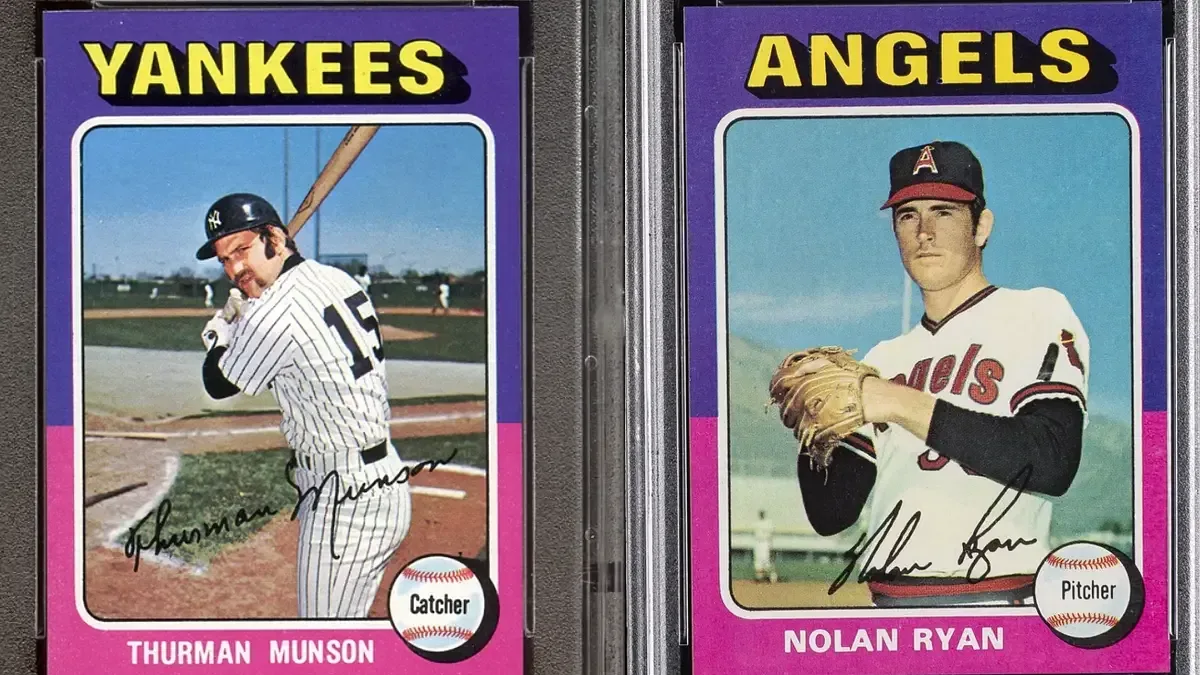
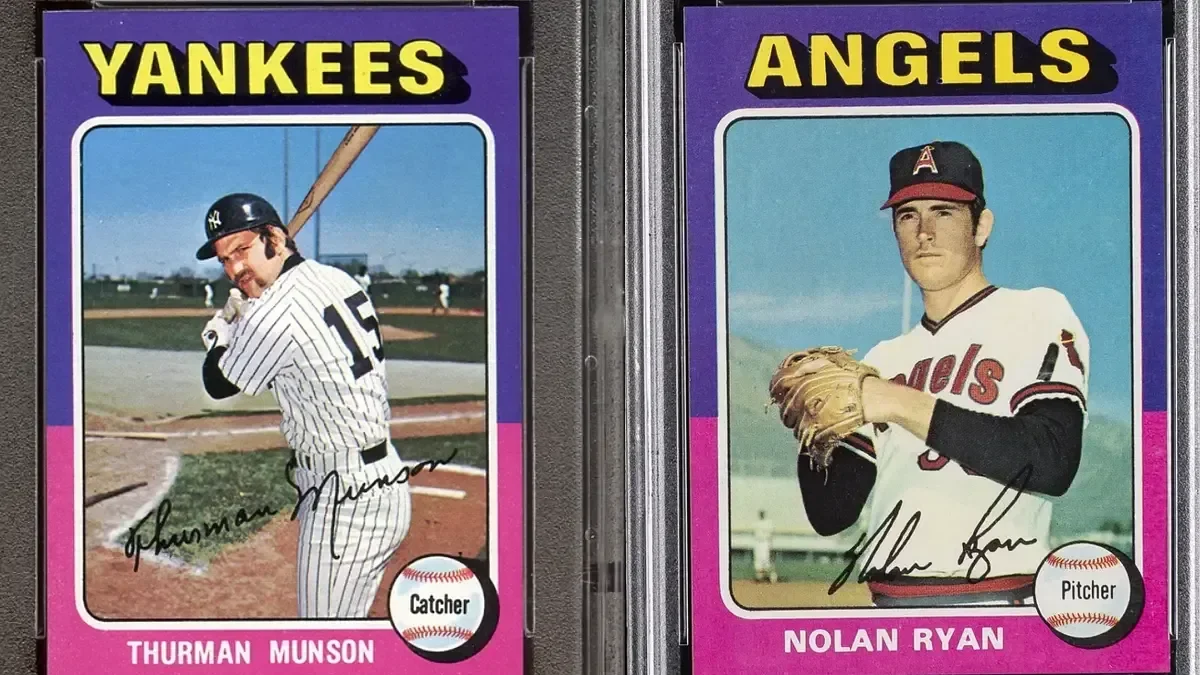
6. Thurman Munson 1975 Topps #20
Thurman Munson’s place in the hobby remains secure, and his 1975 Topps issue is one of the set’s most memorable cards. During the 1975 season, Munson hit .318 with 102 RBIs, won his third Gold Glove, and made his fourth All-Star team. He had already established himself as one of the premier catchers in the American League, and his leadership role with the Yankees only added to the card’s long-term appeal.
The pink-and-purple border combination is one of the set’s boldest choices. On paper, it sounds like an unlikely fit, but in practice it gives the card a look collectors remember instantly. That visual identity matters in a set built around color, and it helps explain why this card gets so much attention whenever a high-grade example surfaces.
Scarcity at the top is a major factor here. Only four PSA 10s are listed, and a PSA 10 sold for $164,700 on December 19, 2025. A recent PSA 7 sold for $104, while the total PSA population is 4,359.
5. Bob Gibson 1975 Topps #150
Not every key card in 1975 Topps is a rookie. Bob Gibson’s 1975 Topps card carries special weight because it marks the final playing-day card for one of the game’s most feared pitchers. Final-season cards of all-time greats can hold a unique place in the market, especially when the player’s legacy is already firmly established.
Gibson was 40 during the 1975 season and struggled on the mound, but his career stature was beyond question. The Cardinals even held Bob Gibson Day on September 1, 1975, in recognition of his 17-year career. When that season ended, he ranked second only to Walter Johnson in career strikeouts among major league pitchers.
The card itself also benefits from strong visual harmony. Its red-and-yellow border pairing lines up naturally with the Cardinals uniform, creating one of the cleaner-looking star cards in the set. In top condition, that appeal has translated to strong prices. A PSA 10 with a population of three sold for $47,580 on May 16, 2026. A recent PSA 7 sold for $118, and the total PSA population is 2,906.
4. Robin Yount Rookie Card 1975 Topps #223
Robin Yount’s rookie card is one of the anchors of the 1975 Topps set and one of the most important solo rookie cards of the era. That solo-card status matters. Many rookies in mid-1970s Topps releases appeared on multiplayer prospect cards, but Yount received a mainstream rookie card all to himself, giving collectors a clean and direct first card for a future Hall of Famer.
Yount was only 19 in 1975, yet he played 147 games as a rookie and hit .267. The long-term significance became obvious with time. He went on to collect more than 3,000 hits, win two MVP awards, and spend his entire 20-year career with Milwaukee, making this issue a foundational card for both Brewers collectors and Hall of Fame rookie-card chasers.
Demand has stayed strong for decades, especially in higher grades where 1975 Topps condition issues can be unforgiving. A PSA 10 with a population of six reached $152,500 on January 31, 2026. A recent PSA 7 sold for $180. The total PSA population is 22,696, showing just how widely submitted and closely watched this card remains.
3. Hank Aaron 1975 Topps #660
Hank Aaron’s 1975 Topps base card stands out for several reasons. It is card #660, the last card in the set, and it captures Aaron late in his career after his return to Milwaukee. It also reflects a transitional moment, with Aaron shown in Brewers colors after being traded from Atlanta late in 1974.
The 1975 season added another chapter to Aaron’s record-setting career. On May 1, 1975, he broke Babe Ruth’s career RBI mark, one year after passing Ruth on the all-time home run list. Though his knees limited him and pushed him into a designated hitter role, Aaron remained one of the sport’s most significant figures, and this card represents the second-to-last season of his career.
There is also an added collecting wrinkle within the same set. Aaron appears on card #1 in the “1974 Highlights / Record Breaker” slot celebrating his historic 715th home run, but card #660 is his standard base issue. That makes it especially important for player collectors building a traditional Aaron run.
A PSA 10 with a population of one sold for $152,500 on January 31, 2026. A recent PSA 7 sold for $219, and the total PSA population is 2,019.
2. Nolan Ryan 1975 Topps #500
Nolan Ryan has one of the strongest collector followings of any pitcher in baseball card history, and his 1975 Topps card is one of his most visually striking base issues. The purple-and-pink border combination is unforgettable, giving the card a look that fits the set’s wild style as well as almost any card in the release.
The timing also works in its favor. Ryan threw his fourth career no-hitter on June 1, 1975, against Baltimore, tying Sandy Koufax’s record at the time. The feat also made him the first pitcher in major league history to throw a no-hitter in three consecutive seasons. During that same year, he also picked up his 100th career win.
Ryan’s lasting popularity gives this card wide demand across the hobby, from vintage-focused collectors to fans building pitcher collections. The top end of the market reflects that steady interest. A PSA 10 with a population of three sold for $38,240 on August 21, 2015. A recent PSA 7 sold for $399, and the total PSA population is 7,833.
1. George Brett Rookie Card 1975 Topps #228
The most sought-after card in the set is George Brett’s rookie card. For many collectors, it is also the most recognizable rookie card of the 1970s. The green-and-purple border combination is one of the defining visuals of the entire release, and the card’s status as Brett’s flagship rookie gives it a level of hobby importance that has endured for generations.
Brett’s 1975 season helped set that foundation. In his first full year in the majors, he hit .308 and led the American League in both hits and triples. What followed was a Hall of Fame career that included an MVP award, a World Series title with Kansas City, three batting championships, 13 All-Star selections, and first-ballot Cooperstown induction.
This is the card many collectors think of first when 1975 Topps comes up, and its market history backs that up. A PSA 10 with a population of 11 sold for $186,000 on February 26, 2021. A recent PSA 7 sold for $440, and the total PSA population is 20,256.
Honorable Mentions From the Set
The depth of 1975 Topps is one reason the release remains so popular. Even beyond the seven headline cards above, collectors still chase several other important names from the set.
Jim Rice Rookie Card #616 “Rookie Outfielders” with a recent PSA 7 price of $80
Johnny Bench #260 with a recent PSA 7 price of $79
Reggie Jackson #300 with a recent PSA 7 price of $76
Mike Schmidt #70 with a recent PSA 7 price of $60
Gary Carter Rookie Card #620 “Rookie Catchers” with a recent PSA 7 price of $60
Those multiplayer rookie cards are an important reminder of how the era handled prospect cardboard. Unlike Brett and Yount, many future stars from the mid-1970s first appeared in shared rookie formats, which makes solo rookie cards from this set even more notable.
What Drives 1975 Topps Values Today
Three factors continue to define the market for 1975 Topps baseball cards. The first is star power. Hall of Fame rookies such as George Brett and Robin Yount give the set long-term demand, while iconic veterans like Hank Aaron, Nolan Ryan, Pete Rose, and Bob Gibson broaden the collector base.
The second is design. The bold color combinations make the set instantly memorable, and the best examples can look spectacular when the border colors complement the uniform and team branding. That visual punch helps certain cards stand above others, even within the same release.
The third is condition sensitivity. Centering issues and miscuts are common across 1975 Topps, which means gem-mint copies can be dramatically rarer than raw supply might suggest. Population reports tell part of the story, but the sharp premium for PSA 10 examples makes clear how difficult top-end cards are to find.
For collectors who appreciate vintage sets with personality, 1975 Topps continues to offer a blend of eye appeal, history, and scarcity that few other baseball releases can match. Whether the target is Brett’s signature rookie, Yount’s solo debut, or one of the set’s major veteran stars, these cards remain central pieces of one of Topps’ most unforgettable designs.
Photo Gallery