Stephen Curry’s place in basketball history has been secure for years. As the NBA’s all-time leader in three-pointers and one of the defining stars of his era, Curry has built the kind of resume that keeps collectors engaged well beyond any single season. That demand is showing up again in the card market, where two of his most important 2009 rookie issues recently pushed to new public sale highs.
The latest results highlight strength at two very different levels of the hobby. On the premium end, Curry’s 2009 National Treasures Rookie Patch Autograph /99 delivered a massive six-figure sale. At the more widely recognized flagship level, his 2009 Topps rookie in PSA 10 also set a new benchmark. Together, the sales reinforce how deep the market remains for one of the most important modern basketball names.
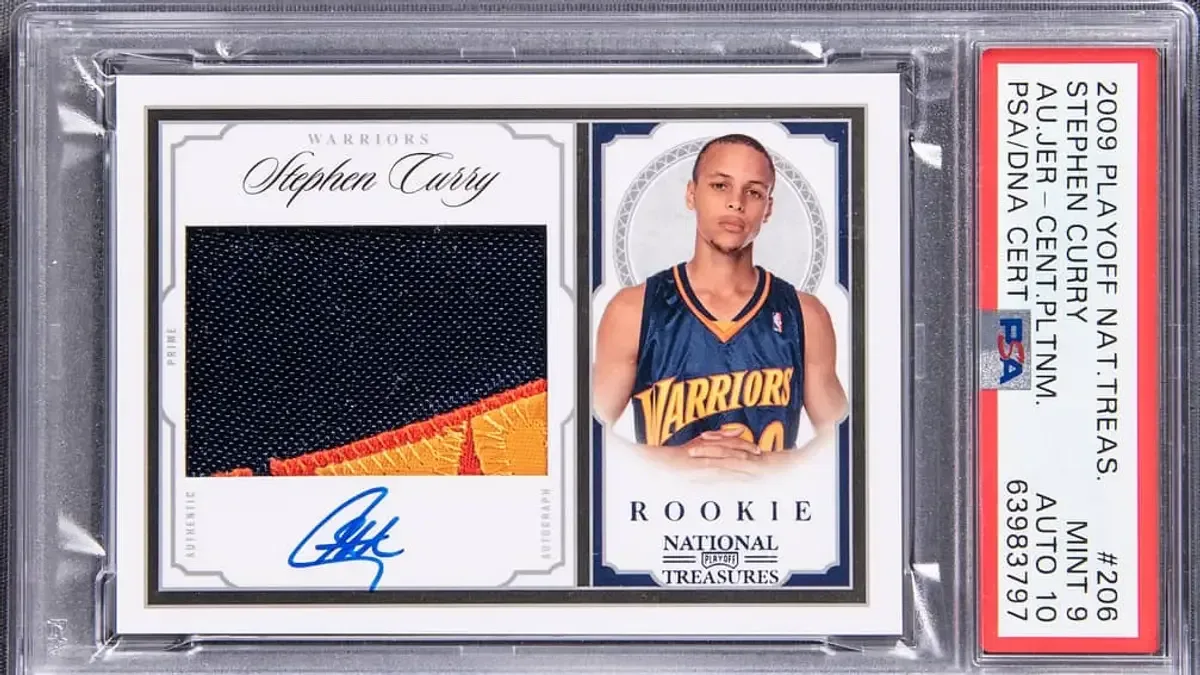
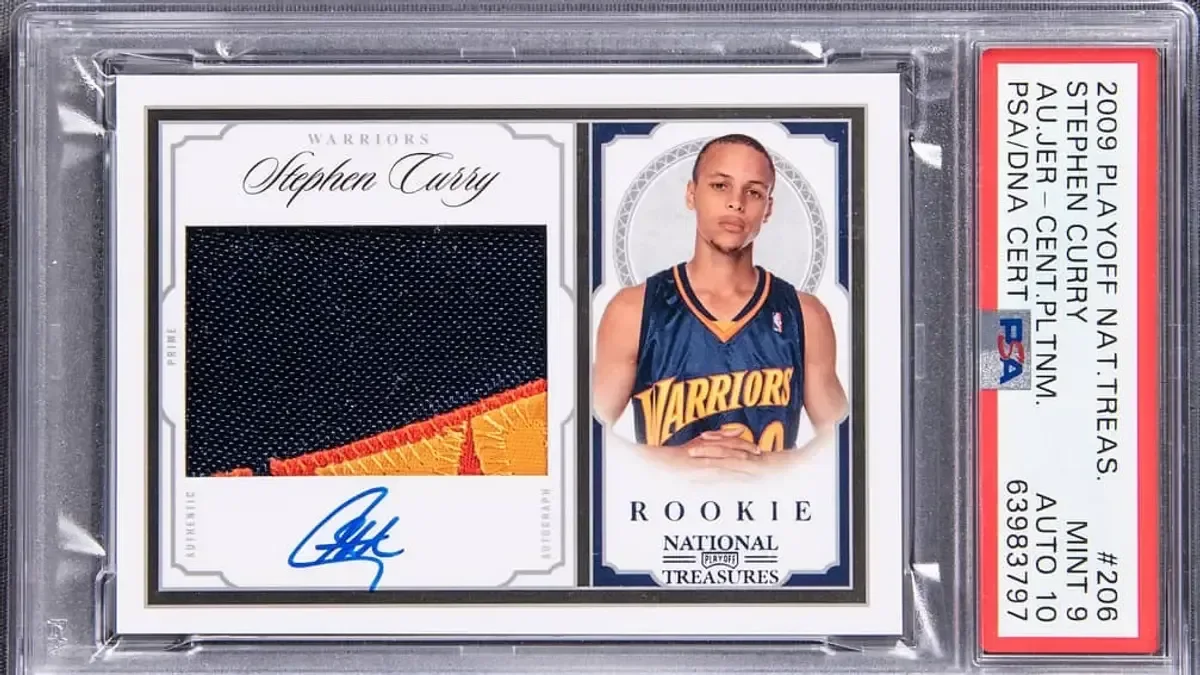
National Treasures Curry RPA Reaches $312,000
The headline sale came on August 28, when a 2009 National Treasures Stephen Curry Rookie Patch Autograph /99 #206 graded BGS 8 with a 10 auto sold for $312,000 in a Fanatics Premier auction. That figure established a new public high for that specific card in that grade and autograph combination.
The result stands out not only for the price, but for the pace of the jump. The same card last sold publicly on January 23, 2026, for $156,000. In just seven months, the value doubled, representing a $156,000 increase and a 100 percent gain.
For more collector background, read Cavan Sullivan’s 2025 Topps Chrome Rookie Debut Patch Auto Sells for $324,000, Shattering MLS Card Records.
Scarcity plays a major role here. This BGS 8/Auto 10 copy carries a population of 8, and public appearances have been limited. Only three public sales of this version have been recorded, giving bidders few chances to compete for it. In a market where elite Curry material does not surface often, that lack of supply can quickly intensify bidding.
The card itself also carries weight because of where it sits in hobby history. The 2009-10 National Treasures Basketball release marked Panini’s first National Treasures NBA product after securing the exclusive league license. At the time, it was considered the company’s most expensive basketball product to date, and it helped establish a product format that still shapes modern high-end collecting. Rookie Patch Autographs from that release became cornerstone cards for the class.
Curry’s RPA is part of a rookie group that also included Blake Griffin, James Harden, DeMar DeRozan, and Tyreke Evans. With copies limited to 99, the set quickly became one of the defining modern basketball releases, and Curry has emerged as one of its most important names. As his career accomplishments have continued to grow, the card’s significance has expanded right along with them.
Why the 2009 National Treasures Release Still Matters
For many collectors, 2009-10 National Treasures Basketball remains a pivotal product because it bridged old-school premium collecting and the modern ultra-high-end era. The release leaned heavily into on-card autographs, premium memorabilia content, and tightly limited rookie cards. Those ingredients are common now, but at the time they helped define what top-tier basketball wax could be.
Curry’s Rookie Patch Autograph sits near the top of that product’s legacy. It combines the elements collectors tend to prioritize most: a flagship-level high-end set, rookie-year status, a hard print run of 99 copies, a patch window, and an autograph from a player whose historical standing has only strengthened over time.
That helps explain why even a copy graded below gem mint can command a major number. In ultra-rare modern cards, the market often values card significance and availability as much as grade. With just a handful of public transactions and a limited number of graded examples in this configuration, buyers may not wait around for a cleaner copy if an opportunity appears.
The latest $312,000 sale adds another important data point to Curry’s high-end market. It also shows that collectors remain willing to pay a premium for centerpiece rookie cards tied to foundational modern releases.
Curry’s 2009 Topps Rookie Also Sets a New Mark
Not every major Curry sale needs to land in six figures to matter. His 2009 Topps Rookie #321 in PSA 10 sold for $21,995 on August 24, setting a new public high for that card in the grade. While it exists in a much larger population than the National Treasures RPA, it remains one of Curry’s most recognizable rookie cards and one of the hobby’s most accessible blue-chip modern basketball keys.
This latest sale continued a strong recent climb. Over the past six months, the card rose by $5,500, good for a 37 percent gain. That kind of movement suggests demand is not limited to elite patch autos and one-of-one caliber material. It is also filtering into mainstream rookie cards that have broad collector recognition.
The 2009 Topps Curry rookie has long held a special place because of its role in basketball card history. The set was the last Topps basketball flagship release before the brand stepped away from licensed NBA cards for years. That alone gives it a distinctive place in the market. Add Curry’s career arc and the card has become a centerpiece of late-2000s basketball collecting.
Unlike some earlier-era flagship rookies, this card is still attainable in lower grades and raw form, but PSA 10 examples have become increasingly competitive. The reported population sits at 371, a far cry from true rarity, but not so large that demand cannot overwhelm supply when collector interest rises.
The Appeal of 2009 Topps Basketball
The 2009 Topps Basketball set is remembered for more than just Curry. Its 330-card base checklist included several notable rookies from a strong incoming class, including James Harden, Blake Griffin, and DeMar DeRozan. Still, Curry has become the standout name, and his base rookie is widely viewed as the signature card of the release.
There is also a visual and historical quirk that makes the set memorable. Because of the licensing situation surrounding the end of Topps’ NBA run at the time, rookies were not shown in official team uniforms. Instead, they appeared in warm-up gear. That detail once felt like a drawback to some collectors, but over time it has become part of the card’s identity and an instantly recognizable trait of the issue.
As collector nostalgia for late-2000s products grows, that uniqueness may continue to help the card. It sits at the intersection of a major brand, a transitional era for basketball cards, and the rookie season of one of the most influential players the sport has ever seen.
Topps Chrome Adds Another Layer to the Curry Market
The strength of Curry’s flagship Topps rookie also brings added attention to its chromium counterpart. The 2009 Topps Chrome Basketball release featured a 110-card checklist that included Curry rookie cards and several notable serial-numbered versions.
Collectors chasing that branch of the market have a defined hierarchy of parallels to track:
- 2009 Topps Chrome Stephen Curry rookie parallel numbered to /999
- Refractor numbered to /500
- Gold Refractor numbered to /50
- Superfractor 1/1
That ladder of scarcity gives Curry collectors multiple levels to pursue, from relatively obtainable serial-numbered cards to true grails. One of the most intriguing details in the entire Curry rookie market is that his 2009 Topps Chrome Superfractor 1/1 has still not surfaced publicly in the 16 years since the product was released.
Whenever a major unrevealed card remains hidden that long, it adds mystique to the surrounding set. It also keeps collectors watching for a possible emergence that could instantly become one of the biggest modern basketball hobby stories of the year. Even without that card coming to market, the Chrome family remains an important part of Curry’s rookie ecosystem.
What These Sales Say About the Stephen Curry Market
Recent Curry results suggest a few clear themes. First, his market continues to reward iconic rookie cards over short-term speculation. Buyers are not simply chasing whatever is newest. They are paying up for cornerstone pieces with established hobby relevance.
Second, there is still separation between truly scarce premium cards and more available mainstream rookies, but both areas are moving upward. The National Treasures RPA doubling in seven months is an extreme example driven by rarity and prestige. The Topps PSA 10 setting a new high shows that broader collector demand is also active.
Third, Curry’s legacy appears strong enough to support continued interest even without a fresh championship run. His on-court resume already includes four NBA titles, two MVP awards, and a spot among the most transformative players in league history. For collectors, those accomplishments matter more than the day-to-day noise of a single season.
That is often how durable card markets are built. When a player’s historical significance is no longer in doubt, the focus shifts toward landmark rookie cards, population data, and long-term supply. Curry checks each of those boxes, which helps explain why his key 2009 cards continue to command attention.
Key Stephen Curry Rookie Card Figures to Know
- 2009 National Treasures Stephen Curry Rookie Patch Autograph /99 #206 BGS 8/Auto 10 sold for $312,000 on August 28, 2026
- Previous public sale for that same card was $156,000 on January 23, 2026
- Increase for that card over seven months: $156,000, or 100 percent
- BGS 8/Auto 10 population for that National Treasures Curry RPA: 8
- Known public sales for that specific copy type: 3
- 2009 Topps Stephen Curry Rookie #321 PSA 10 sold for $21,995 on August 24, 2026
- Increase for the Topps PSA 10 over six months: $5,500, or 37 percent
- PSA 10 population for 2009 Topps Stephen Curry #321: 371
- 2009 Topps Basketball base set size: 330 cards
- 2009 Topps Chrome Basketball checklist size: 110 cards
Where Collectors May Look Next
With the National Treasures RPA and Topps base rookie both establishing new highs, attention may naturally shift toward adjacent Curry rookie cards. That could include other grades of the Topps base rookie, serial-numbered Topps Chrome parallels, and additional premium autograph issues from 2009-10.
The market will also be watching for any new public sale of Curry’s National Treasures RPA in other grades, which could help further define whether the latest result was an isolated premium or part of a larger reset for the card. On the flagship side, any movement in Topps Chrome refractors could offer another signal about how aggressively collectors want to chase top-end Curry rookie material beyond the standard base issue.
For now, the important takeaway is simple: the biggest Stephen Curry rookie cards are still setting the pace. From a six-figure National Treasures RPA to a record-setting Topps PSA 10, collectors continue to treat his 2009 releases as foundational pieces of the modern basketball card market.
Photo Gallery