Pokémon TCG: 30th Celebration lands worldwide on September 16, and most of the attention so far has centered on the set’s headline cards, including its many Pikachu artworks and Classic Collection reprints. Beneath those reveals, though, the product also introduces something more structural: a brand-new rarity called Futuristic Rare.
New rarity tiers matter because they can reshape how collectors chase a set, how checklists are interpreted, and how long-term value gets assigned. In this case, Futuristic Rare enters the hobby in a high-profile anniversary release, but its future inside the Pokémon TCG remains uncertain. That makes the first two cards carrying the label especially important.
What Futuristic Rare Is in Pokémon TCG: 30th Celebration
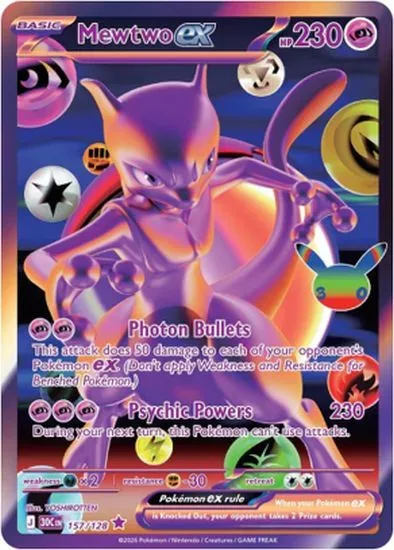
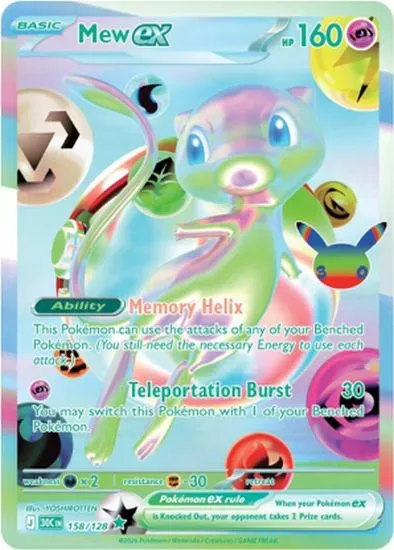
Futuristic Rare, abbreviated as FUR, debuts on two cards in the main set: Mewtwo ex (157/128) and Mew ex (158/128). Those two cards sit at the very end of the numbered checklist and immediately stand out as one of the release’s most discussed chase elements.
Both cards are tied to artist YOSHIROTTEN, whose visual style runs throughout the anniversary product. In addition to these two cards, that same design language is also connected to the set’s broader visual identity and its anniversary-themed Basic Energy cards.
For more collector background, read Pokémon Night Out Preview: Dates, Performers, Merch, and What Fans Can Expect.
The card treatment is distinct from the standard premium looks collectors are used to seeing in the modern game. The featured Pokémon appear with a metallic-textured finish in holographic colors against a futuristic backdrop. The composition also includes all nine Energy symbols encircling the character, with a visible Poké Ball element and a holographic anniversary logo stamp built into the design.
Even the rarity marker is specialized. Instead of a plain symbol, the star is tinted to match the dominant color palette of each card. The result is a rarity presentation that feels intentionally custom-built for the 30th anniversary rather than simply added into the existing visual hierarchy.
Why Mew and Mewtwo Were Chosen
If a new rarity is only going to launch with two cards, character selection becomes a major part of the story. Mew and Mewtwo are among the most dependable names in Pokémon collecting, with strong multi-generation appeal and a long history of commanding collector attention in both English and Japanese releases.
Mew tends to draw buyers who want a more playful, iconic, or mythic side of the franchise, while Mewtwo consistently performs as one of the brand’s most recognizable powerhouse characters. Pairing those two with a new rarity gives Futuristic Rare immediate visibility and a much better chance of being noticed than if it had debuted on less established names.
That matters because when collectors decide whether a new rarity is worth chasing, they usually are not only evaluating the rarity itself. They are also evaluating the Pokémon on the card, the quality of the artwork, the set it comes from, and whether the card feels meaningful within the broader history of the franchise. Mew and Mewtwo check nearly all of those boxes.
Where Futuristic Rare Fits in the Set
Numbering alone does not always tell the full story of a rarity tier, but it does offer clues. In 30th Celebration, the Special Illustration Rare Pikachu ex cards appear as 149/128 and 150/128. The two Futuristic Rare cards follow later as 157/128 and 158/128.
That placement confirms that Futuristic Rare sits in the premium portion of the product, though it does not automatically settle exactly where the tier belongs in the modern rarity ladder. No official formal ranking has been published to establish Futuristic Rare above or below every other modern chase treatment.
Set catalog listings currently place Futuristic Rare between Ultra Rare and Special Illustration Rare. That is useful for organization, but it does not necessarily answer how collectors will treat the cards in practice. Some hobbyists will view the rarity as a special anniversary-side branch rather than a permanent level in the standard chase hierarchy. Others may treat it as one of the set’s highest-priority premiums simply because there are only two of them.
For now, the safest reading is that Futuristic Rare is important inside this set, but not yet proven as a permanent part of the game’s long-term structure.
What History Says About New Pokémon TCG Rarities
The biggest question surrounding Futuristic Rare is not whether the cards look good. It is whether the rarity itself will continue into future products.
Pokémon has introduced notable rarity concepts before, and the track record shows two very different paths.
One path is the short-run novelty. Amazing Rare arrived in Vivid Voltage in November 2020 and returned in Shining Fates in February 2021. Across those two releases, the rarity totaled nine cards before disappearing. Radiant Pokémon followed another limited-life cycle. That concept debuted in Astral Radiance in May 2022, remained active through the back half of the Sword & Shield era, and then did not continue into the Scarlet & Violet base set.
The other path is permanent integration. Illustration Rare and Special Illustration Rare launched with Scarlet & Violet on March 31, 2023 and quickly became foundational chase categories for the modern game. Rather than acting as a temporary gimmick, they became core architecture.
The difference is important. Illustration Rare and Special Illustration Rare were introduced at the beginning of a new era, giving them room to become normalized across releases. Amazing Rare and Radiant Pokémon felt more tied to specific concepts and mechanics of their moment, which made them easier to leave behind when the product line evolved.
Futuristic Rare appears closer to the second group in terms of presentation but closer to the first group in terms of release context. It is debuting in a celebratory anniversary product built around a unique artistic identity, not in the launch window of a new baseline era. That makes it harder to project as a permanent fixture.
Why 30th Celebration Changes the Equation
Anniversary sets operate differently from standard expansions. They are designed to feel commemorative, self-contained, and visually distinctive. Because of that, they often include one-off treatments or thematic ideas that do not need to continue later in order to succeed.
That context is central to understanding Futuristic Rare. A rarity can be meaningful inside a landmark set without becoming part of the ongoing release model. Collectors have seen that happen in trading card games many times, where a special insert, finish, or naming convention remains tied to one product and still becomes memorable.
In this case, the anniversary angle may actually strengthen the appeal of the Mew and Mewtwo cards even if the rarity never returns. Their long-term desirability may come less from the fact that they are “the first Futuristic Rares” and more from the fact that they are signature anniversary cards with standout art tied to two elite characters.
Short-Lived Rarity Does Not Guarantee Long-Term Value
One of the most common mistakes in collectible markets is assuming that discontinued automatically means valuable. Scarcity matters, but scarcity only becomes powerful when it intersects with real collector demand.
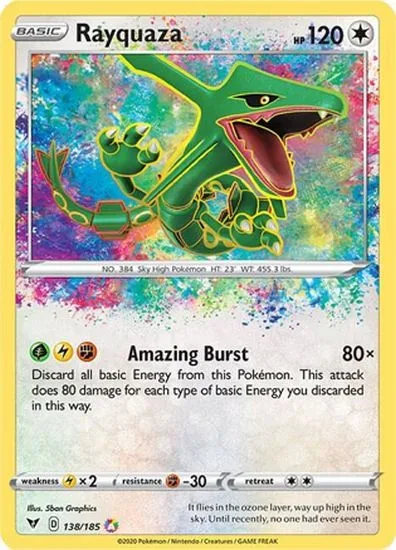
A useful comparison is Rayquaza (138/185) from Vivid Voltage, one of the best-known Amazing Rare cards. Amazing Rare had a brief run and never became a lasting part of the Pokémon rarity structure. Even with years of built-in scarcity from a discontinued concept, ungraded examples of that Rayquaza have remained in a relatively modest price range on the secondary market, around $26 based on the supplied market snapshot.
That does not mean the card lacks appeal. It means that rarity status by itself is rarely enough to force a card into a top market tier. Collectors ultimately decide value through demand, and demand is usually driven by a mix of character popularity, visual impact, nostalgia, and set significance.
In other words, a short print window can help support a card, but it cannot create enduring demand on its own. A rarity label is not a substitute for collector desire.
What Will Matter Most for Mew ex and Mewtwo ex
For the first two Futuristic Rare cards, the strongest case for long-term attention comes from factors that have very little to do with the FUR abbreviation itself.
Mew and Mewtwo are proven collector favorites.
The artwork is highly distinctive compared with more traditional Pokémon TCG chase cards.
The cards are tied directly to a milestone 30th anniversary release.
There are only two examples of the rarity in the main set.
That is a much stronger foundation than simple novelty. If collectors keep returning to these cards years from now, it will likely be because they present iconic Pokémon in a memorable style from a historic set, not merely because the rarity name did not last.
That distinction is important for buyers deciding whether to chase, hold, or speculate. If someone is buying the cards because they love Mew, Mewtwo, the visual execution, or the anniversary significance, the thesis is easy to understand. If the only argument is that “this rarity might disappear,” the case becomes much weaker.
Collector Takeaway Before Release Day
As of now, Futuristic Rare looks like one of the most interesting experiments in Pokémon TCG: 30th Celebration. It adds a fresh visual layer to the set and gives collectors two immediate centerpieces in Mewtwo ex (157/128) and Mew ex (158/128).
Whether it becomes a lasting part of the game is still very much an open question. The release context suggests it could remain an anniversary-specific idea rather than a new permanent chase tier. That does not hurt the cards themselves, but it does change how they should be evaluated.
Collectors weighing these cards ahead of the September 16 launch may want to focus less on the novelty of the rarity symbol and more on the features that tend to hold up best over time: iconic characters, memorable artwork, and genuine significance inside the set. For Futuristic Rare, those are the traits most likely to matter once the initial reveal hype gives way to the market that forms after release.
Photo Gallery