Pokémon TCG: 30th Celebration releases worldwide on September 16, and much of the early discussion has centered on the obvious headline cards. Mewtwo ex introduces the Futuristic Rare treatment, the Classic Collection brings reprints into the product, and the set includes 30 different Pikachu cards with one guaranteed in every pack.
But the more unusual long-term story may be what happens at the bottom of the checklist.
30th Celebration does not use a non-holo baseline. Every card in the set is printed on holofoil stock, including Basic Energy, and each card carries the anniversary logo. That sounds like a simple visual upgrade, and for many collectors it is. Packs should feel premium from top to bottom. At the same time, the design choice disrupts one of the easiest shortcuts the hobby has used for years when separating true hits from cards that eventually get treated as bulk.
In most modern Pokémon releases, foil treatment helps define price tiers. Holo cards and Reverse Holos usually sit above standard Commons and Uncommons, while Basic Energy sits near the very bottom. In 30th Celebration, those visual signals no longer work the same way, which could force bulk buyers and collectors to rethink how the set is sorted, bought, and priced on the secondary market.
Why all-holo matters beyond the chase cards
On the surface, an all-holo release sounds like a collector-friendly decision. Every pack should look flashy, and even lower-rarity pulls carry a more premium presentation than a standard base card. That can be especially appealing in an anniversary product, where the presentation is supposed to feel distinct from a normal expansion.
The challenge appears when collectors move from opening packs to moving volume.
Bulk buying has always depended on simple sorting rules. When thousands of cards are involved, buyers generally do not price each card one by one. Instead, they group cards by broad categories such as Common and Uncommon, Holo, Reverse Holo, Basic Energy, and premium ultra-rare tiers like ex or V cards. Those categories work because they usually reflect both demand and print frequency. A standard Holo tends to be scarcer than a Common, so it gets a different rate. Reverse Holos have their own lane because they appeal to set builders and are harder to complete in volume.
30th Celebration breaks that visual relationship. A Common from this product is still a Common by rarity, but it looks like a Holo because it is one. That means the card can no longer be judged by surface treatment alone. Collectors and dealers have to look at the symbol, numbering, and actual set context rather than the usual shiny-versus-non-shiny shortcut.
How Pokémon bulk is usually priced
In a normal market environment, bulk rates tend to follow a familiar structure. Commons and Uncommons often land around $10 to $25 per 1,000 cards depending on the buyer, condition, and how carefully the lot is sorted. Holo and Reverse Holo cards usually command stronger rates, often in the roughly $15 to $45 per 1,000 range. Basic Energy can fall to about $5 per 1,000 and is sometimes avoided entirely by buyers who already have more than they need.
Separate tiers exist above that for more desirable modern cards, including ex and other premium rarity levels, because those cards are pulled out and sold differently.
That system only works smoothly when foil treatment tells buyers something meaningful about the card’s place in the print run. For decades, that has generally been true. Holo usually meant less common. Reverse Holo usually meant a parallel collectors actively chase for master sets. Basic Energy usually meant very low priority.
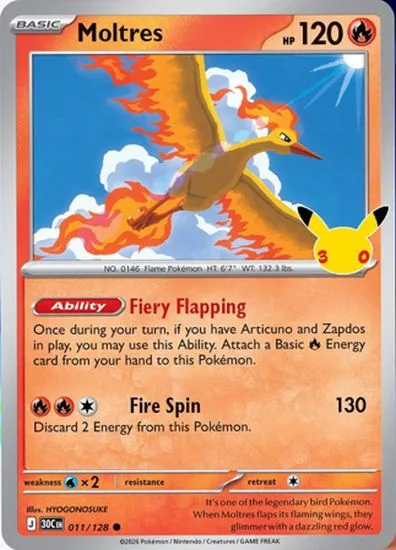
30th Celebration changes the sorting logic. If every card is holofoil, then holofoil is no longer a useful shortcut for scarcity. A card like Moltres, numbered 11/128, is still a Common. It just happens to be printed with a finish that would normally push it into a more valuable bulk category in another set.
That creates a strong chance that major buyers will need set-specific exceptions in their rate sheets. Instead of paying a generic holo rate for any shiny card, they may separate 30th Celebration into its own bulk category or price its lower-rarity holos much closer to ordinary Common and Uncommon levels.
What Celebrations already showed collectors
This is not the first time Pokémon has experimented with an all-holo anniversary product. Celebrations, released on October 8, 2021, also used holofoil stock across its four-card packs. That product offers a useful comparison point, even if 30th Celebration appears much larger in scope.
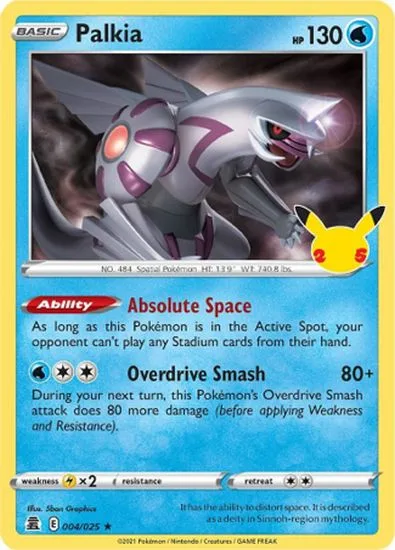
Palkia is one of the clearest examples from Celebrations. It carries a Rare symbol and a holo presentation, yet ungraded copies have sold for around $0.50 on the secondary market. The lesson there is simple: being shiny by itself does not guarantee a durable price floor when supply is high and collector demand is concentrated elsewhere.
That matters because some collectors instinctively assume holo cards should never collapse into true bulk. Anniversary products can challenge that assumption. If enough copies enter the market and the collector base focuses mostly on a handful of premium targets, then many lower-end holos can trade as if the foil layer is mostly cosmetic.
There are still limits to the comparison. Celebrations had a very small main set of 25 cards. Pokémon TCG: 30th Celebration runs to 128 cards in the main English numbering, with more than 160 total cards when the full release is considered. A larger checklist means more distinct low-end singles competing for attention, more cards that could settle into floor pricing, and more opportunities for certain names or artworks to separate themselves from the rest.
The reverse holo category may effectively disappear
One of the most important consequences for set builders is the apparent loss of a traditional Reverse Holo lane.
Reverse Holos have long played a major role in Pokémon collecting. They create a second version of many standard cards, give master set builders another goal, and often provide a meaningful bulk category because there is real demand for complete or near-complete reverse runs. In many modern sets, Reverse Holos can command noticeably better bulk rates than plain Commons.
That structure does not translate neatly to 30th Celebration. If every booster card is already foil, there is no conventional non-holo base layer for a reverse treatment to contrast against. Celebrations handled this the same way by simply existing as an all-holo product without a reverse line.
For collectors, that means the usual two-track completion chase may be reduced. Instead of building a standard set and a reverse set, attention may flow more heavily toward the set’s special components, particularly the guaranteed Pikachu subset and the Classic Collection reprints. Those become the places where additional scarcity, identity, and collector competition can live.
For bulk sellers, it means one of the hobby’s familiar value buckets could be missing. Cards that might have produced reverse-holo volume in a normal release may instead enter the market as lower-rarity holo cards with much less separation from standard pack filler.
Why the Basic Energy cards could be different
If there is one area where the all-holo format may create real value near the bottom of the checklist, it is Basic Energy.
Basic Energy is usually treated as the least interesting category in modern Pokémon products. It is heavily available, often ignored in bulk deals, and frequently excluded by buyers altogether. In a standard release, there is little reason to assign meaningful standalone value to common energy stock unless it has a notable stamp, special artwork, or limited distribution.
30th Celebration changes that equation.
The set’s Basic Energy cards are printed with holofoil treatment, feature anniversary visuals, and are illustrated by YOSHIROTTEN, the artist associated with the expansion’s key visual identity and its Futuristic Rare style. That gives the Energy cards a collector angle they normally do not have. Each Elite Trainer Box also includes 16 foil Basic Energy cards, reinforcing the idea that these are not just filler accessories but a designed subset of the product experience.
That does not automatically make them expensive, but it does make them more collectible than ordinary modern Energy. For binder builders and anniversary set completists, those Energy cards could become a legitimate target rather than a disposable extra. Among the lowest-rarity pieces of the release, they stand out as one of the clearest examples of universal foil treatment potentially adding real demand instead of just adding surface shine.
The set still has a true rarity structure
One point worth keeping clear is that 30th Celebration has not removed rarity. It has only removed the usual visual shortcut collectors use to identify it.
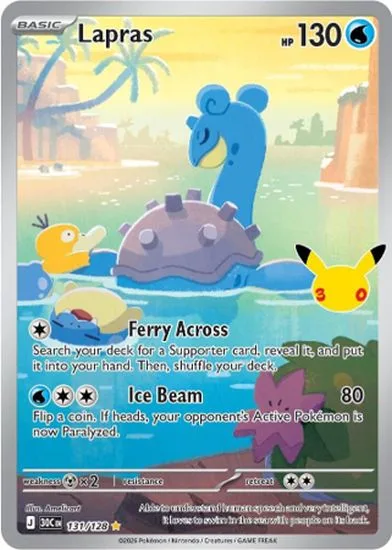
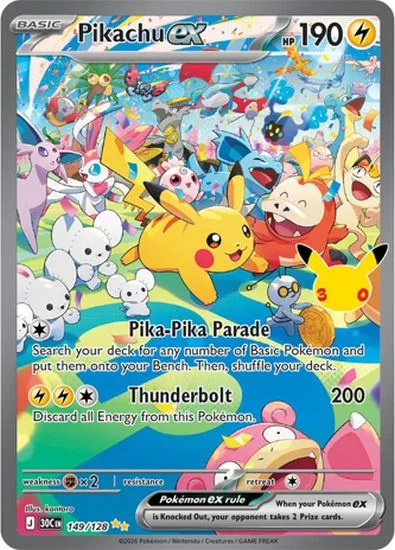
Moltres (11/128) is listed as a Common. Ho-Oh (12/128) is a Rare. Greninja ex (21/128) is a Double Rare. Cards above the 128-card main set numbering, such as Lapras (131/128) and Pikachu ex (149/128), sit in more premium rarity tiers including Illustration Rare and Special Illustration Rare territory.
That means the hierarchy still exists exactly where it matters most for supply and desirability. Collectors just cannot rely on foil treatment to read the room anymore because every card carries a premium finish.
In practical terms, that should change how people open the product. Usually, a shiny card can instantly feel like it belongs in a separate pile. With 30th Celebration, the better move will be to check set number, rarity symbol, and subset placement before assuming a card belongs in a higher-value category. The shine is universal. The scarcity is not.
What collectors and sellers should watch after release
The first few weeks after release should reveal how quickly the market adapts. Bulk buyers will likely be forced to clarify their policies on 30th Celebration sooner than later, especially if sellers begin submitting large quantities of all-holo Commons and Rares that do not fit normal sorting templates.
Collectors should also pay close attention to which parts of the release hold demand once the opening rush settles. The chase cards are likely to dominate early attention, but the more revealing market signal may come from the cards that do not headline social posts and break videos. If standard lower-rarity holos begin moving at very low single-card prices, it would confirm that the foil layer is not creating a meaningful floor by itself. If the Energy cards, Pikachu subset, or Classic Collection pieces stay stronger than expected, that would show where anniversary-specific collector demand is concentrating.
There is also a wider lesson here for future sealed products. If 30th Celebration performs well as an all-holo experience, more special sets could lean into this kind of full-premium presentation. When that happens, the hobby may need to become more careful about separating appearance from rarity. In this release, those two ideas no longer mean the same thing, and that is what makes the set so interesting once the pack-opening excitement gives way to actual market behavior.
Photo Gallery