A $229 Eddie Collins card and a $6,000 Stan Musial rookie can both offer relative value. The question isn’t whether either card is cheap in isolation. It’s what collectors paid for a comparable card of another star and what they get for the difference.
For this OTIA Top 3, the comparisons use reported sales of cards from the same set in the same PSA grade. That gives collectors a clearer starting point than comparing a high-grade parallel with a lower-grade base card. It doesn’t make every pair equivalent: rookie status, scarcity, player demand and the appeal of a particular card can still move prices. These are individual sales, not price guarantees or predictions. What they show is how differently the hobby can price players with similarly exceptional résumés.
1. Eddie Collins: A Prewar Great at Several Price Points
Eddie Collins collected 3,315 hits, stole 741 bases and batted .333 across 25 seasons. He finished with 123.7 career wins above replacement, ahead of Ted Williams, Lou Gehrig and Mickey Mantle by that measure. That puts his career in rare company, but collectors don’t have to pay the biggest names’ prices to add him to a prewar collection.
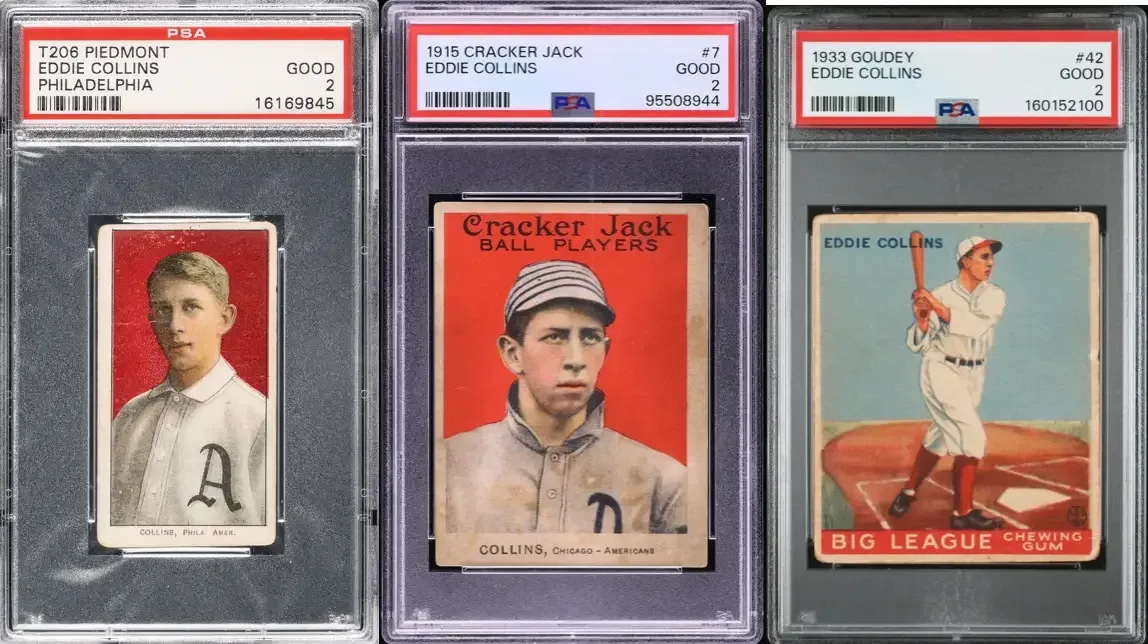
- 1909–1911 T206, PSA 2: Eddie Collins sold for $661; Nap Lajoie (Portrait) sold for $1,020.
- 1915 Cracker Jack, PSA 2: Eddie Collins #7 sold for $1,850; Shoeless Joe Jackson #103 sold for $92,000.
- 1933 Goudey, PSA 2: Eddie Collins #42 sold for $229; Jimmie Foxx #29 sold for $1,103.
The T206 pair makes the cleanest case for Collins as a relative value. Lajoie is another all-time great at second base, and the listed Collins sale came in $359 lower in the same grade. That’s a more useful comparison for a collector choosing between stars at the position than the enormous gap in Cracker Jack. Jackson’s $92,000 result shows how much demand can concentrate around a particular player and card; it doesn’t make $1,850 an inexpensive purchase.
For more collector background, read 7 Most Valuable and Iconic 1987 Fleer Baseball Cards to Know Right Now.
The Goudey offers a different way in. At $229 in PSA 2, it was the least expensive Collins card in these comparisons and sold for roughly one-fifth of the Foxx from the same set. A collector who wants one graded Collins card can start there without taking on the cost of the T206 or Cracker Jack. For any of the three, compare photos as well as grades: two PSA 2 cards can present quite differently, especially when centering, creases or print quality matter to the buyer.
2. Stan Musial: Modest Topps Prices and a Premium Rookie
Stan Musial’s 3,630 hits split perfectly between home and road: 1,815 apiece. He hit .331 over his career, won seven batting titles and earned three MVP awards. Musial spent his entire career in St. Louis, and his cards give collectors a way to buy a hitter of that caliber without always paying the premiums attached to Mickey Mantle, Hank Aaron or Joe DiMaggio.
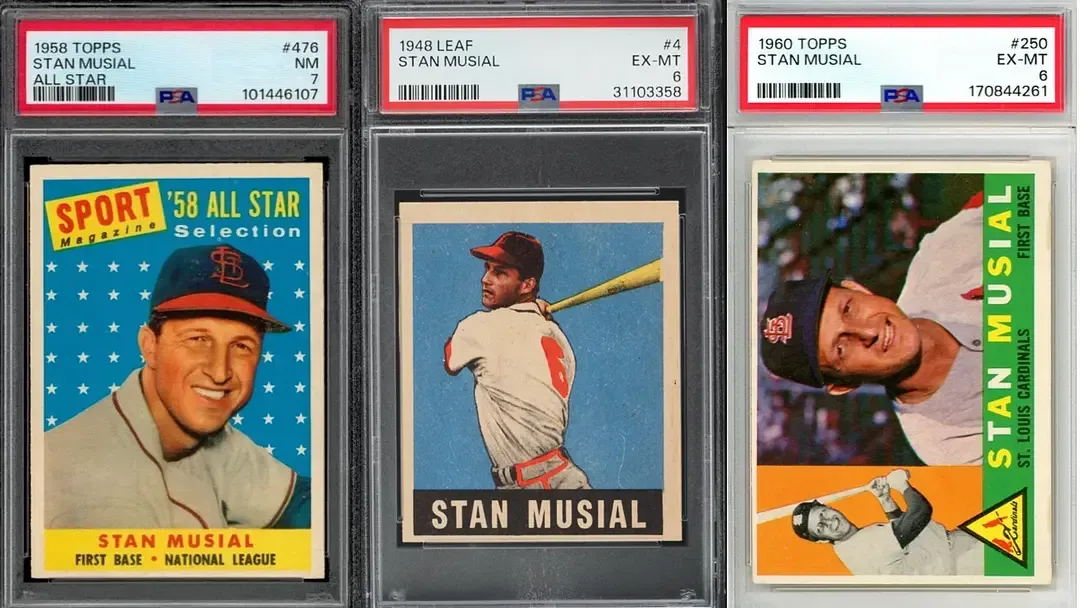
- 1958 Topps All-Star, PSA 7: Stan Musial #476 sold for $188; Mickey Mantle #487 sold for $1,100.
- 1960 Topps, PSA 6: Stan Musial #250 sold for $210; Hank Aaron #300 sold for $652.
- 1948 Leaf, PSA 6: Stan Musial rookie #4 sold for $6,000; Joe DiMaggio #1 sold for $9,040.
The 1958 Topps comparison is especially useful because both cards are All-Star issues. The Musial sold for about one-sixth of the Mantle at the same grade. The 1960 Topps card offers another route at a similar dollar amount: for $22 more in these sales, a buyer could choose a regular set card rather than an All-Star issue, albeit in PSA 6 instead of PSA 7. Both are examples of vintage Musial cards selling near $200, rather than evidence that every Musial issue is affordable.
The 1948 Leaf rookie belongs in a different budget. At $6,000, it’s the most expensive Musial card in this comparison, and its sale still came in $3,040 below DiMaggio’s card. The Leaf pair matches set and grade, not rookie status, so the result is best read as a snapshot of how collectors priced two marquee cards from the set. It’s useful for someone building a 1948 Leaf collection or shopping specifically for Musial’s rookie, but it doesn’t tell a buyer what premium to pay for the rookie over his later Topps cards.
3. Greg Maddux: High-Grade Topps Cards Without Nolan Ryan Prices
Greg Maddux won 355 games, took home four consecutive Cy Young Awards from 1992 through 1995 and earned a record 18 Gold Gloves. He remains the only major league pitcher to reach 300 wins and 3,000 strikeouts while issuing fewer than 1,000 walks. His 78-pitch complete game against the Cubs in 1997 captures what made him distinctive: he could get through an entire lineup repeatedly without needing deep counts or a big strikeout total to control the game.
Nolan Ryan is a useful hobby comparison because collectors can find both pitchers in the same premium issues. All three pairs below are graded PSA 10, and each compares like versions rather than a Maddux base card against a Ryan parallel.
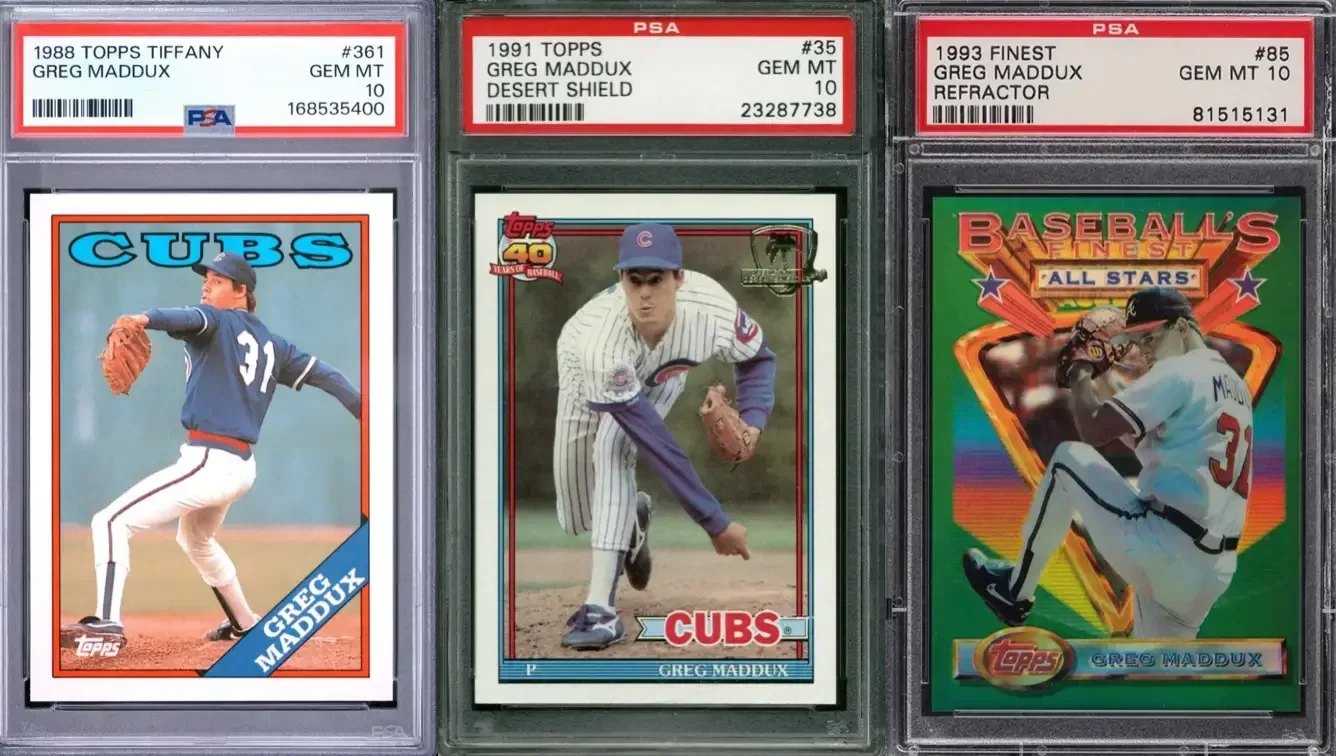
- 1988 Topps Tiffany, PSA 10: Greg Maddux #361 sold for $225; Nolan Ryan #250 sold for $634.
- 1991 Topps Desert Shield, PSA 10: Greg Maddux #35 sold for $1,125; Nolan Ryan #1 sold for $5,160.
- 1993 Topps Finest Refractor, PSA 10: Greg Maddux #85 sold for $3,825; Nolan Ryan #107 sold for $36,000.
The 1988 Tiffany is the most approachable Maddux card here. The $225 sale gives collectors a concrete reference point for a PSA 10 from early in his career. The Desert Shield sale crosses into four figures, but the Maddux still sold for less than a quarter of the Ryan. The Finest Refractor has the largest gap: Ryan sold for more than nine times as much. That comparison is striking, but the Maddux itself sold for nearly $4,000, so it’s a relative value only for someone already shopping for a high-grade early Refractor.
When searching sold listings, match the complete issue name as well as the card number and grade. For Maddux #361, use Tiffany sales rather than standard 1988 Topps sales. For #35, look for Desert Shield, and for #85, compare Refractors rather than base Finest cards. Those distinctions matter more to a buying decision than the size of the gap between Maddux and Ryan in any single sale.
Photo Gallery