Three weeks into the 2026 NFL season, the hobby is already juggling a familiar tension: production today versus upside tomorrow. Undefeated starts, early MVP chatter, and breakout skill-position numbers are reshaping how collectors view key football cards, especially in a market that tends to move quickly on quarterbacks and much more cautiously on everyone else.
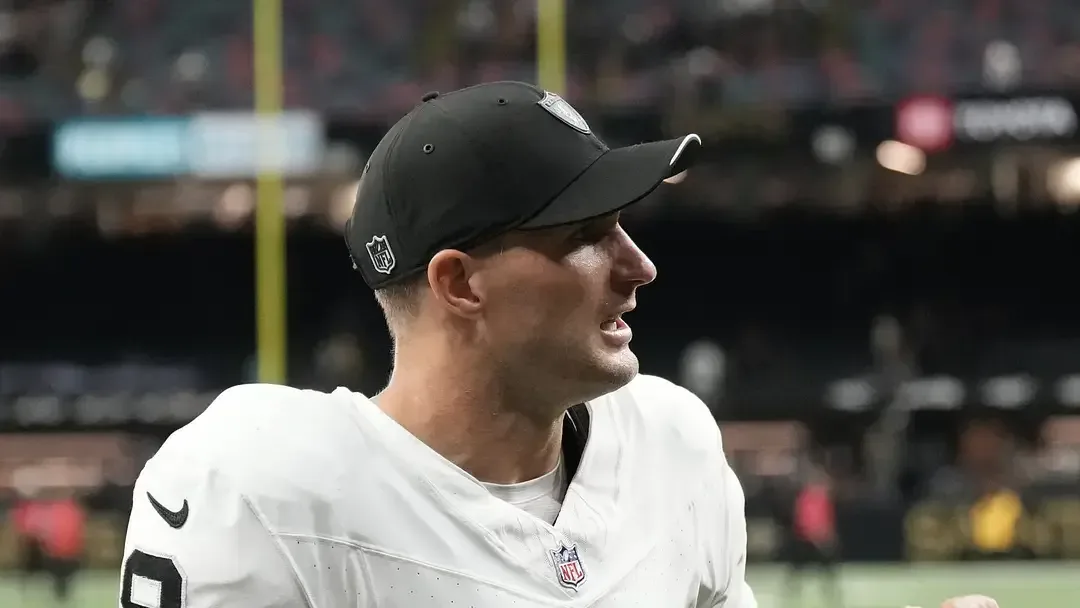
The biggest surprise so far sits in Las Vegas. The Raiders are 3-0, Kirk Cousins is playing efficient football, and the timeline many collectors had in mind for No. 1 pick Fernando Mendoza suddenly looks much less certain. At the same time, elite early-season production from Bijan Robinson and Jahmyr Gibbs is putting running backs back into the conversation, while Josh Allen continues to test whether dominant regular-season play alone can push his market meaningfully higher.
Here is what stands out from Week 3 and what it could mean for football card values moving forward.
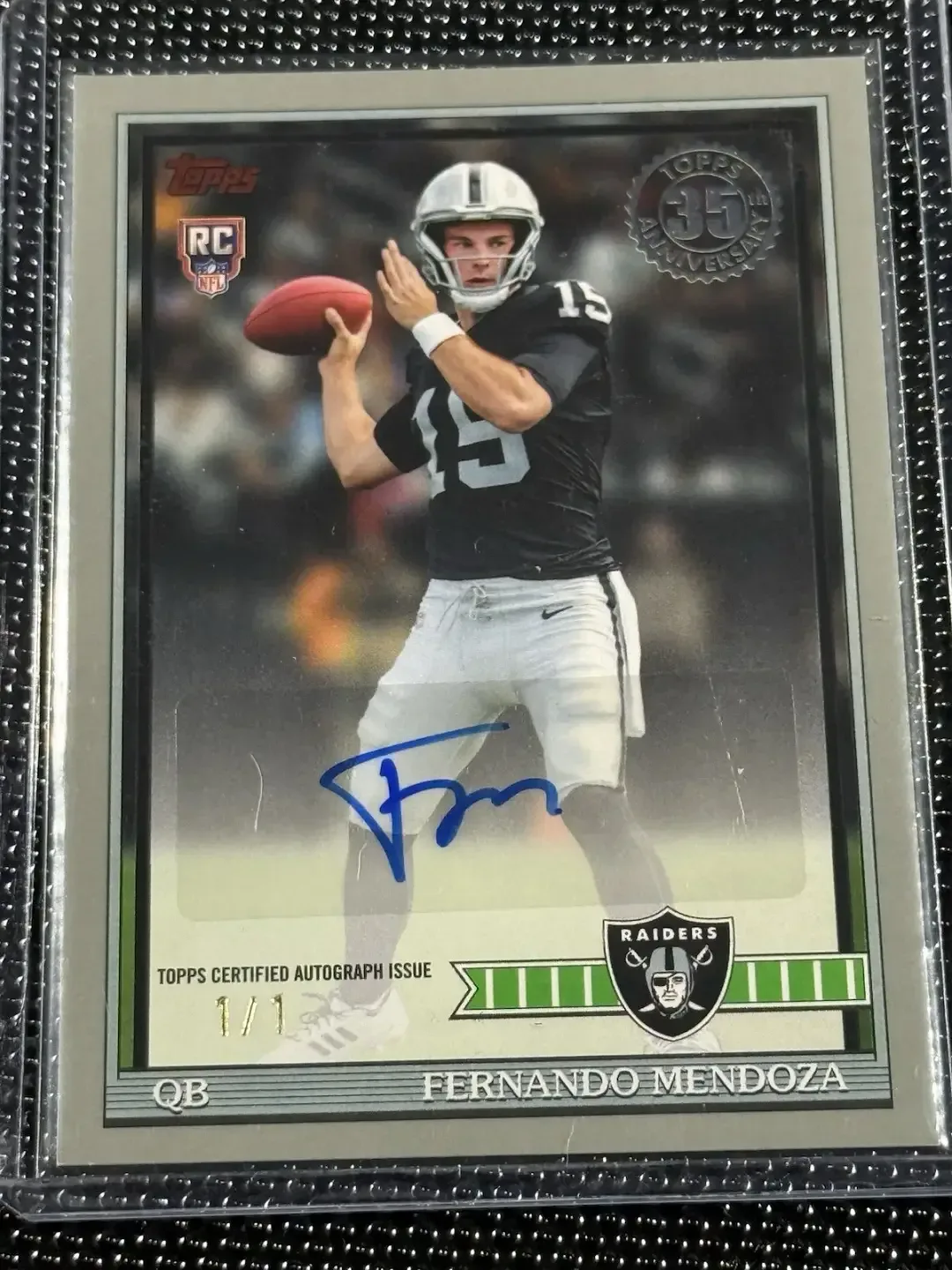
The Raiders' 3-0 Start Changes the Fernando Mendoza Conversation
The Raiders entering Week 4 undefeated is one of the most unexpected developments of the season. For a franchise that has struggled to string together sustained success in recent decades, a 3-0 opening matters on its own. In hobby terms, it matters even more because it directly affects the timing of Fernando Mendoza's debut window.
For more collector background, read NFL Rookie Card Market After Week 3: 20 Players Collectors Are Watching Closely.
Mendoza came into the year as one of the hobby's most watched rookies, and for good reason. He has been one of the key names helping support a 2026 rookie class that has not been viewed as especially deep at the top. Add in the increased attention around Topps' licensed football push, and Mendoza quickly became one of the most important rookie-market tests of the season.
The original collecting thesis was straightforward. If the Raiders hit turbulence early, Mendoza's path to the field could open sooner rather than later. More playing time would likely lead to more attention, more transactions, and the kind of sharp price acceleration modern rookie quarterbacks often get once the live-game speculation phase becomes an on-field reality.
That script has been interrupted by Cousins and the Raiders' early success.
For another perspective on this story, read Raiders Start, RB Surge and Josh Allen Define Week 3 Card Market.
Cousins has thrown three touchdown passes in each of the team's first three games, and the offense has looked comfortable in Klint Kubiak's system. When a veteran quarterback is producing that efficiently and the team is winning, there is little incentive to force a transition. That creates a strange short-term environment for Mendoza collectors. The long-term ceiling remains intriguing, but the immediate catalyst many were waiting for has been delayed.
That does not automatically make Mendoza a weak hold. In some ways, the opposite may be true. A slower runway can prevent an overextended rookie market from overheating too soon. If Mendoza eventually takes over later in the season, he could step into a more stable offensive environment, potentially with a playoff chase still relevant. That would give his first starts far more weight than they might have carried on a struggling team already out of contention.
There is also the ripple effect on the rest of the Raiders' offensive core. If collectors believe the system is real and the infrastructure is working, surrounding skill players benefit as well. Ashton Jeanty and Brock Bowers have already delivered impact moments early in the season, and continued team success can strengthen demand for cornerstone pieces attached to an offense that looks more viable than expected.
For now, Mendoza's market appears to be stuck between excitement and patience. He still profiles as one of the most important rookie bets in the sport, but his next major price move probably needs either a clear path to starts or a much stronger wave of long-term confidence from collectors willing to buy the wait.
Why the Mendoza Delay Is Not Necessarily Bad for Collectors
Quarterback rookies are often judged too quickly in the modern card market. If they play early, prices can jump on anticipation before a player has even proven anything. If they sit, the hobby sometimes interprets that as stagnation. Neither reaction always reflects the best longer-term opportunity.
With Mendoza, there is a real case that delayed playing time could preserve the strength of his market rather than damage it. The reason is simple: mystery still sells, and so does situation. If his eventual debut comes after weeks of offensive success under Cousins, collectors can talk themselves into the idea that Mendoza is stepping into a setup built for immediate numbers.
That potential matters because his market has already been elevated relative to much of the 2026 class. When a player is carrying this much rookie attention, the first true slump can hurt just as much as the first breakout helps. A later debut, especially one tied to meaningful games, could keep the runway cleaner.
Collectors should also remember that market timing and football timing are not always aligned. A player can be more valuable as a card asset in weeks when he is not even starting if the expectation of what is coming remains strong. Mendoza still holds that kind of anticipation. The Raiders simply have not given the hobby a reason to cash it in yet.
Bijan Robinson and Jahmyr Gibbs Are Forcing the Hobby to Reconsider Running Backs
The running back position has spent years fighting an uphill battle in the card market. Even great players at the position usually struggle to command the kind of sustained attention quarterbacks receive, and many collectors have treated running backs as short-window assets tied to highlights rather than long-term collecting priorities.
Week 3 offered a reminder that extraordinary production can still break through that bias.
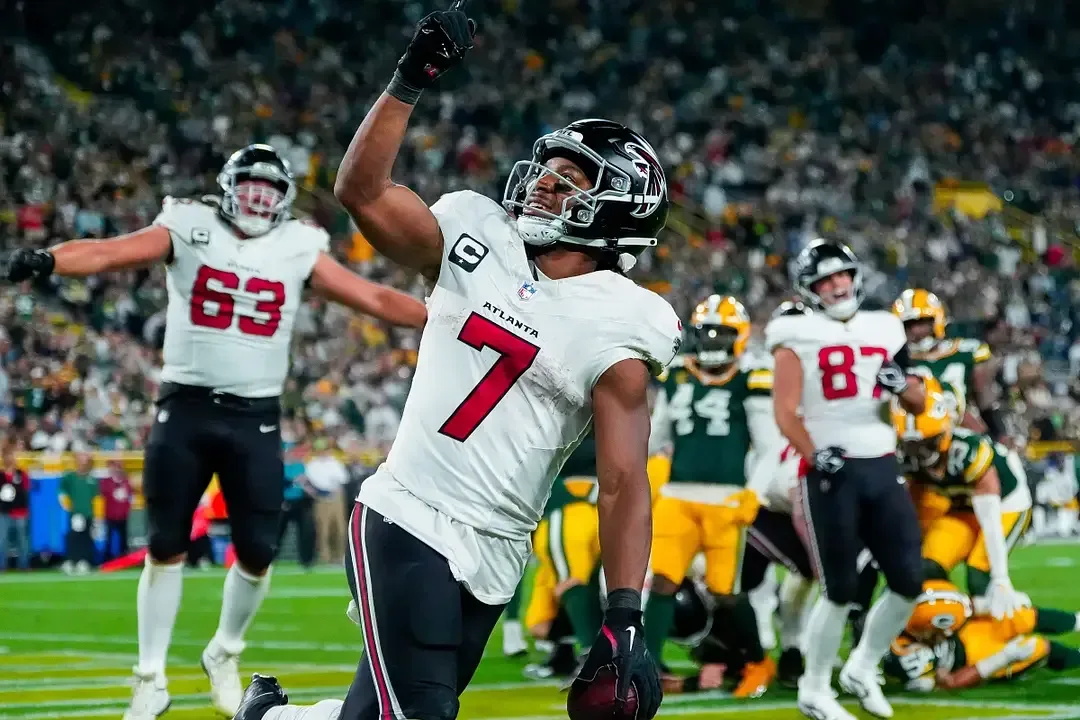
Bijan Robinson has piled up 467 total yards through three games. Jahmyr Gibbs has been nearly as productive with 463 total yards while adding six touchdowns. Together, they are producing at a historically significant pace to open the year, trailing only a tiny handful of legendary starts in post-merger context.
That kind of output is not just impressive on the field. It gives the hobby a reason to engage with a position it often sidelines.
Robinson's rise has been especially notable because Atlanta needed spark early, and his production gave collectors something tangible to chase even before the offense found more balance. Gibbs has benefited from a different kind of narrative. Detroit's defense has left the door open for high-volume offensive game scripts, and Gibbs has turned that environment into touchdown-driven market strength.
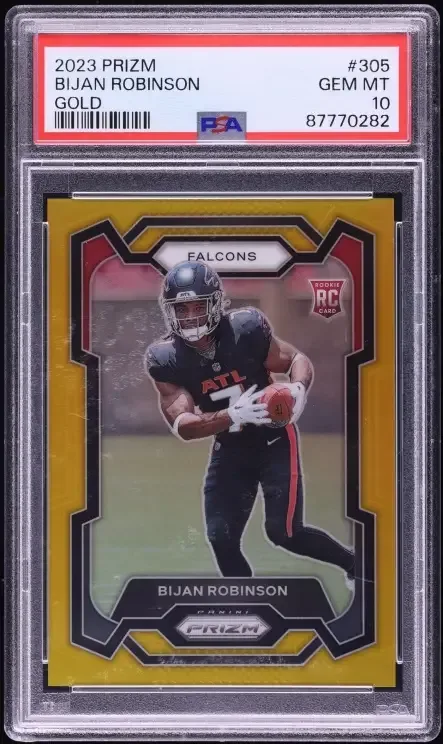
The card sales reflect the momentum. Robinson's 2023 Silver Prizm PSA 10, which had been selling in roughly the $150 to $180 range during the summer, has now recorded multiple sales around $220. Gibbs' 2023 Silver Prizm PSA 10 has moved even higher, climbing from around $200 in the summer to multiple recent sales near $300.
Those are meaningful jumps, especially for players at a position that many collectors still hesitate to treat as a core investment lane. The question now is whether this is a short-term spike or the beginning of a broader running back re-rating.
What Makes the Robinson and Gibbs Markets Different Right Now
Not every hot start translates into durable card demand. In the case of Robinson and Gibbs, though, there are reasons their movement looks more substantial than a single-week reaction.
First, both players have draft pedigree and hobby familiarity already built in. These are not obscure breakouts coming from nowhere. The market knows them, recognizes the talent, and has prior sales history to compare against.
Second, their production is not coming through a narrow stat line. Robinson is winning with all-purpose yardage. Gibbs is winning with both yardage and touchdowns. That gives each collector base a different path to conviction. One can be sold on versatility and centrality to the offense, while the other can be sold on game-breaking scoring upside.
Third, both players are attached to narratives larger than individual box scores. Robinson represents the case for an elite back being able to carry an offense when the rest of the unit is still finding itself. Gibbs represents the explosive engine of a team that still expects to matter in the playoff race. When the hobby can frame a player as either the identity of an offense or a featured star on a contender, values tend to hold better.
This does not mean running backs are about to close the hobby gap with quarterbacks. It does mean the best backs can still produce real, measurable gains when performance becomes impossible to ignore.
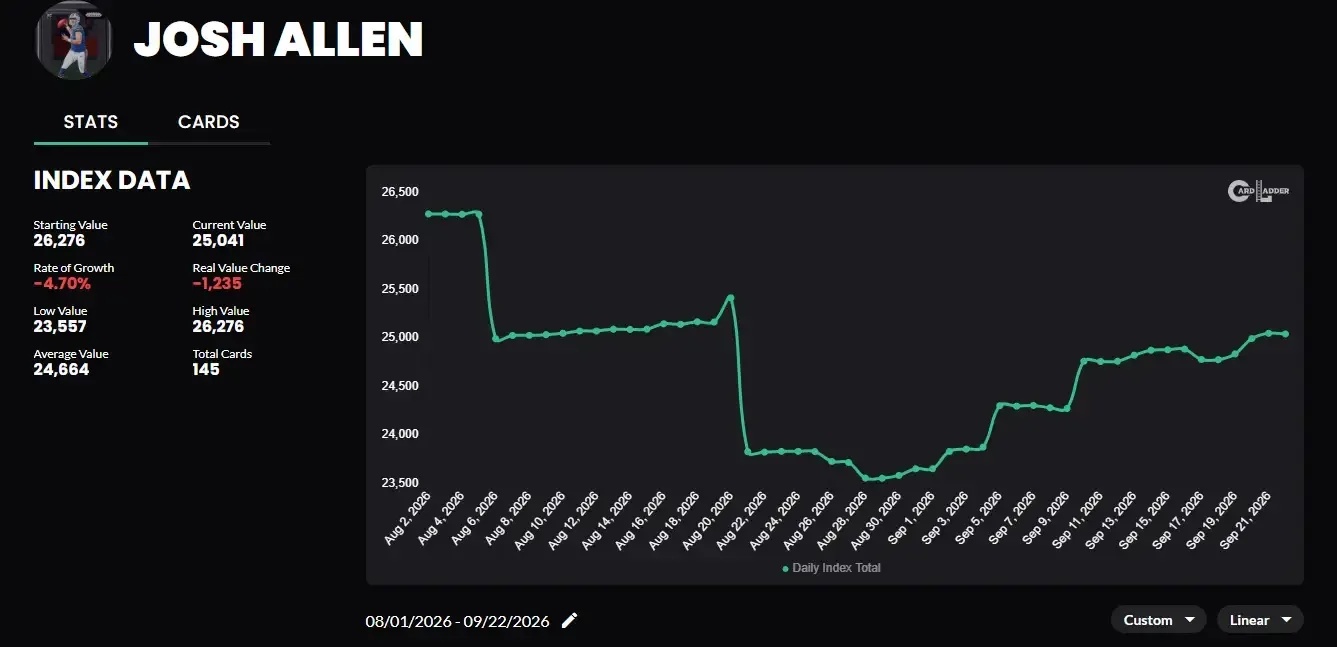
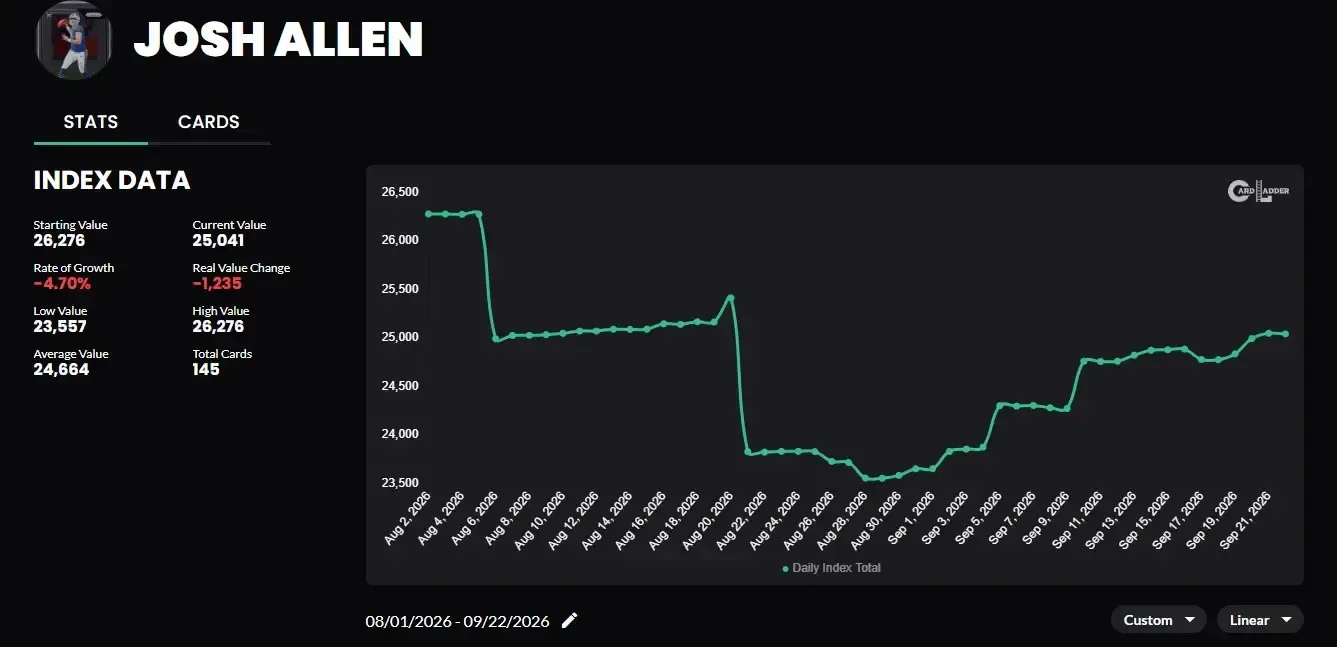
Josh Allen Is Still One of the Most Interesting Tests in the Football Card Market
If the Raiders and the running backs represent fresh early-season stories, Josh Allen represents a more established debate. Few stars are easier to believe in on the field and harder to fully price in the hobby.
Allen's regular-season track record is already elite. Buffalo is undefeated through three weeks, the offense looks strong, and he has quickly placed himself at the center of the MVP conversation. The Bills also sit among the top Super Bowl favorites, giving collectors the exact kind of team-level support they usually want around a premium quarterback.
And yet the market remains measured.
That restraint says a lot about where Allen stands as a card asset. Collectors are not waiting to be convinced he is excellent. They are waiting to see whether excellence leads to the postseason breakthrough that would elevate him into a different pricing tier. For many hobby participants, Allen's path to a much larger jump still runs through a Super Bowl appearance or title.
That can create an interesting opening during the regular season. When a player is performing at an MVP level, leading one of the league's best teams, and still not receiving the kind of full repricing that usually follows those conditions, selective value hunting becomes easier to justify.
The Bills' upcoming stretch could matter a great deal here. If Buffalo stays undefeated deep into the season, especially through notable matchups with top competition, the hobby may have a harder time holding Allen in a waiting pattern. Signature regular-season wins can only do so much, but enough of them can change the tone around a market that has been cautious for a long time.
There is also a schedule argument in play. If Buffalo clears the early hurdles and remains in strong position heading into the middle and later portions of the season, collectors may begin pricing in not just MVP potential but playoff positioning. The closer a team gets to a favorable path in January, the more its quarterback tends to benefit from speculative momentum.
Why Allen's Market Still Has a Different Ceiling Than Mahomes
One of the clearest truths in football cards is that championships create separation. Patrick Mahomes has already reached a level where his hobby standing is supported by hardware, legacy projection, and collector trust. Allen is admired, heavily collected, and regularly spectacular, but he does not yet have the same immunity from postseason scrutiny.
That does not make Allen a weak market. It makes him one of the most revealing markets. He may be the best example of how much regular-season dominance can matter in an era where the hobby increasingly prices legacy in real time.
If Allen continues to stack elite numbers and Buffalo keeps winning, his cards should remain active. Whether they make a major leap before the playoffs is the bigger question. Some collectors will continue to wait for January proof. Others may decide that a player with sustained MVP-level production on one of the AFC's strongest teams is worth buying before the most expensive part of the story arrives.
What Collectors Should Watch After Week 3
The next wave of movement around these players will likely depend on catalysts rather than broad sentiment alone.
For the Raiders, the key question is whether Cousins can keep the offense humming long enough to turn Mendoza from immediate rookie chase into longer-term stash. Every win makes that dynamic more interesting, not less.
For Mendoza, collectors should watch for signs of whether the market stays patient or starts discounting the delayed debut. If his cards remain firm without starts, that would be a strong signal that belief in his long-term role is still intact.
For Robinson and Gibbs, the focus shifts to sustainability. If both continue producing at this pace, more collectors may have to admit the running back position can still create serious hobby momentum under the right conditions. Their flagship rookies, especially graded chromium staples, will remain important measuring sticks.
For Allen, it is about whether the market finally reacts before the postseason. If Buffalo keeps stacking wins and he stays near the top of the MVP board, the gap between performance and pricing becomes harder to ignore. That tension could turn his cards into one of the season's most closely watched quarterback markets by midyear.
Week 3 did not completely rewrite the football hobby, but it did sharpen several key debates. The Raiders have created a winning problem around Fernando Mendoza, elite running backs are earning fresh respect from buyers, and Josh Allen remains the best test case for how far regular-season greatness can carry a modern quarterback market.
Photo Gallery