Jason Williams remains one of the most unforgettable players of the late 1990s and early 2000s, and that lasting popularity continues to show up in the card market. His flashy style, fearless passing, and nightly highlight-reel moments made him a collector favorite during his Sacramento Kings breakout, and demand for key cards from that era has stayed remarkably strong.
For collectors, Williams offers a little bit of everything. There are recognizable 1998 rookie cards, genuinely scarce NBA-licensed rookie autographs, early memorabilia cards tied to his Kings years, and a handful of high-end grails that have reached major price levels in recent sales. The result is a market driven less by Hall of Fame resume building and more by cultural impact, fan nostalgia, and the kind of on-court creativity that still gets rediscovered by younger basketball fans.
Why Jason Williams Still Connects With Collectors
Williams carved out a place in hobby memory that goes beyond traditional stat lines. As the No. 7 pick in the 1998 NBA Draft, he arrived with instant personality and quickly became one of the league's most watchable guards. His no-look feeds, behind-the-back deliveries, and deep pull-up confidence made him a fixture on sports highlight shows and a fan favorite in Sacramento.
That style matters in the memorabilia and card world. Not every player needs MVP trophies or all-time scoring totals to build a resilient collector base. Williams is a strong example of how hobby demand can thrive on entertainment value, identity, and a memorable peak. Collectors who grew up watching him still chase his best cards, while newer buyers often discover him through old clips that continue to circulate online.
For more collector background, read Josh Allen and Patrick Mahomes Share Top Spot in This Week’s Biggest Football Card Sales.
The nickname White Chocolate still carries real hobby power, especially for Kings-era material. That has helped keep demand alive across multiple tiers of the market, from affordable inserts and memorabilia pieces to low-pop rookies and one-of-one modern autographs.
1998 Rookie Cards Remain the Entry Point
Williams' rookie-year cards anchor his market, and the 1998 releases remain the easiest way for collectors to connect with his earliest NBA buzz. Many of those cards were built around fairly standard photography, especially compared with the chaos and flair he brought to actual games, but that has not hurt demand.
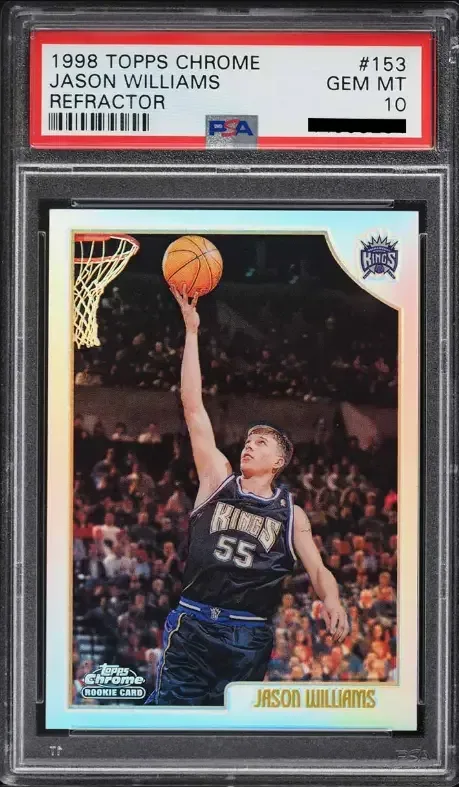
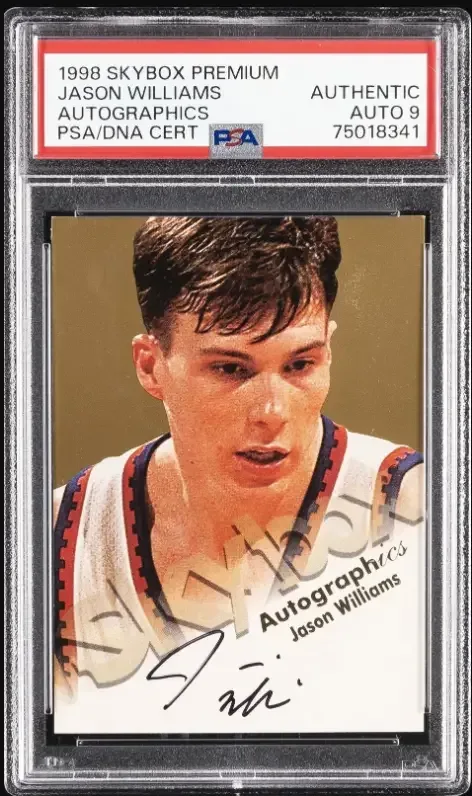
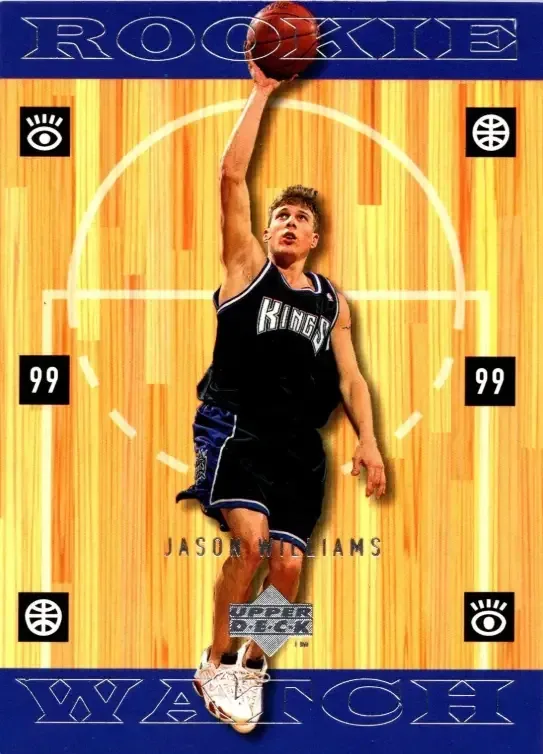
Some of his most recognizable rookie cards come from 1998 Topps, Topps Finest, and Topps Chrome. The imagery on those flagship issues is more traditional, with Williams pictured going up for a finger roll. Other rookie cards, including releases from SkyBox and Upper Deck, use posed photo-shoot images showing him in a blank Kings jersey before he officially adopted No. 55.
That pre-No. 55 look has become part of the charm. It captures a transitional moment before his identity was fully cemented, and collectors of late-1990s basketball often appreciate those small era-specific details.
The biggest movement has come in higher-grade 1998 Topps Chrome copies. Over the past year, several grades and parallels have posted strong gains, reflecting a market that still responds when scarce or clean examples surface.
Key 1998 Topps Chrome sales
- 1998 Topps Chrome Jason Williams Rookie Card PSA 10 last sold for $5,759.
- 1998 Topps Chrome Refractor PSA 9 sold for $1,500 on October 30, a record high.
- 1998 Topps Chrome Refractor PSA 10, with a population of 12, rose from just under $3,000 to $5,759 over the same span.
- 1998 Topps Chrome base PSA 10 reached $239 on September 5.
- 1998 Topps Chrome base PSA 9 moved from $32 to $70.
Those numbers show two important things. First, the premium for condition remains very real with late-1990s chromium cards. Second, even non-superstar names can break out when the player has a devoted fan base and the key rookie issues are visually iconic within the era.
Scarcity Gives His Early Autographs Extra Appeal
One of the most interesting parts of the Jason Williams market is how limited his early certified autograph output was. In an era when modern prospects often sign hundreds of pack-issued cards before even establishing themselves professionally, Williams' NBA-licensed rookie autographs are surprisingly scarce.
He has only three NBA-licensed rookie-year autograph cards:
- 1998 SkyBox Autographics Black Ink
- 1998 SkyBox Autographics Blue Ink /50
- 1998 Upper Deck Ionix UD Authentics
That small autograph footprint gives his rookie signatures a very different profile from modern releases. Instead of navigating endless parallel trees and large checklists, collectors are dealing with a highly focused group of early certified autographs that feel meaningfully limited.
Recent sale ranges reinforce that point. Raw and PSA 9 examples of the black-ink SkyBox Autographics and the Ionix UD Authentics have sold in roughly the $150 to $170 range, while the tougher blue-ink SkyBox Autographics parallel numbered to 50 recently climbed past $1,800 at auction.
For collectors who prioritize signature scarcity, that blue-ink version stands out as one of the more important Jason Williams cards on the market. It combines rookie-year timing, NBA licensing, a popular autograph brand, and a low serial number.
Autographs Disappeared for Years, Then Returned
Williams' autograph timeline is unusual, which helps explain why certain signed cards get extra hobby attention. After his rookie season, collectors had to wait nearly three years for another pack-issued autograph, which arrived in 2002 Stadium Club Lone Star Signatures.
He later appeared on more signed cards during his Memphis Grizzlies and Miami Heat years, but the broader autograph run never became especially deep by modern standards. Then came a much longer gap. Despite remaining popular with collectors after retirement, Williams went away from pack-issued autograph products for roughly a decade.
That changed in 2017-18 when he returned in Panini National Treasures. Since then, he has appeared in a range of Panini and Leaf products, adding more modern options for collectors who want hard-signed or premium-signed cards without paying rookie-auto prices.
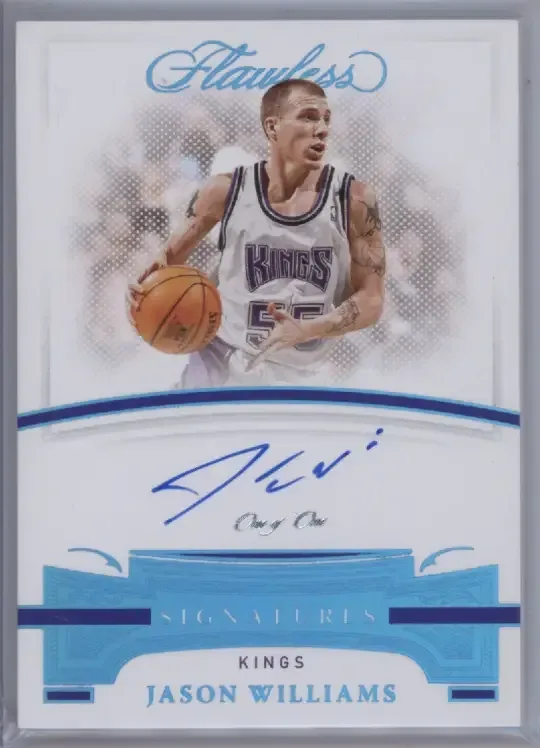
Several of those modern one-of-one autographs have crossed the $2,000 mark, including a 2020 Flawless Signatures Platinum and a 2024 Prizm Black Nebula FOTL Legends Autograph. Those results show that his market is not limited to late-1990s nostalgia alone. There is also real strength in premium modern releases, especially when the card is a true one-of-one with strong eye appeal.
Memorabilia Cards Capture the Kings Era
Williams also has a notable place in the early memorabilia-card era, and that gives collectors another lane to chase. For many fans, memorabilia cards tied to his Sacramento years hold special appeal because they connect directly to the stretch when he became a national sensation.
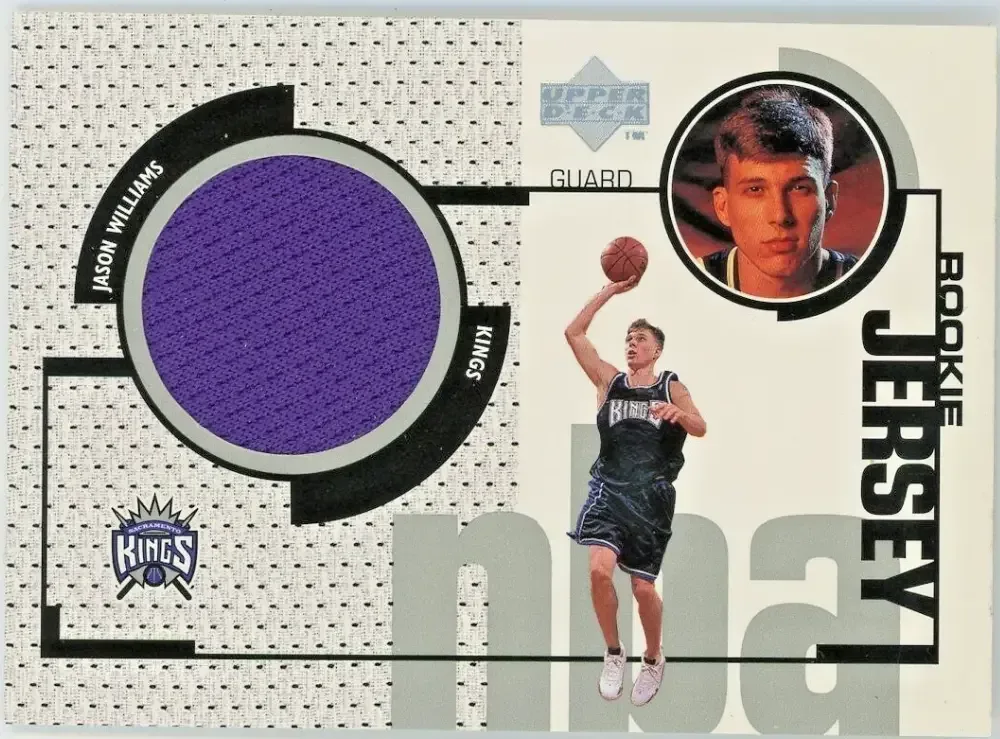
One of the most important issues is the 1998-99 Upper Deck Game Worn Jerseys / Rookie Jerseys card, which contains pieces from the Kings uniform he wore at his rookie photo shoot. Purple and black swatches from that release have become especially desirable, partly because they are tied so closely to his rookie identity and visual brand in Sacramento.
Recent pricing has been strong. A raw copy sold for $1,200 on November 17, and a PSA 9 copy most recently finished at $1,950 in a public eBay auction. For a memorabilia card from that era, those are impressive numbers and another signal that Williams' collector base remains active.
There is also a bit of historical context that makes this card more compelling. At one point during his early rise, Williams' No. 55 jersey reportedly ranked second in NBA merchandise sales behind only Kobe Bryant's No. 8. That kind of fan demand helps explain why Kings-era memorabilia cards continue to resonate.
Later Upper Deck and Fleer products expanded the memorabilia mix, featuring not only fabric swatches but also pieces of basketballs, nets, and court floors from games tied to Williams. These cards give collectors a more affordable path into his memorabilia category.
Notable memorabilia themes in Jason Williams cards
- Rookie photo-shoot jersey swatches from 1998-99 Upper Deck releases
- Game-used basketball pieces in later Upper Deck and Fleer products
- Court floor and net relic cards from turn-of-the-century insert programs
- Low-numbered parallels that can bring significant premiums over standard versions
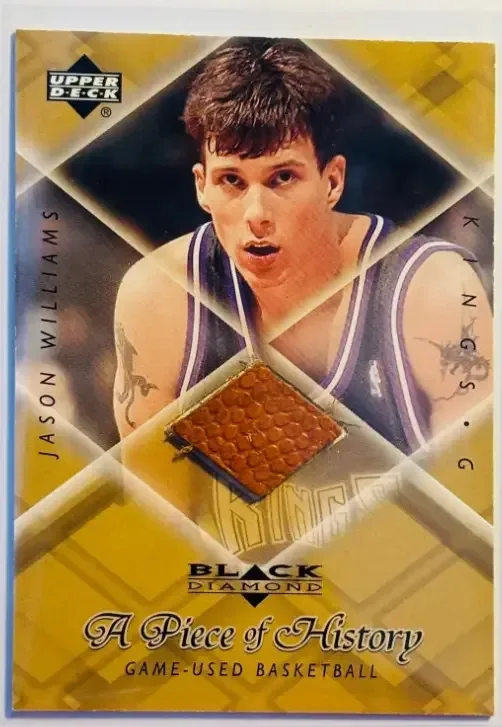
Many of those basketball relic cards, including 1999 Upper Deck Black Diamond A Piece of History, can still be found in the $20 to $30 range, while scarcer parallels have reached around $300. That makes this corner of the market especially interesting for collectors who want something unique without jumping immediately into four-figure territory.
High-End Grails Are Reaching New Levels
At the top of the market, Jason Williams has already shown he can produce major sales when the right card surfaces. Three of his four biggest public card sales have come within the past 12 months, a sign that interest is not fading as more collectors revisit late-1990s and early-2000s basketball.
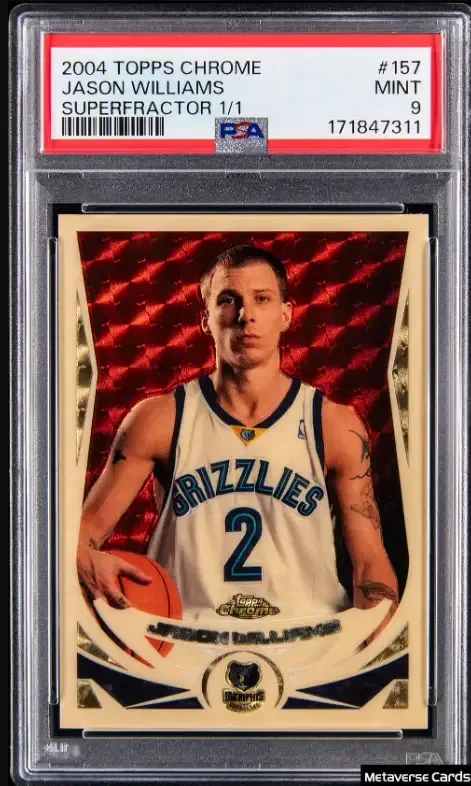
The current benchmark public sale is a PSA 9 2004 Topps Chrome SuperFractor #157, a one-of-one that sold for $23,180 in a Goldin auction on August 15. That figure sits nearly $9,000 above any other publicly recorded Williams card sale mentioned in the available sales history.
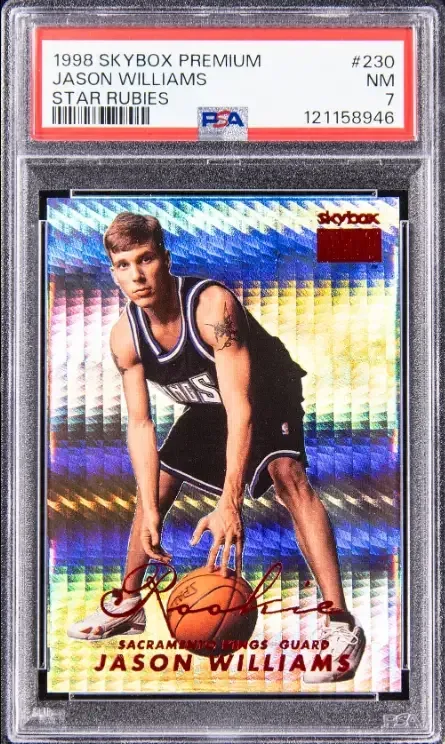
Another major hobby name in his catalog is the 1998 SkyBox Rubies, serial-numbered to 25. Two PSA 7 copies have sold around the $13,000 level, with the most recent example bringing $13,200. Rubies cards from the late 1990s carry strong brand prestige on their own, and pairing that with Williams' rookie-year aura creates a natural grail for set builders and player collectors.
These sales illustrate that Williams has a meaningful ceiling in the hobby. He may not have the all-time résumé of the biggest basketball legends, but rare late-1990s and early-2000s premium cards can still perform at an elite level when scarcity, visual strength, and player nostalgia line up.
Game-Worn Memorabilia Has Its Own Lane
Cards are only one side of the Williams market. His game-worn memorabilia has also shown the ability to command serious money, particularly when tied to his Kings rookie season. In January 2026, a photo-matched and authenticated white Kings jersey from that rookie year sold privately for $140,000.
That sale represents the highest known price paid for a Jason Williams memorabilia item and offers a useful signal for collectors evaluating the broader market around his best cards. When top-end memorabilia reaches six figures, it often reflects a player whose cultural impact extends beyond standard collecting niches.
For Williams, that impact is rooted in style and memory. His best material captures a very specific moment in basketball history, when improvisation, flair, and personality made him one of the sport's most talked-about young stars.
What Collectors Should Watch Next
The Jason Williams market appears strongest in four specific areas: high-grade 1998 Topps Chrome rookies, scarce NBA-licensed rookie autographs, standout Kings-era memorabilia cards, and true high-end rarities such as SuperFractors and Rubies. Those are the segments most likely to lead future price movement.
Collectors should also keep an eye on population dynamics. Cards like the Topps Chrome Refractor PSA 10 remain especially sensitive to supply because of how few top-grade copies exist. When even one or two strong sales land publicly, the market can shift quickly.
Meanwhile, his autograph market remains more nuanced than that of many retired stars. The early certified signed cards have scarcity and era appeal, while modern one-of-ones bring a different kind of premium tied to brand, patch quality, and design. Buyers who understand the difference between those two markets can navigate Williams more effectively.
For anyone building around late-1990s basketball nostalgia, Jason Williams still offers one of the hobby's most entertaining collecting paths. His best cards capture a player whose appeal has outlived his playing days, and the recent sales data suggests collectors are still willing to pay up for the pieces that best represent the White Chocolate era.
Photo Gallery