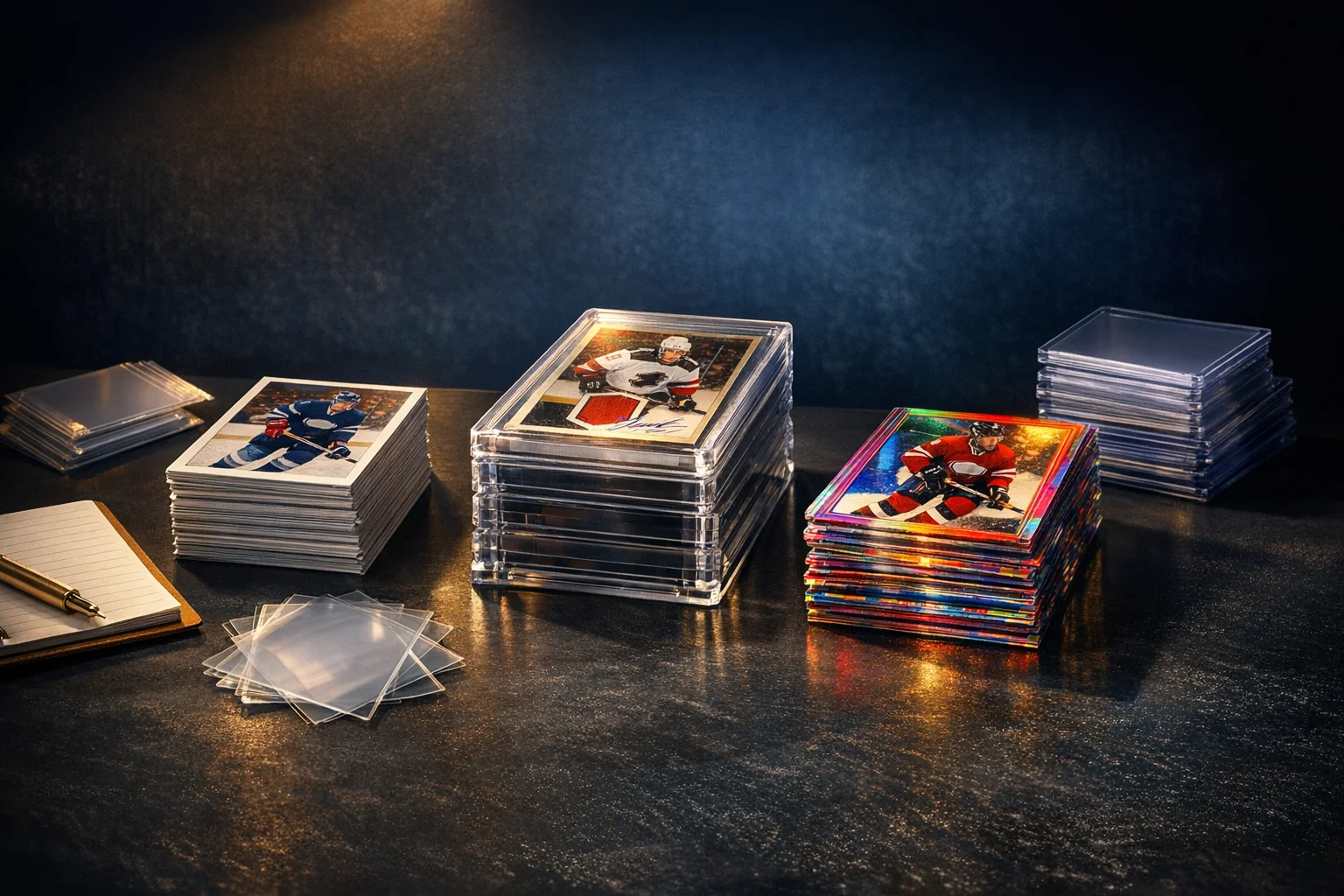
Hockey card collecting gets expensive fastest when every release starts to feel necessary. The way out is not perfect discipline. It is giving yourself a structure before you buy anything.
If you decide which set family anchors your collection, which kinds of players belong in it, and how much of your money goes to singles versus pure entertainment, the hobby gets easier to enjoy and much easier to explain. A focused plan also makes passing on off-theme cards feel like progress instead of deprivation.
For most collectors, the most stable approach is to choose one main set lane, use premium cards as occasional upgrades rather than the foundation, and keep prospect speculation in a clearly limited side bucket. That still leaves room for taste and spontaneity. It just prevents every new release from trying to become your whole hobby.
Understand the licensing landscape before you choose a lane
If your goal is licensed physical NHL cards with official team branding, your first big choice usually is not between multiple major manufacturers. The current licensed landscape is anchored by Upper Deck through long-term exclusive NHL and NHLPA physical trading card licenses. That narrows your practical decision from who makes the cards to which product family best fits the kind of collection you want to build.
That matters because it removes a layer of noise. Instead of trying to compare a crowded field of fully licensed physical NHL options, you can spend your time on a more useful question: do you want broad annual coverage, a rookie autograph lane, a design-driven lane full of color and parallels, or a premium capstone lane built around centerpiece cards?
There is one important distinction to keep in mind. A league and union trading card license is not the same thing as every player's individual autograph arrangement. In other words, the overall licensed card environment can be straightforward while autograph availability still varies by player. For you as a collector, that means a product can fit your licensed NHL plan even when a specific autograph chase is shaped by separate rights deals.
That distinction helps when you feel the urge to overgeneralize. If you are building a licensed NHL collection, the license tells you where the core card lanes live. If you are specifically building an autograph collection, you still need to think card by card and player by player. Those are related questions, but they are not identical.
- Use the licensing picture to simplify your decision tree.
- Treat general card licensing and autograph access as separate buying questions.
- Let the product family choice do most of the work before you evaluate individual cards.
Pick one set lane first or your budget will become five side projects
Most overspending in hockey cards starts with a fuzzy collecting identity. If your plan is simply to buy good hockey cards, then Flagship starts to feel essential for rookies, SP Authentic feels essential for signed rookies, Allure or Metal feels essential for eye appeal, and premium products feel essential for big-card excitement. That is how one collection quietly turns into several unfinished ones.
A set lane fixes that problem. Your set lane is the family that defines what counts as on-plan. Once that lane is clear, every other release becomes optional rather than urgent. You stop asking only whether a card is attractive or popular. You start asking whether it belongs in the story your collection is trying to tell.
The best set lanes are easy to describe in one sentence. If you can say, 'I collect my team through Flagship and Young Guns,' or, 'I buy one Future Watch Auto for each rookie I truly want,' you have given yourself a workable filter. If you cannot explain your collecting rule simply, your spending will usually drift the same way your definition does.
Imagine two hypothetical buyers. One says he is collecting whatever feels big this season. By February, he has partial stacks from four products and no clear finish line. Another says she is collecting one team's Flagship cards from one season plus any matching Young Guns. Her collection may be smaller, but every purchase strengthens the same idea. Focus does not reduce meaning. It concentrates it.
- A strong lane can be explained in a sentence.
- A weak lane forces you to re-decide your identity every time a new product appears.
- If a card is cool but outside your lane, it is not a miss. It is a skip.
Why Flagship and Young Guns are the safest foundation for most collectors
If you want the broadest and easiest foundation, Flagship remains the clearest starting point. Series One covers the first 250 cards of the annual base set and includes 49 Young Guns. Extended Series also functions as part of completing the full annual base set and advertises six Young Guns or 1st Round Rookies cards per box on average. That structure gives you a recognizable annual framework with rookie content built directly into it.
That is why Flagship works for so many different styles of collectors at once. Team collectors get roster coverage. Player collectors can build year-by-year runs. Rookie collectors get a built-in chase through Young Guns. Set builders get a defined annual project with a clear shape. You do not have to decide on day one whether you are only a rookie collector or only a team collector, because the same family supports both approaches.
The risk is not that Flagship is too narrow. The risk is that it is broad enough to tempt you into overexpanding. A team build can become a full Young Guns class. A full Young Guns class can become a parallel chase. One season can turn into a decade. The answer is not to abandon the set. It is to narrow your mission inside it.
A few focused examples work especially well. You can collect one team's base and Young Guns from one season. You can build one player's flagship run from rookie year onward. You can choose one rookie class in base form only and refuse to branch into rainbow-style variations. In each case, the product family stays broad, but your assignment inside it stays clear.
If you are new, this is often the most forgiving lane because you learn how annual hockey products are structured without needing to master every niche release at once. You also give yourself room to discover what you actually enjoy before you commit to a more expensive or more specialized lane.
- Best beginner version: one team across Series 1, Series 2, and Extended.
- Best player version: one star's flagship run year by year.
- Best rookie version: one season's Young Guns in base only unless your budget says otherwise.
When SP Authentic, Metal Universe, or Allure make more sense than Flagship
Flagship is the default answer, not the only good answer. Some collectors do not want annual breadth. They want fewer cards with a sharper identity. That is where SP Authentic can be a cleaner fit. Its strongest draw is the Future Watch autograph lane, including Autographed Future Watch cards serial-numbered to 999. If your goal is one serious rookie card per target player rather than stacks of base, inserts, and side chases, that can be a more disciplined path than trying to do a little bit of everything.
Other collectors care less about traditional rookie hierarchy and more about visual impact. Metal Universe and Allure speak to that impulse. Metal Universe is built around a 150-card base set with rookies included in that structure, plus strong parallel and chase-card appeal. Allure also uses a 150-card base set with 50 top rookies and a presentation style that emphasizes finish and color. If you are the kind of collector who wants cards that look dramatic in hand or on display, those products can make more sense than a strictly conventional lane.
The tradeoff is that design-heavy products need stricter rules. Parallels multiply goals very quickly. A collector who starts by wanting one nice player card can suddenly be debating blue, red, gold, numbered, and short-print variations. If you choose one of these lanes, write your stop rule before you make the first purchase.
That stop rule can be simple. Base only. One favorite color per player. Numbered copies only. One copy per season, no matter how many parallels exist. The rule does not have to impress anyone else. It only has to protect your budget and keep your collection legible.
Picture a hypothetical buyer who loves one winger and decides to chase that player in Allure. Without a rule, every new parallel starts to feel like part of the mission. With a rule such as 'numbered copies only,' the chase becomes selective rather than endless. The card still scratches the design itch. The spending stays connected to a plan.
- Choose SP Authentic if you want an autograph-centered rookie lane.
- Choose Metal Universe or Allure if aesthetics matter more than standard rookie hierarchy.
- Set your stop rule before your first purchase: base only, one color, or numbered only.
Use Ultimate Collection and The Cup as capstones, not as your base plan
Premium hockey products have a useful role once you stop asking them to do everything. Ultimate Collection is positioned as a premium release with serial-numbered parallels and autograph, jersey, and patch content. The Cup is presented as the crown jewel of the lineup. Those descriptions tell you what these brands are built to do: deliver concentrated premium content, not provide the broad yearly coverage that a foundation lane needs.
That makes them excellent capstones. A capstone card is the card that lifts your collection without replacing its structure. If your core lane is Flagship, a premium patch auto of your favorite veteran can become the annual centerpiece. If your core lane is Young Guns, one carefully chosen high-end rookie autograph can serve as the punctuation mark at the end of the season.
This is especially important if you feel drawn to expensive wax because it seems more efficient to pull something huge than to buy slowly. In practice, premium sealed product often makes a poor engine for a focused collection. The card counts are low, the stakes are high, and the contents may not line up with your actual player or team targets. A single chosen premium card usually adds more coherence than several premium box gambles.
A useful mindset is to let your core lane tell the story and let your premium card summarize it. If you collected one team's Flagship season, a single premium team card can become the trophy at the end. If you built around one rookie class, one premium auto of your top target can mark the point where your collection moves from broad interest to conviction.
- Think of premium cards as upgrades, not the whole foundation.
- One premium single often helps more than multiple premium box rips.
- Buy premium only when you can name its role in your collection.
Choose player buckets that match your risk tolerance
Once your set lane is clear, the next decision is who belongs in it. The simplest way to think about this is by player bucket: established stars, current NHL rookies, and prospects or draft picks. Each bucket can be enjoyable, but they create very different collecting experiences.
Established stars are usually the steadiest lane because their achievements, fan base, and hobby identity are already clearer. Current rookies bring more uncertainty and more upside. Prospects are the most speculative because excitement can build long before an NHL body of work exists. None of these lanes is wrong. The mistake is mixing them together without realizing you are taking on different kinds of risk.
Official NHL rookie eligibility rules help you draw a real line between rookies and broader prospect talk. A player becomes Calder-ineligible after exceeding the games-played thresholds in prior professional seasons, and there is also an age condition for eligibility. For collectors, that gives you a practical distinction between a true NHL rookie lane and a prospect lane driven mostly by projection.
That distinction matters in simple, real-world decisions. Suppose you have room in your budget for one big rookie-related purchase. If the player is already in the NHL rookie conversation, you are buying into uncertainty, but with a meaningful on-ice context. If the player is still mainly a prospect story, you are buying a different kind of excitement, one that deserves a stricter cap.
A healthy structure for many collectors is to put most of the budget into established stars or clearly established collecting themes, a smaller slice into current rookies, and only a limited side allocation into prospects. That way, the speculative part of the hobby stays fun without quietly becoming the whole hobby.
- Established stars fit a steadier long-term approach.
- Current NHL rookies fit collectors comfortable with performance swings.
- Prospects should live in a separate speculative bucket, not inside your core by accident.
Let marquee card prices and grading fees teach you patience
A focused collection gets stronger when you learn from expensive cards without assuming you must own them immediately. Market snapshots of major rookie cards show how quickly true grails can become four-figure pursuits once condition and grading enter the picture. That does not mean you need to abandon star collecting. It means you should separate the idea of representing a player from the idea of owning the top version right away.
If your favorite player's most iconic rookie card is beyond your budget, that is not a sign that the player is unavailable to you. A raw copy, a lower-grade copy, a later-year flagship card, or another licensed card within your chosen lane may serve the same storytelling purpose far better. The question is not, 'What is the most famous card?' The question is, 'What card best fits my plan right now?'
Grading adds another layer of discipline. Public grading fees show that submitting cards is never a trivial decision. Once you account for the fee itself, shipping, and the possibility that a card may not achieve the grade you hope for, impulsive grading can be one of the fastest ways to weaken a modest budget.
Try a pre-submission test. Ask yourself whether the card needs grading for one of four reasons: long-term protection, authentication, resale strategy, or true centerpiece status. If none applies, keeping the card raw may be the smarter call. That is not anti-grading. It is pro-intention.
A hypothetical example makes the point. Suppose you pull or buy a nice rookie auto of a player you like, but he is not a cornerstone of your collection. Sending it to grading might feel like the next serious step. But if the fee equals what you would have spent on two or three on-plan singles, grading may actually pull your collection away from focus rather than toward it.
- Use grail prices to understand scale, not to create urgency.
- A raw or lower-grade copy may tell the same story much more efficiently.
- Grade for a reason, not because the card feels important in the moment.
Build a budget that assumes singles do the real work
If you want a collection that stays coherent over a full year, start by assigning roles to each type of spending. Singles build the collection. Supplies protect it. Grading is selective. Ripping is entertainment. Once those roles are separated, you stop asking sealed product to do a job it usually does poorly: fill exact wants on command.
At a modest yearly budget, narrow projects work best. Think one team in Flagship, one player's annual run, or one small rookie subgroup. Most of your money should go toward specific singles, not blind attempts to hit them. That keeps progress visible and prevents one disappointing rip from derailing the whole month.
At a midrange budget, you can support one main lane and one small side lane without losing focus. That might mean your core is Flagship while your side lane is one Future Watch Auto target or one design-first player chase in Allure. The key is that the side lane stays visibly secondary. It adds depth rather than chaos.
At a higher but still finite budget, the smartest upgrade is often a premium-card fund rather than more random wax. Saving intentionally for one meaningful centerpiece tends to produce a collection with more identity than scattering the same money across several product openings and a handful of unrelated hits.
You do not need perfect percentages for this approach to work. You just need honesty. If most of your money is disappearing into packs while your checklist goals remain unfinished, entertainment has quietly taken over the job of collecting. That is fine if it is what you want. It is not fine if your stated goal is a focused collection.
A simple self-audit at the end of each quarter helps. Ask what was actually added to the collection on purpose, what was bought for fun, and what still feels like part of the plan. If the answers are murky, your budget structure probably needs to tighten before your next order.
- Singles should do most of the collection-building work.
- Supplies are part of the hobby budget, not an afterthought.
- Ripping is easiest to enjoy when it is not carrying your collecting plan.
Three focused collection blueprints you can actually sustain
Blueprint one is the team-season build. Pick one NHL team, one season, and the Flagship family only. Your goal is the base cards and relevant Young Guns, with any premium purchase saved for later only if the budget still supports it. This works because it teaches you product structure, roster awareness, and restraint at the same time.
Blueprint two is the rookie hybrid. Use Young Guns as the main lane for current NHL rookies, then add SP Authentic Future Watch Autos only for the one or two rookies you most believe in long term. This keeps the mainstream rookie structure intact while still giving you room for a premium autograph lane. It also cuts down on the common mistake of buying too many expensive rookie autos before the class sorts itself out.
Blueprint three is the design-first player collection. Choose one player and make Metal Universe or Allure the full framework. Then define the finish line before your first purchase: base only, one favorite parallel color, or numbered cards only. This is ideal if display appeal matters more to you than traditional checklist logic.
The hidden strength in all three blueprints is not what they tell you to buy. It is what they help you skip. Once your plan is clear, a random hot card from an unrelated product stops being a test of willpower. It becomes an easy no because it does not advance the project you chose.
That may be the most valuable habit in the hobby. A focused collection is not built by finding every yes. It is built by making peace with good noes.
- Blueprint 1: one team, one season, Flagship only.
- Blueprint 2: Young Guns core plus one or two SP Authentic upgrades.
- Blueprint 3: one player in Metal Universe or Allure with a strict parallel rule.
Illustration generated for this guide; not a photograph of an actual card, product or event.
Photo Gallery