Greg Maddux has always had the resume of a hobby heavyweight. Four straight Cy Young Awards, elite longevity, pinpoint command, and a reputation as one of the smartest pitchers the game has ever seen should have made him a much bigger force in the baseball card market long ago. Instead, his cards have often lagged behind similarly accomplished stars, especially when compared with superstar hitters and crossover names from other sports.
That may be starting to change. In 2026, Maddux cards have shown clear momentum, with multiple key issues posting strong year-over-year gains. The movement is showing up across several parts of the market too, from iconic 1990s inserts and early refractors to scarce parallel variations from the junk wax era and early 2000s chrome releases.
The broader case for Maddux is easy to understand. He dominated during an era that was heavily tilted toward offense, yet still put together one of the most impressive peaks any modern pitcher has produced. During his four straight Cy Young seasons, he went 75-29 with a 1.98 ERA. That is the kind of peak collectors normally expect to see reflected in premium pricing. For much of the hobby, it has not been.
Now, as collectors continue chasing all-time greats whose card values still look modest relative to their accomplishments, Maddux is emerging as one of the most interesting names to watch.
For more collector background, read 2026 Topps Update Series Baseball Pre-Order Date, Box Format, and Early Rookie Cards to Know.
Why Greg Maddux Cards Are Getting Fresh Attention
Pitchers have historically been a difficult category in the card market. Even inner-circle Hall of Famers often trail elite position players by a wide margin, largely because the hobby tends to reward offensive stars, flashy highlights, and mainstream popularity. Maddux never built his legacy on overpowering velocity or towering home runs. He built it on command, sequencing, and efficiency, which made him legendary on the field but did not always translate into hobby excitement.
That disconnect is part of what makes his recent movement stand out. Collectors in 2026 appear more willing to revisit players whose long-term historical standing looks stronger than their market prices. Maddux fits that profile extremely well. He is one of the defining pitchers of his generation, yet many of his most recognizable rare cards have remained accessible compared with iconic cards of stars in basketball, football, and even baseball hitters from the same era.
One telling example is the 1998 Metal Universe Precious Metal Gems Greg Maddux numbered to 50, which sold for $7,016 in 2024. For a PMG of a pitcher with Maddux's stature, that number still looks relatively modest in the modern card market. Another striking point is that only one Maddux card has ever cleared $10,000 publicly, the 2008 Topps Chrome Greg Maddux Superfractor 1/1, which sold for $10,200 in June 2026.
That kind of pricing history helps explain why more collectors are taking a closer look now. There is a growing sense that some of the best Maddux cards have been underappreciated for years.
Five Greg Maddux Cards Posting Notable Gains
The current surge is not tied to just one flagship rookie or one ultra-rare grail. Instead, the market is rewarding several different types of Maddux cards. Here is a closer look at five issues that have posted especially notable gains.
1993 Finest #85 Refractor PSA 9
This card sits in an important spot in hobby history. The 1993 Finest release introduced the first refractors, making the set a foundational product for modern parallel collecting. For many collectors, early refractors carry a special weight because they combine historical importance, visual appeal, and real scarcity.
Maddux's 1993 Finest Refractor checks all three boxes. It comes from one of the hobby's landmark products, features one of baseball's most accomplished pitchers at his peak, and remains quite difficult in top condition. PSA has graded 257 copies of the Maddux refractor, with only 30 receiving PSA 10 status.
In PSA 9, the card has moved sharply higher. Recent sales hit $1,999 on July 14, 2026 and $2,113 on June 28, 2026. That compares with sales of $1,220 on June 26, 2025 and $1,408 on February 4, 2025, representing a 64% increase.
The appeal here is easy to see. Early refractors continue to be one of the strongest long-term categories in the hobby, and Maddux's place in the 1993 season only strengthens the story. He won the Cy Young Award that year while leading the majors with a 2.36 ERA and 237 innings pitched.
1998 Finest The Man #TM20 /500
Late 1990s serial-numbered inserts remain one of the hobby's most active lanes, especially when they feature Hall of Famers and visually distinctive designs. The 1998 Finest The Man insert is a strong example of that trend. Numbered to 500, it may not sound ultra-rare by today's standards, but in 1998 that kind of print run carried real significance.
This card also brings a layer of collector culture that keeps it relevant: the long-running peeled-versus-unpeeled debate. Many Finest cards from the period were issued with a protective coating, and opinions remain split on whether cards look better left untouched or peeled to reveal a cleaner surface. Market preferences have often leaned toward unpeeled examples, but the discussion itself adds character and visibility to the card.
Recent pricing reflects growing demand. A copy sold for $175 on August 27, 2026 after earlier sales at $84 on June 9, 2025 and $45 on May 7, 2025. That works out to a 108% increase.
The card also lines up nicely with another standout season for Maddux. In 1998, amid an offense-heavy era, he posted a 2.22 ERA across 251 innings. Collectors looking for scarce 1990s inserts tied to dominant seasons have plenty to like here.
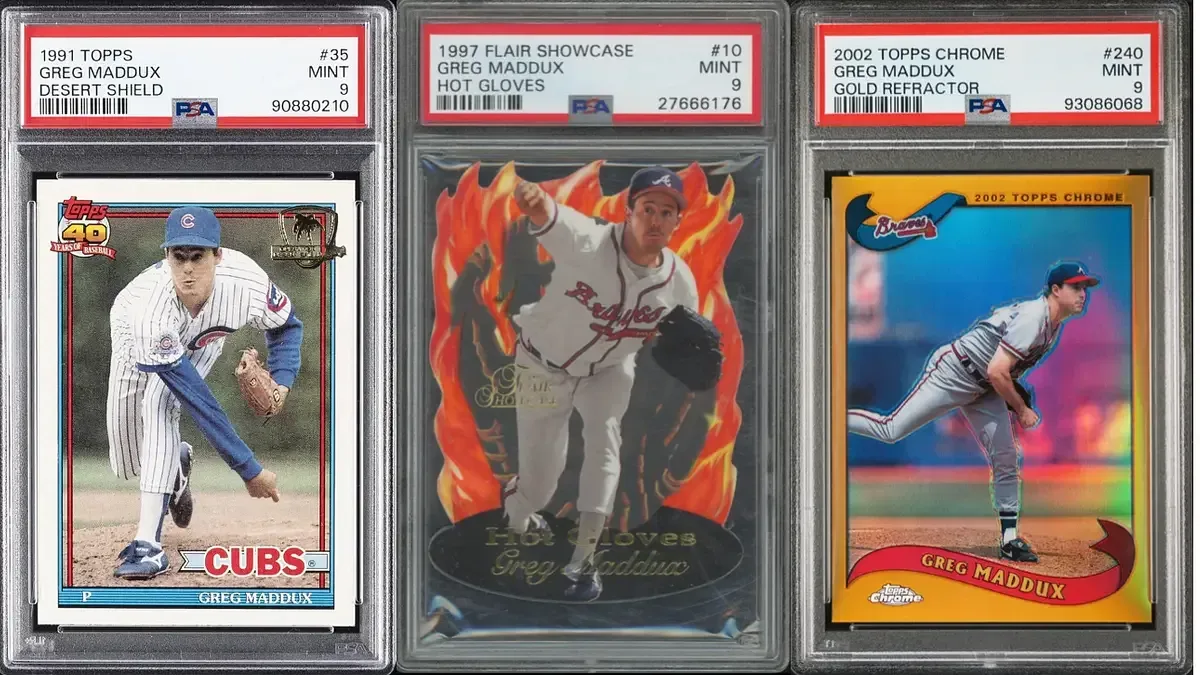
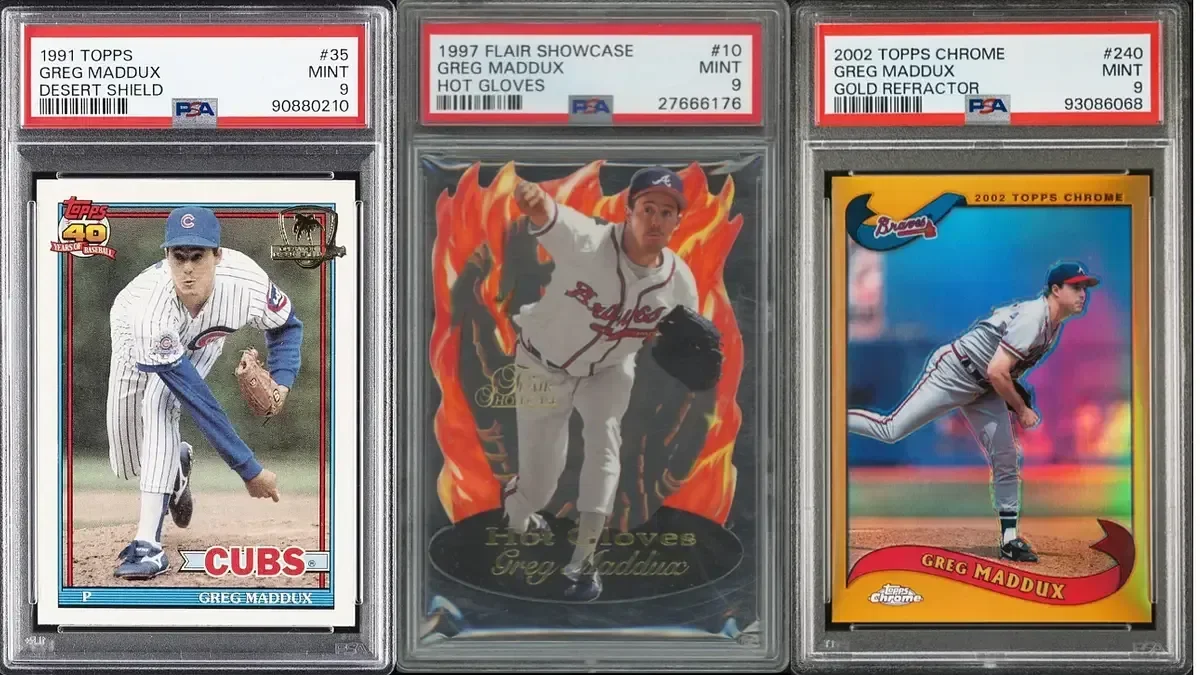
2002 Topps Chrome #240 Gold Refractor PSA 9
Gold refractors have become one of the hobby's most durable and desirable parallel formats. While collectors chase many color parallels across modern products, gold still holds a unique place because of its visual identity and its long track record in chrome collecting.
Maddux's 2002 Topps Chrome Gold Refractor has seen one of the strongest jumps among his key cards. A PSA 9 sold for $225 on September 2, 2026 and another brought $200 on May 3, 2026. Those figures are up from $81 on April 30, 2025 and $63.56 on November 5, 2024, good for a 178% increase.
Scarcity is part of the attraction. PSA has graded only 20 copies of this card, and just one has earned a PSA 10. That kind of pop report gives collectors a clear reason to compete when quality examples surface.
For buyers who focus on cards that combine player legacy, recognized parallel branding, and low graded populations, this is one of the more compelling Maddux options in the market right now.
1991 Topps Desert Shield #35 PSA 9
The 1991 Topps Desert Shield release remains one of the hobby's most recognized scarcity stories from the junk wax era. Standard 1991 Topps baseball was printed in enormous quantities, but the Desert Shield variation is a completely different conversation. These cards were distributed to American troops serving in the Middle East and can be identified by the gold Desert Shield emblem on the front.
Because the estimated print run is only around 6,500 copies, Desert Shield cards offer rare-card appeal in an era that otherwise has very little of it. That dynamic has turned the set into a favorite among collectors looking for legitimate scarcity attached to familiar flagship cardboard.
Maddux's Desert Shield is one of the cards benefitting from that demand. PSA 9 sales reached $400 on July 19, 2026 and $412 on June 15, 2026. One year earlier, copies sold for $140 on June 1, 2025 and $145 on May 28, 2025. That represents a 186% increase.
PSA has graded 537 copies of the Maddux Desert Shield, with only 29 PSA 10s. Those numbers are not impossibly low, but they are strong enough to keep quality examples relevant, especially as more collectors seek out scarce alternatives from overproduced early 1990s sets.
1998 Metal Universe All-Galactic Team #12-AGT
The biggest percentage mover among the five is also one of the most visually and structurally interesting cards on the list. The 1998 Metal Universe All-Galactic Team insert comes from a product line that has become increasingly popular with collectors who appreciate bold 1990s design and difficult insert pulls.
Metal Universe built its following on futuristic styling and memorable artwork, with many designs influenced by Marvel comic book artists. That identity has aged very well in the hobby, and key inserts from the line continue drawing attention across multiple sports.
The All-Galactic Team Maddux was inserted at a rate of one in 3,456 packs, giving it true chase-card status. Despite that, the card still trades at a level far below many comparable inserts of stars from other categories. Only three copies have ever been graded by PSA, underscoring just how rarely the card appears in the market.
Prices have responded quickly once buyers noticed. Recent sales came in at $63 on August 20, 2026 and $70 on August 11, 2026, compared with $17.25 on November 25, 2025 and $15 on August 28, 2025. That is a 265% increase, the strongest growth among the five highlighted cards.
For collectors who believe the hobby still has more room to appreciate rare late-1990s Maddux inserts, this is one of the clearest examples of how quickly the market can move once supply dries up and attention shifts.
What the Recent Sales Say About the Market
There is an important nuance in these results. Most of the cards on this list are not posting massive absolute prices compared with the top end of the sports card market. Instead, they are posting major percentage gains from lower starting points. That matters because it suggests Maddux's market may still be in a discovery phase rather than a fully matured boom.
Collectors are not just pushing a single grail card to an eye-popping record. They are lifting a range of Maddux issues across different eras and formats. That kind of broad movement often says more about hobby sentiment than one headline sale ever could.
It also reinforces the larger argument around Maddux as a value play among all-time legends. If a player of his caliber has only one card above $10,000 and still trails far behind many less accomplished stars in premium categories, then there is still room for the market to reevaluate his place.
The Cards to Watch Next
If the current trend continues, collectors will likely keep circling back to Maddux cards with one or more of the following traits: landmark set history, low serial numbering, strong insert rarity, iconic parallel branding, or genuinely limited supply from a heavily printed era. That puts cards like his PMGs, early refractors, gold refractors, and major insert hits squarely in focus.
The bigger story is not just that five Maddux cards have jumped in price. It is that the hobby may be starting to treat him more like the all-time great he has always been. For a pitcher known for precision and consistency, the card market is finally showing signs of catching up, one scarce parallel and one overlooked insert at a time.
Photo Gallery