Connor McDavid is forcing the hockey world, and the card market, to pay attention again.
Through nine games, McDavid has piled up 26 points with six goals and 20 assists while posting a plus-17 rating. That works out to an outrageous 2.89 points per game, the best opening stretch of his 12-year NHL career. Edmonton has followed his surge with a 7-1-1 start, and the conversation around McDavid is already moving beyond another scoring title or another MVP-level season.
For collectors, the real question is larger: if McDavid finally wins his first Stanley Cup, how much higher can his cards go?
The answer is not as simple as assuming every key rookie card would soar and stay there. McDavid is already priced like the game’s top active talent. His market has depth, liquidity, and years of hobby confidence behind it. A championship would matter, but the way that impact shows up likely depends on which card collectors are holding and when they plan to sell.
For more collector background, read How to Choose Sleeves, Top Loaders, Semi-Rigid Holders and Magnetic Cases Without Putting the Wrong Card in the Wrong Protection.
McDavid’s early pace is historic
McDavid’s start is not just hot. It is brushing against some of the most untouchable names in league history.
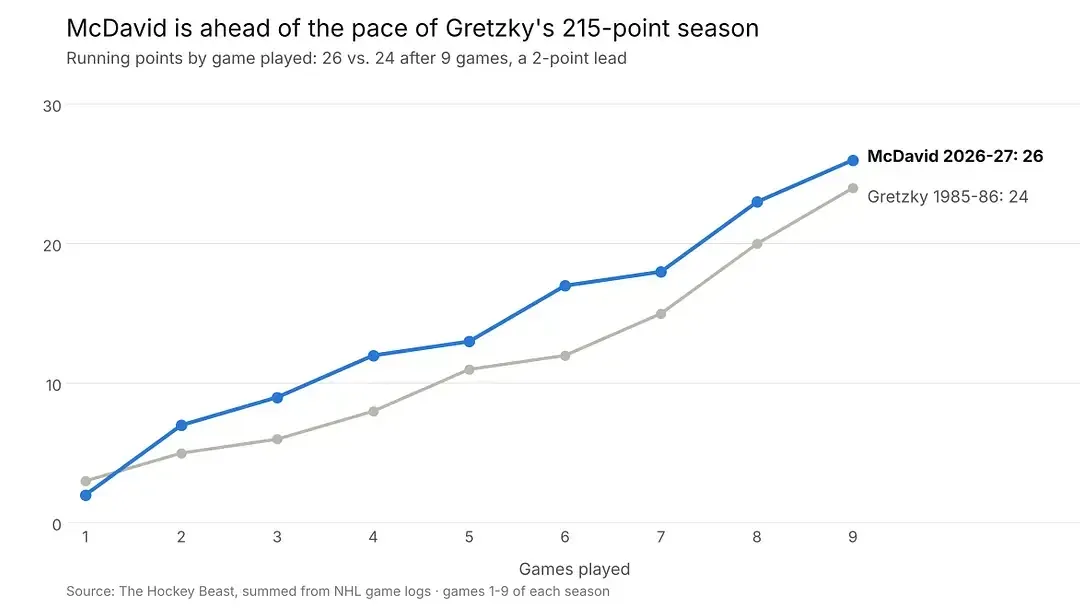
He became the fastest player in NHL history to 20 assists, getting there in only nine games. The previous mark was 10 games, shared by Wayne Gretzky, Mario Lemieux, and Pat LaFontaine. Through the same nine-game point in Gretzky’s legendary 1985-86 season, Gretzky had 24 points. McDavid sits at 26.
If his current rate held for a full season, he would finish with 243 points. That would top Gretzky’s 215-point benchmark by 28 points. Nobody expects a 2.89 points-per-game pace to hold all year, but the math shows just how explosive the opening has been.
For another perspective on this story, read Connor McDavid’s Historic Pace Puts His Card Market in Focus.
Even if McDavid cools dramatically and simply plays at the level of his 2022-23 career-best season, he would still project near 166 points, which would set a new personal high. If he falls back to last season’s scoring pace, he still lands around 152 points, right in the territory collectors expect from a dominant MVP candidate.
That matters because hobby momentum often follows storylines. A Stanley Cup chase is one thing. A serious threat to Gretzky’s single-season points record is something else entirely. If McDavid can stay above 2.5 points per game deep into the winter, the record chase could become a stronger short-term market driver than postseason speculation.
Why a Stanley Cup still matters to McDavid’s legacy
As great as McDavid’s individual resume already is, collectors know there is one major line still missing. He has the production, the awards, and the eye test reputation as the best player in the world. What he does not yet have is a championship.
That absence matters in legacy discussions, and legacy is a major force in long-term card demand.
The sport’s inner circle tends to break into different timelines. Some all-time greats won early. Others had to wait. Gretzky, Lemieux, and Sidney Crosby captured Cups sooner in their careers. Steve Yzerman and Alex Ovechkin had to endure long waits before finally clearing that hurdle.
If McDavid wins in 2027, he would do it at age 30 in his 12th season, which places him closer to the later-breakthrough path than the early-coronation path. That would still be a powerful moment for his place in hockey history. It just does not automatically mean every major rookie card becomes permanently repriced at a much higher level.
The lesson collectors keep seeing: the run can be stronger than the aftermath
One of the clearest patterns in sports cards is that prices often jump during major runs and around championship moments, then soften after the celebration passes. Collectors call it selling the news, and hockey has shown that pattern before.
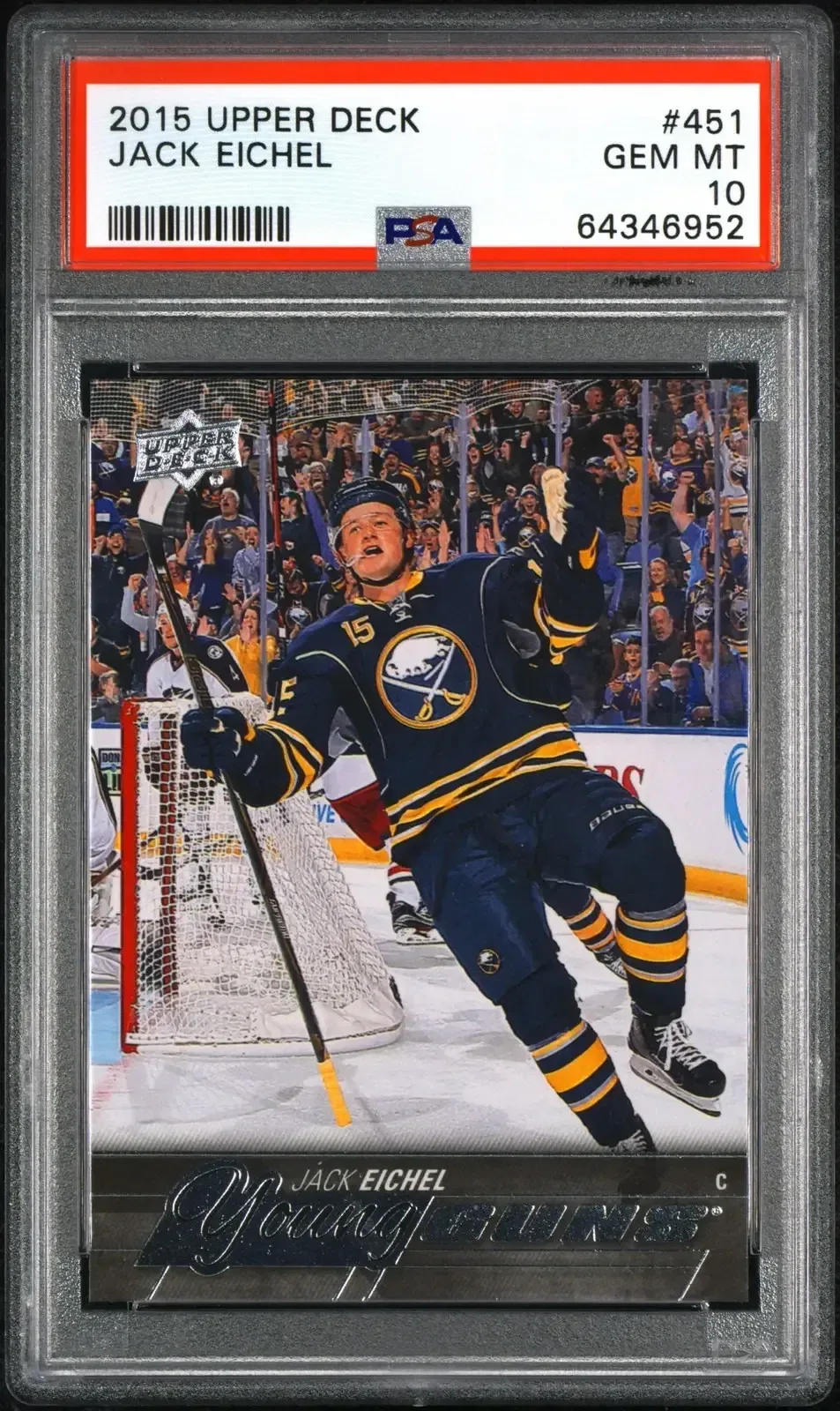
Jack Eichel offers a useful recent example. In the days before Vegas clinched the Stanley Cup, his 2015-16 Young Guns PSA 10 was selling roughly in the $138 to $185 range. After the title, sales pushed into about the $225 to $232 range. By August of that same summer, prices had dropped back near $107.
That kind of movement does not mean a title is meaningless. It means the market often prices in anticipation, peaks when casual demand and media attention collide, and then recalibrates once the event becomes part of the record instead of the active headline.
For McDavid, a Cup could create a very real spike. The bigger question is how much of that rise would stick, and the answer probably differs between his most liquid flagship rookie and his scarcer premium cards.
Where McDavid’s Young Guns stands right now
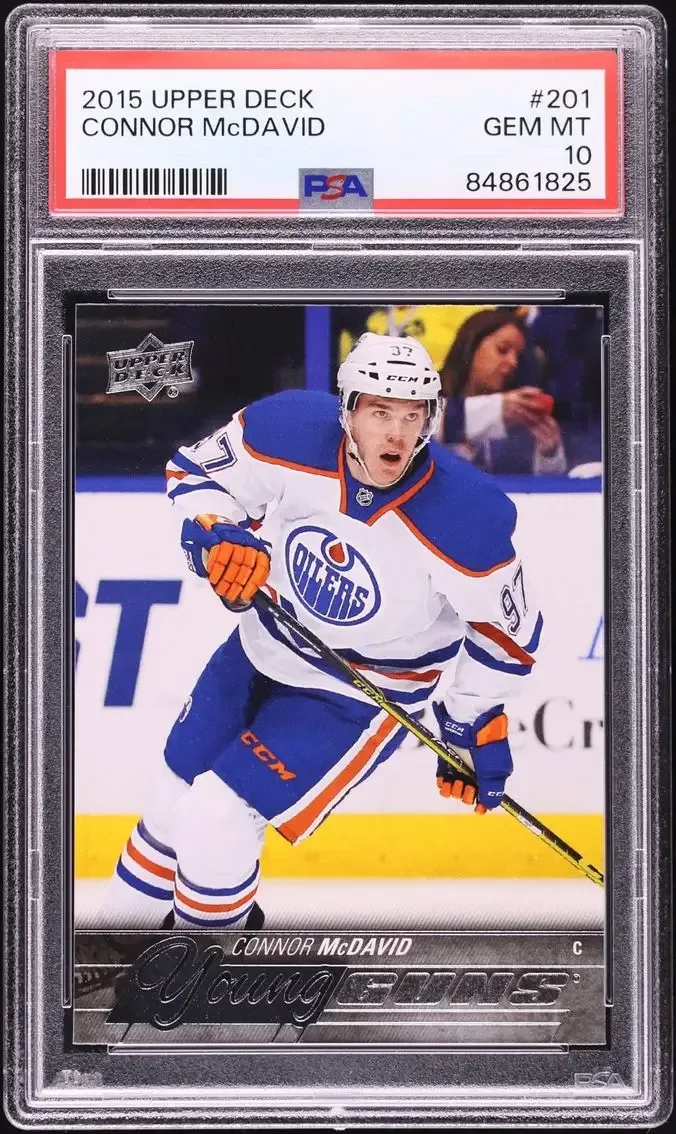
The card most collectors watch first is his 2015-16 Upper Deck Young Guns #201, especially in PSA 10. It is the hobby’s main benchmark for McDavid, and it is one of the most actively traded modern hockey rookies in the market.
Over the previous three months, the PSA 10 has averaged $3,191 across 44 sales. The most recent reported sale came in at $3,450 on October 20, representing a roughly 15% move higher over that span.
Those numbers matter for two reasons.
First, they show the market is already responding to McDavid’s start, even during a period when some collectors have described modern hockey prices as softer. Second, they highlight how efficient this card’s market has become. This is not an obscure issue waiting to be discovered. It is a heavily watched, frequently sold flagship rookie with deep collector awareness and strong historical pricing data behind it.
That usually limits the odds of a massive sustained surprise breakout from a single event, even one as meaningful as a first championship.
Supply is the biggest check on a lasting Young Guns surge
McDavid’s Young Guns has one huge advantage and one huge limitation.
The advantage is liquidity. Buyers know the card, trust the card, and can move in and out of the market with relative ease. When excitement builds, this is often the first place money goes.
The limitation is supply.
There are thousands of graded copies available, and the PSA 10 population is much larger than the equivalent top rookies for other modern stars. McDavid’s PSA 10 supply is roughly 2.4 times that of either Crosby’s or Ovechkin’s 2005 rookie cards, yet it also trades at significantly higher volume. Over the same recent window, it has moved at nearly twice the sales volume of Ovechkin’s comparable card and almost three times Crosby’s.
That creates a market with tremendous activity, but also one where extra inventory can emerge quickly if a title run brings out sellers. In practical terms, a Cup win could absolutely drive a headline-worthy spike in the Young Guns. It also means the market has the supply to absorb demand and cool off later, especially if many holders decide the championship is their best exit point.
McDavid’s market history shows how reactive this card can be
Collectors do not have to guess whether McDavid’s flagship rookie reacts to momentum. It already has a track record of doing exactly that.
His Young Guns PSA 10 has traded around $800 during the mid-2020 period, climbed into the $5,600 to $6,332 range during the 2021 boom, and then slid as low as $2,025 during the 2025 playoffs. That is a wide band for a card tied to a player whose greatness has never really been in doubt.
The takeaway is that McDavid’s biggest mainstream rookie is deeply connected to market cycles, collector sentiment, and major on-ice moments. It can rise fast, but it can also retrace once enthusiasm fades or broader conditions weaken.
That is why a Stanley Cup should probably be viewed as a catalyst rather than a guarantee of a permanently higher floor for the Young Guns.
Why premium McDavid rookies could react differently
Not every McDavid rookie behaves like the Young Guns, and that distinction is important for collectors deciding where championship upside may stick.
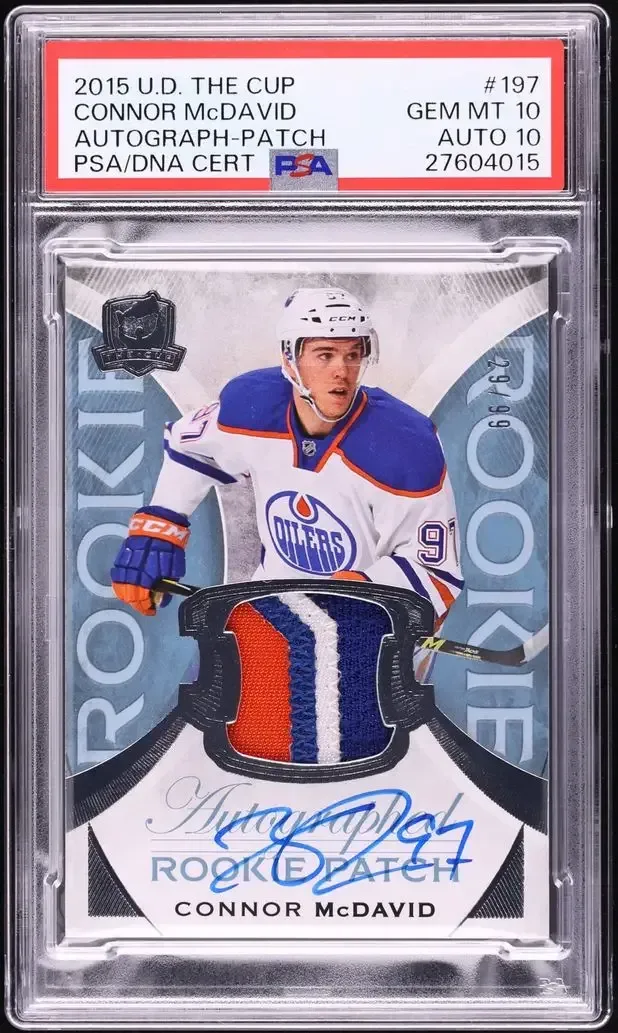
Cards such as the 2015-16 SP Authentic Future Watch Autograph /999 and the 2015-16 The Cup Rookie Patch Autograph /99 live in a different part of the market. They are scarcer, far less available, and far less likely to see a flood of copies hit the market at once during a title run.
That lower supply can create very different price behavior. Instead of a rush of dozens of listings meeting demand, buyers may find only a handful of opportunities to acquire one. In those moments, career-defining events can have more durable pricing impact because scarcity gives sellers leverage and reduces the market’s ability to quickly normalize.
For elite athletes, the cards that tend to hold the strongest long-term premium after a legacy milestone are often the scarcest iconic rookie autographs and rookie patch autographs, not the most abundant flagship base rookie. McDavid’s market structure fits that idea well.
What collectors should watch if Edmonton makes a real run
If Edmonton puts together a deep playoff push, several signals could reveal how the hobby is treating McDavid in real time.
Young Guns PSA 10 volume: A large jump in sales count would show fresh demand, but it could also signal more sellers are arriving.
Price consistency after big wins: If the Young Guns spikes after major playoff moments and holds those gains between games, that is a healthier sign than one-off peak sales.
Premium rookie availability: If cards like Future Watch Autograph /999 or The Cup RPA /99 disappear from the market, scarcity may start doing the heavy lifting.
Record-chase headlines: If McDavid remains on a pace that keeps Gretzky comparisons front and center, collectors may have two major narratives pushing the market at once.
That last factor could be especially important. Championships create emotional buying. Record chases create historical buying. If both are active at once, McDavid’s card market could see unusual pressure on the demand side, especially from collectors who usually sit outside the hockey segment.
So what would a first Cup likely do to McDavid cards?
The most likely outcome is a split market reaction.
The 2015-16 Upper Deck Young Guns #201 in PSA 10 would probably jump during the run and around the championship moment because it is the hobby’s most recognizable McDavid rookie and the easiest major card for buyers to target quickly. But because it is also a high-supply, high-volume card, history suggests some of that gain could fade once the celebration passes and more copies come to market.
The scarcer McDavid rookies are better positioned to show lasting strength if a title changes how collectors frame his career. That is where a legacy event often leaves a more permanent mark, especially when the cards are already established as premium cornerstone pieces.
For now, McDavid’s market is already acting like collectors understand the stakes. His hot start has helped push his flagship rookie higher, and any extension of this pace will keep pressure on the market. If he stays close enough to make the Gretzky scoring conversation real into February, the hobby may have another driver to chase before the playoffs even arrive.
That leaves collectors watching two parallel storylines at once: whether Connor McDavid can finally capture the Stanley Cup, and whether a season this explosive can force one of hockey’s most watched card markets into another major move.
Photo Gallery