Most card-damage stories start with a small mistake: a card forced into the wrong holder, shipped in a case a grader does not want, or displayed in a one-size-fits-all setup that never really fit. The good news is that the four basic protection tools most collectors use each have a clear job when you match them to the card and the next step.
A sensible default is simple. Start with a sleeve. Move to a semi-rigid holder if the card is headed to grading. Use a top loader when you want rigid everyday protection for handling, sorting, or short-term movement. Use a magnetic case for display only after you confirm the thickness is truly correct. The main challenge is not buying more supplies. It is choosing the right one for the card in front of you.
Start with the real question: what is this card about to do next?
Collectors often shop for supplies as if there must be one best holder for every card. In practice, the right choice depends less on the card’s fame or value and more on its next destination. Is it going into a submission box for grading? Sitting in a storage box for routine access? Traveling to a show? Going on a shelf for display? Those are four different jobs, and the same holder does not perform equally well in all four.
That decision tree matters because grading companies publish packing instructions that favor one format over another. PSA’s submission guidance says cards should be placed in a protective flexible pouch such as a Card Saver and advises against submitting in top loaders, hard acrylic cases or screw-down holders. PSA’s shipping guide also tells submitters to put each sleeved card into a semi-rigid holder. CGC gives similar instructions, telling submitters to place each card in a protective sleeve and then into a semi-rigid sleeve sturdy enough for safe removal.
For collectors, that creates a useful rule of thumb. If the next step is grading, optimize for what the grading company wants to receive and remove safely. If the next step is storage or display, you have more flexibility, but fit still matters. Many preventable mistakes happen when collectors treat a display solution like a shipping solution, or a shipping solution like a permanent presentation format.
- Ask yourself one question before buying supplies: Is this card being stored, mailed for grading, handled often, or displayed?
- Use grader instructions as your default for submission prep, not habit or convenience.
- Treat display holders and grading-submission holders as different tools, even if both feel rigid and secure in hand.
Why sleeves are the base layer for almost everything
A sleeve is the first-contact protection, and that makes it more important than its low price suggests. Both PSA and CGC instruct submitters to sleeve cards before placing them into semi-rigid holders. That tells you something fundamental: even when a card is going into a more substantial holder, the thin inner layer still matters. The sleeve is what helps reduce direct handling contact and insertion friction during the moments when corners and surfaces are most vulnerable.
One published product detail helps explain why sleeves serve this role so well. CGC’s sleeve product page describes sleeves with a 2.5 by 3.5 inch pocket size made from inert, clear polypropylene. That does not prove every sleeve on the market uses the same material or behaves the same way, but it does support the basic idea that sleeves are meant to be the soft, direct interface between card and holder.
For practical collecting, this means a sleeve is not optional just because a card is going into something rigid. If you are organizing raw cards in boxes, setting aside cards for a show, or preparing a submission stack, the sleeve is the simplest layer that protects against the most common day-to-day risks. The tradeoff is that a sleeve alone offers almost no rigidity. It protects against surface contact better than against bending, compression, or rough handling. That is why sleeves are best understood as the foundation, not the finished answer.
- Use sleeves as the minimum starting point for raw cards you care about keeping clean and presentable.
- Do not generalize one brand’s material claims to every sleeve product on the market.
- Think of the sleeve as contact protection, not structural protection.
Semi-rigid holders are the grading lane, not just another plastic option
If your card is going to a grader, semi-rigid holders have the strongest support of any protection format in current public guidance. PSA’s submission guide explicitly recommends a protective flexible pouch such as a Card Saver and advises against top loaders, hard acrylic cases and screw-downs. PSA also warns that submissions sent in those disfavored holder types can be delayed and that those cases will not be returned under that guide. CGC’s instructions also say sleeve first, then semi-rigid.
That clarity matters because collectors sometimes default to whatever feels most solid in hand. A top loader or magnetic case can feel sturdier on your desk, yet that is not the same thing as being preferred for intake by a grading company. The graders’ stated concern is safe removal and efficient processing, not whether a holder looks premium to the submitter.
There is an important fit caveat, though. PSA’s own store listing for its standard semi-rigid says it is for standard-size cards up to 2.5 by 3.5 inches and up to 35 points thick. So a standard semi-rigid is not a universal answer for every raw card in your collection. If you are sending a thick relic or patch card, you should not assume the same semi-rigid that works for a base chrome rookie will work there too.
A useful buyer habit is to separate your submission pile into standard and thick cards before you ever start packing. That prevents the common mistake of discovering too late that your standard semi-rigids are wrong for part of the order.
- For grading submissions, sleeve plus semi-rigid is the clearest default supported by PSA and CGC.
- Do not equate harder plastic with better submission prep.
- Check thickness before assuming a standard semi-rigid will fit.
Top loaders still have a job, but it is not the grading-submission default
Top loaders remain useful because collectors do more than submit cards. You sort, trade, transport, photograph, review, and sometimes pull cards in and out of short-term storage. For those jobs, a top loader offers rigid everyday protection that a sleeve alone cannot. That makes it a practical option for raw cards you expect to handle occasionally but are not mailing to a grader right now.
What current evidence does not support is treating top loaders as the preferred format for grading intake. PSA explicitly advises against submitting cards in top loaders, and CGC’s shipping instructions tell collectors to use sleeve plus semi-rigid instead. That does not amount to a universal ban on top loaders for all hobby uses. It means their strengths are elsewhere.
A realistic collector workflow might look like this: your show table candidates go sleeve plus top loader because they will be handled, moved, and reviewed; your grading candidates are moved out of that setup and into sleeve plus semi-rigid before packing. That is a small extra step, but it aligns each holder with its best role.
The tradeoff is convenience versus specialization. Top loaders are familiar and versatile, so many collectors reach for them automatically. But when the card’s next stop is a grading room, familiarity is not the standard that matters most.
- Top loaders are sensible for everyday rigid storage and short-term handling.
- Move cards out of top loaders before grading submission if the grader instructs otherwise.
- Do not read grader guidance against top loaders as proof that top loaders are bad for all collector uses.
Magnetic cases are for presentation, and presentation only works when the fit is exact
Magnetic cases appeal to collectors for obvious reasons. They look cleaner than a top loader, feel substantial in hand, and can make a favorite card look more intentional on a shelf or in a display cabinet. But they only do that job well when the thickness is right. Beckett’s thickness-guide discussion explains the key point: top loaders and magnetic holders come in different point sizes, and a thickness gauge helps you match the holder to the card.
That may sound obvious until you remember how many collectors still guess. A holder that is too tight invites pressure and awkward insertion. A holder that is too loose can let a card shift in ways that defeat the purpose of premium display. The lesson is not that magnetic cases are risky by nature. It is that magnetic cases punish guesswork more quickly than some other formats.
There is also a boundary collectors should keep in mind. PSA advises against submitting cards in hard acrylic cases, which covers the usual magnetic-style display category. So a magnetic case can be a good display endpoint, but not the best handoff format if you later decide the card should go to grading.
A practical compromise is to reserve magnetic cases for cards you want to enjoy visually in the near term, while keeping likely grading candidates in submission-friendly materials. That helps avoid the annoying cycle of repeatedly rehousing the same card because one holder was asked to do two different jobs.
- Measure thickness before choosing a magnetic case.
- Use magnetic cases for display, not as your assumed grading-shipment solution.
- If you may grade the card soon, consider whether a display holder will only create an unnecessary extra transfer later.
Thickness is not a detail; it is the whole fit question
Many supply mistakes begin with a false assumption: if a card is standard height and width, then it must fit standard protection. PSA’s own published specs show why that is too simplistic. Its standard semi-rigid listing says up to 35 points thick. PSA also states that its standard graded holder is for standard-size cards up to 40 points max thickness, while standard-size cards above 40 points still use a thicker or original holder style.
That distinction matters well beyond grading. If your card is a patch, relic, memorabilia, or otherwise premium stock card, you should assume nothing until you verify thickness. CGC’s announcement of thick holders in multiple thicknesses underscores the same principle from another angle: thicker cards require a different fit treatment even at the encapsulation stage.
For collectors, the actionable takeaway is to stop using the word standard too casually. A card can be standard in footprint and still be non-standard in thickness. That difference affects what semi-rigid you choose, what top loader might work, what magnetic case will fit, and even what kind of graded holder may eventually house the card.
If you want a practical routine, keep thick cards physically separated from ordinary paper or chrome cards the moment you sort them. That single habit reduces forced fits, wasted supply purchases, and last-minute packing errors.
- Standard dimensions do not guarantee standard thickness.
- A 35pt capacity example is a reminder to verify, not to assume all holders share the same capacity.
- Relic and patch cards deserve their own supply plan from the beginning.
Odd-size and undersize cards need a different mindset, not brute force
Collectors naturally focus on thickness because that is the most visible mismatch problem, but width and height can be just as important. PSA says some items may be placed in Mylar and then into an oversized holder if they do not fit the designated holder. CGC also notes that small and odd-sized cards may be holdered with an inner plastic sleeve inside the slab to keep them secure. That shows fit issues are not limited to thick cards.
This matters for older cards, unusual releases, regionals, minis, and cards with dimensions that stray from familiar modern standards. The wrong response is to improvise by wedging them into normal supplies because the card almost fits. Almost is exactly the danger zone. A holder that grips awkwardly or leaves a card unsecured can create stress points or excessive movement.
The practical lesson is to identify non-standard cards early. Before you buy supplies in bulk, sort any cards that look unusually small, large, narrow, or otherwise atypical into a separate group. Then ask basic fit questions: Is the issue thickness, footprint, or both? Is this a storage problem, a display problem, or a future grading problem?
That extra step is especially useful for collectors who mix eras or sports. A storage setup that works for modern base cards may be clumsy for unusual vintage dimensions. Fit is not just about what goes in. It is about what stays secure without pressure.
- Do not force odd-size or undersize cards into standard holders because they nearly fit.
- Separate unusual dimensions before buying bulk supplies.
- Think in two measurements: footprint and thickness.
A simple collector workflow that keeps cards safer and decisions easier
If you want a repeatable system, build it around the card’s destination. For raw storage in boxes, sleeve first as the baseline. Add a top loader when you want rigidity for regular handling, sorting, shows, or short moves. For grading prep, change that setup to sleeve plus semi-rigid because that is what PSA and CGC currently direct submitters to use. For display, move the card into a correctly sized magnetic case only after confirming thickness.
This kind of workflow is more efficient than it sounds because it reduces indecision. Instead of debating whether a card is important enough for a certain holder, you ask a simpler question: what is happening next? The answer tells you the holder. Important cards often move through several stages over time, and that is normal. A card can begin in a sleeve, spend a while in a top loader, move into a semi-rigid for grading, and later return to a display setup in a magnetic case if it remains raw or after slabbed display if graded.
Here are three practical examples. First, a modern rookie insert you may submit next month: sleeve it now, keep it in a semi-rigid when you finalize the order, and avoid leaving it in a top loader out of habit. Second, a thick patch card you love displaying: do not assume a standard magnetic will do the job; check the thickness before buying a display case. Third, a stack of trade-night cards: sleeve everything, top load the cards you expect others to handle often, and keep grading candidates separated so you do not have to re-sort later.
The tradeoff is that a more disciplined workflow asks you to own more than one kind of supply. But that is usually cheaper than damaging a better card or discovering too late that your submission prep does not match grader instructions.
- For box storage: sleeve as the minimum, top loader as needed for rigidity.
- For grading: sleeve plus semi-rigid.
- For display: magnetic case only after thickness confirmation.
The common mistakes worth avoiding, and the questions to ask before you buy
The most avoidable mistake is sending cards to PSA in a top loader, hard acrylic case, or screw-down despite PSA saying not to. That is not a style preference issue. It is published submission guidance. The second mistake is assuming one holder fits every standard-size card. PSA distinguishes by thickness, and Beckett’s point-size guidance exists for a reason. The third is using a standard semi-rigid for thick cards without checking capacity. PSA’s own example for a standard semi-rigid tops out at 35 points.
A quieter mistake is ignoring fit issues with unusual dimensions. PSA and CGC both describe alternate approaches for cards that do not fit normal holder dimensions, which is a useful reminder that secure protection is not always a one-product solution. Another mistake is overgeneralizing product materials. CGC’s sleeve page describes polypropylene, while PSA’s store listing for one semi-rigid describes clear PVC. Material claims can vary by product, so it is smarter to read specifications than to assume every sleeve or holder category is materially identical across brands.
Before you buy in quantity, ask five plain questions. What is the next step for these cards: storage, handling, grading, or display? Are these cards ordinary thickness or obviously thick? Do any have unusual dimensions? Am I buying this holder because it is truly suited to the job, or because it is what I already have? And if I later submit to a grader, will I need to rehouse everything anyway?
Those questions will not make supply shopping glamorous, but they will make it more accurate. And in card protection, accurate usually beats impressive. The right holder is the one that fits the card, fits the task, and does not create a new problem later.
- Avoid submission habits that conflict with published grader instructions.
- Check both thickness and dimensions before assuming a holder is correct.
- Read product specs instead of generalizing materials across all brands and holder types.
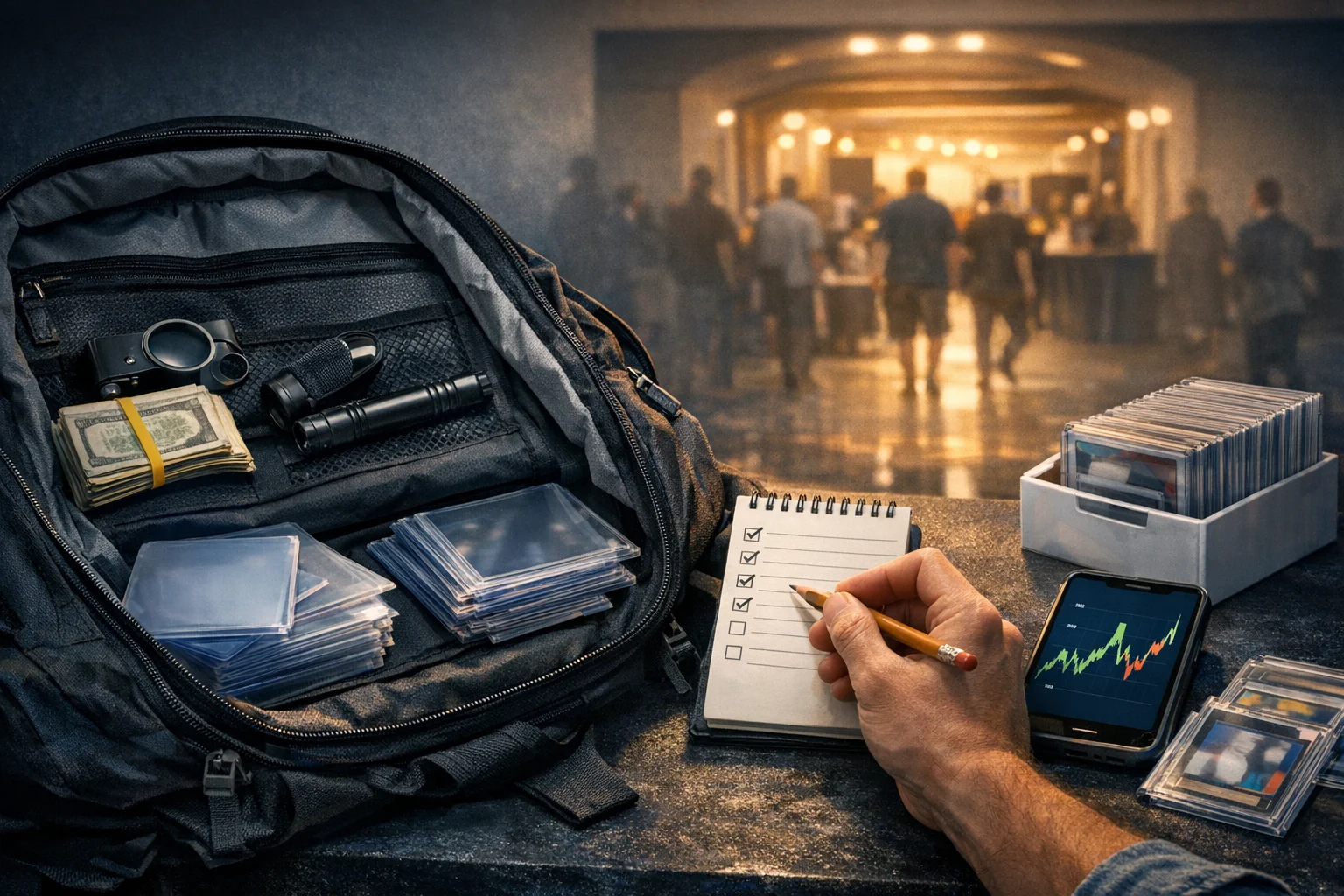
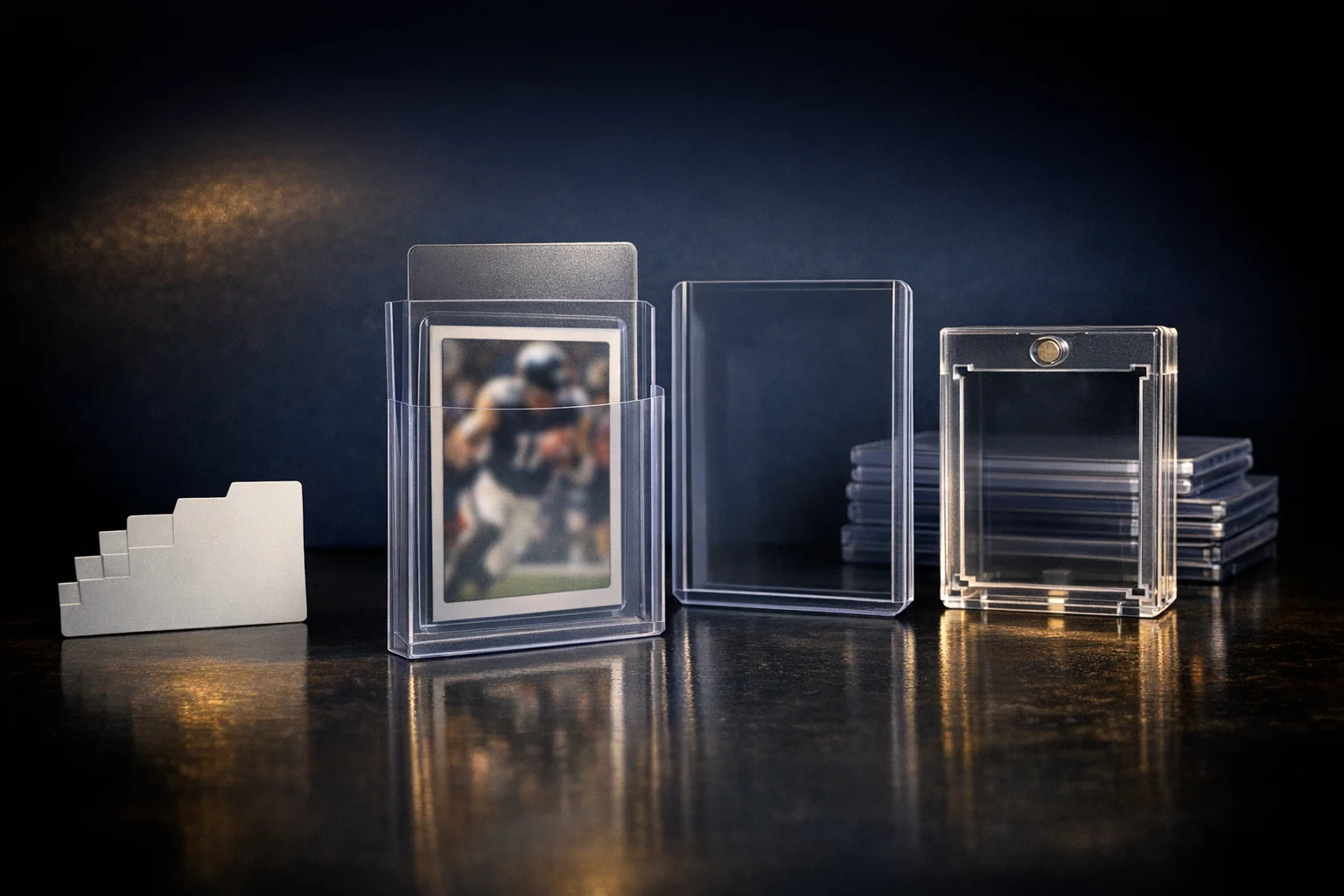
Illustration generated for this guide; not a photograph of an actual card, product or event.
Photo Gallery