Charles Barkley’s post-playing fame has introduced him to a new generation as one of basketball’s most quotable television personalities, but his trading cards still point back to the player collectors remember best: an undersized force who rebounded like a center, attacked like a wing, and won MVP in an era packed with Hall of Fame talent.
That combination of on-court greatness and larger-than-life visibility has helped keep Barkley relevant across multiple corners of the hobby. His market stretches from one of the most debated rookie-era releases in basketball cards to 1990s insert staples and ultra-premium modern Logoman autographs. The result is a catalog that appeals to vintage-minded collectors, 1990s insert chasers, and high-end patch auto buyers alike.
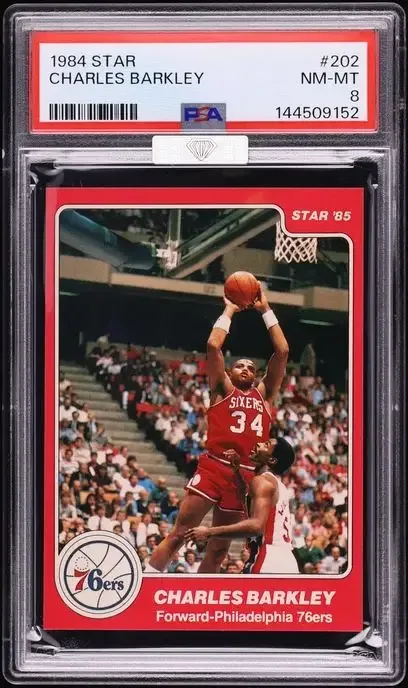
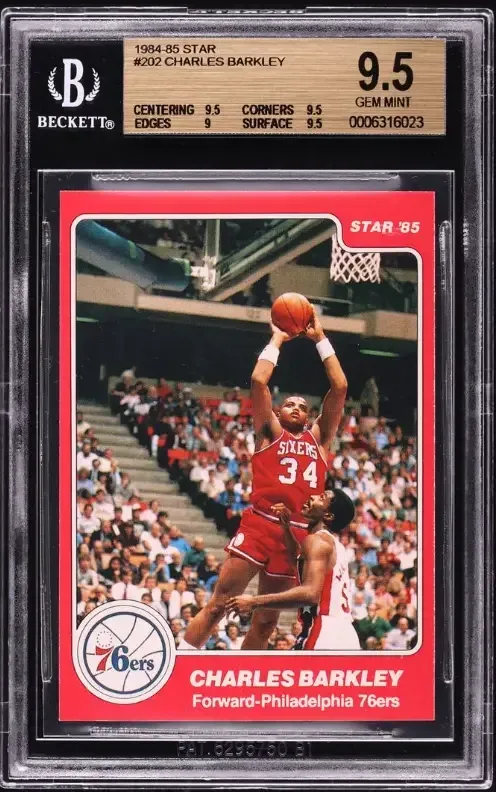
The 1984 Star issue remains Barkley’s defining early-career card
Barkley entered the NBA during a complicated stretch for licensed basketball cards. With Topps out of the market and Fleer not yet back, Star became the lone licensed NBA manufacturer. That left Barkley’s 1984 Star card, numbered #202, in a unique place historically and financially.
Collectors have argued for years over how to classify the card. Because Star products were distributed in sealed team bags rather than traditional wax packs, some hobbyists refer to Barkley’s 1984 release as an XRC, while others treat it as his true rookie. Whatever label a collector prefers, the demand is easy to understand. It is Barkley’s earliest major licensed NBA card, and high-grade examples are extremely difficult to locate.
For more collector background, read 1968 Topps Baseball Cards: The 6 Most Iconic and Valuable Cards in the Set.
Condition sensitivity has played a major role in the card’s mystique. Chipping, centering trouble, corner wear, and surface flaws have all made top-tier copies scarce. Among Beckett Grading Services examples, only nine BGS 9.5 copies exist out of a population of 943, or just under 1 percent. One of those BGS 9.5 copies sold for $34,200 in January, after another reached $27,000 roughly a year earlier.
The PSA side is even more unusual. For decades, early Star cards carried extra scrutiny because of counterfeit concerns and questions involving examples that surfaced after Star lost its NBA license. PSA stopped accepting submissions for those cards from the early 1990s until July 2022. That long pause helped shape a population profile that still stands out today. PSA’s database shows 429 graded copies of Barkley’s 1984 Star, with only 12 PSA 8s, one PSA 8.5, and nothing graded higher. A recent PSA 8 sale reached $21,000, up sharply from a $12,600 sale only two months earlier.
For collectors building a Barkley run, this is the card that usually starts the conversation. It carries rarity, a longstanding hobby debate, and pricing that continues to reflect both.
For another perspective on this story, read 8 Charles Barkley Cards That Map a Hall of Fame Hobby Legacy.
The 1986 Fleer rookie is still Barkley’s most recognizable mainstream card
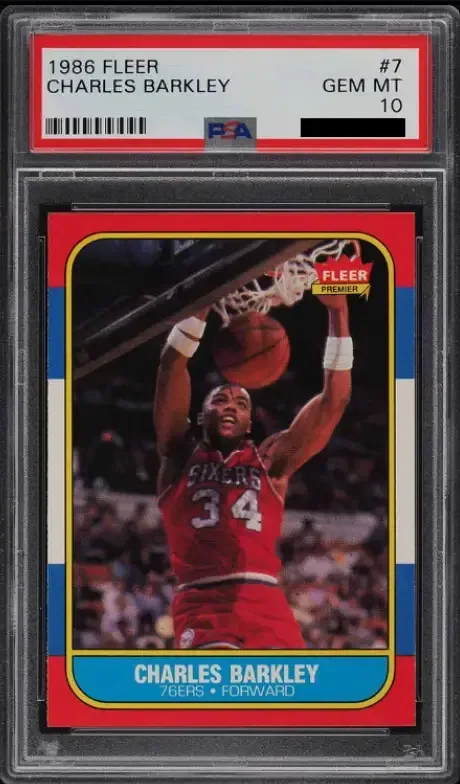
If the 1984 Star issue is Barkley’s most debated early release, the 1986 Fleer #7 is the card most collectors instantly recognize. It arrived after Barkley had already established himself as a star, which gives the card a different feel than a typical rookie. By the time 1986 Fleer reached collectors, he was already an All-Star and one of the most productive forwards in basketball.
That timing has always added to the appeal. The card is not just a rookie in the traditional sense. It is also a snapshot of a player whose breakout had already happened. For Barkley collectors who want a cornerstone card without the complexity of the Star debate, 1986 Fleer remains the easiest choice.
The market has rewarded that status. A PSA 10 most recently sold for $9,900, reflecting a year-over-year gain of 21.10 percent and a two-year rise of 44.53 percent. PSA 9 copies have also moved sharply higher, climbing from $870 to $1,550 over a 12-month span.
That makes the card both iconic and comparatively accessible relative to Barkley’s scarcer grails. There is a wide difference between chasing a top-grade 1984 Star and stepping into Barkley’s hobby legacy through 1986 Fleer. For many collectors, that accessibility is part of why the card remains so important.
Barkley’s 1987 Fleer second-year card has become a serious sleeper
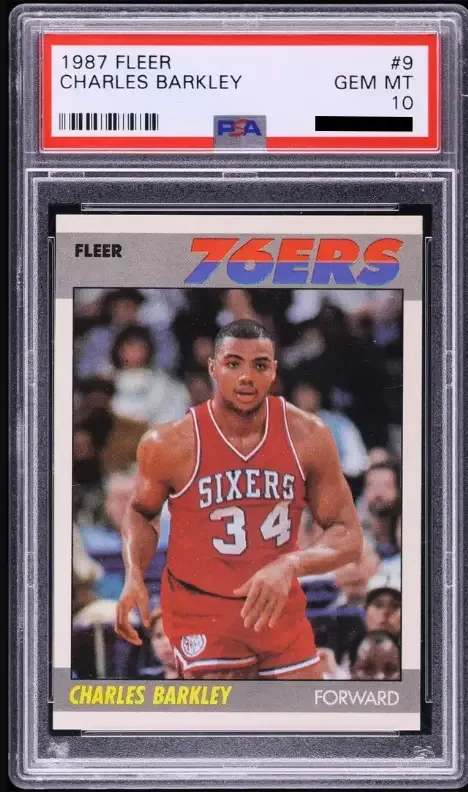
While the rookie gets most of the attention, Barkley’s 1987 Fleer #9 has quietly become one of the more interesting cards in his market. It does not carry rookie-card prestige, but it has something collectors care about just as much in certain segments of the hobby: real scarcity in top condition.
Only 25 PSA 10 copies exist for Barkley’s 1987 Fleer, compared with 246 PSA 10s for his 1986 Fleer rookie. That population gap is massive, and the sales history has started to reflect it. Just five PSA 10 examples have sold over the past two years, and the last two each topped $10,000. In practical terms, that means gem-mint copies of Barkley’s second-year Fleer have recently sold for more than many copies of his better-known rookie.
That does not automatically make the 1987 Fleer more important historically, but it does make it one of the strongest examples of how condition rarity can reshape collector interest. Advanced player collectors often look for exactly this kind of card: familiar set, strong visual identity, and a population profile that makes top-end copies far harder to obtain than casual buyers might expect.
Phoenix-era inserts helped define Barkley’s 1990s collecting appeal
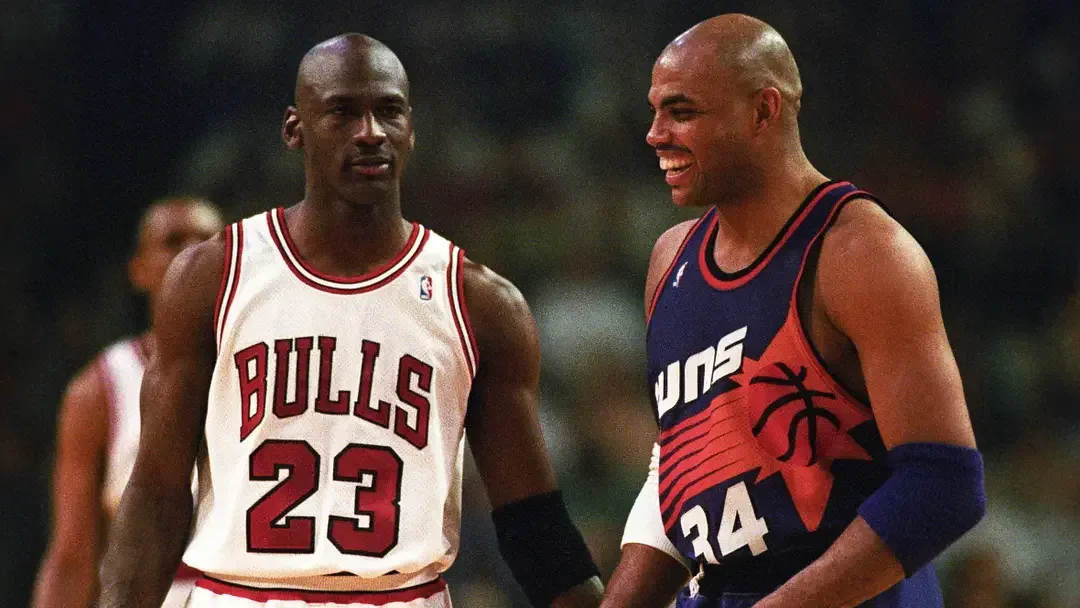
Barkley’s move to Phoenix in 1992 elevated his national profile even further. Coming off the Dream Team summer and stepping into a Suns team that reached the NBA Finals, he added an MVP season and one of the most memorable stretches of his career to his resume. Those years also produced some of his most popular 1990s cards.
Because this period came before serial-numbered parallels fully took over the hobby, demand has centered heavily on inserts with strong designs, lower survival rates in top condition, and established nostalgia. Barkley’s Suns cards check all three boxes.
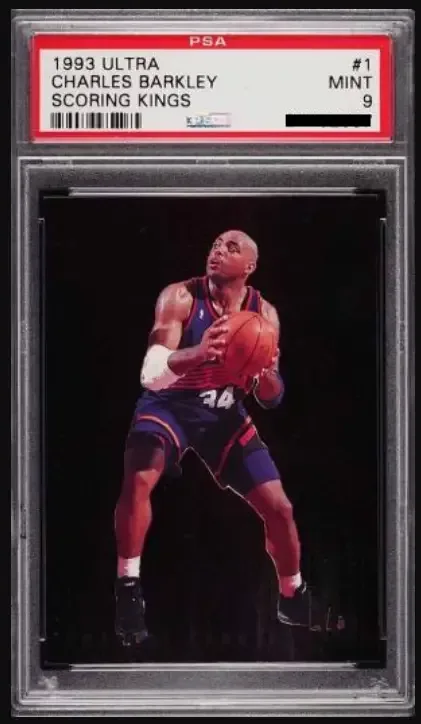
1993-94 Ultra Scoring Kings
The 1993-94 Ultra Scoring Kings #1 has been one of the fastest movers in Barkley’s market. Multiple grades have posted significant year-over-year gains. A PSA 9 that had been selling in the $300 to $350 range as recently as June later climbed to $965 in August and most recently reached $1,300, the highest price on record in the available sales data referenced here.
The gains have not been limited to high-grade slabs. PSA 8 copies moved from $69 to $450 over the course of a year, while raw copies climbed from $41 to $100. That kind of movement shows how broad the demand has become. Collectors are not just chasing the highest-end examples. They are also buying into the card as an iconic insert in any respectable condition tier.
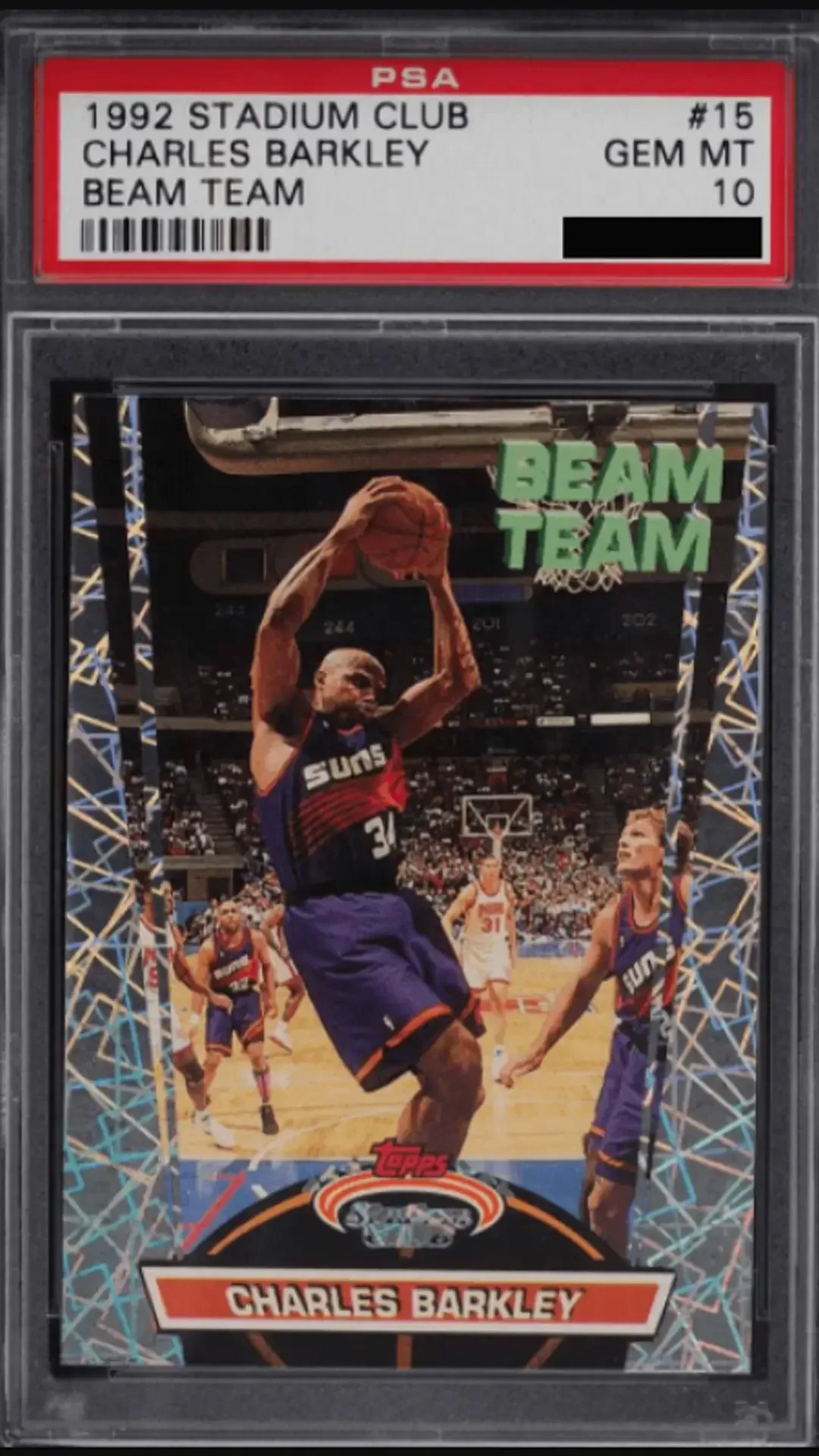
1992 Stadium Club Beam Team
Barkley’s 1992 Stadium Club Beam Team #15 has also surged. A PSA 10 rose from $500 to $2,400 over a one-year span, while PSA 9 sales moved from $100 to a record $353.50. Beam Team has long been one of the signature insert concepts of the 1990s, and Barkley’s copy benefits from both the brand’s enduring popularity and the timing of his transition into the Suns era.
These inserts are a reminder that Barkley’s hobby strength is not tied only to rookies and one-of-one patch cards. He also has meaningful depth in the classic insert space, which matters for collectors who want recognizable, display-friendly cards with established hobby status.
Houston-era parallels contain some of Barkley’s biggest non-rookie grails
Barkley joined Houston in 1996 as part of a veteran core built to chase another title. The championship run never fully materialized, but his late-career Rockets years landed right in the middle of one of the hobby’s most important design periods. That has made the era especially valuable for advanced Barkley collectors.
Many of Barkley’s top-selling non-rookie cards are tied either directly to 1997 and 1998 releases or to memorabilia from that stage of his career. In other words, even though his statistical peak came earlier, his cardboard peak in scarcity-driven collecting often points to Houston.
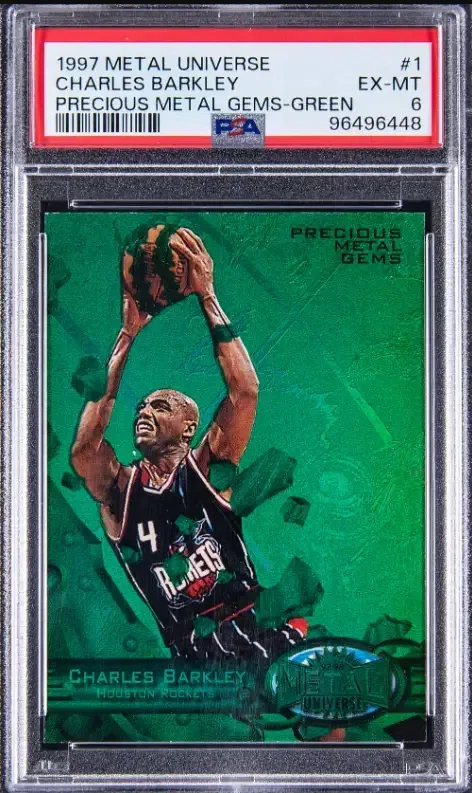
1997 Metal Universe Precious Metal Gems
No conversation about elite 1990s basketball cards is complete without Precious Metal Gems, and Barkley is no exception. His 1997 Metal Universe Green PMG, limited to 10 copies, sold for more than $79,000 in March despite receiving a PSA 6 grade. That sale underscores just how little the market cares about technical grade once the card enters true grail territory.
His Red and Championship PMG versions have also sold in the $30,000 to $35,000 range when examples have surfaced. These are not cards that trade often, which only adds to the aura when one finally reaches the market.
1997 E-X2001 Essential Credentials Now
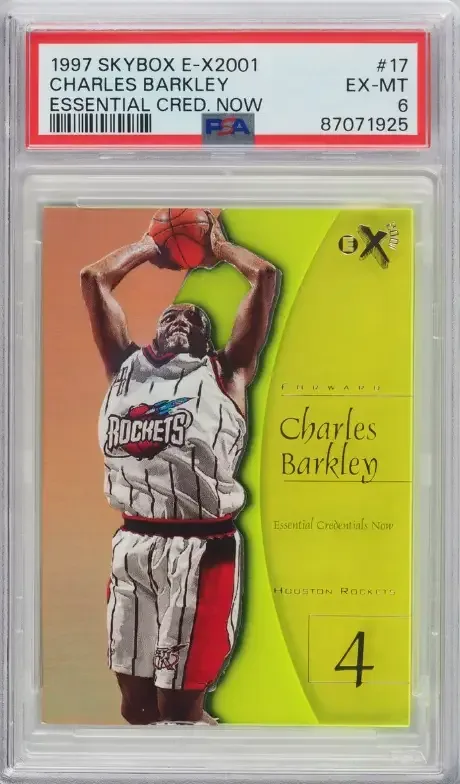
Another major entry from the same era is Barkley’s 1997 E-X2001 Essential Credentials Now, numbered to 17. High-end sales have reached more than $20,000 in a PSA 6 holder, while even an Authentic example without a numerical grade has brought $17,000. That is a strong signal of market confidence in the card itself rather than in pristine condition alone.
For collectors of 1990s parallels, Barkley has exactly what they want: iconic brands, low numbering, infrequent public sales, and a Hall of Fame subject whose personality never drifted far from the spotlight.
Modern Logoman autographs have pushed Barkley’s market to new heights
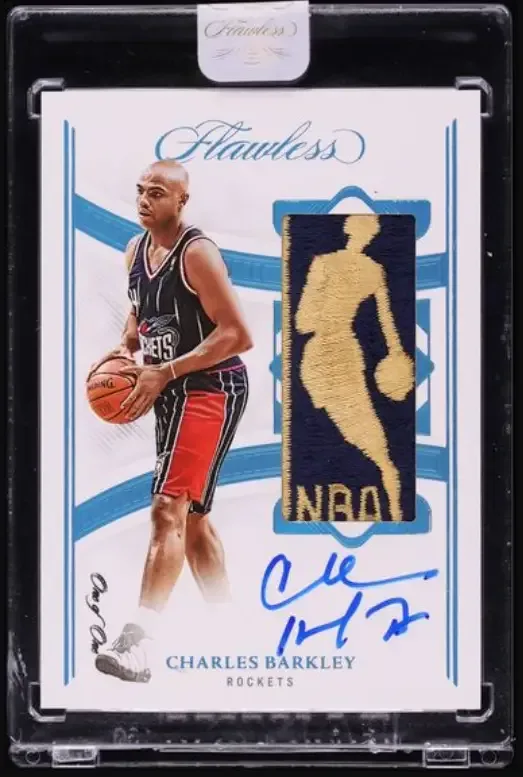
Even with all of the interest in Star, Fleer, and 1990s inserts, Barkley’s highest-dollar sales now sit in the modern ultra-premium segment. Logoman patch autographs have become the clearest example of how his legendary status translates into top-tier auction results.
The biggest sale cited here belongs to a 2021 Panini Flawless Platinum Logoman Auto featuring a gold 50th anniversary patch used during the NBA’s 1996-97 season. That one-of-one card sold for $144,000 on March 20, making it Barkley’s highest-selling card in the data referenced.
Other Logoman sales show that the six-figure result was not a standalone outlier. A 2024 Panini Flawless Update '22 Barkley Logoman graded PSA 8 sold for $63,400, while a 2021 Immaculate Collection Logoman graded BGS 8 realized $37,200.
These cards appeal to a different type of collector than the one searching for a 1986 Fleer PSA 9 or a Beam Team PSA 10. They sit at the intersection of game-used patch appeal, autograph demand, and one-of-one modern scarcity. But they still fit naturally into Barkley’s market because his career spans enough eras to attract multiple collector groups at once.
Why Barkley remains such a strong player market in basketball cards
Barkley’s card market works because it offers several different entry points without losing its identity. Collectors can debate the hobby history of his 1984 Star card, pursue the classic status of his 1986 Fleer rookie, chase the scarcity of his 1987 Fleer in PSA 10, build around beloved Suns-era inserts, or stretch into elite 1990s parallels and premium Logoman autographs.
Just as important, the player behind the cards still matters. Barkley was not simply a star with great highlights. He was an MVP, a dominant rebounder despite being undersized for his position, and a franchise-changing personality in Philadelphia, Phoenix, and Houston. That kind of legacy tends to age well in the hobby, especially when the player has remained visible long after retirement.
For collectors reviewing the landscape today, Barkley’s market shows a rare mix of historical importance, condition scarcity, 1990s nostalgia, and modern high-end strength. Few Hall of Famers offer that many lanes at once, and fewer still do it with cards that feel this distinct from one era to the next.
Photo Gallery