The 1966 Topps Football set occupies a very specific place in hobby history. It arrived at a time when pro football was changing fast, television was becoming more colorful and central to American life, and card design was starting to reflect that cultural shift in a more literal way. The result was a 132-card AFL release that collectors still remember instantly for its woodgrain television frame look.
More than a nostalgic design piece, 1966 Topps Football has developed into one of the more intriguing vintage football sets for player collectors, set builders, and condition-sensitive investors. It has star power, rookie appeal, unusual checklist cards, and one of the stranger insert-related wrinkles of the decade. It also has a reputation for being difficult in high grade, which continues to shape pricing at every level of the market.
A set tied to a major moment in football history
In 1966, the American Football League and National Football League agreed to merge, setting in motion the path to full unification that officially arrived with the 1970 season. That year also brought the first championship meeting between the leagues at the end of the season, the game later recognized as Super Bowl I, where the Green Bay Packers defeated the Kansas City Chiefs.
Topps' 1966 football issue focused on the AFL, while Philadelphia covered NFL players in its own release. That split gives the Topps set a distinct identity. It is not just a football set from the mid-1960s. It is an AFL snapshot issued during one of the most consequential periods in the sport's growth, with future Hall of Famers, important rookies, and team representations that speak directly to the pre-merger landscape.
For more collector background, read 2026 Topps Flagship Football Parallel Guide and Checklist.
For collectors who enjoy vintage sets that connect strongly to a turning point in league history, 1966 Topps checks a lot of boxes. It captures the AFL as a standalone property while also sitting right at the doorstep of the sport's modern era.
Why the design still gets attention
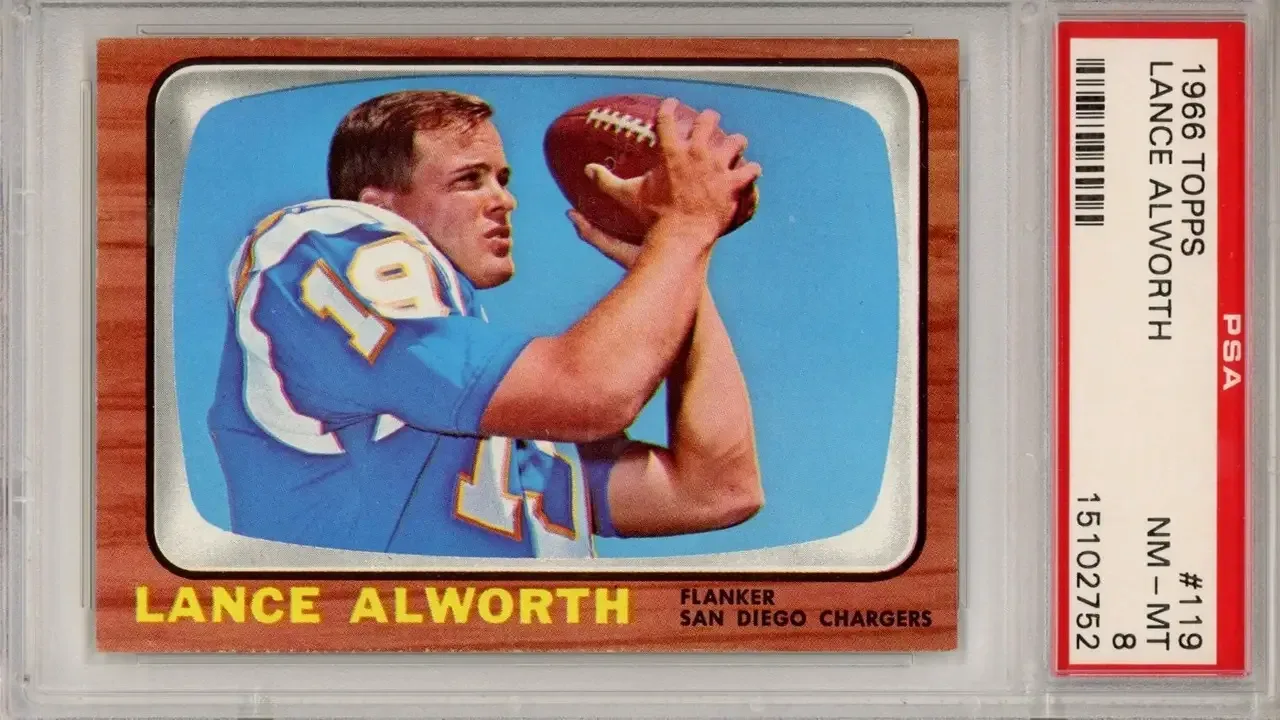
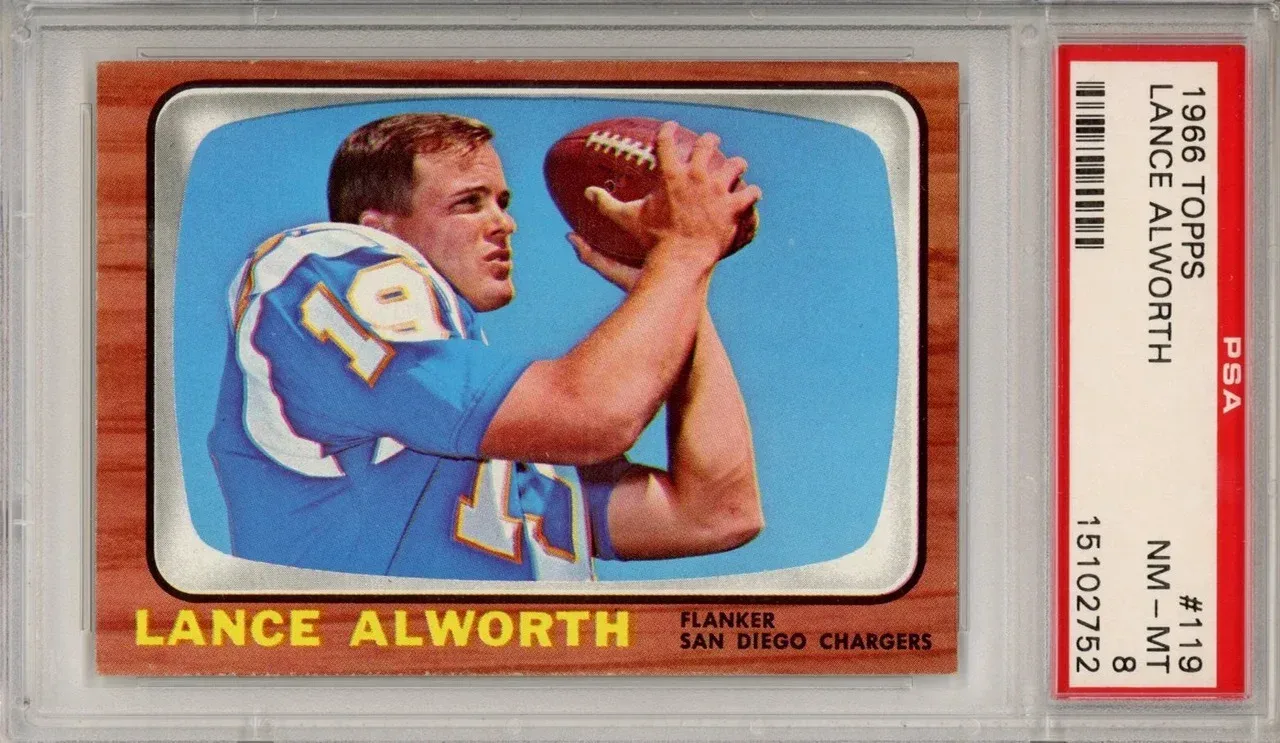
The signature feature of 1966 Topps Football is the front design. Each player image appears inside a television-shaped frame, complete with a woodgrain style border that evokes the home TV sets of the era. It is one of those concepts that can feel gimmicky in theory but works remarkably well in practice.
The visual identity is strong enough that many collectors simply refer to it as the “TV set.” In a hobby full of clean portrait issues, action-driven layouts, and standard nameplate treatments, this one looks different at a glance. The design ties directly to the cultural backdrop of the mid-1960s, when color television was becoming a bigger part of everyday life and televised sports were gaining even more reach.
That connection between football and television is part of what has kept the set relevant. It is not merely vintage. It feels rooted in a specific American moment. For collectors who value design as much as player selection, 1966 Topps Football offers an unusually clear theme.
The key cards that drive collector interest
Joe Namath card #96 remains the headline card for many collectors. As a second-year card for one of the hobby's most recognizable football figures, it has long been treated as one of the anchors of the set. Namath's popularity, crossover fame, and enduring market strength make his card central to any discussion of 1966 Topps.
Otis Taylor rookie card #75 is another major piece of the release. Taylor's rookie has become one of the more important cards in the set, especially for collectors building around Hall of Fame names and significant AFL players. Its place in the checklist and its demand in stronger grades help keep it high on want lists.
Other standout names frequently associated with the set include:
- George Blanda #48
- Len Dawson #67
- Johnny Robinson #74
- Bobby Bell #64
- Don Maynard #95
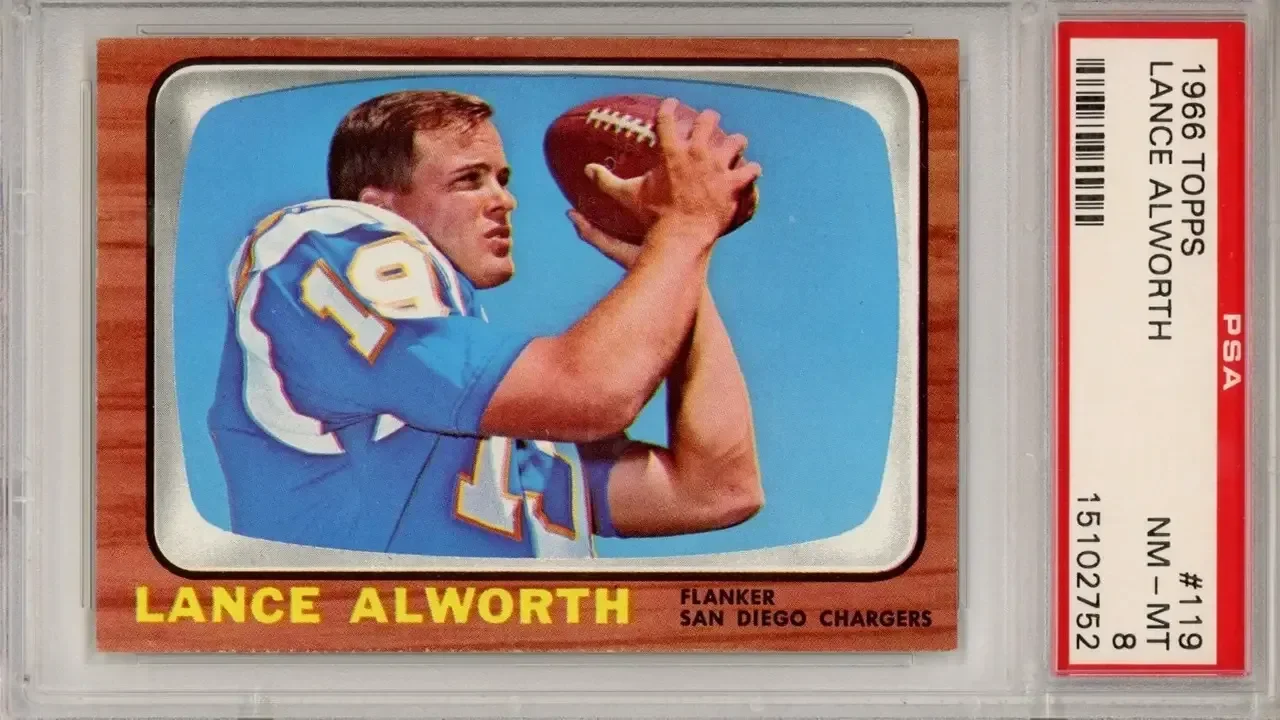
- Lance Alworth #119
- Fred Biletnikoff #104
- Billy Shaw #29
There are also notable rookie cards beyond Taylor, including Wendell Hayes #34, George Sauer #101, and Jim Turner #103. While not every rookie in the set carries the same weight, they add depth for collectors who want more than just a few marquee singles.
One of the more appealing things about 1966 Topps Football is that it works on multiple levels. A collector can chase a Namath, build a Hall of Fame run, target the key rookies, or go after the full 132-card issue. Each path feels legitimate because the set has enough substance to support all of them.
The checklist cards matter here
Checklists are often an afterthought in many vintage releases, but that is not the case with 1966 Topps Football. Base checklist cards #61 and #132 are widely recognized as important parts of the set, especially in solid condition.
Even though the full release came out at once and was not divided into true separate series, collectors often reference these checklist cards in a series-like way because there are two of them in the base issue. Their utility, set-building importance, and relative scarcity in higher grades have made them more desirable than a casual observer might expect.
The set-ending checklist #132 is especially notable because it is one of the tougher cards from a grading standpoint. It also carries extra hobby intrigue because it belongs to a tiny group of cards from the release that have no PSA 9 or PSA 10 examples recorded in the cited population discussion.
The oddball Funny Ring checklist twist
One of the most unusual cards associated with 1966 Topps Football is Funny Ring checklist #15. It is not a standard player card, and that is exactly why it has become such a conversation piece.
The card shows the 24 Funny Ring insert designs that appeared in wax packs. These included names like Bloodshot Eye, Fish Eats Fish, and Mr. Fang. The inserts were not football-themed in the traditional sense. Instead, they were novelty cardboard rings designed to be pushed out from their backing and worn.
That puts checklist #15 in a strange but memorable place within the release. It is a sports-card-era oddity embedded inside a football product, and collectors do not always agree on how naturally it fits with the rest of the set. Yet that same tension is part of its appeal. It is a one-off issue within the broader checklist and has become one of the more interesting non-player cards from the year.
For vintage collectors who enjoy unusual inserts, side content, and hobby quirks, the Funny Ring checklist gives 1966 Topps Football an extra layer of personality that many comparable sets do not have.
Why high-grade examples are so hard to find
Condition is one of the biggest reasons this set remains challenging. The woodgrain television border gives the cards visual charm, but it also leaves them vulnerable to edge and corner wear that shows up easily. Chipping has long been a known issue, and that matters even more on a design where border flaws can be obvious at first glance.
That difficulty has had a major impact on the grading population. High-grade examples are scarce, and true top-pop cards are especially difficult. Only 33 total PSA 10 grades were noted across the entire set in the population snapshot referenced by collectors. That is a remarkably small number for a 132-card release with multiple stars and key commons.
Even more telling, Don Maynard is the only card in the set reported with three PSA 10 examples. That level of scarcity helps explain why advanced set registry collectors face a steep challenge when they try to upgrade from PSA 7s and 8s into 9s and 10s.
There is also a small group sometimes referred to as the “Otto Club,” named after Jim Otto and his famous No. 00. In this context, the label refers to cards from the set that have neither a PSA 9 nor a PSA 10 in the cited population discussion. Those cards are:
- Wray Carlton #21
- Claude Gibson #110
- Bob Mischak #113
- Checklist #132
That kind of scarcity matters because it affects more than elite registry competition. It also shapes how the market values commons, semi-stars, and checklists in collector-friendly grades. In other words, the challenge of the set does not begin and end with Namath.
Recent prices show strength across stars and set pieces
Recent sales cited for 1966 Topps Football show a healthy mix of demand across marquee stars, premium-condition commons, and structurally important cards like checklists. Rounded prices include:
- Joe Namath #96, PSA 8: $2,358
- Joe Namath #96, raw EX-NM: $721
- Complete set, raw EX-NM: $1,875
- Bill Mathis #94, PSA 9: $1,300
- Base Checklist #132, PSA 7: $1,285
- Base Checklist #61, PSA 8: $810
- Funny Ring Checklist #15, PSA 7: $600
- Billy Shaw #29, PSA 9: $600
- George Blanda #48, PSA 9: $537
- Lance Alworth #119, PSA 8: $482
- Otis Taylor #75, PSA 8: $400
- Johnny Robinson #74, raw EX to EX-MT: $16 to $34
Several of those numbers stand out immediately. A PSA 7 example of checklist #132 reaching $1,285 underlines how much scarcity can push value outside the expected star hierarchy. The Funny Ring checklist at $600 in PSA 7 also confirms that oddball content within this release is not treated as throwaway material.
The Namath market remains central, but it is not the only story. The spread of realized prices shows that 1966 Topps Football has matured into a set where condition, rarity, and collector perception can elevate a wide range of cards.
The long-term appeal for vintage football collectors
Part of the set's staying power comes from the way several hobby themes intersect in one place. It has a memorable design. It represents the AFL during a transformative year. It includes Hall of Famers, meaningful rookies, and scarce high-grade cards. It also offers a challenge level that appeals to serious set builders without becoming inaccessible to collectors who prefer lower-grade vintage examples.
That makes it versatile. A raw collector can still enjoy the eye appeal and historical connection. A graded-card buyer can focus on stars or difficult commons. A registry participant can spend years trying to improve specific slots. The set supports each of those approaches naturally.
There is also a broader market argument in its favor. Vintage football has continued to benefit from a growing appreciation for historically important releases, and 1966 Topps fits neatly into that category. It is tied to a landmark year in pro football, and its strongest cards are linked to players who remain highly recognizable in the hobby.
What collectors should know before buying
Anyone shopping for 1966 Topps Football should pay close attention to border wear, corner touches, print quality, centering, and surface chipping. The woodgrain frame can hide minor issues in lower-resolution images, so close inspection matters. On raw cards, eye appeal can vary sharply even within the same approximate grade range.
Collectors should also avoid viewing the set as just a Namath chase. While his card is the flagship in many ways, checklist cards, key rookies, and certain Hall of Famers can be just as important depending on the collecting goal. Buyers pursuing a complete set should expect some cards to be noticeably tougher than their star level might suggest.
And for anyone drawn to the oddities of the era, Funny Ring checklist #15 is more than a novelty. It is one of the most distinctive side pieces in a vintage football issue that already has one of the hobby's most recognizable designs.
More than 60 years after release, 1966 Topps Football remains a set that rewards both nostalgia and patience, whether the target is a single Namath, a Hall of Fame run, or the full woodgrain TV lineup from card #1 through checklist #132.
Photo Gallery