WNBA cards can look deceptively simple until you start chasing the shiny versions. A base card turns into a rainbow of colors, the same player shows up in multiple designs, and terms like SSP, Zebra, Gold Vinyl, and Color Blast start carrying very different meanings. If you do not slow down and identify exactly what you are looking at, it is easy to mistake visual flash for true scarcity.
The useful habit is to separate what is documented from what is implied. Some WNBA cards have manufacturer-stated print runs. Some are exclusive to a certain product format. Some inserts are clearly positioned as hard chases but do not come with a published count. Those distinctions matter when you are deciding what to buy, how to compare listings, and how to avoid paying numbered-card prices for something that is merely colorful.
As of October 15, 2026, Panini’s WNBA materials and league pages give collectors enough evidence to build a cleaner framework. The result is not a magic ranking of every parallel. It is a more reliable way to read WNBA cardboard on its own terms, one card at a time.
Start with the simplest distinction: base card, parallel, or insert
The first step in evaluating a WNBA card is identifying its lane. A base card is the standard card in the main set. A parallel is an alternate version of that same card slot, usually changing color, surface treatment, or pattern while keeping the basic player image and design structure intact. An insert is a separate subset outside the base checklist structure, often with its own design name and chase identity.
That sounds obvious until you are looking at a listing that says only “Prizm Caitlin Clark Purple” or “Select Zebra rookie.” In practice, many collector mistakes begin with skipping the card-family question. If the card is a parallel of a base card, compare it only against other versions of that exact base card. If it is an insert, compare it against that insert set and then ask whether the insert itself has parallels.
Panini’s WNBA product announcements make this distinction explicit. In recent WNBA releases, the company highlights named parallels such as Lime Green, Blue Carolina, Purple Velocity, Purple Ice, Pink, Gold Ice, Tie-Dye, and Gold Vinyl, while also separately promoting insert sets like Color Blast, Fireworks, Fearless, Fractal, Groovy, Kaleidoscopic, Sublime, and Top Tier. That means a card’s category is not trivia. It is the foundation for understanding what, exactly, is scarce.
A practical rule helps: if two cards share the same core front design and card slot but differ in finish or color, you are usually dealing with parallels. If the entire design identity changes and carries its own insert name, you are usually dealing with an insert. Before you care about price, make sure you can answer that classification question confidently.
- Ask sellers for the full card name, not just the player and color.
- Check whether the design matches the main base layout or a named insert set.
- Do not compare a base parallel directly to a separate insert unless you first understand both print structures.
Serial numbers are the clearest proof of scarcity, but only for that exact version
Among all the signals collectors use, serial numbering is the cleanest manufacturer-side evidence. If a card says /25, /10, /5, or 1/1, the maker has stated a maximum print run for that exact parallel or insert parallel. That does not tell you everything about desirability, but it does tell you something concrete that a color name alone cannot.
Panini’s WNBA materials provide several straightforward examples. Select WNBA has highlighted versions such as Tie-Dye /25, Gold Ice /10, Gold Vinyl 1/1, and Black Finite 1/1. Earlier Prizm WNBA hobby materials listed parallels such as Mojo /25, Gold /10, Black Gold /5, and Black Prizm 1/1. Panini’s Prizm WNBA Blockchain article also published numbered structures for digital cards, including Silver /296, Purple /169, Pink Velocity /49, Mojo /25, Gold /10, Black Gold /5, and Gold Vinyl 1/1, plus numbered insert versions.
The caution is just as important as the headline. A serial number proves scarcity only inside that exact lane. A player can still have many different cards and many different scarce versions inside the same release. So a /10 is scarce, but it is not automatically the player’s only premium card from that product. Collectors sometimes talk as if any /10 creates a one-of-ten universe around the athlete. It does not. It creates a one-of-ten universe around that precise card version.
That matters when comparing two listings. Suppose you are deciding between a Gold /10 base parallel and a different unnumbered SSP insert of the same player. The numbered card gives you documented scarcity. The SSP insert may still be harder to pull in practice, but unless a count is published, its exact supply remains unknown. If you want certainty, the serial number wins. If you want design appeal or a famous chase name, you may prefer the insert. Just be honest about which benefit you are paying for.
- Read the serial number as a cap for that specific card version, not the player’s entire output.
- Treat 1/1, /5, /10, and /25 as separate scarcity lanes, not interchangeable badges.
- When comparing cards, ask whether both have disclosed print runs or only one does.
Not every shiny parallel is rare, and the same color name can mean different things across products
One of the easiest ways to overpay is to assume every colorful WNBA parallel carries the same level of scarcity. It does not. Panini’s own product descriptions show that different brands and release years use different parallel menus, different numbering structures, and different exclusivity patterns. The word Gold in one release might signal one print run, while another product’s gold-themed card may belong to an entirely different setup.
That is why product context matters more than surface appearance. A collector who sees a bright card in a photo may think, “rare parallel.” But the useful question is, “rare compared with what?” Compared with the base card? Compared with all parallels in that product? Compared with only the same insert family? Without that context, color becomes a shortcut that can mislead you.
Prizm and Select are especially good reminders. Both offer layered chases and premium-sounding names, but they do not use an identical system. Purple Ice, Pink, Purple Prizms, Gold Ice, Tie-Dye, and Gold Vinyl do not all represent the same type of scarcity even before you get into numbering. In another release, Lime Green, Blue Carolina, or Purple Velocity may sound flashy but require separate verification of whether they are numbered, format-tied, or simply part of a wider rainbow.
The practical fix is simple but not glamorous: always match the card to its exact year, brand, and subset before deciding what the parallel name means. If a listing title leaves out any of those pieces, treat it as incomplete. A collector who can identify the exact card first will make fewer mistakes than a collector who reacts to color alone.
- Never value a card by color name alone.
- Require year, brand, set, player, and parallel before making a comparison.
- If two cards use similar names in different products, assume nothing until you confirm the print structure.
Inserts can be important chases, but their scarcity is often less transparent
Inserts are where many WNBA products become the most visually distinctive. They often carry stronger design identity than base cards, and some become release-defining chases. But inserts also create one of the biggest clarity problems for collectors, because they split into two very different types: quantified scarcity and signaled scarcity.
Quantified scarcity is the easier case. If an insert or insert parallel is serial-numbered, you have a documented ceiling. Panini’s Prizm WNBA Blockchain material, for example, described Color Blast, Dual Color Blast, and Abstract versions numbered to /25, along with certain insert parallels numbered as Silver /49, Gold /10, and Gold Vinyl 1/1. In that kind of setup, you can talk about scarcity with precision.
Signaled scarcity is murkier. Panini has described some WNBA inserts using terms like ultra-rare or super-short-printed without publishing a card-by-card print run. Color Blast in Prizm WNBA has been promoted in that language, and Select chase pieces such as Color Wheel or Zebras are often treated by collectors as major hits even when a specific count is not given in the source material. That does not mean those cards are common. It means the exact supply is not disclosed there.
This is one of the healthiest distinctions a collector can learn. If a card is unnumbered but branded as SSP, you can fairly say the manufacturer is signaling scarcity. You cannot fairly claim a precise print run unless one is actually published. For buyers, that means the premium is partly for design status and chase reputation rather than a confirmed count. That may still be worth it. Just do not confuse the two kinds of evidence.
- Use “documented scarcity” for numbered inserts or numbered insert parallels.
- Use “manufacturer-signaled scarcity” for unnumbered SSPs when no print run is disclosed.
- If a listing claims an unnumbered insert is rarer than a /10, ask what evidence supports that.
Format exclusives add a second layer of scarcity that many buyers overlook
Scarcity is not only about the number stamped on the card. Distribution channel matters too. If a parallel is confined to a particular format, such as hobby-only, its availability is narrower than a version spread across broader retail distribution. That does not automatically make it more valuable, but it does make its path into the market more restricted.
Panini’s 2021 Prizm WNBA hobby material is useful here because it explicitly identified certain parallels as hobby-box only. When a card is both serial-numbered and tied to a specific product format, you have two scarcity filters working together: a capped print run and a limited release channel. For collectors building a targeted player run, that can make some versions harder to source consistently even when the serial number is clear.
This is also where unopened product language matters. A release can contain dozens of parallel names, but if one subset is available only in hobby while another is tied to other formats, those cards do not enter the market under the same conditions. A buyer who ignores format will often misread why one numbered card appears often while another barely surfaces.
A practical example: imagine two cards are both numbered /25. One comes from a broad format; the other is hobby-only. The numbering makes them equally capped in theory, but the collecting pathways are different. One may show up more often because more of that format is opened or more copies were pulled into the market faster. The point is not to guarantee which one will sell for more. The point is to notice that serial number alone is not the whole distribution story.
- Check whether the parallel is described as hobby-only, retail-only, or otherwise format-exclusive.
- Use format exclusivity as a secondary scarcity factor, not a substitute for the actual print run.
- When two numbered cards seem similarly scarce, ask whether they entered the market through the same product channel.
A better buying checklist: five questions to ask before you pay a premium
You do not need a master spreadsheet of every WNBA parallel ever printed to make better decisions. You need a repeatable checklist. Start with five questions. First, is the card serial-numbered? If yes, you have direct evidence of a maximum print run. Second, is it a base parallel or an insert? That tells you which family of cards you should be comparing it against.
Third, is the card tied to a specific format such as hobby-only? That can affect how often it appears. Fourth, does the exact version have a published print run, or is the seller leaning on words like SSP, case hit, or ultra-rare without a disclosed count? Fifth, can you identify the full card correctly by year, brand, set, player, and parallel name? If you cannot, you are not ready to price it.
This checklist sounds basic, but it solves common real-world problems. A seller may title an item “Gold rookie” without noting whether it is a base Gold parallel, a Gold Ice version, or a Gold insert parallel from a separate chase. Those are not interchangeable. Another listing may show a Zebra pattern from Select, which can be a legitimate premium chase, but if the title does not establish the exact card slot and year, comparison shopping becomes guesswork.
The tradeoff is time. Careful identification slows you down, and fast-moving chase cards can tempt you to skip steps. But the cost of moving too quickly is often paying for vagueness. In a category with many visually striking variants, the collector who asks boring questions usually makes the smarter purchase.
- Is it numbered?
- Is it a base parallel or an insert?
- Is it format-exclusive?
- Is the scarcity quantified or only signaled?
- Can you identify the exact year, brand, set, player, and parallel name?
Licensing explains why a card exists, but it does not answer every rights question
Collectors often treat licensing as one big yes-or-no stamp. In reality, the rights behind a WNBA card can be layered. The WNBA’s licensing application states that the league holds the exclusive right to license for commercial purposes the names, symbols, emblems, designs, logo identifications, and uniforms of the WNBA and its member teams. That is the clearest statement here about league and team visual identity.
Separately, league pages described Panini as the WNBA’s exclusive trading card partner in 2024, 2025, and again in July 2026. As of the October 15, 2026 research date, that is strong evidence that Panini remained the operating trading-card partner recognized by the league. It is also more precise than broad hobby shorthand. Saying a company is the exclusive trading card partner is specific. Saying it owns every possible player right would go beyond the available evidence.
Panini’s own WNBA retail page adds another wrinkle by promoting certain athletes as Panini exclusive athletes. That suggests player-specific arrangements can exist alongside league or team licensing. But a retail page does not, by itself, publish the full scope of those athlete agreements. It may point to autograph rights, card rights, memorabilia rights, or a combination, and the details are not fully laid out there.
For collectors, the practical lesson is restraint. League logos and uniforms, athlete participation, and autograph access are related but not automatically identical buckets. If you are evaluating why one release includes certain players, why autographs appear in a product, or why a company markets a specific athlete heavily, use precise language. Licensing explains structure. It does not justify assumptions beyond what the source actually says.
- League and team identity rights are not the same as player-specific rights.
- An exclusive trading card partnership does not automatically reveal every autograph or athlete agreement.
- Use precise terms like league licensing, team identifiers, athlete exclusives, and autograph content instead of collapsing everything into “rights.”
Be careful with future-rights assumptions and hobby shorthand about who has WNBA cards
It is easy to let broader basketball news blur into WNBA card assumptions. The NBPA announced a multiyear Fanatics Collectibles, NBA, and NBPA partnership and a 2025-26 Topps Basketball launch date for fully licensed NBA and NBPA cards. That is important for the basketball hobby at large. But it does not, by itself, prove that physical WNBA card rights changed hands on the same timetable.
As of the October 15, 2026 research date, the league itself was still describing Panini as the exclusive Trading Card Partner of the WNBA in July 2026. That means the safe collector conclusion is narrower than hobby rumor often is. You can say there was a documented NBA and NBPA Topps launch. You can also say the WNBA still publicly referred to Panini as its exclusive trading card partner in mid-2026. What you should not do from these sources alone is declare a completed physical WNBA cardboard handoff date.
Why does this matter for scarcity and card identification? Because confusion about rights can distort how collectors read a release. People may wrongly frame a Panini WNBA product as a last licensed issue, a transitional issue, or an unlicensed detour without source-backed support. Those narratives can influence buying behavior even when the underlying claim is not established by the available evidence.
The best habit is to separate what is current from what is speculative. As of the research date, Panini’s WNBA relationship was still publicly recognized by league pages cited here. If future changes occur, treat them as future changes when they are clearly announced, not as assumptions imported from other basketball licensing news.
- Do not assume NBA licensing changes automatically apply to WNBA physical cards.
- Use “as of October 15, 2026” when discussing the current WNBA card-partner picture.
- Be skeptical of “last licensed” or “rights change” claims unless the WNBA or the card company states them clearly.
The most useful conclusion: chase documented scarcity first, then decide how much mystery you actually want
The healthiest way to approach WNBA parallels and inserts is not to eliminate uncertainty. It is to label it correctly. Serial-numbered cards offer documented scarcity. Format exclusives add an extra layer of distribution context. Unnumbered SSPs and premium inserts can still be important cards, but their scarcity is often manufacturer-signaled rather than fully quantified in the cited product materials.
That distinction gives you control over your own collecting style. If you prefer certainty, build around numbered parallels and numbered insert versions where the ceiling is plainly stated. If you love design-forward chases such as Color Blast, Zebra, or Color Wheel, you can still pursue them with confidence as long as you understand that some of the premium rests on aesthetics, reputation, and pull difficulty rather than a published print total.
There is no universal right answer between those approaches. The tradeoff is transparency versus mystique. Numbered cards give you a cleaner factual case. Unnumbered chase inserts may deliver stronger visual identity and hobby cachet. The mistake is not choosing one lane or the other. The mistake is paying for one while believing you are getting the other.
If you remember only one principle, make it this: in WNBA cards, genuine scarcity is strongest when the manufacturer actually documents it. Everything else may still matter, but it should be described with the right level of confidence. That small shift in language can save you money, sharpen your collection goals, and make every future parallel decision easier.
- If you want the strongest proof, prioritize serial-numbered cards.
- If you want visual chase appeal, pursue SSP-style inserts with open eyes about undisclosed counts.
- Describe cards precisely: documented scarcity, format exclusivity, or manufacturer-signaled scarcity.
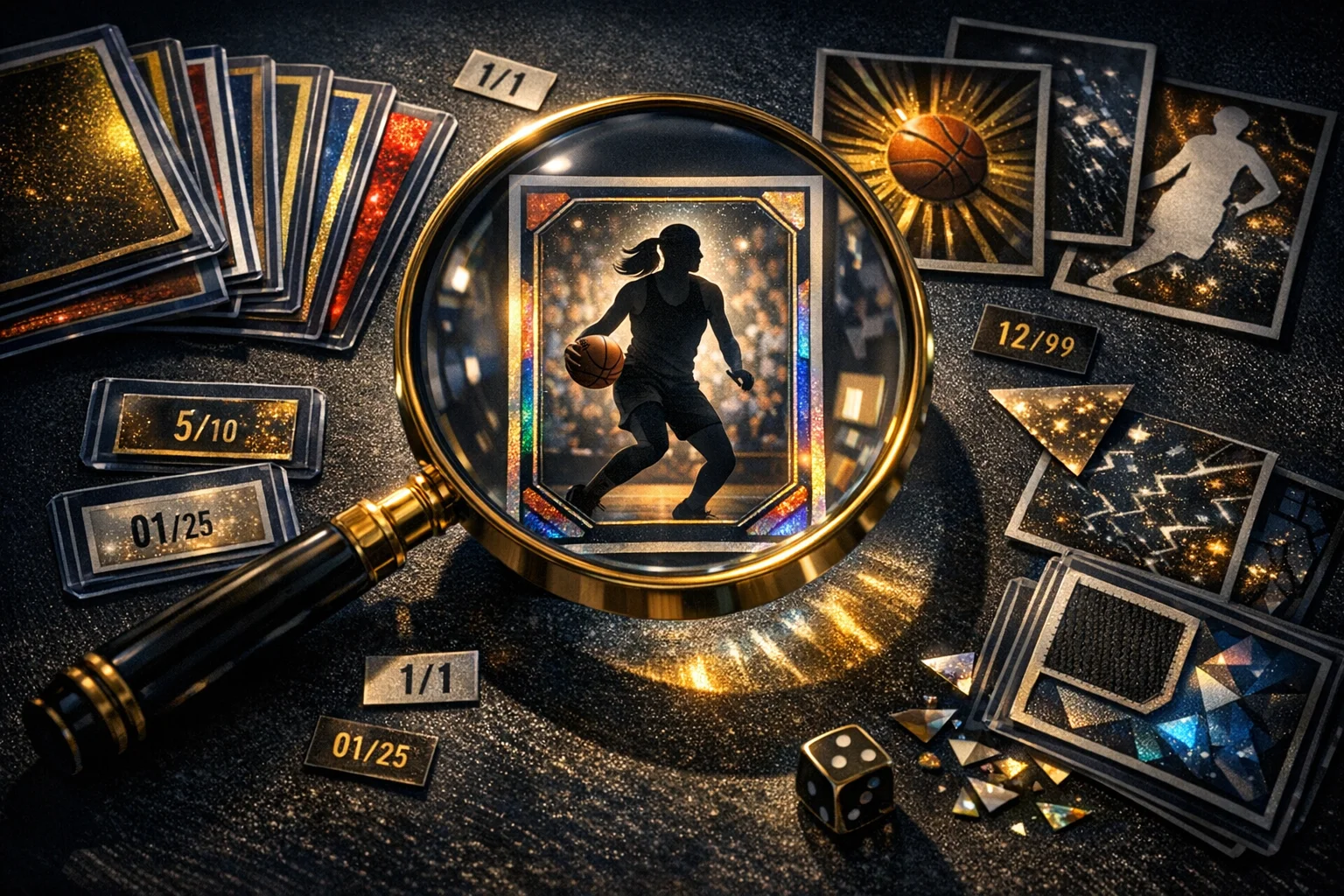
Illustration generated for this guide; not a photograph of an actual card, product or event.
Photo Gallery