Short prints, super short prints, and image variations can be some of the most appealing cards in modern collecting. They can also be some of the easiest to mislabel. A card that looks unusual is not automatically a variation. A card that is hard to pull is not automatically an SP. And a scarce card with a different finish may be a parallel rather than a variation.
The safest approach is not guesswork or hobby shorthand. It is a repeatable research process: identify the exact card, find the manufacturer’s checklist, compare the odds sheet, and then match the card to the maker’s own visual description. If you build that habit, you give yourself a much better chance of buying accurately, listing honestly, and avoiding the common trap of paying a premium for a card whose status was never actually verified.
1. Start with the exact card identity, not the seller’s label
Before you look for rarity, write down the full identity of the card in front of you: manufacturer, sport, set, year, card number, player, and what appears different about it. That last part matters. The difference might be a photo change, a nickname plate, a black-and-white treatment, a throwback uniform, a back foil cue, or something else entirely.
Collectors often get into trouble by starting with the phrase in a marketplace title rather than the card itself. If a listing says “SSP variation,” treat that as a claim to test, not a fact. Manufacturers do not always organize products the way sellers do. One brand may group a card under image variations, another under short-printed base variations, and another may separate base, insert, SPs, and odds in different checklist columns.
A practical example: if you pull a baseball card that shares a card number with the base version but shows a different photo, do not jump straight to “SP.” First record the exact set and number. Then ask a narrower question: does this release even have a manufacturer-listed variation category tied to that card number? Narrow questions get you cleaner answers.
This small habit also helps when you revisit a card months later. A note that says “looks different” is not enough. A note that says “2023 Heritage, card number X, black-and-white image, player name matches base” gives you something researchable.
- Write down year, brand, set, player, and card number before anything else.
- Note the visible difference in plain language: photo, nameplate, uniform, color treatment, back, or foil.
- Treat listing language such as “SP” or “SSP” as an unverified description until the manufacturer confirms it.
2. Pull the official checklist first, because it tells you whether the card type exists at all
Your first destination should be the manufacturer’s own checklist page or release document. That is where you learn whether the product includes variation categories in the first place. Without that step, it is easy to invent a rarity tier that the maker never designated.
Topps directs collectors to official, release-specific product checklists and product odds. It also states that its current support system maintains official product checklists back to 2018 and official odds back to 2022. Panini points collectors to its checklist tool, where the intended method is to filter by sport, year, brand, and program. Upper Deck publishes current product checklists with structured fields that can include set name, card, description, numbering, SPs, and odds.
When you open a checklist, search for category words rather than reading line by line. Useful terms include variation, image, photo, SP, short print, nickname, error, throwback uniform, black and white, golden mirror, or any other phrase the manufacturer has used in that brand family. If none of those terms appear, that absence is meaningful. It does not prove a special card cannot exist, but it should make you skeptical of any unsupported claim that the card is a recognized variation type.
One of the clearest examples is 2023 Topps Heritage Baseball, where the official checklist explicitly names an “All Stars BW Image Variation” section and then lists the matching card numbers and players. That is the level of proof collectors want: not a rumor about scarcity, but a labeled checklist category tied to exact cards.
- Use the maker’s checklist before using marketplace labels or community shorthand.
- Search the checklist for variation words instead of assuming every unusual card falls under SP.
- If the checklist names a category and specific card numbers, you have strong evidence.
3. Use the odds sheet to separate existence from scarcity
A checklist tells you that a card type exists. The odds sheet helps tell you how scarce that card type is relative to the rest of the release. That distinction matters because collectors often blur two different questions: “Is this a real variation?” and “How hard is it to pull?” The first is about category. The second is about frequency.
Topps is especially clear that odds are release-specific and should be checked on the official odds page for the exact product. In the official 2023 Topps Heritage Baseball odds document, the categories are broken out in separate buckets such as High Numbered Short Prints Cards, Base Card Black & White Images, Error Short Prints, Throwback Uniform, and Nickname. That structure is a useful reminder that not every scarce card belongs under one giant SP umbrella.
This is why a card can be rare without being the kind of rare a seller claims. A numbered parallel may be scarcer than a basic image variation. A hard-to-hit insert may be tougher than a short print. An image variation may not be serial-numbered at all. If you skip the odds sheet, you can confirm that a card exists but still misunderstand what kind of chase it is.
For buyers, this affects pricing discipline. For sellers, it affects honesty. If the odds sheet labels a card as a black-and-white image category, calling it simply an “SSP” may sound exciting, but it can muddy the actual manufacturer designation unless that same product documentation uses SSP language.
- Checklist answers: does this card type exist?
- Odds sheet answers: how is this card category distributed?
- Do not let rarity language replace the manufacturer’s actual category names.
4. Learn the difference between base, parallel, variation, SP, and SSP
Many collecting mistakes start with category confusion. A base card is the standard checklist entry. A parallel is the same underlying card with a changed finish, color, pattern, or numbering treatment. A variation is a deliberately different version of a card, often through a different image, text treatment, or corrected detail. SP and SSP are scarcity labels, not automatically design descriptions. They can apply to base-related cards, subsets, or variations depending on the release.
Panini’s 2019-20 Spectra Basketball guide is a useful example because it explicitly refers to short-printed base variations and then explains the visual differences card by card. In other words, the card is a variation in design content and a short print in distribution. Those are related facts, but they are not identical concepts. Upper Deck’s glossary reinforces the scarcity side by defining a short print as a card with a lower print run than the rest of the set.
For collectors, the practical payoff is cleaner thinking. If you are holding two cards with the same player and number, and one has a different holo pattern plus a serial number, that often points you toward a parallel question. If the same number instead shows a different image or text plate, that pushes you toward a variation question. Then you use the checklist and odds sheet to learn whether the manufacturer also treats that variation as an SP or SSP.
This distinction is especially useful when comparing cards across sports. A baseball variation in one Topps release may be photo-driven, while a hockey or basketball release may organize scarcity differently. The labels are familiar, but the structure can vary product by product.
- Base: standard card listing.
- Parallel: same card design, altered finish, color, or serial numbering.
- Variation: deliberate content difference such as image or text.
- SP/SSP: scarcity labels that may apply to variations or other card categories.
5. Match your card to the maker’s stated visual tell
Once you know a variation category exists, the next step is simple but important: compare your card to the manufacturer’s own description of what changes. This is where you stop researching in the abstract and start testing the card in hand.
If the checklist says image variation, compare the photo, pose, crop, or background against the standard base card. If the odds sheet says nickname, inspect the front text treatment and player naming. If it says throwback uniform, compare the jersey styling. If it says black-and-white image, confirm that the photograph treatment matches the category rather than assuming any muted photo means the same thing. If the product family uses a named cue such as Golden Mirror, inspect the relevant back or foil element in addition to the front image.
This process sounds obvious, but it is where sloppy listings often fail. Sellers may upload a scan that hides the back, or describe a card by a broad term without showing the exact visual cue. Buyers should respond by asking narrower questions: What is the card number? Which checklist category are you matching it to? What is the manufacturer-described difference? Can you show the back if the variation cue is there?
As analysis, not a market claim, think of this as a mini authentication exercise for category rather than condition. You are not asking whether the card is nice. You are asking whether the card matches the release’s official description closely enough to justify the label attached to it.
- Compare against the base version, not just against memory.
- Ask for front and back images when the variation cue may be on the reverse.
- Use the manufacturer’s wording to guide what difference you should be able to see.
6. Do not mistake “hard to pull” for “variation”
Collectors love scarcity, but scarcity by itself does not tell you what a card is. A tough pull can be a short print, a serial-numbered parallel, a difficult insert, or a retailer-specific chase. Those are not interchangeable categories, and treating them as interchangeable creates bad listings and confused purchases.
Upper Deck’s glossary is helpful here because it separates the idea of a short print from the broader reality that inserts can also be difficult pulls. That means rarity language should not be your first proof. It is supporting information after category identification, not a substitute for it.
This is especially relevant in modern products where collectors may see social media posts about cards that “fall one per case” or “barely show up.” Those posts may be directionally interesting, but they are not the same as an official category designation. A case-hit insert can be genuinely scarce without being an SP. A low-numbered parallel can be objectively rarer than an unnamed variation but still belong in a different checklist bucket.
A good buying question is: is the premium here based on confirmed checklist status, confirmed odds status, or just community buzz? Buzz may matter in the market, but category verification should come first if your goal is accuracy.
- Scarcity does not equal variation.
- Difficult inserts and low-numbered parallels can be rarer than some SPs.
- Use rarity claims only after you know the official checklist category.
7. Adjust your method by manufacturer, because the paperwork style is not the same
The core process stays the same across brands, but the documents can look different enough that your workflow should adapt. With Topps, the cleanest habit is often checklist first and odds second, because the two documents together may tell the full story. With Panini, the checklist tool is the starting point, but some products are also supported by dedicated explainer posts that walk through the differences card by card. With Upper Deck, the checklist format itself may expose SPs and odds more visibly through structured columns.
That matters because some collectors waste time expecting identical documentation across every maker. If a Topps release requires you to combine two PDFs, that is not a flaw in your research. It is just the structure of the evidence. If Panini published a product-specific guide showing which jersey color or pose distinguishes a variation, that can be more useful than a generic marketplace image. If Upper Deck’s checklist page includes an SPs field and an odds field, read those columns carefully instead of searching message boards first.
A practical workflow might look like this. For a Topps card: locate the exact release, pull checklist, then pull odds, then compare the card. For a Panini card: filter by sport, year, brand, and program, then search for any product explainer that details variation cues. For an Upper Deck card: inspect the checklist row, including description, numbering, SPs, and odds if present. Same logic, different interface.
Collectors who accept those differences usually research faster and make fewer category mistakes. The goal is not to force every release into one template. The goal is to use each manufacturer’s own structure against the claim being made about the card.
- Topps often requires checklist plus odds together.
- Panini may pair checklist tools with product explainers.
- Upper Deck may surface SPs and odds directly in checklist structure.
8. Be careful with older cards, unofficial SSP language, and licensing assumptions
Not every research trail is equally complete. Topps states that its current support system does not maintain official checklists before 2018 or official odds before 2022. For older issues, that means you may need archived official PDFs or brand articles rather than relying on the current support hub alone. The absence of a document in today’s interface is not proof that a card type never existed. It just means you may need a more patient search for official-era material.
You should also be cautious with the term SSP unless the manufacturer itself uses that language for the exact release. Upper Deck offers a broad definition for SP as lower print run, but SSP usage is less standardized across the hobby. Some products or product guides may use “super short print,” but many collectors apply SSP far more loosely than the documentation supports. If the maker does not say SSP, it is safer to describe the card using the official category name you can verify.
A separate but related caution: variation status is not the same thing as licensing status. A card can be a legitimate variation while licensing rights for league logos, active player group rights, or autograph rights involve entirely different agreements. MLBPA states that it holds the exclusive worldwide group-licensing right to the names, numbers, nicknames, likenesses, signatures, records, and biographical data of active MLB players in group-licensing situations. MLB reported on January 4, 2022 that Fanatics had secured exclusive rights agreements with MLB and MLBPA and, through its purchase of Topps, began designing, manufacturing, and distributing baseball cards immediately rather than waiting until 2026. For NBA, the NBPA announced on October 15, 2025 that Topps returned as the official exclusive trading card licensee of the NBA and NBPA, with 2025-26 Topps Basketball releasing on October 23, 2025.
Autograph rights can be another separate layer. MLB reported on August 29, 2024 that Shohei Ohtani signed an exclusive global trading card deal with Topps covering autographs and memorabilia. For collectors, the takeaway is simple: an SP label does not tell you who held the logo license, the player group license, or a player’s autograph rights for that release year. Verify those separately when they matter to your buying decision.
- For older Topps products, current support pages may not contain every official checklist or odds document.
- Use SSP carefully unless the exact release materials support it.
- Do not confuse card-type verification with league, player, or autograph licensing.
9. A reusable verification checklist you can apply before you buy, grade, or list
The best outcome of all this research is a system you can repeat. Start by identifying the exact card. Pull the official manufacturer checklist. Search it for category language tied to your card number or player. Pull the official odds sheet when available. Confirm whether the scarcity bucket is SP, SSP, image variation, or something else. Then compare your card against the manufacturer’s stated visual tell. Finally, keep any licensing or autograph-rights questions separate from the card-type question.
This process works before a purchase, before a submission, and before you write your own sale listing. If you are buying raw, it helps you ask better questions and avoid category premiums built on weak evidence. If you are submitting for grading, it helps you decide how to describe the card accurately on your own inventory notes. If you are selling, it helps you write a title that is persuasive without overstating what the card is.
Here is a realistic example. Suppose you find a card with the same number as a base card but a different image. Do not list it instantly as an SSP variation. First confirm the release and number. Check whether the official checklist includes an image variation or comparable category. Check the odds sheet to see whether that category is treated separately and how it is named. Compare the front and back cues. If the documentation supports “black-and-white image variation,” use that. If it supports “short-printed base variation,” use that. If the documents do not support SSP, skip SSP.
The discipline may feel slower in the moment, but it pays off in trust and accuracy. In a collecting category where one changed photo can move attention fast, careful terminology is part of the hobby skill set.
- Identify the exact card.
- Find the official checklist.
- Search for variation category language.
- Find the official odds sheet when available.
- Match the card to the manufacturer’s visual cue.
- Keep licensing and autograph-rights questions separate.
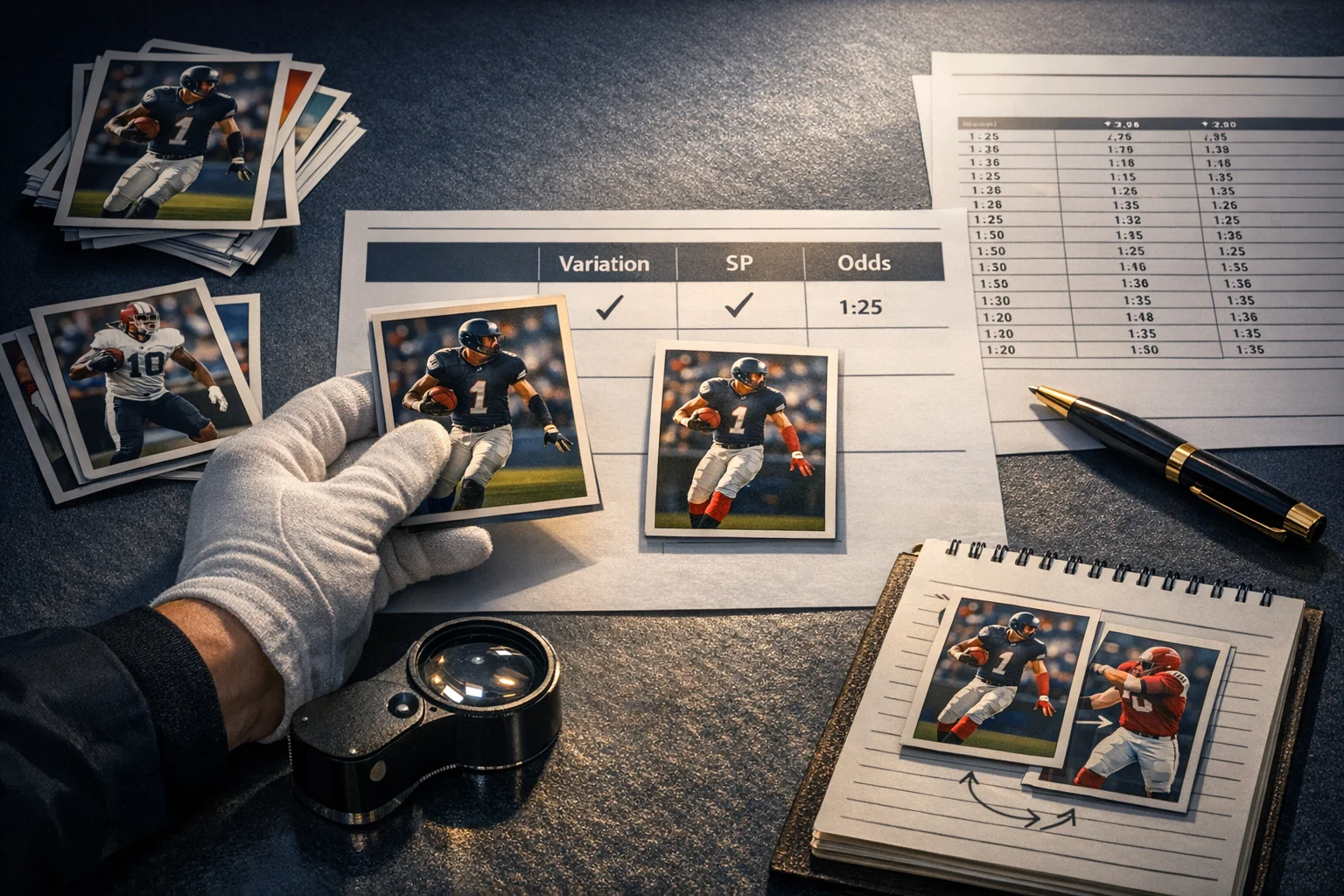
Illustration generated for this guide; not a photograph of an actual card, product or event.
Photo Gallery