Prospect-card collecting rewards excitement, but it punishes shortcuts. A loud stat line, a sharp refractor, or a player who keeps showing up on social feeds can make a buy feel urgent. The problem is that urgency often arrives before context.
A cleaner process is available. Before you decide what a baseball prospect card means, verify whether the player still fits prospect status, log his level, pair that level with his age, check for injury context, state the real sample size, and confirm the card on the manufacturer’s own checklist. Stats still matter, but they become more useful after those checks than before them.
As of October 30, 2026, that order matters even more in Bowman-style prospect collecting because MLB’s rookie standard affects prospect eligibility, upper-minors levels do not mean the same thing for every age, and Topps explicitly separates prospect cards from rookie-designated structure in 2026 Bowman Chrome.
Start by asking whether the player is still a prospect
Collectors use the words prospect and rookie casually, but MLB does not. MLB’s rookie-eligibility standard is tied to Major League thresholds: a player loses rookie eligibility after exceeding 130 MLB at-bats, 50 MLB innings pitched, or 45 active-roster days in a prior season. MLB also states that a player must have rookie eligibility to appear on MLB Pipeline prospect lists. That means prospect status is not just hobby slang. It has a rules-based backbone.
That matters directly for Bowman Chrome. Topps says on its 2026 Bowman Chrome page that Chrome Prospects are players who have not yet earned MLB rookie designation. In other words, the first question for a prospect-card buyer is not whether the player is exciting. It is whether the player still belongs in the prospect bucket at all.
This is where many collectors blur categories. A player can remain young, desirable, and heavily chased even after moving beyond prospect eligibility. But once that shift happens, you should not keep using prospect logic automatically. Product structure changes, checklist placement can change, and the language you use as a buyer or seller should change too. Calling everything a prospect card because the player is not yet a star only creates confusion.
A practical move is to put one line at the top of every player note: Prospect-eligible as of research date, yes or no. If the answer is no, do not stop researching the player. Just stop pretending you are making the same kind of bet you would be making on a player who still fits the prospect framework.
- Check MLB rookie-eligibility status first.
- Remember that MLB Pipeline prospect eligibility depends on rookie eligibility.
- Use Topps product structure to distinguish prospect placement from rookie-related placement.
Level only helps when you understand what the ladder means
A prospect’s level is one of the first details collectors mention, but level alone is a blunt tool. MiLB’s current About page identifies the four full-season affiliated levels as Triple-A, Double-A, High-A, and Single-A. That gives you the official ladder, which is useful for getting organized. It does not tell you how much to infer from the player’s stop on that ladder.
MLB’s farm-system explainer adds the nuance collectors actually need. Triple-A is the closest full-season level to the majors, but it can include many older players and former big leaguers. Double-A, meanwhile, is commonly treated as the biggest developmental jump and a major separator level. That distinction matters because collectors often over-credit proximity to the majors without asking who usually occupies that level.
The practical implication is simple: being at Triple-A does not automatically mean a player is sending a stronger card signal than a player at Double-A. A younger player producing at Double-A may be doing something more developmentally impressive than an older player surviving at Triple-A. That is analysis, not a universal ranking rule, but it is the kind of analysis that keeps you from treating every upper-minors stat line as interchangeable.
When you research a target, write down the affiliate and class first, then add one sentence explaining what that class means in context. If the player is in Double-A, note that it is widely viewed as a key proving ground. If he is in Triple-A, note that the level can be mixed with older and more experienced competition. Those small notes force better card decisions because they turn level into interpretation instead of mere label-reading.
- Log the affiliate and class directly from the current player page.
- Do not assume Triple-A always gives the strongest prospect signal.
- Treat Double-A success as meaningful context, especially when paired with youth.
Age matters most when attached to the level, not in isolation
Age is one of the most misused prospect details in the hobby because collectors mention it without tying it to anything. A player being 20, 22, or 24 is not automatically good or bad. It becomes meaningful when paired with where he is playing. The same stat line can carry very different weight depending on whether it came from a teenager in Single-A, a 20-year-old in Double-A, or a 24-year-old in Triple-A.
MiLB player pages help here because they give you the listed age and birth date on the date you are researching. That sounds basic, but it matters because prospect narratives can swing on small age differences, and age changes over time. If you are building notes or writing listings, you should treat age as dated information, not as a permanent characteristic frozen from an old ranking graphic.
The best habit is to combine age and level into one phrase every time. Write Double-A, age 20 instead of writing Double-A in one line and age 20 somewhere else. That forces you to interpret the player in relation to his competition rather than admiring a stat line in a vacuum. It also helps you avoid giving too much credit to older players whose numbers may be less surprising for the level.
There is a tradeoff here. Age-relative-to-level is useful, but it is not destiny. Younger is not always better, and older does not always mean limited upside. What it does do is improve the quality of your first read. For collectors, that is valuable enough. You are not trying to predict every career perfectly. You are trying to avoid buying cards on shallow impressions.
- Use the age listed on the player page as of your research date.
- Always pair age with level in the same note.
- Treat age-relative-to-level as context, not a guarantee.
Build a dated player snapshot before you build an opinion
Prospect-card mistakes often begin with vague memory. A collector remembers that a player was hot, ranked, promoted, or talked about, then buys as if those fragments add up to current knowledge. A better approach is to create a dated snapshot from the official player page before you let yourself interpret anything.
That snapshot should include the affiliate, level, age, birth date, and the exact season line you are citing. For Leo De Vries, his MiLB page as viewed on October 30, 2026 listed Double-A Midland, age 20, birth date October 11, 2006, and a 2026 line of 369 at-bats, .290 average, 13 home runs, 55 RBI, 34 stolen bases, and an .836 OPS. Those facts are useful not because they tell you what to buy, but because they tell you what file you are actually studying.
Once you build the snapshot, your opinions become easier to test. Saying young hitter with real Double-A production is more informative than saying he is mashing. The first phrase tells you why the performance might matter. The second mostly tells you that you are excited. Card collectors do not have to be emotionless, but they do benefit from separating description from enthusiasm.
This same habit improves selling. If you ever move the card later, your listing will be clearer if you already know the player’s level, age, and dated production context. Buyers can tell when a seller is leaning on generic hype versus actual player context. A precise snapshot will not guarantee a sale, but it does make your description more trustworthy.
- Start every player file with a dated factual snapshot.
- Use exact stats instead of vague hot-streak language.
- Separate what the page says from what you think it means.
Injury context can change the meaning of the entire season
If you skip injury research, you are not really researching the card. A strong line attached to a hurt player can be less straightforward than it looks, and a disappointing season can deserve more patience if it happened through physical limitation. Either way, health context often changes how a collector should read the year.
Official prospect injury reporting is especially important because it keeps you away from rumor-driven hobby narratives. MLB Pipeline’s prospect injuries and roster-moves update dated September 25, 2026 reported that Leo De Vries suffered an anterior labrum tear in his right shoulder, underwent surgery, and was expected back in 2027. Those details do not erase the quality of his season, but they absolutely change the risk profile attached to it.
For collectors, the right lesson is not avoid every injured player. The right lesson is price uncertainty honestly. A season-ending shoulder surgery is not background noise. It creates recovery risk, development-timeline risk, and fresh uncertainty about how quickly the player resumes prior form. If the market seems to ignore that, you may want to slow down. If the market is harsh and you are comfortable with risk, you may decide the uncertainty is already reflected enough for your own budget. Both views are possible, but neither should exist without the injury file being complete.
This is one area where restraint helps. Do not overstate what an injury means, and do not minimize it because you like the card. Simply note the injury type, date of the report, whether surgery occurred, and the expected return window if one is given. That small discipline prevents a lot of preventable buying mistakes.
- Check official MLB prospect or roster-moves coverage for injury updates.
- Note injury type, surgery status, and expected return if reported.
- Treat the injury as context that can alter how you value the season.
Sample size is not a rule, so stop using it like one
Collectors love saying small sample, but that phrase often hides lazy thinking. The available official sources give you games, at-bats, and innings. What they do not give you is a hobby rule saying trust this player only after a fixed cutoff. There is no official MLB or Topps threshold that turns a prospect line into reliable card evidence at one exact number.
The more honest method is to state the sample and let the context do the work. De Vries is again a useful example. His official pages show 93 Double-A games and 369 at-bats in 2026 before the injury update. That is obviously more meaningful than a two-week heater or an early-season burst. It is also not the same thing as multiple healthy upper-minors seasons. The correct reading is not tiny sample or fully proven. It is meaningful Double-A sample with real but incomplete certainty.
This matters because vague sample-size language can distort prices in both directions. Overexcited buyers can talk themselves into tiny bursts as proof of arrival. Overcautious buyers can dismiss substantial upper-minors work without even quoting the actual numbers. Precision protects you from both errors. If you can state the games, at-bats or innings, and level, you are already ahead of much of the market conversation.
A practical note-taking formula works well here: Player produced X over Y games or Z at-bats or innings at this level, with or without injury interruption. That one sentence is usually enough to keep your judgment grounded. It does not remove uncertainty, but it forces you to be accurate about what kind of uncertainty you are accepting.
- State exact games and AB or IP instead of saying small sample.
- Weigh the sample differently depending on level.
- Note whether injury interrupted the sample.
Verify the card on the manufacturer’s own checklist path
Checklist verification should be boring, direct, and official. That means starting with the manufacturer’s product page rather than a marketplace listing, reseller graphic, or social-media screenshot. For Bowman and Topps prospect cards, the best sequence is simple: use the official product page, then use the official downloadable checklist linked there.
Topps’ 2026 Bowman Chrome page gives collectors several facts that are worth confirming before spending money. Topps describes the release as prospect-focused, separates the Bowman Prospect set from the base set, says Chrome Prospects are players who have not yet earned MLB rookie designation, and notes that players receiving their first trading card will carry the 1st Bowman logo. Those points are not minor details. They directly affect how you identify what kind of card you are looking at.
The practical benefit of official verification is that it reduces labeling errors. A player can be in a product without being in the exact section you assumed. A collector who relies on a seller title may end up thinking a card is part of a prospect subset when it is not, or may confuse a first-card marker with a broader rookie claim. Starting with Topps’ own structure cuts down on those mistakes.
There is also an important tradeoff: official checklists reflect intended product structure, but unopened-product outcomes can still contain normal packaging uncertainty. That is another reason to separate two questions in your mind. First, does the manufacturer say the card belongs in the release and in which category? Second, what are the odds of pulling it from sealed product, and does that matter to your buying plan? Those are related questions, but they are not the same question.
- Start with the official Topps product page.
- Use the official downloadable checklist linked from that page.
- Do not let a reseller listing define the card’s category for you.
Use 1st Bowman correctly, and do not confuse it with a rookie card
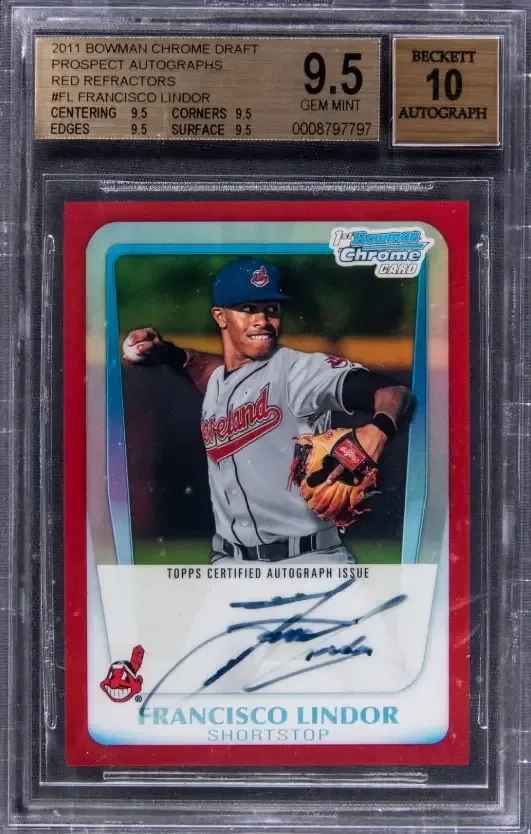
The 1st Bowman logo is meaningful, but only when used precisely. Topps says players receiving their first trading card will carry the 1st Bowman logo. That makes the logo an important structural marker inside Bowman collecting. It tells you something real about card sequence.
What it does not tell you is whether the player is the best prospect buy, the safest play, or the strongest long-term card bet. Those are collector judgments that still require level, age, injury, sample-size, and checklist work. A 1st Bowman can be attractive because it marks an early point in a player’s card timeline, but it does not excuse sloppy research.
It is also important not to confuse a Bowman first-card marker with MLB rookie-card designation. A player can have a 1st Bowman while still being years away from rookie-card treatment in later products. Conversely, once a player moves beyond prospect eligibility, the collector should expect his placement in product structure to evolve. Those are different lanes of collecting, even when the same player is involved.
If you are building a prospect-focused collection, the 1st Bowman marker may deserve real priority in your budget. If you are building a rookie-focused collection, it may matter less than later cards that fit your goal better. That is a preference call, not a measured market fact. The key is that you should know which lane you are in before you pay extra for the symbol.
- Use 1st Bowman as a first-card identifier within Bowman.
- Do not equate 1st Bowman with MLB rookie designation.
- Decide whether you are collecting prospects or rookie cards before paying a premium in your own budget.
A worked example: Leo De Vries shows why one stat line is never enough
Leo De Vries is a good example of why prospect-card research should read like a file, not a headline. As of October 30, 2026, his MiLB page listed him at Double-A Midland, age 20, with a 2026 line of .290, 13 home runs, 55 RBI, 34 stolen bases, and an .836 OPS over 369 at-bats. By itself, that is the kind of line that naturally attracts collectors.
Now add level and age. MLB’s farm-system explainer says Double-A is often viewed as a key separator level. Pair that with age 20 and the production becomes more informative than a generic upper-minors stat line. Add sample size and it becomes more useful again: 93 Double-A games is not a random blip. There is real evidence here, and collectors should not pretend otherwise.
But then the file turns. MLB Pipeline’s late-September injury update reported a right-shoulder anterior labrum tear, surgery, and an expected return in 2027. Suddenly the same season reads differently. The line still matters. The development signal still exists. Yet the path forward is less clean than the raw numbers suggest because health uncertainty is now attached to the evaluation.
That is exactly why process matters. A more aggressive collector could decide that age-20 Double-A production is compelling enough to justify continued interest despite the injury. A more cautious collector could decide to wait for return-to-play evidence. Both are reasonable approaches. What would be unreasonable is buying or selling the card as if the injury never entered the picture, or as if the stat line alone settled everything.
- Positive signal: age-20 production at Double-A.
- Meaningful context: 93 games and 369 at-bats.
- Key risk: shoulder surgery with expected return in 2027.
Turn the process into a repeatable buying checklist
The biggest advantage most collectors can build is not inside information. It is consistency. Prospect-card errors usually happen when someone changes standards depending on how badly they want the card. A player they already like gets a pass on age, or a flashy parallel gets a pass on injury context, or a seller’s title gets treated like a checklist. A repeatable process prevents those lapses.
The sequence is straightforward. First, confirm whether the player still fits prospect eligibility under MLB’s rookie standard. Second, record the current affiliate and level. Third, pair the level with age as of the research date. Fourth, search for official injury reporting that might change how the season should be read. Fifth, verify the card through the manufacturer’s own product page and checklist path. Only after those five checks should you decide whether the price fits your goals.
This process is not glamorous, and it does have a cost. You may move slower. You may miss a few fast spikes. That tradeoff is real. But prospect collecting already involves uncertainty you cannot control. There is no benefit in adding avoidable uncertainty on top of it. Slower, cleaner research is usually cheaper than fixing rushed mistakes later.
The practical result is confidence, not certainty. You still might be wrong about the player. Every collector will be wrong sometimes. The point is that you will be wrong for better reasons. That is a meaningful edge in a category where hype often outruns context.
- Five checks in order: eligibility, level, age, injuries, checklist.
- Use the same process for every target, not just the players you like least.
- Accept slower buying if it keeps your assumptions honest.
Illustration generated for this guide; not a photograph of an actual card, product or event.
Photo Gallery