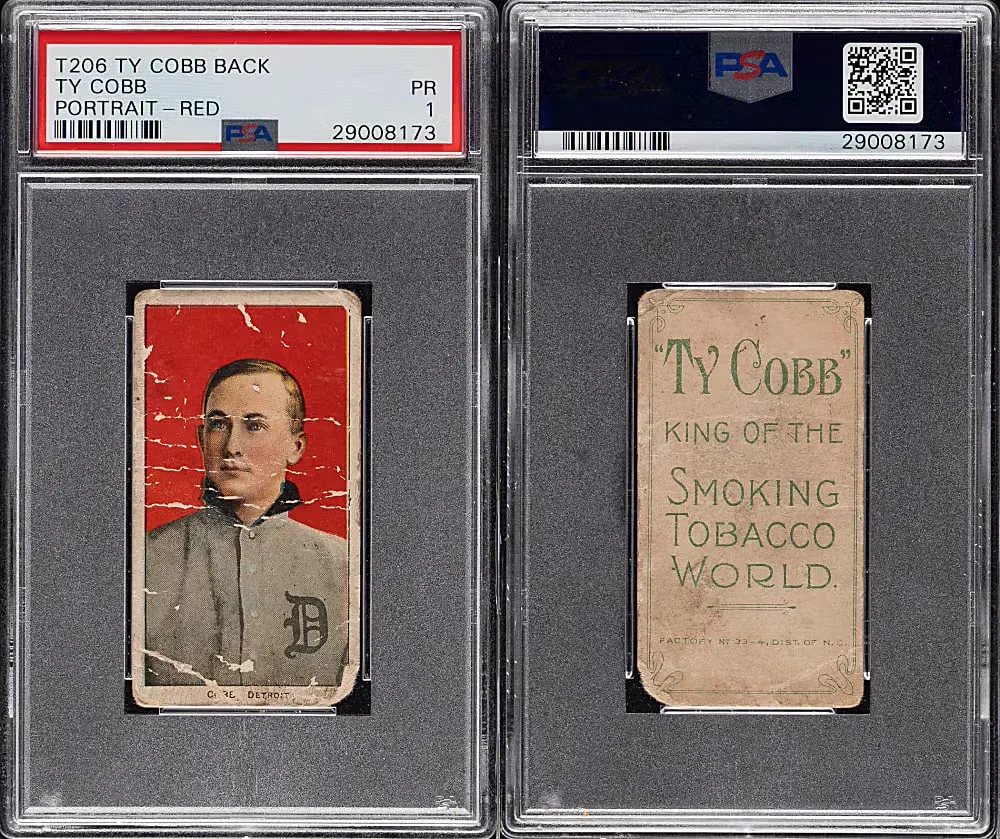
For many vintage collectors, the tobacco-card conversation starts with T206 and rarely leaves it. That is understandable. The 1909-11 issue is one of the hobby’s most famous sets, fueled by the Honus Wagner legend, major star power, and a checklist large enough to earn its “Monster” nickname.
But T206 was not the only important tobacco issue from that era. T205 and T207, both produced around the same pre-World War I window, remain two of the most distinctive baseball card sets of the early hobby. They are smaller, tougher in places, and often less celebrated, yet each has a visual identity and collecting challenge all its own.
For collectors willing to look beyond the hobby’s most famous tobacco release, these two sets offer a mix of artistry, rarity, and historical quirks that have kept them relevant for more than a century.
T205: The Gold Border Set With a Different Personality
Despite its catalog number, T205 did not come before T206 in chronological release order. The set is generally dated to 1911, with some hobby references placing at least part of its distribution into early 1912. The catalog number is simply a long-standing hobby designation, not a release timeline.
For more collector background, read The 7 Most Iconic Baseball Cards of the 1970s and Why Collectors Still Chase Them.
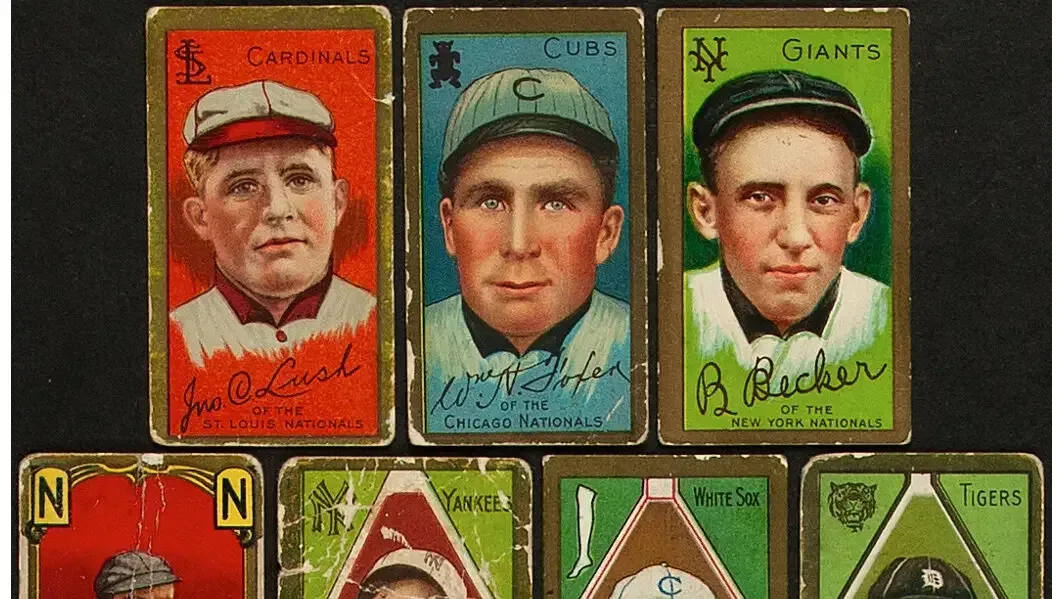
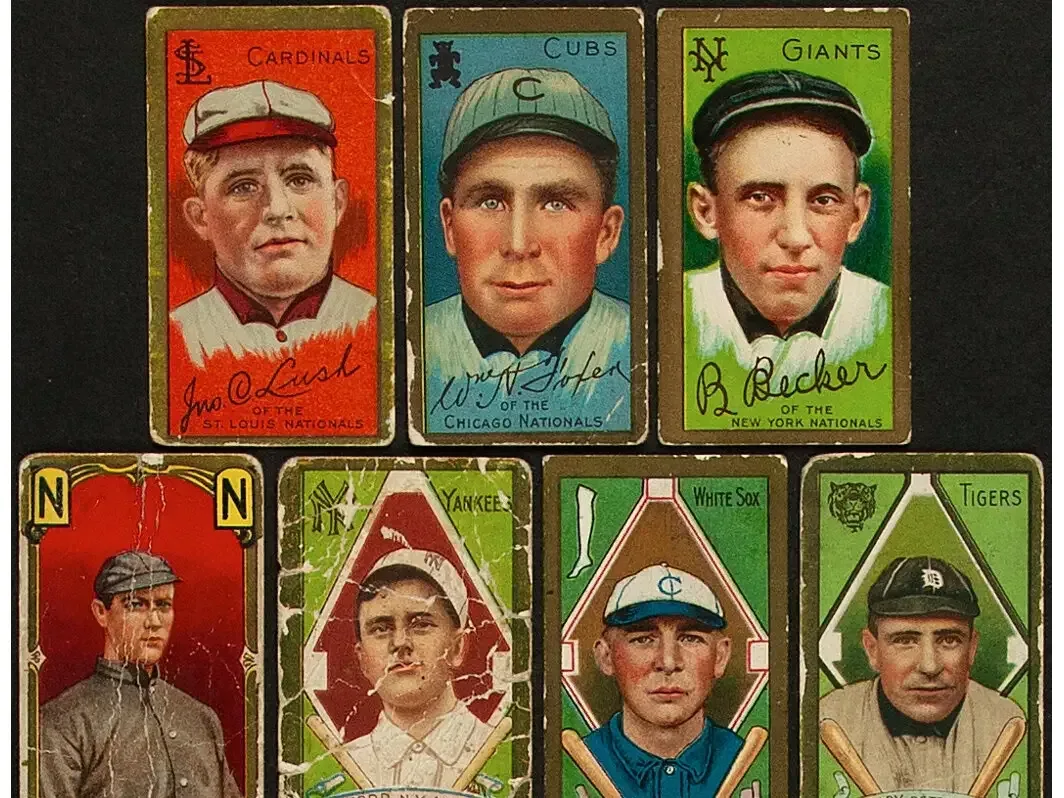
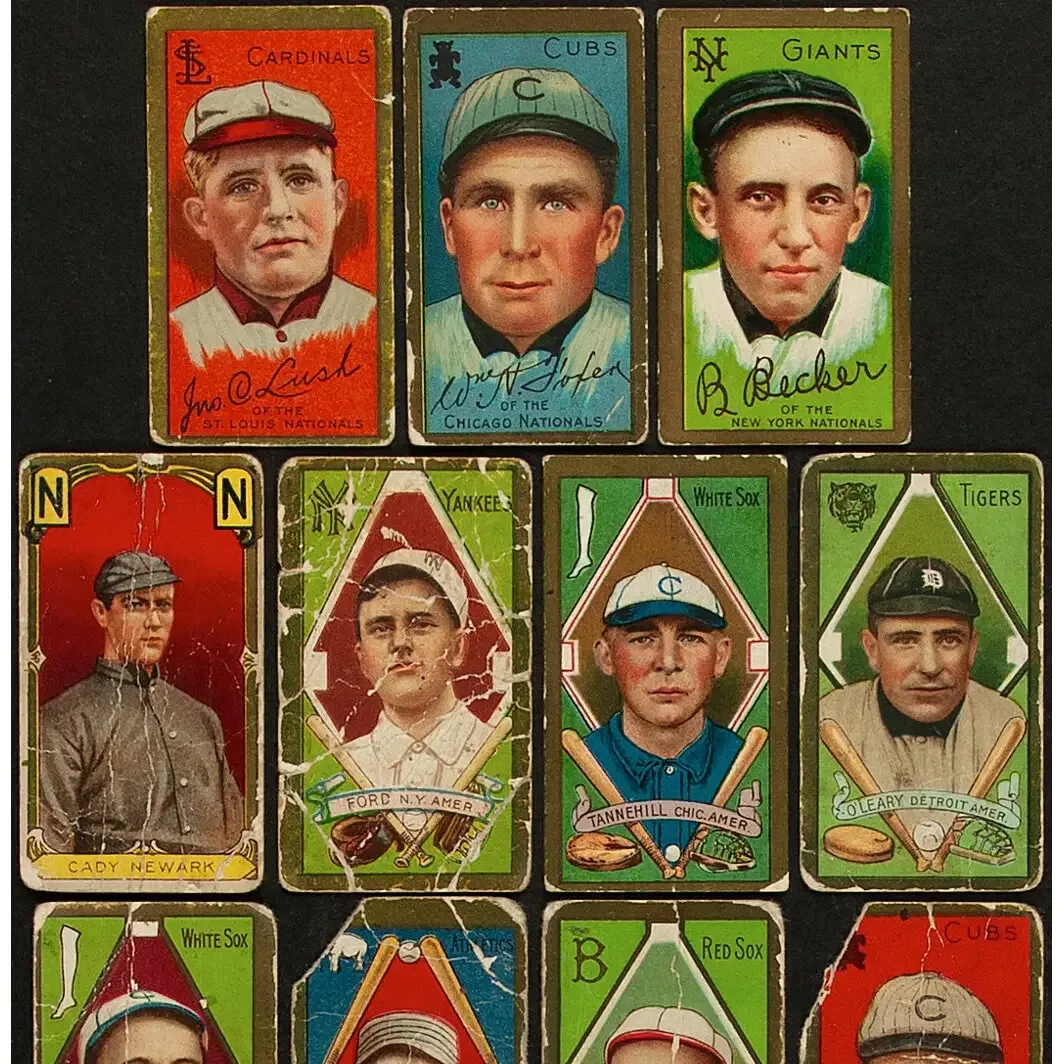
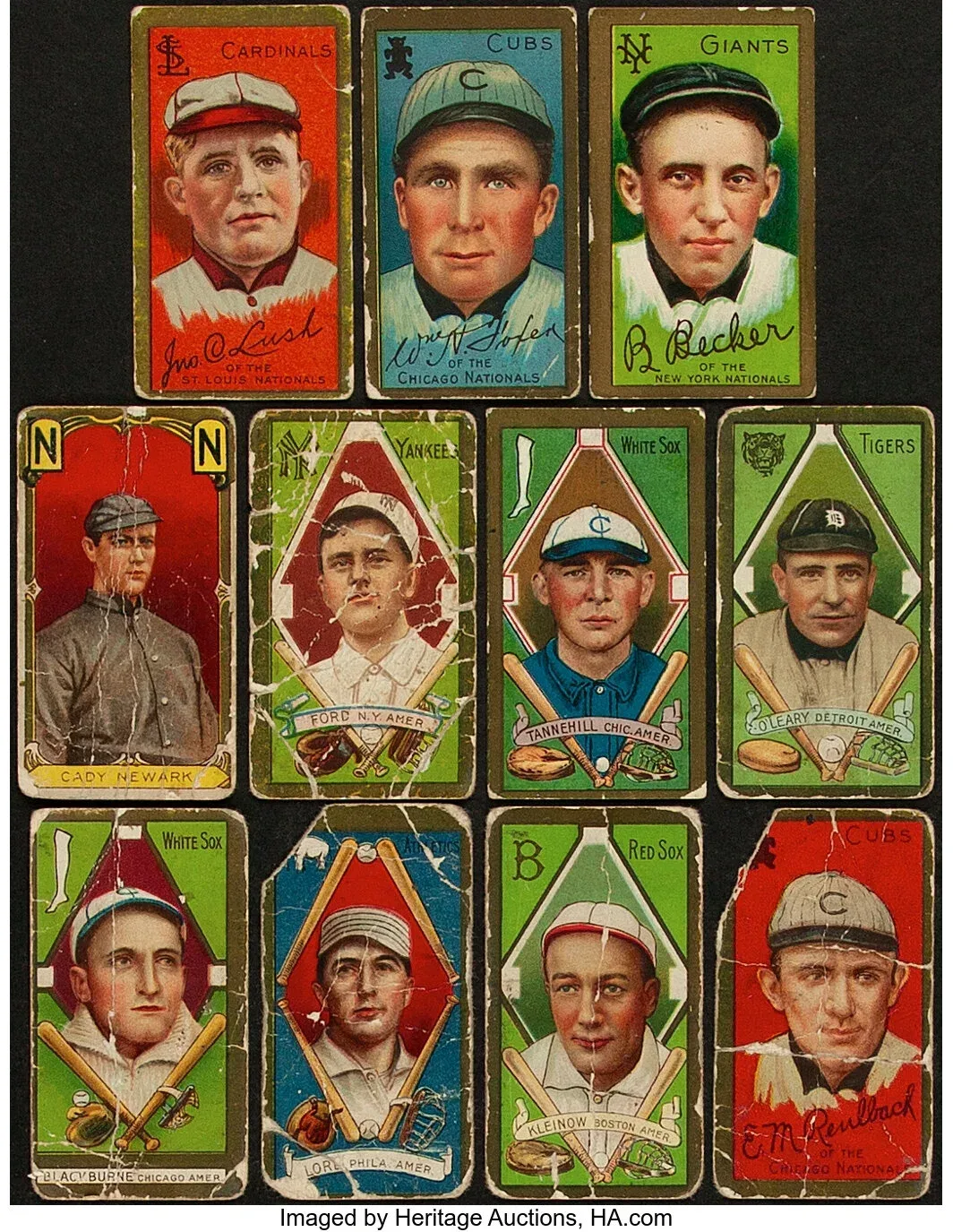
What makes T205 immediately recognizable is the gold border. At a glance, it stands apart from the white-bordered tobacco cards that dominate the era. That gold frame gave the set its enduring nickname, “Gold Borders,” and it still gives the cards some of the strongest shelf appeal in prewar collecting.
The catch is that the same decorative feature also created one of the set’s biggest condition problems. The gold leaf border chips easily, and after more than 100 years, clean examples are exceptionally difficult to locate. High-grade copies are far scarcer than the visual beauty of the set might suggest.
How T205 Cards Were Designed
T205 used multiple front styles rather than one uniform template. American League players appear as head-and-shoulders portraits inside a baseball diamond, with bats, gloves, and catching equipment worked into the design. Their names sit in a scroll, adding to the ornate presentation.
National League players also appear in vertical portrait form, but with a plainer background and the addition of a facsimile signature. Without the extra ornamentation used on many American League cards, some of these portraits appear even larger and more direct.
The 12 minor leaguers in the set have their own look. These Eastern League subjects are framed in elaborate designs, with some cards featuring bats as part of the frame and others including appealing stadium scenes. A few of the minor league cards rank among the most attractive images in the entire release.
Every card includes a team name at upper right and a team emblem or letter at upper left, creating a design language that remains busy, decorative, and unmistakably early 20th century.
T205 Backs Added Information Collectors Still Appreciate
T205 card backs are notable for doing more than just selling tobacco. They identify many players by formal names, such as Christopher Mathewson and Denton T. Young, which adds a period-correct historical flavor. The cards are unnumbered, as expected for the era, but they also include limited statistical information and short biographical text.
The statistical categories are sparse by modern standards. Batters are generally listed with games played, batting average, and fielding average. Pitchers receive wins, losses, winning percentage, and fielding percentage. Even so, the presence of stats from the 1908-1910 seasons gives the set added historical depth.
The biographies can be surprisingly memorable. Some are basic career summaries, while others contain colorful praise. Ty Cobb is described as “lightning on the bases.” Mathewson is credited with “splendid control.” Eddie Collins is hailed as a rising star after moving to second base. These snippets are part scouting report, part advertisement, and part time capsule.
Key T205 Facts Collectors Should Know
- Set size: Commonly listed at 200 players, though total card counts rise when accepted variations are included.
- Minor leaguers: 12, all from the Eastern League.
- Orientation: All standard fronts are vertical.
- Nickname: Gold Borders.
- Back advertising: 10 cigarette brands plus Polar Bear loose tobacco.
- Condition issue: Gold borders are highly prone to chipping and wear.
Some backs advertise “400 Designs,” even though the standard player checklist is 200 subjects. That mismatch has long added another layer of intrigue to the set.
Hall of Famers and Standout Subjects in T205
T205 packs a strong roster of stars from the dead-ball era. Cy Young appears during the final active season of his career. The checklist also includes Tris Speaker, John McGraw, Mordecai “Three Finger” Brown, and the famed Cubs trio of Tinker, Evers, and Chance.
One especially notable card is Addie Joss. He died on April 14, 1911, yet he remains in the set, with his passing noted on the card back. That makes his T205 issue a posthumous tribute as well as a major Hall of Fame key. The back also contains an error, incorrectly identifying Joss as a native of Cleveland.
There is no Honus Wagner in the set, a major omission considering Wagner’s place in tobacco-card history. The “Wagner” found in T205 is Heinie Wagner of the Red Sox, not the Pirates legend.
T205 Variations Give the Set Extra Depth
Collectors can pursue T205 as a straightforward front checklist, but the set becomes much more complex once variations enter the picture. Some are well established and widely recognized.
- Peaches Graham and Dave Shean can be found with different team identifications following early 1911 trades.
- Roger Bresnahan and Eddie Collins have open-mouth and closed-mouth versions.
- Dolly Gray can be found with or without statistics, and the stats used are notably incorrect for a pitcher.
- Christy Mathewson has a famous back variation showing his 1908 record as either 37-11 or the incorrect 37-1. The scarcer error appears with Cycle advertising.
- Pat Moran exists with and without an added typed line below the statistics.
Then there is Doc Hoblitzell, one of the set’s most variation-heavy players. His card appears in four versions, including examples with no statistics, with “1908 Cin.,” with the year but no team designation, and with a misspelled surname on the back. For specialists, Hoblitzell alone can turn a basic T205 run into a real project.
Other differences, such as printing inconsistencies on E.B. Barger, Otis Crandall, and Danny Hoffman cards, are debated more heavily and are not always treated the same way by collectors.
T205 Backs and Scarcity
Back collecting is another major branch of the T205 chase. Piedmont and Sweet Caporal are among the most common, while scarcer options include Hindu and Drum. Some brands also exist with different ink colors. Not every player was issued with every back, which means a true back run is not just expensive but structurally complicated.
The minor leaguers are especially restricted, found only with Hassan or Polar Bear advertising. That limitation adds another point of interest for advanced collectors who enjoy tracking distribution patterns.
Even lower-grade commons can bring meaningful prices, often around the $100 range or higher depending on eye appeal, back scarcity, and exact subject. Hall of Famers, tougher variations, and minor leaguers command clear premiums, and graded examples significantly outnumber raw cards in the marketplace.
T207: The Brown Background Counterpart
If T205 is ornate and bright, T207 moves in the opposite direction. Issued in 1912, the set is widely known as the “Brown Backgrounds,” and the name fits perfectly. Each front places the player against a dark brown backdrop with very little extra decoration. A small box at the bottom identifies the player, team, and league, while a tan or beige border frames the image.
The effect is unmistakable, but not universally loved. Compared with the colorful design work of T205 and the varied artwork of T206, T207 can feel austere, muted, and even severe. For some collectors, that is part of the charm. For others, it explains why the set has always occupied a more niche place in the prewar market.
The set has 200 players, like T205, but all are major leaguers. There are no minor leaguers in the standard T207 checklist.
What Makes T207 Different
The biggest visual departure is the lack of variety in backgrounds. There are no decorative baseball-diamond frames, no large signatures, and almost no scenic touches. Many cards look monochromatic, particularly on infield poses where the dirt nearly blends into the background.
There is also one famous format exception: Jack Barry’s card is horizontal, making it the only landscape-oriented card in the set. That single card stands out immediately in any T207 group.
The checklist also differs in notable ways from T205. T207 omits several giants of the era, including Ty Cobb, Christy Mathewson, Eddie Collins, and Cy Young. Walter Johnson, Tris Speaker, and John McGraw are present, though Johnson’s image is often criticized as one of the least flattering portraits in the set. McGraw’s card is also unusual because it depicts him as a player rather than in his better-known role as manager.
Among Hall of Famers newly added in T207 are Max Carey and Harry Hooper. Still, the overall Hall of Fame draw is lighter than collectors might expect from a 1912 major league tobacco set.
T207 Backs, Advertising, and Biography Text
The backs continue the tobacco-era formula of short career write-ups paired with advertising. Unlike T205, T207 backs do not include career statistics. The biographies are typically concise, though some contain colorful period commentary. Speaker is called a “brilliant outfielder,” and McGraw is praised as a masterful strategist.
The set was issued with six back types:
- Recruit Little Cigars - most common
- Napoleon - less common than Recruit
- Broadleaf - scarcer
- Cycle - scarcer
- Red Cross - extremely rare
- Anonymous/Coupon pack issue - cataloged without advertising text
Most players are found with Recruit or Napoleon backs. A separate group is tied primarily to the scarcer Broadleaf or Cycle backs, with a very small number also known with Red Cross or anonymous backs. Most backs are printed in black ink, while Cycle is usually found in red, and brown-ink printings exist in smaller numbers.
T207 Variations and the Toughest Cards
Like T205, T207 has recognized variations and a few long-standing mysteries. Paddy Livingston appears with multiple uniform-lettering versions after his move from Philadelphia to Cleveland, progressing from a “P” to a lowercase “c” and then an uppercase “C.” Jimmy Austin and Tom Clarke can be found with or without team emblems on their uniforms.
The set also includes a famous swapped-back anomaly involving Bill Carrigan and Heinie Wagner of the Red Sox, with each known carrying the other player’s reverse. That pair is standard checklist material for advanced collectors.
Scarcity becomes even more important with three notoriously difficult T207 cards: Irving Lewis, Louis Lowdermilk, and Ward Miller. These three have long been treated as short prints or at least as dramatically tougher subjects than the rest of the set.
Lewis is generally considered the hardest card in T207. His card exists with and without the Boston “B” on the sleeve, and both versions are rare, with the no-emblem version tougher still. Lowdermilk and Miller are also major obstacles for anyone trying to complete the full set.
Those scarcity patterns have inspired theories tied to roster timing and player status in 1912, but the exact production reasons remain unresolved. That uncertainty only adds to the mystique.
Why Collectors Still Care About T205 and T207
Neither set has surpassed T206 in popularity, recognition, or mainstream hobby prestige. That gap is unlikely to close. But comparing everything to the biggest prewar giant misses what makes these issues worthwhile.
T205 offers decorative artwork, a loaded Hall of Fame roster, meaningful variations, and some of the most memorable backs of the tobacco era. T207, while less colorful, gives collectors a tougher and more enigmatic challenge, with unusual rarity pockets, a stark visual identity, and several cards that remain genuinely difficult to track down more than a century later.
For vintage specialists, both sets reward deeper study. They raise questions about printing, distribution, back combinations, checklist definitions, and what “complete” really means. They also remain tangible links to baseball’s dead-ball era, when card makers paired portraits, brief biographies, and tobacco advertising in a format that still defines prewar collecting today.
Collectors chasing early baseball history do not have to stop at T206. T205 and T207 continue to offer plenty of substance, from gold-border elegance to brown-background scarcity, for anyone interested in the hobby’s earliest masterpieces and mysteries.
Photo Gallery