Collectors often use shiny-parallel language casually, but the hobby gets clearer and more useful when you stop treating every reflective card as the same thing.
Refractor, Prizm, and foil all live in the same visual neighborhood, yet they usually point to different product vocabularies. If you want cleaner want lists, more accurate listings, and fewer misunderstandings in trades, the safest move is simple: call the card what its issuer called it.
Why these terms sound interchangeable even when they are not
At a glance, the confusion makes perfect sense. Many modern cards share the same visual cues: reflective surfaces, color shifts, patterned finishes, and serial-numbered rainbow chases. If you are looking at a shiny parallel under a light, it is easy to slip into generic shorthand and call everything a refractor. In casual conversation, plenty of collectors will understand what you mean. The trouble starts when casual shorthand turns into cataloging, buying, selling, or comparing specific cards across brands.
Modern product language is more precise than hobby slang. PSA’s glossary describes a Refractor as a card with chrome reflective devices, which helps explain the general idea collectors have in mind. But manufacturer pages show that companies do not all use the same term for the same kind of visual effect. Topps regularly uses Refractor in Chrome-family products. Panini uses Prizm and Prizms as the native language for that line’s parallel rainbow. Upper Deck materials separately discuss foil board and refractive parallels, showing that finish terms and named parallel families are not automatically the same thing.
That difference matters because product-specific wording does real work. It helps you match checklists, odds sheets, slab labels, marketplace titles, and set-builder conversations. Once you accept that these terms overlap in appearance but not always in naming, a lot of hobby confusion disappears.
- Visual similarity does not equal identical naming.
- Hobby slang may be understandable, but product naming is better for identification.
- A card’s official term is usually the most useful term.
What “Refractor” usually means in today’s hobby language
In current collecting practice, Refractor is best treated as a named parallel term closely associated with Topps and Fanatics Chrome-family products, not as a universal word for all shiny cards. That is the safest reading when you compare general hobby definitions with actual product pages. Topps’ Bowman Chrome page presents Bowman Chrome as an all-Chrome release and uses Refractor language in product imagery. Topps Finest likewise leans into refractor finishes as a defining feature of the product.
For collectors, the key insight is not that Refractor describes something shiny. It is that Refractor functions as part of a product family’s own vocabulary. If you pull a Gold Refractor from a Chrome-style Topps release, calling it a Refractor matches how the card maker presents that line. That gives you cleaner inventory notes and makes it easier for other collectors to find exactly the version you mean.
There is an important tradeoff here. Refractor has become such a strong hobby shorthand that some collectors use it descriptively beyond Topps. You will still hear that in conversation, and historical overlap exists. But if your goal is precision rather than shorthand, the better move is to reserve Refractor for products that actually use the term in their own naming. That approach loses a little conversational convenience, but it gains accuracy.
- Use Refractor confidently when the product itself uses that term.
- Treat Chrome-family naming as a strong clue, but verify the specific parallel name.
- Do not assume every reflective card from every brand should be called a Refractor.
What “Prizm” means, and why Panini collectors should stick with it
Prizm is not just a descriptive adjective in Panini products. It is the organizing term for the brand’s parallel structure. Panini’s product materials use Prizm and Prizms repeatedly, from hobby sell sheets to later release descriptions. In those documents, the rainbow is not framed as a group of refractors. It is framed as Prizms, with names such as Silver, Blue Wave, Gold Vinyl, and Black Finite inside the Prizm system.
That distinction is especially important for football and basketball collectors who move between brands. A Silver Prizm may occupy a similar mental category to a Topps silver-toned shiny parallel, but it is still not best labeled as a Silver Refractor. Using Panini’s own naming keeps you aligned with checklists and with how other collectors search for those cards. If you are listing a card, “Silver Prizm” is better than “silver refractor-style parallel” because one is exact and the other is an interpretation.
The practical tradeoff is that brand-specific naming can feel fussy when you are talking informally. But the extra precision is worth it whenever money, scarcity, or set completion enters the conversation. A buyer searching for a Blue Wave Prizm is not asking for any blue reflective card. They are asking for a particular named variation in a particular brand language.
- In Panini Prizm products, use the exact full name when possible.
- Examples include Silver Prizm, Blue Wave Prizm, Gold Vinyl Prizm, and Black Finite Prizm.
- Avoid substituting Refractor for Prizm, even if the card looks similar in hand.
Where “foil” fits: broad finish term, not a catch-all replacement
Foil is broader than either Refractor or Prizm. It usually points to a finish, stock, or surface treatment rather than a single cross-brand parallel family. That broader use can be helpful, especially when you are describing appearance before you know the exact parallel name. But broad language is not the same thing as precise naming.
Topps provides a useful example because one product page can separate foil and Refractor terminology instead of blending them together. On the Topps Finest page, assets are distinguished with names such as SilverFoil, RainbowFoil, and GoldRefractorParallel. That means the company itself is signaling that foil and Refractor are different labels within the same release. Upper Deck offers a second useful angle by discussing metallic foil board and different foil board while also mentioning refractive parallels. Again, the point is separation: substrate or finish language on one side, named parallel language on the other.
For collectors, foil works best as a broad descriptor when exact naming is not yet confirmed. Saying a card is a foil parallel, foil-board card, or shiny foil finish can be accurate at a high level. But once the checklist or product page gives you the official term, broad foil language should step aside. It is a bridge term, not always the destination.
- Foil often describes material or finish rather than a brand-specific parallel family.
- A foil card is not automatically a Refractor or a Prizm.
- Use foil as a temporary or broad descriptor when exact identification is still pending.
The safest rule: identify by issuer term first, then add a broad description if needed
If you want one habit that solves most terminology problems, make it this: use the exact issuer term first. That means writing Gold Refractor, Silver Prizm, Rainbow Foil, or whatever the product documentation actually says. If further explanation helps, add a broad descriptor second. You might say, for example, that a Gold Refractor is a chrome-style parallel, or that a Rainbow Foil is a foil-finish parallel. The order matters. Exact name first; generalized explanation second.
This method works because it respects both precision and readability. Exact names preserve checklist accuracy. Broad descriptors help newer collectors understand what kind of card they are looking at. You do not need to choose between hobby fluency and beginner-friendly language. You can do both in the same sentence as long as you do not replace the official name with a borrowed term from another brand.
The main downside is that it requires a little more research before you speak confidently. Sometimes a card looks obvious until you compare it with the product page and realize there are several similar shiny parallels in the same release. That extra minute is usually worth it. It prevents the kind of small labeling mistake that can ripple into bad listings, mismatched trades, or accidental duplicate purchases.
- Best practice: exact product term first.
- Helpful add-on: use broad descriptors only as explanation, not substitution.
- This approach works for inventory lists, sales posts, trade talks, and collection apps.
A step-by-step way to identify an unknown shiny parallel
When you are unsure what to call a card, resist the urge to guess from memory. Start with the product line. Is it Topps Chrome, Bowman Chrome, Finest, Panini Prizm, or something else entirely? The product name is often the quickest clue because parallel vocabularies tend to live inside product families. Once you know the line, check whether the manufacturer uses named parallels on the product page, sell sheet, odds page, or checklist.
Next, compare the card’s visual features against the documented names. Color alone is rarely enough. Look for pattern cues such as waves, scope, ice-style textures, or foil-only distinctions. Then note whether the product distinguishes foil terms from other shiny terms. A release may contain both, and the wrong shortcut can send you into the wrong lane. If you still cannot tell, write the card down in your inventory with temporary descriptive language such as “blue shiny parallel, exact subtype unconfirmed” rather than assigning a confident but wrong name.
This process is slower than eyeballing a card and blurting out a label, but it is much more reliable. It also helps with online buying. If a seller titles a card vaguely, you can compare the image to the manufacturer’s own naming conventions before deciding whether the listing is accurate enough to trust. For collectors trying to avoid mistakes, method beats memory.
- Step 1: identify the exact product line.
- Step 2: consult product documentation for official parallel names.
- Step 3: match color and pattern, not just shine.
- Step 4: use temporary descriptive language if certainty is missing.
- Step 5: update your inventory once the exact parallel is confirmed.
Common mistakes that create bad listings, duplicate buys, and trade friction
The most common error is cross-brand substitution. Calling a Panini Silver Prizm a Silver Refractor may seem harmless if both parties know what you mean, but it introduces needless ambiguity. The exact same problem appears in reverse when collectors call a Topps Refractor a Prizm. A second mistake is collapsing all shiny cards into foil. That can be too vague to distinguish between separate named parallels inside the same release.
Another frequent problem is overconfidence from visual memory. Many products contain several parallels that share a similar color family but differ in pattern, numbering, or finish. If you identify a card only by color, you can easily log the wrong version. That matters when you are trying to complete a rainbow, compare scarcity, or insure a collection with useful notes. It also matters on purchases. A sloppy title can hide whether a card is a base shiny variation, a numbered parallel, or a different finish altogether.
The solution is not to become stiff or joyless about terminology. It is simply to know when precision matters more than speed. In a casual pack-opening chat, broad language may be fine. In a sale, trade, want list, or long-term inventory, exact naming pays off. The tradeoff is a few extra seconds of verification in exchange for far fewer hobby headaches later.
- Mistake: using Refractor as a universal label for all reflective cards.
- Mistake: calling every shiny card a foil parallel without checking the product’s naming.
- Mistake: identifying a card by color alone without verifying pattern or finish.
- Better habit: match the listing title to the issuer’s full parallel name.
How to write cleaner want lists, listings, and collection notes
A good want list should be understandable even months later when you have forgotten the context of a conversation. Instead of writing “need blue refractor,” write the full product and parallel name: “2024 Panini Prizm Football Blue Wave Prizm” or “2026 Topps Finest Gold Refractor Parallel,” depending on the card. That level of specificity makes it easier for other collectors to help you, and it reduces the chance that someone offers the wrong card in good faith.
The same rule improves selling titles and personal inventory. In a sales post, exact naming helps serious buyers locate the card quickly and compare it against known checklists. In a spreadsheet or collection app, it helps you avoid duplicate purchases. If you do not know the exact subtype yet, label uncertainty honestly. A note such as “foil parallel, exact variant to verify” is better than locking in a wrong name and forgetting to revisit it.
This is also where subjective analysis belongs. You may personally prefer the look of foil-board cards, or feel that certain Prizm patterns display color more dramatically than some Refractors. Those are legitimate collecting preferences, but they are tastes, not official categories. Keeping taste separate from naming is one of the easiest ways to sound more credible and stay more organized.
- For want lists: product name plus exact parallel name.
- For sales titles: avoid shorthand if the official name is known.
- For inventory: note uncertainty explicitly instead of guessing.
- Keep design opinions separate from identification facts.
The practical collector’s takeaway: precision beats shorthand
The hobby does not need less colorful language. It just needs better habits around when that language is used. Refractor, Prizm, and foil all point you toward shiny-parallel territory, but they do not all mean the same thing in product documentation. If you want to reduce confusion, the easiest rule is also the most useful one: use the manufacturer’s exact term whenever you can.
That means Refractor where Topps uses Refractor, Prizm where Panini uses Prizm, and foil where the card is actually presented as a foil parallel or foil-board finish. It also means accepting a small historical and conversational gray area without letting that gray area flatten everything into one generic label. Collectors can still speak casually; they just should not let casual speech do the job of exact identification.
In practical terms, this habit improves more than vocabulary. It sharpens your searches, cleans up your records, strengthens trade communication, and helps newer collectors learn product families correctly. The result is not just more accurate terminology. It is a more usable collection.
- Use the exact parallel term printed or documented for that release.
- Treat broad shiny language as explanation, not replacement.
- When uncertain, describe honestly and verify later.
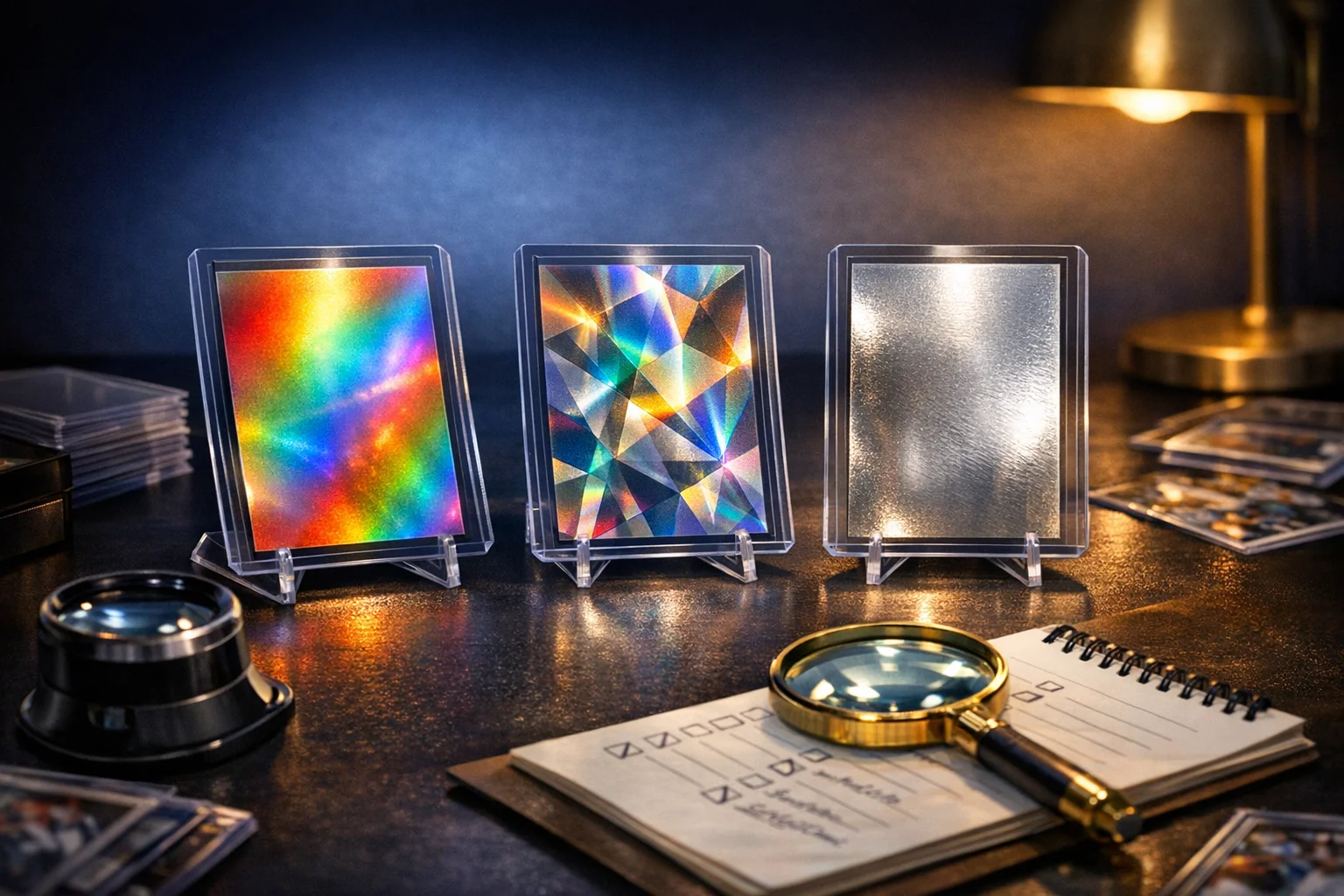
Illustration generated for this guide; not a photograph of an actual card, product or event.
Photo Gallery