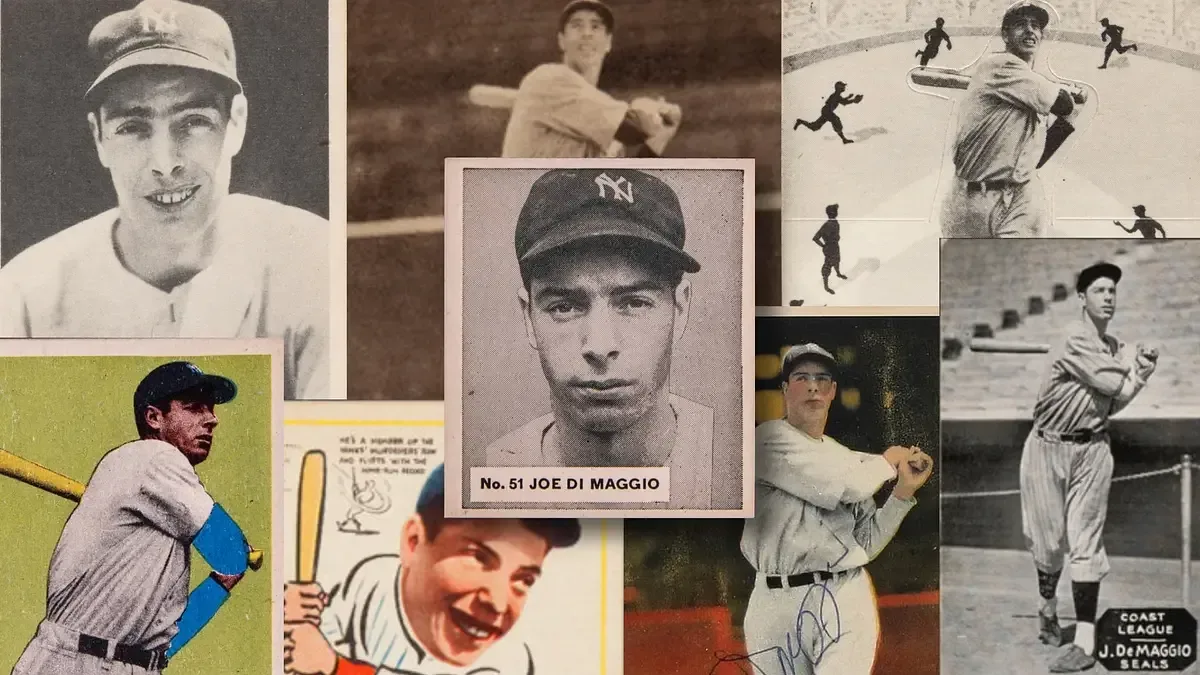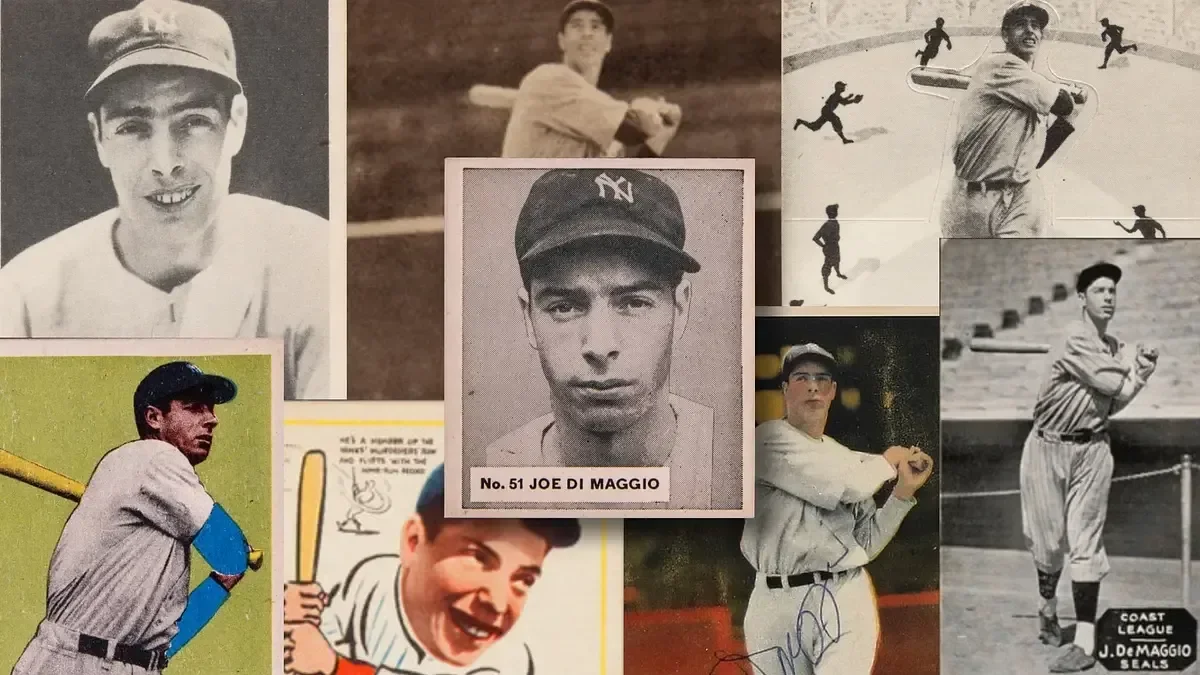
Joe DiMaggio’s legacy in baseball cards mirrors his legacy on the field: elegant, historic, and relentlessly collectible. The Yankees legend remains one of the hobby’s true blue-chip names, helped by a career that included a 56-game hitting streak in 1941, a long run of winning in New York, and a playing-era card catalog that ranges from mainstream classics to genuinely scarce regional issues.
For vintage collectors, DiMaggio offers something rare. His cardboard history includes a widely debated rookie-era centerpiece, several visually striking pre-war staples, major post-war classics, and even obscure discoveries that still reshape how collectors think about surviving inventory. That combination keeps his best cards near the top of want lists for advanced vintage buyers.
Here is a closer look at the playing-day Joe DiMaggio cards that stand out most, along with what makes each one so important in the modern market.
Why Joe DiMaggio Cards Carry Lasting Weight
Not every all-time great translates equally to cardboard, but DiMaggio checks nearly every box collectors want. He was a Yankees star, a World Series winner, a Hall of Fame-caliber talent, and one of the defining athletes of his era. His card run also spans an interesting period in hobby history, touching the late pre-war gum boom, unusual Canadian issues, West Coast minor league pieces, post-war color sets, and rare regional releases.
For more collector background, read The 7 Most Iconic and Valuable 1975 Topps Baseball Cards Still Driving the Hobby.
That breadth matters. A collector can chase DiMaggio through multiple styles and price levels, from iconic mainstream examples to hobby mysteries with almost no population depth. It also helps that many of his most famous cards are immediately recognizable, whether it is the clean portrait work of the mid-1930s, the bold color choices of 1948 Leaf, or the inventive pop-up construction found in 1937 O-Pee-Chee.
His cards are not only historically important. Many are genuinely beautiful pieces of design, which helps explain why high-grade examples continue to command such attention.
1936 World Wide Gum and the Rookie-Era Debate
The 1936 World Wide Gum Joe DiMaggio sits near the center of any serious discussion about his key cards. For many collectors, it functions as his true rookie card, and it carries the type of hobby prestige that comes with first-year status tied to an all-time legend.
World Wide Gum served as Goudey’s Canadian affiliate, but the 1936 release moved beyond simply repeating older designs. DiMaggio’s card from the set presents one of the most important early images of the young Yankees star and is widely noted as the first card to show him in his signature New York cap.
That visual detail matters because it connects directly to his emergence as a major league star. In 1936, DiMaggio was only 21, yet he immediately looked like a foundational Yankees player. He hit .323 with 125 RBI during his rookie season, finishing second on the club in RBI behind Lou Gehrig, who won the American League MVP that year.
Collectors who prioritize rookie-era significance, visual appeal, and historical importance routinely place the 1936 World Wide Gum near the top of the DiMaggio card pyramid. It is one of those cards that feels essential rather than optional in a top-tier vintage collection.
1948 Leaf Delivers a Post-War Classic
For collectors who prefer bold post-war issues, the 1948 Leaf Joe DiMaggio is one of the most attractive cards in his run. The card’s green background and mid-swing pose give it a powerful presentation, and the larger context of the set only adds to its appeal.
Leaf’s 1948 baseball issue is one of the hobby’s landmark releases. It is closely associated with major names like Jackie Robinson, Satchel Paige, Babe Ruth, and Stan Musial, and its visual style remains one of the most distinctive of the era. Even in a loaded checklist, DiMaggio’s card stands out.
The set itself is famous for its unusual numbering structure. Though it contained 98 cards, it was numbered from 1 to 168. That quirky approach has become part of the set’s history, giving collectors another layer of intrigue when building or studying it.
DiMaggio’s Leaf card works especially well for collectors who want a single post-war representative piece. It combines star power, strong set identity, and enduring market respect, making it one of the safest iconic choices in the category.
The 1949 Aero Service Station Card Is One of the Hobby’s Great DiMaggio Mysteries
Most famous DiMaggio cards have been known and pursued for decades. The 1949 Aero Service Station card is different. It has the feel of a hobby discovery that arrived late and instantly changed the conversation around rare regional DiMaggio issues.
The card surfaced publicly in 2024 when a raw example sold on eBay for $350. At the time, its scarcity and recognition level made it easy to view as an oddity. That changed quickly. After being graded by PSA, the same card sold 10 months later for $19,200 in a November 2025 auction.
What makes the issue so compelling is how little is known in comparison to mainstream vintage cards. The Aero Service Station cards were distributed out of St. Louis and share similarities in style and geography with the 1949 Schumacher Service Station release. Yet the DiMaggio remains elusive, and a second example or variation has still not meaningfully emerged into the hobby spotlight.
Its PSA population remains one, which places it in a category far removed from standard scarcity. This is not merely a tough card. It is the sort of piece that reminds collectors that even for legendary players from heavily studied eras, there are still hidden corners of the hobby capable of producing major surprises.
The 1939 to 1941 Play Ball Run Is a Vintage Showcase
If a collector wants a compact run that captures changing pre-war baseball card design, the 1939 through 1941 Play Ball DiMaggio trio is hard to beat. These cards are not just important because they feature a Hall of Famer. Together, they form a mini-timeline of how gum cards evolved right before the hobby’s wartime interruption.
The 1939 Play Ball DiMaggio is known for its strong profile image and polished visual presentation. The 1940 issue stripped things down into a simpler format that still has plenty of vintage charm. Then 1941 added color, giving collectors a final bright note before the landscape changed.
These releases also matter because they signaled a competitive shift. Goudey had dominated baseball cards earlier in the 1930s, but Play Ball established Gum, Inc. as a serious force in the category. For DiMaggio collectors, that means his catalog includes important examples tied to a major transition in card production history.
As a group, the Play Ball cards appeal to both type collectors and player collectors. Someone building a DiMaggio-focused collection can enjoy the continuity of owning all three, while a broader vintage collector can appreciate each issue as a representative of its year.
Pre-Yankees DiMaggio Cards Offer a Different Kind of Rarity
Not every important DiMaggio card shows him as a Yankees superstar. Some of his most fascinating pieces come from before he ever reached New York, when he was still a San Francisco Seals player in the Pacific Coast League.
Two of the standout pre-1936 issues are the 1934 Zeenut P.C.L. card and the 1935 Pebble Beach card. These cards are especially interesting because they document DiMaggio during his West Coast minor league years, before the Yankees pinstripes became part of his identity.
The Zeenut issue fits into a long and respected Pacific Coast League card tradition. The Pebble Beach entry is even more unusual, functioning as a postcard and belonging to a group of seven postcards featuring West Coast minor league baseball players. That format gives it crossover appeal for collectors who enjoy postcard issues, regional baseball material, or unusual early player appearances.
For advanced collectors, these minor league cards do something the later mainstream issues cannot. They freeze DiMaggio at the point just before national stardom. That gives them a unique historical flavor, and it helps explain why early West Coast material can be so prized when it reaches the market.
1937 O-Pee-Chee Combines Innovation and Elite Demand
The 1937 O-Pee-Chee Joe DiMaggio is one of the most visually inventive cards of his playing years. Rather than relying on a standard flat design, the issue features a pop-up construction that gives the card a three-dimensional element. That design choice makes it memorable even before factoring in the player pictured on it.
The set has broader significance too. It includes all American League players and is one of the notable 1937 issues tied to Bob Feller’s rookie-year cardboard. For DiMaggio, the card occupies a sweet spot where scarcity, eye appeal, and innovation all meet.
Collectors have shown just how strong demand can be for top-end examples. In 2024, an SGC 9 copy of the 1937 O-Pee-Chee DiMaggio sold for $288,000. That price underscored the card’s standing among elite pre-war pieces and confirmed that condition-sensitive, visually unusual DiMaggio cards can compete at the highest level of the market.
It is also a card that bridges collecting styles. Traditional vintage collectors appreciate its era and significance, while design-focused collectors love the engineering and presentation. That broad appeal strengthens its long-term status.
1938 Goudey Heads Up Is One of the Most Distinctive DiMaggio Cards Ever Made
Among DiMaggio’s playing-era cards, the 1938 Goudey Heads Up issue may be the most stylistically unusual. Goudey moved away from the look that had defined its earlier successes and produced a set with cartoon-like bodies, oversized player heads, and backgrounds that almost resemble comic strip panels.
That could have resulted in a novelty release with limited staying power. Instead, the set became one of the most discussed visual departures of the pre-war era, and DiMaggio emerged as its marquee card. While he also appeared on 1936 and 1937 Wide Pen Premium issues, the 1938 Goudey release has become the more popular and recognizable option with many collectors.
Its market history reflects that stature. A PSA 9 example sold for $288,000 in 2017, and price indexing has since placed that level around roughly $1.4 million. Those figures put the card in true trophy territory.
Collectors do not pursue the 1938 Goudey DiMaggio merely because it is expensive. They pursue it because it is unmistakable. Even in a hobby filled with great artwork and famous player cards, Heads Up looks like nothing else.
Key Joe DiMaggio Playing-Day Cards to Know
- 1934 Zeenut P.C.L. Early Pacific Coast League issue showing DiMaggio with the San Francisco Seals.
- 1935 Pebble Beach Regional postcard issue featuring DiMaggio before his Yankees debut.
- 1936 World Wide Gum Widely viewed by many collectors as DiMaggio’s true rookie card.
- 1937 O-Pee-Chee Canadian pop-up style card with standout three-dimensional design.
- 1938 Goudey Heads Up Highly distinctive pre-war issue and one of the hobby’s most recognizable DiMaggio cards.
- 1939 Play Ball Strong profile image from an important pre-war gum set.
- 1940 Play Ball Simpler design that remains a staple for vintage player collectors.
- 1941 Play Ball Color issue from the same run, released during DiMaggio’s historic hitting-streak season.
- 1948 Leaf Bold post-war classic from one of baseball card collecting’s landmark sets.
- 1949 Aero Service Station Extremely rare regional card with a known public sale history that transformed collector awareness.
What These Cards Mean for Today’s Vintage Market
DiMaggio’s card market shows why vintage baseball remains so compelling. There is no single path to collecting him. One buyer may focus on a rookie-era cornerstone like 1936 World Wide Gum. Another may prefer the artistic prestige of 1938 Goudey or the post-war strength of 1948 Leaf. A more advanced collector may spend years watching for regional issues like the 1949 Aero Service Station.
His market also illustrates how scarcity works on multiple levels. Some DiMaggio cards are famous because they are widely recognized and eternally in demand. Others are important because they are barely seen at all. When those two forces exist within the same player catalog, collectors tend to keep circling back.
That is part of what makes DiMaggio such a durable hobby figure. His best cards are not just relics from a legendary career. They are active landmarks in vintage collecting, from pre-war artistry and innovative design to post-war star power and newly surfaced regional rarity.
For anyone building around baseball history, few player runs offer this much depth across so many different corners of the hobby.
Photo Gallery