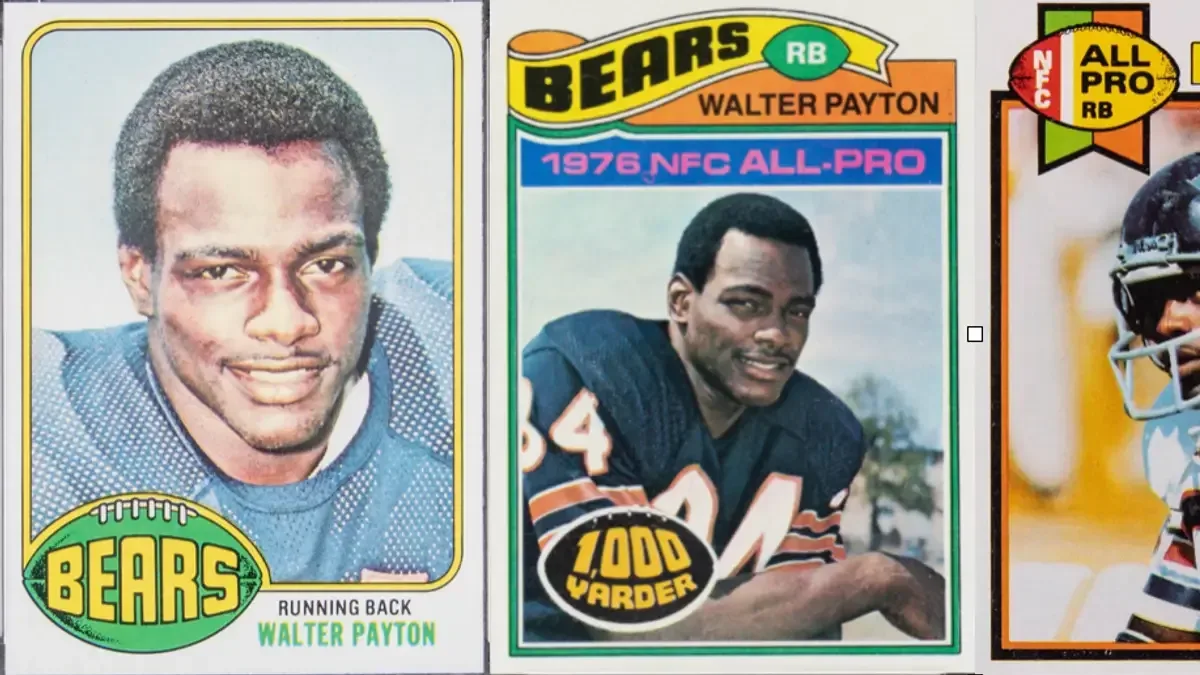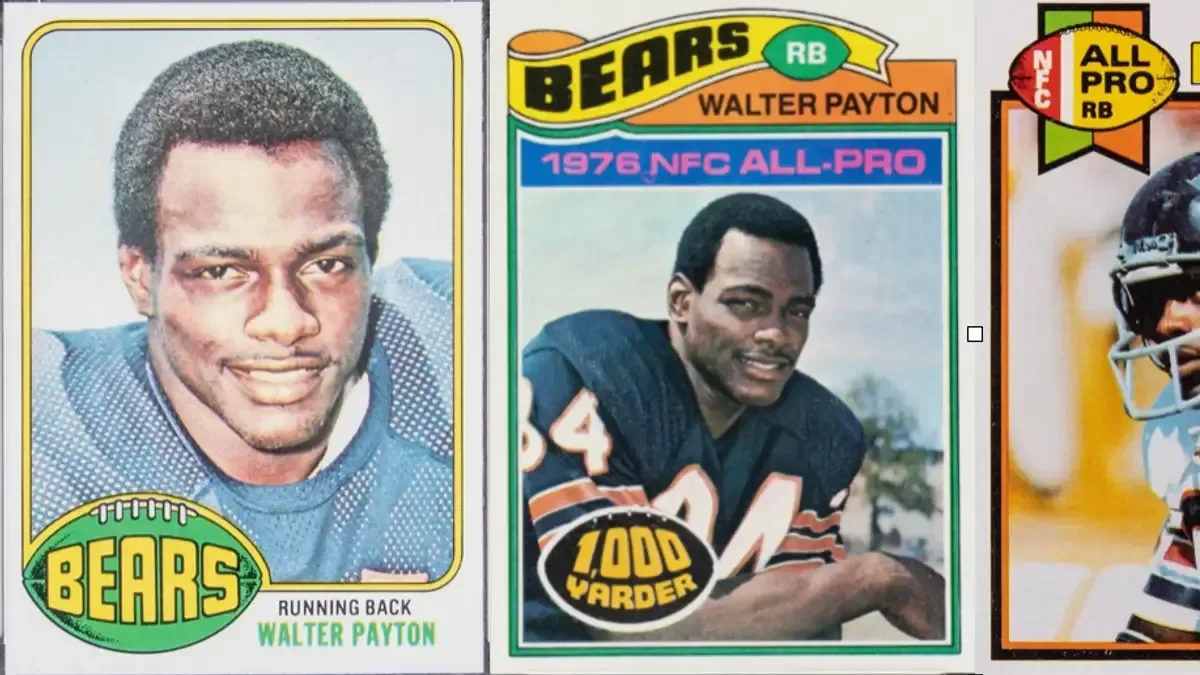
Walter Payton remains one of the most respected names in football history, and his card market reflects that standing. For collectors, Payton’s best-known issues blend Hall of Fame status, vintage appeal, strong demand, and condition rarity in a way few legends can match.
Known as “Sweetness,” Payton built a legacy that extended well beyond the field. His impact is still recognized every year through the NFL’s Walter Payton Man of the Year Award, a reminder that his place in the hobby is tied to both greatness and character. On cardboard, that legacy centers on a small group of key Topps releases from the late 1970s and early 1980s, led by one of the most important rookie cards of the era.
Here is a closer look at six iconic Walter Payton football cards and the sales data that continue to make them hobby landmarks.
Why Walter Payton Cards Continue to Matter
Payton’s vintage market has staying power because it checks every box collectors typically want. He is one of the most accomplished running backs the game has ever produced, he has a universally recognized nickname, and his rookie card sits inside one of the defining football releases of the 1970s. Add in difficult high-grade populations and a strong autograph premium on select examples, and his top cards remain fixtures in serious football collections.
For more collector background, read Most Iconic 2012 and 2013 Topps Football Rookie Cards Still Drawing Collector Interest.
Another important factor is visual familiarity. Payton’s key cards come from a run of Topps designs that many longtime collectors know immediately, from the classic rookie card look of 1976 Topps to the color-framed 1978 issue and the clean early-1980s style of 1981 Topps. Even when they are not his most expensive cards, these releases are instantly recognizable and often serve as entry points for collectors building vintage Bears or all-time NFL collections.
6. 1981 Topps Walter Payton #400
The 1981 Topps Walter Payton #400 stands as the lone 1980s issue on this list, and that alone gives it a distinctive place in his card run. The card shows Payton in a bright white Chicago Bears jersey with his famous No. 34, a number the franchise later retired in his honor in 1988.
From a market perspective, the card remains a notable condition-sensitive piece. Its top recorded PSA 10 sale reached $9,975 on July 16, 2025, through eBay. The PSA 10 population sits at 30, which helps explain why gem-mint copies still command attention despite the card being later than his late-1970s classics.
For another perspective on this story, read The Walter Payton Cards That Define a Vintage Football Collection, From 1976 Rookie to Signed Rarity.
Collectors who chase iconic player runs often like this card because it gives them a strong Payton issue from a different visual era. It may not carry rookie-card status or the same weight as his late-1970s MVP-era pieces, but it remains an important part of any focused Walter Payton lineup.
5. 1979 Topps Walter Payton #480
The 1979 Topps Walter Payton #480 is one of the more rugged-looking entries in his flagship run. The image is memorable in part because the wear on his helmet, including visible scuffs and scratches, fits the physical style of play that defined elite NFL running backs in that period.
That strong image has helped the card maintain hobby appeal, and high-grade examples are not easy to find. A PSA 10 reached $11,285 on April 26, 2025, while the PSA 10 population stands at just 19.
Those numbers place the card in an interesting spot. It is not his most celebrated issue, but the small gem-mint supply gives it more market intrigue than many casual collectors might expect. For advanced player collectors, low-pop flagship cards from this era often become priority targets once the rookie card is secured.
4. 1978 Topps Walter Payton #200
The 1978 Topps Walter Payton #200 is one of the most recognizable cards in his catalog because of the set’s classic design. Topps used a colored frame around the player and team name, giving the release a look that stands out immediately in vintage football boxes, binders, and registry sets.
On this card, Payton appears in uniform and ready for action, and the issue ties directly to one of the peak stretches of his career. The card notes his All-Pro status from the 1977 season, the same year he was named NFL MVP by the Associated Press.
Collectors continue to respond to that combination of design and career significance. A PSA 10 sold for $11,750 on June 11, 2026, and the PSA 10 population is 25. That leaves the card firmly in the conversation as one of Payton’s key non-rookie collectibles.
For many hobbyists, this is one of the most balanced Walter Payton cards available. It has a strong visual identity, direct ties to an MVP season, and enough condition scarcity to keep top-end values meaningful.
3. 1977 Topps Walter Payton #360
The 1977 Topps Walter Payton #360 is a major card in his vintage run because it captures the early part of his NFL rise. Released for his sophomore season, the card highlights accomplishments from his rookie year, including surpassing 1,000 rushing yards and earning 1976 All-Pro honors.
That context matters in the hobby. Collectors often place a premium on cards that document the moment a star turned into a true force, and this issue sits right at that inflection point for Payton. He was no longer just a promising rookie. He was becoming one of the league’s defining players.
The market data reinforces its importance. A PSA 10 sold for $31,200 on April 25, 2022, and the PSA 10 population stands at just 13. That is a very limited gem-mint count for a player of Payton’s stature, and it helps elevate the 1977 Topps card from a strong flagship issue to a genuinely significant condition-rarity chase piece.
Among non-rookie Payton cards, this is one of the most serious targets for high-grade collectors.
2. 1976 Topps Walter Payton #148
No Walter Payton card discussion can go far without landing on the 1976 Topps rookie card, and for good reason. The 1976 Topps Walter Payton #148 is the foundational card in his market, the issue most collectors identify first, and the one that continues to anchor his vintage value.
Its sales history shows just how powerful demand can be for elite examples. An SGC Gold Label Pristine 100 copy sold for $228,000 on February 26, 2021, through Heritage. A PSA 10 top sale reached $124,230 on March 8, 2021. Even more recent results show that serious interest remains active, with a PSA 10 selling for $98,405.20 on August 6, 2026, and a PSA 7 bringing $888 on September 15, 2026.
The PSA 10 population is 56, which is higher than some of the later Payton flagship cards listed here, but rookie-card demand places this issue in a different tier. It is the card most collectors want first when they begin building a Walter Payton collection, and it is also one of the cornerstone rookie cards from 1970s football.
The card’s status goes beyond scarcity. It is a symbol card in the hobby, representing one of the game’s all-time great players at the very beginning of his cardboard story. For vintage football collectors, that combination is hard to top.
1. 1976 Topps Walter Payton #148 PSA 7 / Auto 10
If the standard 1976 Topps rookie is the cornerstone of Payton’s card market, the signed version with elite appeal reaches an even higher level. A 1976 Topps Walter Payton #148 graded PSA 7 with an Auto 10 sold for $280,600 on March 2, 2026, through Heritage, and the card is listed as a population 2 example.
That result pushed the autographed rookie past even the biggest public sales for unsigned examples, showing how powerful the pairing of rookie-card status and a premium autograph can be. In this case, collectors are not just chasing the most famous Payton card. They are chasing one of the most desirable forms that card can take.
This version stands apart because it combines several layers of scarcity and demand at once. There is the historical importance of the rookie issue, the enduring popularity of Walter Payton as a football icon, and the limited population of authenticated, high-end signed copies. When those elements come together, the market ceiling climbs quickly.
For advanced collectors, this is the kind of card that sits in a different category from standard player issues. It is less about completing a run and more about owning one of the most elite Walter Payton items available in the graded card market.
Sales Snapshot of Payton’s Most Iconic Cards
The market data attached to these six cards shows a clear pattern. Payton’s rookie card drives the top of the market, but his late-1970s flagship cards carry real strength of their own, especially in PSA 10. Here is the breakdown of the notable sales and PSA 10 populations mentioned above:
- 1981 Topps Walter Payton #400 - Top PSA 10 sale: $9,975 on July 16, 2025; PSA 10 population: 30
- 1979 Topps Walter Payton #480 - Top PSA 10 sale: $11,285 on April 26, 2025; PSA 10 population: 19
- 1978 Topps Walter Payton #200 - Top PSA 10 sale: $11,750 on June 11, 2026; PSA 10 population: 25
- 1977 Topps Walter Payton #360 - Top PSA 10 sale: $31,200 on April 25, 2022; PSA 10 population: 13
- 1976 Topps Walter Payton #148 - SGC Gold Label Pristine 100 sale: $228,000 on February 26, 2021; Top PSA 10 sale: $124,230 on March 8, 2021; PSA 10 population: 56
- 1976 Topps Walter Payton #148 PSA 7 / Auto 10 - Top sale: $280,600 on March 2, 2026; population: 2
What Collectors Can Take From These Numbers
Two themes stand out when looking at Payton’s best cards. First, the rookie card still commands the broadest and deepest demand. Even with a higher PSA 10 population than some later issues, the 1976 Topps rookie remains the centerpiece because of its iconic status.
Second, condition scarcity matters greatly across the rest of the run. The 1977, 1978, 1979, and 1981 Topps cards all show relatively limited PSA 10 populations, and that keeps them relevant beyond simple nostalgia. For collectors working in top grades, Payton’s flagship cards become a challenge of patience as much as budget.
That is a major reason his card market has held collector interest for so long. There are accessible entry points in lower grades, but there is also a legitimate high-end chase for gem-mint examples and premium signed rookie variations. Few retired stars offer both as clearly as Walter Payton.
For anyone building around football legends, Chicago Bears icons, or vintage Topps stars, these six cards represent the core of Walter Payton’s cardboard legacy and the issues that continue to shape his place in the hobby.
Photo Gallery