Women’s sports cards are easier to enjoy once you stop treating them as one giant category. The biggest difference between a smart buy and a confusing one is usually not the athlete. It is the rights lane behind the product.
As of October 5, 2026, the clearest modern paths are distinct: Panini for current WNBA cards, Topps for women’s UEFA competition cards, Panini for NWSL starting in 2026, Topps for the clearest current women’s tennis products in this evidence set, and Topps Olympic and Paralympic releases for cross-sport collecting.
If you organize your collection around those boundaries, you can shop with more confidence, ask better questions, and build something that still makes sense a few years from now.
Start with the map: women’s sports cards are several categories, not one
Many collectors begin with a player name and only later realize they have mixed together league cards, tournament cards, multi-sport cards and autograph-driven releases that do not really belong in the same lane. That does not make the cards bad. It just makes the collection harder to understand, harder to organize and easier to overspend on.
A cleaner approach is to sort the category by what the card is licensed to represent. A WNBA card is one lane. A UEFA Women’s Champions League card is another. An NWSL card sits in a different domestic-league bucket. Tennis products operate under their own product structure. Olympic and Paralympic releases work best as a separate multi-sport discipline rather than an extension of soccer, basketball or any other single sport.
This matters because rights boundaries shape everything else: logos, checklist depth, brand continuity and sometimes autograph availability. If you ignore those boundaries, you can end up assuming one manufacturer covers an entire sport when it may only cover one competition or one league context. If you respect them, the hobby gets much simpler.
A useful first question before buying any women’s sports card is plain and practical: what exactly is this product meant to represent? Once you know whether the answer is league, competition, tour or multi-sport event, the rest of your decision becomes easier.
- Sort by league, competition, tour or multi-sport event before sorting by athlete.
- Use product family names in your inventory, not just player names.
- Treat licensing context as part of card identification, not trivia.
WNBA is the clearest modern entry point for a focused women’s league collection
If you want one clean place to begin, WNBA is the most straightforward lane in the current evidence. As of July 2026, the league referred to Panini as its exclusive Trading Card Partner in All-Star fan-event coverage. Panini also stated in April 2026 that it is the official Trading Card Partner of both the WNBA and the WNBPA. That combination gives collectors a relatively clear modern framework for league and player-group rights.
There is also a helpful timeline marker. Panini’s November 2025 WNBPA announcement said the players association reclaimed group licensing rights from the league in 2018 and partnered exclusively with Panini for trading cards in 2019. For collectors, 2019 forward is a useful modern-era checkpoint for the current structure, not a claim that earlier cards lack importance.
That clarity is valuable because it reduces guesswork. Newer collectors do not have to decode several overlapping league-card ecosystems just to understand where the main licensed products live. More experienced collectors can use the same boundary to organize binders, want lists and season runs with less confusion.
If your goal is a coherent women’s sports collection rather than a pile of disconnected singles, modern WNBA gives you an unusually stable foundation. You can build by player, by team, by season or by Panini brand family and still remain inside a well-defined lane.
- Practical era marker: use 2019 forward for the current WNBA rights structure.
- Good beginner goal: one favorite player, one season or one Panini brand family.
- Keep base, inserts and autographs in separate sections if you want a collection that stays readable.
Inside WNBA, separate flagship brands, Instant cards and signer-specific chases
Once you choose WNBA, the next decision is not simply which player to buy. It is what type of collecting experience you want. Panini’s current WNBA ecosystem in this evidence includes Panini Instant WNBA, and Panini’s A’ja Wilson announcement said she would appear in Prizm, Origins and Instant. Panini also announced a 2026 Prizm WNBA blockchain release on September 25, 2026. Those examples show that one athlete can appear across several different product styles.
Panini Instant works best for collectors who like moment-based collecting. A practical example would be choosing one milestone or standout-performance card per favorite player each season rather than trying to chase every parallel from a boxed release. That can create a focused season diary without forcing you into full-set behavior.
Flagship brand collecting is different. If you prefer a unified visual identity, you might decide to collect only Prizm WNBA for your main run, or only Origins if that design language better fits your taste. That is subjective analysis, not a measured market fact, but design consistency matters more than many collectors admit. A binder that follows one brand can feel far more intentional than a random mix of cards from every release.
Autographs deserve their own category. Panini’s A’ja Wilson news is strong evidence that individual autograph deals can sit on top of broader league and player-group rights. In plain terms, a company can have official WNBA card rights and still have signer access that varies by athlete. If autographs are your priority, check athlete-by-athlete rather than assuming every star signs equally often in every licensed line.
- Moment collector: focus on Instant cards tied to achievements or key dates.
- Brand collector: pick one main WNBA release and stay disciplined for a season.
- Autograph collector: verify signer presence separately from general product licensing.
Women’s soccer gets easier when you divide UEFA competitions from domestic leagues
Soccer is where collectors often make avoidable mistakes because the athlete is familiar but the product context is not. The simplest fix is to split women’s soccer into at least two lanes: UEFA competition cards and domestic-league cards. Those are not interchangeable categories even when some of the same stars matter in both.
For UEFA women’s properties, Topps is the clearest current documented route in this evidence. Active products include Topps Chrome UEFA Women’s Champions League 2025/26, Topps UEFA Women’s Champions League Knockout 2025/26 and Topps Merlin UEFA Women’s Euros 2025. Topps’ broader soccer page also says it holds official licenses for major competitions including UEFA Champions League, which supports the competition-based framing for these releases.
That means a UWCL or Women’s EURO card should be understood first as a competition card. For some collectors, that is the whole attraction. You might collect one tournament only, one club’s run through a competition, or one branded chrome line across a season. Those are coherent collecting goals because the set is built around a specific event structure rather than a generic category of women’s soccer.
The tradeoff is that player-only shopping can blur these distinctions. If you collect one star across club, national-team and league settings, you will encounter cards that look related but belong to very different rights buckets. Labeling those cards by competition instead of simply by player name will save you a lot of confusion later.
- Treat UWCL and Women’s EURO cards as competition issues, not generic soccer cards.
- For binders, group women’s UEFA sets by tournament or season.
- If you collect by player, note competition context in your checklist or spreadsheet.
NWSL opened a separate domestic lane in 2026, so do not flatten women’s soccer into one brand battle
As of March 11, 2026, Panini announced an exclusive multi-year trading card partnership with the NWSL and the NWSLPA. Panini said the partnership begins through Panini Instant for the 2026 season and later expands to more card products and an official sticker collection. That is important because it creates a clearly documented domestic U.S. women’s league lane that sits apart from Topps’ women’s UEFA competition products.
The practical lesson is that women’s soccer in 2026 is not a simplistic Topps-versus-Panini argument. The companies are tied here to different rights buckets. Topps is the strongest documented path for UEFA women’s competitions in this evidence set. Panini is the strongest documented path for NWSL from March 11, 2026 forward. Both can matter to the same collector for different reasons.
This matters most if you collect by context. A collector who wants club-competition identity may stay in Topps UEFA products. A collector who wants the U.S. domestic-league environment may follow the NWSL Panini lane. A player collector may choose both, but should still organize the cards as separate categories rather than one continuous run.
A good buying habit is to ask whether a soccer card is tied to a continental competition or a domestic league before worrying about color, numbering or parallels. That one habit clarifies the product far faster than almost any checklist detail.
- For women’s soccer, maintain separate want lists for UEFA and NWSL.
- Do not assume one manufacturer covers every women’s club context.
- If you PC one player, separate domestic cards from competition cards in storage.
Women’s tennis offers one of the cleanest broad-entry lanes right now
In the current evidence set, women’s tennis is unusually approachable because Topps has clearly active products that explicitly include women. The 2026 Topps Chrome Tennis page says the 300-card base set spans legends, current champions and the next generation. Topps also offers 2026 Topps Triumphant Tennis, and the collector guide says it mixes current ATP and WTA stars with retired legends.
That structure gives collectors several ways to build without leaving the category. You can focus on women only within the broader tennis release, separate active stars from retired greats, or target autograph-heavy cards inside a more premium line. Because women are explicitly present in the stated product makeup, you are not relying on a few cameo cards buried inside a mostly unrelated set.
A practical reading of the product positioning is that Chrome is the broader entry lane while Triumphant looks more premium and chase-oriented, especially for autographs and multi-signer formats. That is analysis based on the product descriptions rather than a formal rights document, but it is still useful for planning a budget.
The main tradeoff is scope. Tennis can tempt collectors into buying across eras and styles at once because legends and current stars appear together. To avoid sprawl, decide whether your goal is a women’s tennis binder, a single-player PC, a legends section or a premium-autograph lane. Any of those can work. Trying to do all of them at once usually gets expensive fast.
- Broader entry product: Topps Chrome Tennis.
- Premium-leaning lane: Topps Triumphant Tennis.
- Helpful rule: choose active stars, legends or autographs as your first focus, not all three at once.
For cross-sport collecting, Olympic and Paralympic products are the clearest women’s-sports bridge
Not every collector wants to live inside one league or one tour. If your goal is breadth, the strongest evidence-backed route is Topps Olympic and Paralympic material. Topps’ 2024 Chrome U.S. Olympic and Paralympic Team Hopefuls checklist includes women across many disciplines, including names such as Katie Ledecky, Jessica Long, Konnor McClain, Alex Morgan, Ilona Maher, Tara Davis-Woodhall, Chloe Dygert, Katie Grimes, Vashti Cunningham, Minna Stess, Shilese Jones, Hannah Roberts and Caity Simmers. Topps also has a 2026 Topps Chrome U.S. Winter Olympics and Paralympic Team Hopefuls page active as of the research date.
The appeal here is not just star power. It is collecting range. A single multi-sport women’s binder can introduce swimming, gymnastics, track and field, cycling, soccer, skateboarding, rugby and winter-sport athletes without asking you to follow four or five separate annual product calendars. That can make Olympic and Paralympic cards one of the most educational and enjoyable lanes in the category.
There is a tradeoff, though. A multi-sport release is rarely as deep in one sport as a dedicated league or competition set. If you want total immersion in WNBA or UWCL, a crossover product will feel thinner. If you want variety and discovery, that same product can feel refreshingly efficient.
Upper Deck’s 2026 Goodwin Champions is another active multi-sport option and shows women in product imagery, including Sarah Strong, Kerri Walsh Jennings and Alex Morgan. Based on the current evidence, though, Goodwin works best as a supplement to a women’s sports collection rather than a dedicated foundation for one.
- Choose Olympic and Paralympic cards when you want range across sports.
- Use dedicated league products when you want depth inside one sport.
- Treat Goodwin as a crossover add-on, not a replacement for women-centered releases.
Build a collecting plan you can actually maintain
The best women’s sports collection is usually the one with a clear rule behind it. Without a rule, this category can sprawl quickly because the athletes, product styles and sports are all appealing for different reasons. A little structure prevents impulse buying from turning into clutter.
One practical model is the league collector. That might mean modern WNBA only, one Panini brand plus selected Instant cards, and no side quests unless they fit your player PC. Another is the competition collector, especially useful in women’s soccer: collect only UWCL, only Women’s EURO, or only NWSL from the 2026 start of the Panini partnership. A third is the athlete-first model, where you follow one player across league, tournament and multi-sport appearances but track each card by context. A fourth is the cross-sport curator, where you collect women across basketball, soccer, tennis and Olympic releases while limiting duplicates and keeping a design standard.
None of these paths is objectively best. Narrow focus offers clarity, easier storage and a better chance of feeling complete. Broad focus offers discovery, personality and a richer visual mix, but demands better organization. The mistake is not choosing broad or narrow. The mistake is pretending you chose one when your purchases show the other.
A simple one-sentence rule can solve most hobby drift. You might decide to collect one official base card and one milestone card per favorite athlete each year. Or only women’s UEFA competition chrome cards. Or only women from at least four sports, with no more than one parallel of the same base card. Rules like these do not limit enjoyment. They protect it.
Before every purchase, ask three questions: what lane is this card from, what role will it play in the collection, and would I still want it if no one else were talking about it this week? Those questions are boring in the best possible way. They keep the collection yours.
- League collector: easiest path for consistency.
- Competition collector: especially strong for women’s soccer.
- Athlete-first collector: fun, but needs careful tracking by context.
- Cross-sport curator: broadest and most personal path, but also the easiest to let sprawl.
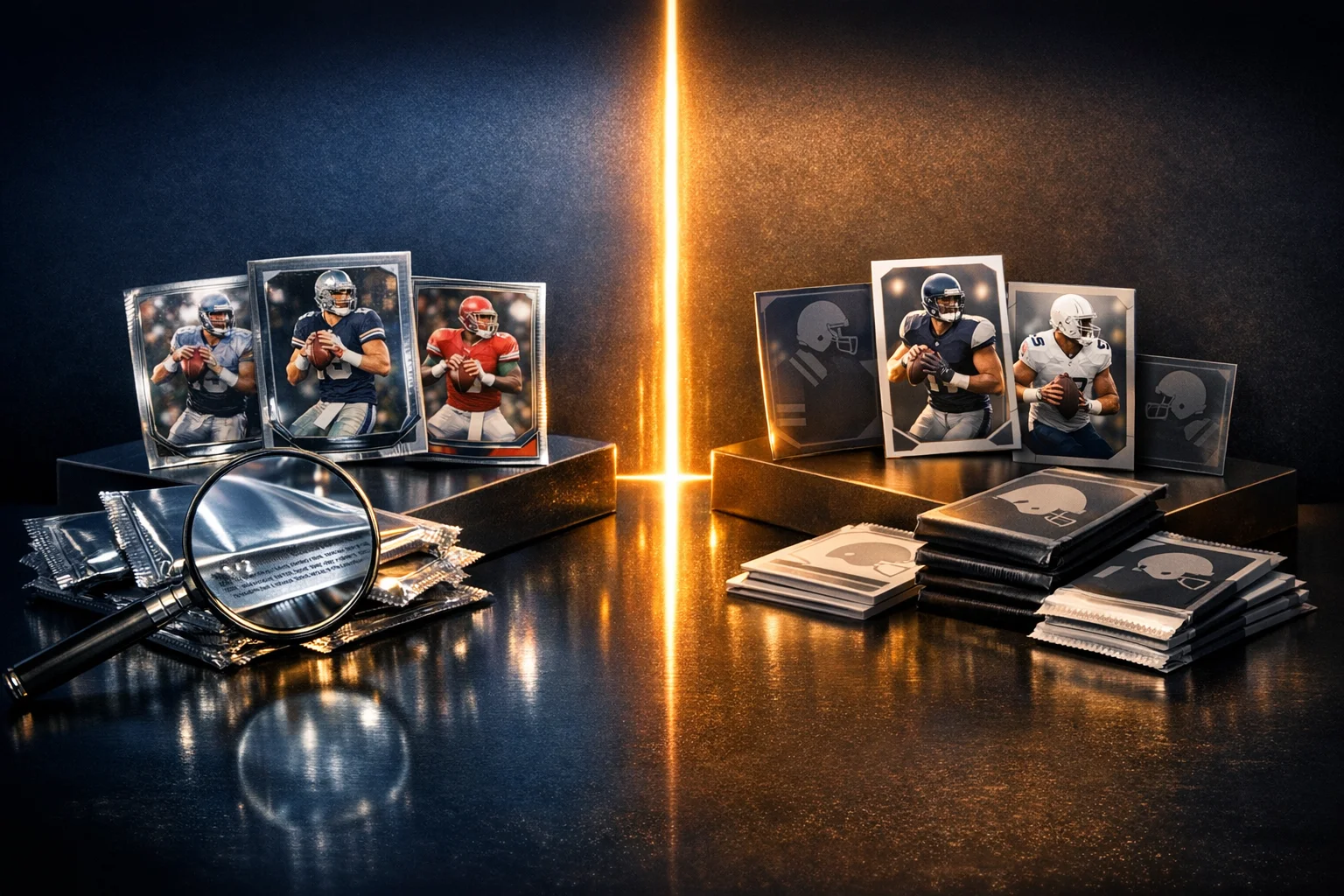
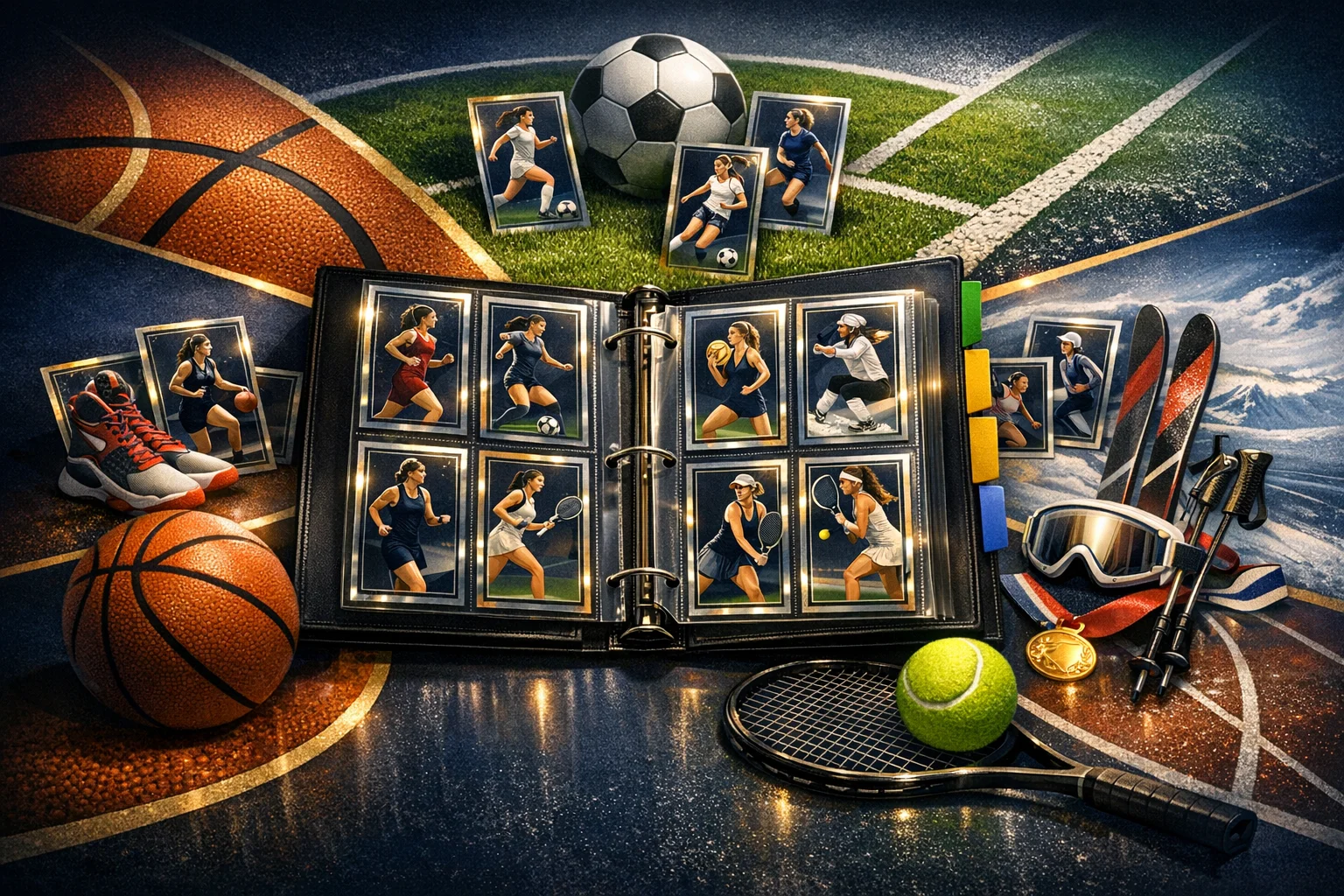
Illustration generated for this guide; not a photograph of an actual card, product or event.
Photo Gallery