Chris Webber’s card market is a natural fit for collectors who appreciate how basketball changed in the 1990s. His game blended power, vision, ball-handling and scoring in a way that felt ahead of its time, and his cardboard timeline lines up with one of the hobby’s most creative eras. From early chromium rookies to inventive memorabilia concepts and scarce pack-issued autographs, Webber’s best cards tell the story of a star whose style translated beautifully to premium designs.
His collecting profile also benefits from timing. Webber entered the league as manufacturers were pushing harder into glossy finishes, bold inserts and tougher parallels. By the end of his career, many of the companies that helped define that decade had already disappeared, leaving behind a compact but memorable run of playing-day cards.
For collectors building around Hall of Fame talent from the era, a handful of Webber issues stand out above the rest for design, scarcity, historical placement and market movement.
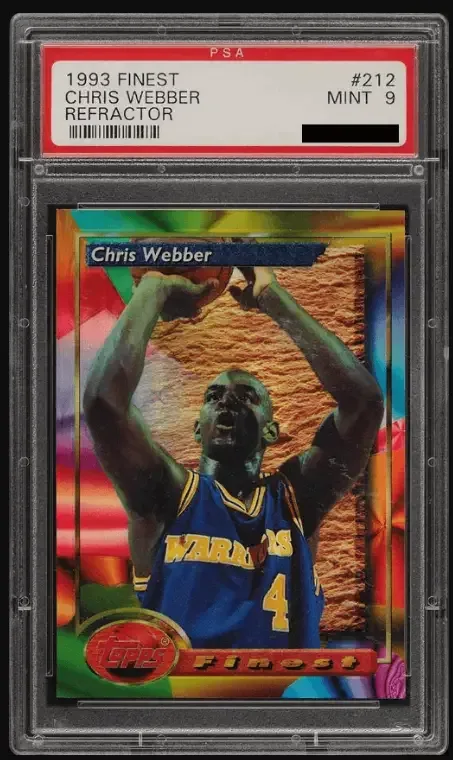
1993 Topps Finest Refractor anchors Webber’s rookie-year market
Few cards represent early premium basketball collecting better than 1993 Topps Finest Refractor, and Chris Webber’s copy is one of the key rookie-year examples from the set. As the No. 1 pick in the 1993 draft, Webber entered the NBA with major expectations after his college run at Michigan, and his debut coincided with the launch of a product that helped reshape modern basketball cards.
For more collector background, read Why a Physical Game Can Matter to a Sports Fan.
Topps Finest introduced chromium-style stock to basketball in a major way, and the Refractor parallel quickly became one of the era’s defining chase cards. Webber’s card, numbered #212, remains his most important mainstream rookie-year parallel because it combines hobby significance with star-level player demand.
The market data supports that status. PSA 10 examples have been especially difficult to find, with only two recorded sales over the past year. The most recent changed hands for $5,320, a gain of 44.59%. PSA 9 copies have also pushed upward, climbing 44.31% from $492 to $710. That combination of iconic set recognition and meaningful graded growth keeps this card near the top of any serious Webber want list.
Collectors chasing cornerstone cards from the 1990s often want something that checks several boxes at once: rookie-year relevance, visual impact, hobby history and steady long-term interest. Webber’s Finest Refractor does all of that.
For another perspective on this story, read 7 Chris Webber Cards That Capture a Transformative NBA Career.
1993 Stadium Club Beam Team captures the hype of his first NBA season
Webber’s rookie season gave collectors plenty to work with. He arrived in Golden State after the draft-night move that sent him west, then immediately produced with the kind of all-around stat line that justified the attention. He averaged 17.5 points, 9.1 rebounds, 3.6 assists and 2.2 blocks per game, edging Penny Hardaway for Rookie of the Year.
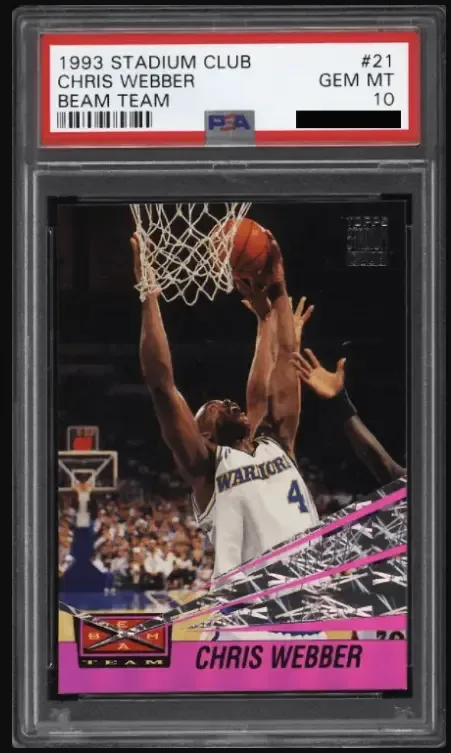
One of the most appealing cards from that stretch is the 1993 Stadium Club Beam Team insert. Beam Team was already one of the hobby’s standout insert concepts, and Webber’s appearance in the second edition gave collectors a card that felt energetic and unmistakably tied to the decade. The design overlays metallic beam effects on an action image, and Webber’s card shows him attacking the glass above defenders.
Unlike some of his rarer cards, this is still a relatively accessible entry point for collectors, which adds to its appeal. At the same time, it has shown meaningful movement. Raw copies have climbed to roughly $8, and PSA 8 examples have risen to about $31, with both categories posting gains of around 120% year over year. PSA 10 sales have nearly doubled as well, moving from $264 to $525, which marked a high point in the available sales history.
That makes Beam Team one of the more interesting Webber cards on the board. It is recognizable, affordable in lower grades and still capable of showing strong momentum when higher-end examples surface.
1994 Ultra Power in the Key stands out for its Bullets uniform and peak-1990s design
Webber’s early NBA career was not short on drama. After a promising rookie campaign, tension with coach Don Nelson helped speed up a departure from Golden State. Thanks to an unusual contract structure that allowed an early escape, Webber eventually landed in Washington, where he reunited with Juwan Howard.
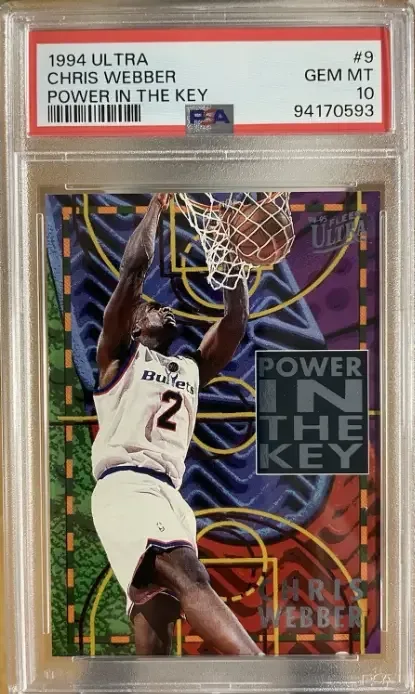
That move matters for collectors because relatively few second-year cards show Webber in a Washington Bullets uniform. Among them, 1994-95 Ultra Power in the Key #9 is one of the most visually memorable. The card leans into the era’s design excess, placing a cutout image of Webber finishing a two-handed dunk over a colorful, stylized court background.
It is the kind of insert that appeals to collectors who want something very specific from 1990s basketball cards: strong player photography, loud design choices and a look that could only have come from that period. It also has a noteworthy population profile at the top end. PSA has just five Gem Mint 10s in its database, and the most recent sale of a PSA 10 reached $300 in June 2025, up 50% from the previous sale a year earlier.
At the same time, lower-grade copies tell a very different story. The last two PSA 9 sales came in at just $26 and $23, which is a reminder that scarcity alone does not always translate evenly across grades. For collectors who like condition rarity and unusual team-uniform appearances, though, this is one of the more compelling niche Webber cards available.
1997 Hoops High Voltage reflects his Washington prime and a surging insert market
Webber’s years in Washington helped reestablish him as one of the league’s premier forwards. In his first game against Golden State, he erupted for a 40-point triple-double, and across four seasons in Washington he produced at an All-Star level while helping return the franchise to the playoffs.
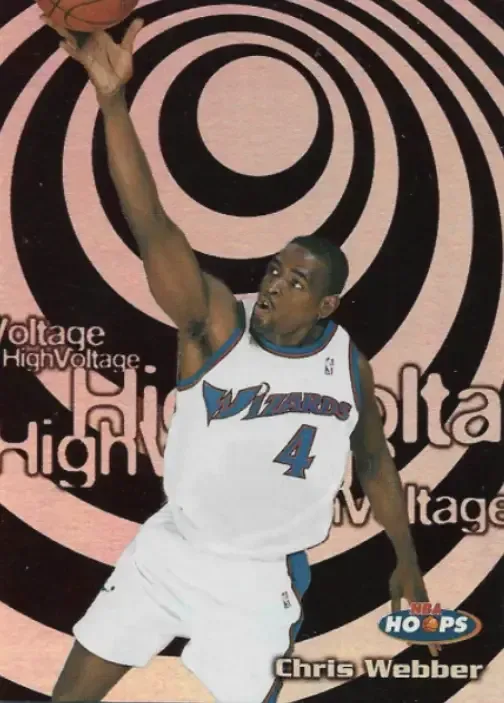
The 1997-98 Hoops High Voltage insert fits that phase of his career well. Built around players with crowd-igniting styles, the set featured just 20 names and used a striking black-and-white swirling background that gave the cards a chaotic, high-energy look. Webber’s copy captures him on the move, driving toward the basket, and the design remains one of the more distinctive insert concepts of the late 1990s.
It has also delivered one of the biggest jumps among the Webber cards being tracked. Raw copies have climbed from $20 to $69 over the last year, a gain of 240%. PSA 9 examples have also moved up strongly, rising 60% to $160.
That kind of movement is notable because High Voltage is not just another star insert. It sits in the sweet spot many 1990s basketball collectors value most: limited checklist, memorable aesthetics and enough scarcity to feel meaningful without being impossible to chase. For Webber collectors who want a card from his Washington run with strong visual identity, this is one of the best choices.
1999 SkyBox APEX Net Shredders documents the start of his Sacramento peak
Webber’s trade to Sacramento changed the course of his career. What looked uncertain at the time became the setting for his best and most celebrated NBA years. In the Kings’ fast-moving offense, his passing, touch and interior power all had room to breathe, and collectors finally got to see his game framed around winning, identity and style.
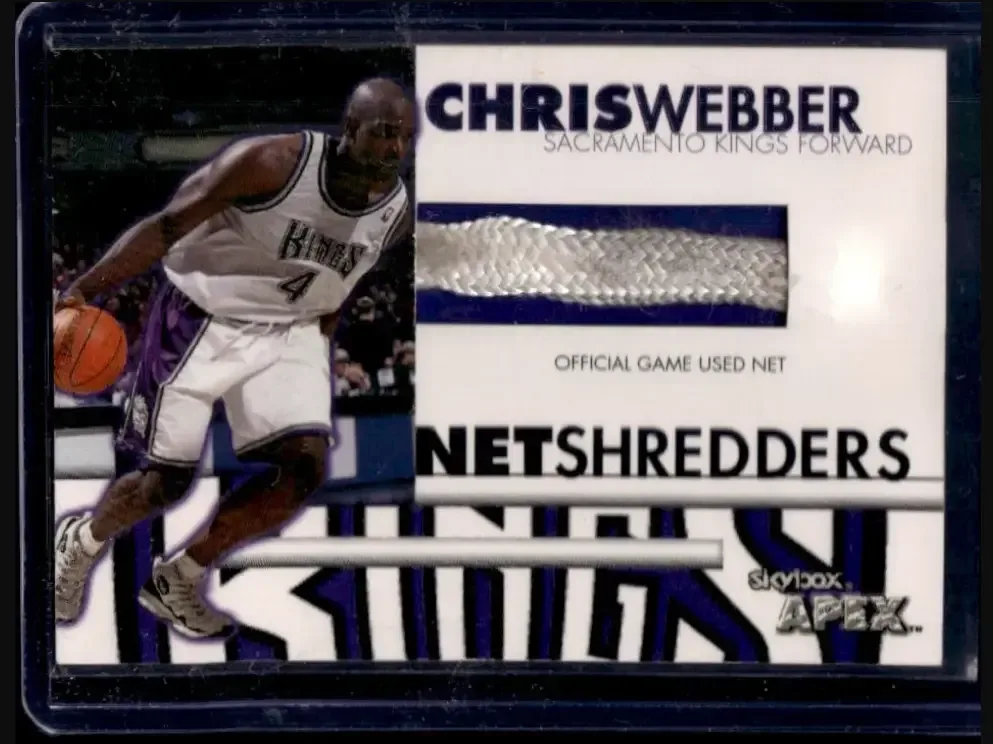
One of the more unusual cards tied to that period is 1999 SkyBox APEX Net Shredders. By the end of the decade, memorabilia cards were becoming more common, but they still carried novelty. This release stood out by using pieces of game-used basketball nets, making it one of the more creative relic concepts of its moment.
That matters because the card matches the player well. Webber was producing 24.5 points per game during the 1998-99 season, ranking sixth in the league, and the idea of pairing him with a net-themed memorabilia insert feels especially fitting. It is not a card that floods the market, either. Only three copies have sold during the last two years, with realized prices ranging from $67 to $104.
For collectors focused on late-1990s innovation, Net Shredders offers a nice blend of player significance, period-specific memorabilia design and limited recent transaction volume.
Pack-issued autographs from Webber’s playing days remain unusually scarce
One of the more interesting parts of Webber’s collecting story is what is not out there. Compared with many stars of his era, he simply did not sign many pack-issued autographs during his active NBA years. That scarcity has given added weight to the few standalone autograph releases that do exist.
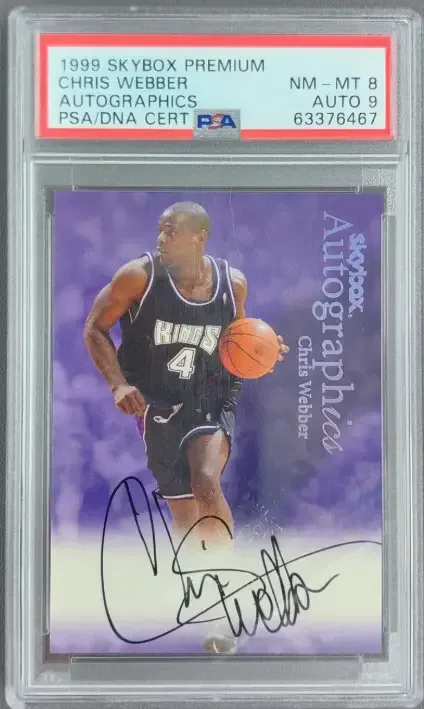
Two 1999 issues are especially important: Fleer Focus Fresh Ink and SkyBox Autographics. Both arrived as Webber was settling into his Sacramento years, just before he put together a run of five straight All-Star selections from 2000 through 2004. Those seasons cemented his place as the centerpiece of one of the league’s most entertaining teams.
Fresh Ink has typically sold in the $200 to $300 range, making it a relatively attainable signed card for collectors who want a pack-pulled Webber autograph from his playing career. SkyBox Autographics sits at a different level. It is more sought after and has reached as high as $1,500, with the most recent recorded sale coming in at $911 in September.
The limited autograph supply is a major reason these cards matter. Later licensed releases offered far more signed and memorabilia content for Webber, but many collectors still place special value on autograph cards produced during the years he was actively shaping his legacy on the court.
2006 Topps Chrome Superfractor leads the late-career short list
By the middle of the 2000s, Webber’s career had changed dramatically. A serious knee injury and microfracture surgery altered both his explosiveness and Sacramento’s championship path. He remained a productive player, but the version of Webber who could dominate games with speed, lift and power had given way to a more grounded scorer and facilitator.
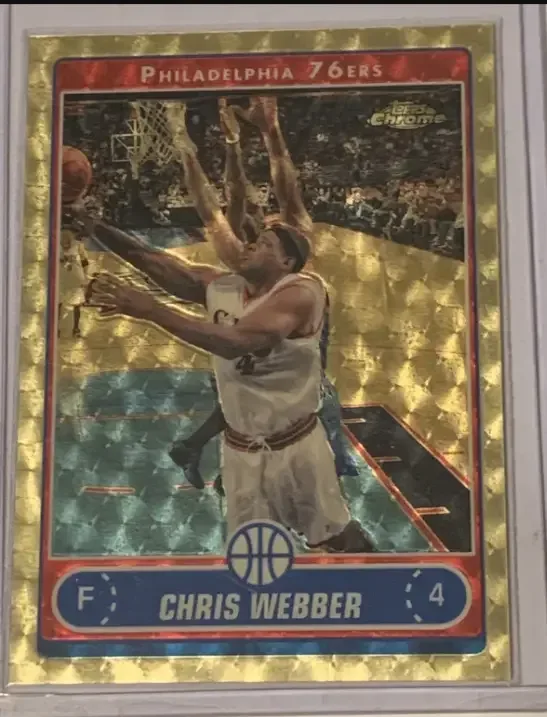
Even so, there are still notable late-career cards for collectors to chase, and the biggest modern-style target from that stretch is the 2006 Topps Chrome Superfractor. As a true one-of-one from a product line with long-term hobby credibility, it sits in a very different category from his earlier mass-market inserts and parallels.
The card sold for $6,655 in January 2023, putting it among the strongest public sales tied to Webber’s later playing years. It is a reminder that while his 1990s cards often define his market identity, premium post-prime issues can still command major attention when the format and scarcity align.
Checklist of notable Chris Webber cards from his playing days
- 1993 Topps Finest Refractor #212 - flagship rookie-year premium parallel and one of his most important cards
- 1993 Stadium Club Beam Team - early-career insert with strong design recognition and broad collector appeal
- 1994-95 Ultra Power in the Key #9 - notable Washington Bullets-era issue with low PSA 10 population
- 1997-98 Hoops High Voltage - late-1990s insert tied to his Washington prime
- 1999 SkyBox APEX Net Shredders - memorabilia card featuring game-used net pieces
- 1999 Fleer Focus Fresh Ink - one of the key standalone playing-day autographs
- 1999 SkyBox Autographics - scarcer and more coveted playing-day autograph issue
- 2006 Topps Chrome Superfractor - major late-career one-of-one chrome card
Why Webber’s best cards still resonate with 1990s basketball collectors
Webber’s strongest cards work because they mirror the qualities that made him memorable as a player. They are versatile, visually bold and a little unconventional. There is the hobby landmark status of 1993 Finest Refractor, the affordable nostalgia of Beam Team, the loud styling of Ultra inserts, the strange beauty of High Voltage and the inventive memorabilia angle of Net Shredders. Add in a short list of truly meaningful playing-day autographs, and his catalog feels focused rather than bloated.
That smaller supply of signature cards from his active years is especially important in today’s market. Collectors who want authenticity tied to a specific moment in time often prefer cards released while a player was still competing, and Webber does not have a deep pool of those options. That reality gives extra significance to 1999 autograph issues and helps separate them from later material.
For collectors building around Hall of Famers whose cardboard reflects both on-court innovation and the design creativity of the 1990s, Webber remains an appealing target. The best entries in his catalog are not just reminders of his career. They are snapshots of a hobby era that took big swings visually and commercially, just as Webber was redefining what a power forward could look like on the floor.
Photo Gallery