A satisfying football card collection usually gets smaller before it gets better. The moment you stop trying to own a little of everything, your cards start to look like a plan instead of leftovers from random purchases.
In 2026, that planning matters. Entry-level retail football can still be approachable, premium hobby can be very expensive, licensing details now shape what different products actually offer, and grading costs can rival the price of the box that produced the card. The collectors who stay happiest tend to pick one lane, define what belongs, and spend accordingly.
Start with one collecting lane
The easiest way to lose control of a football collection is to make every purchase decision card by card. One cool rookie here, one shiny parallel there, one discounted autograph that was too tempting to pass up. None of those choices is automatically wrong, but together they often produce clutter instead of identity.
A focused collection usually works better when you choose the lane first. For most football collectors, the cleanest options are set-focused, player-focused, team-focused, or type-focused. Set-focused means building one annual release or one brand family. Player-focused means following one quarterback, one retired legend, or one rookie class. Team-focused means staying with one NFL franchise. Type-focused means limiting yourself to rookies, autographs, parallels, or graded cards.
If you want the collection to remain manageable, three lanes tend to be easier than the rest: one flagship-style set, one player across multiple sets, or one team inside one product family. Each gives you natural boundaries. A team collector in one set knows exactly which cards matter. A player collector can ignore most sealed product. A set builder can stop wandering across brands just because a parallel looked exciting in the moment.
Try writing your collection rule in one sentence before you buy anything else. For example: I collect my favorite team only in 2026 Topps Flagship Football. Or: I collect one quarterback, but only base rookies, one chrome rookie, and one autograph if it fits my budget. If your rule needs a paragraph, it is probably still too broad.
- Good starter lanes: one set, one player, one team, or one card type
- The narrower the lane, the easier it becomes to skip impulse buys
- A one-sentence collecting rule is often more useful than a vague budget
Choose sets by what you want to own, not what is loudest
Once you know your lane, the next question is simple: what kind of cards do you actually want to look at a year from now? This is partly taste, and taste matters more than collectors sometimes admit. A coherent binder full of cards you enjoy is a better result than a scattered pile of cards that were merely trendy when you bought them.
If you want lower-cost entry, broad player coverage, and a buildable paper-style release, 2026 Topps Flagship Football is an obvious starting point. Topps describes it as a fully licensed return with stars, rookies, and legends, and the verified retail pricing makes it a practical set for team pages, rookie sampling, and annual binders. That does not guarantee big hits in retail, but it does create a straightforward way to collect a modern licensed football release without starting at premium hobby prices.
If you prefer chrome surfaces, refractors, and a more premium visual feel, Topps Chrome Football offers a different kind of appeal. Topps says 2025 Topps Chrome Football marked the return of the official NFL license to Topps football, and Fanatics identified that set as the first product under its licensing deal. The tradeoff is cost. Chrome makes sense for singles, occasional sampling, or a carefully defined player run far more than it does for repeated rip-and-chase buying.
Panini still belongs in the conversation if you like its football design language. Panini's football category page shows 2026 products including Donruss and Obsidian on its own store. That tells you those lines are active products, not just nostalgia topics. A Donruss-style project can work for collectors who like broader insert culture and familiar set rhythms. An Obsidian-style project can suit collectors who want thicker, premium-feeling cards and lower card counts. The right question is not which brand wins in the abstract. It is which format best fits the cards you actually want to keep.
- Flagship-style paper sets usually suit team builders and base-rookie collectors
- Chrome-style products often work best as singles-first projects
- Panini product families may still be the right aesthetic choice for some collectors
Understand licensing before you commit to a brand
Modern football cards no longer reward lazy assumptions about licensing. If you care about NFL logos, uniforms, player group rights, or autograph access, you should verify what a product actually has instead of treating all football releases as interchangeable.
Fanatics Collectibles, the NFL, and the NFLPA announced a multi-year deal under which Topps returned as the official exclusive trading card licensee. Fanatics said the NFL and NFLPA rights include official team logos, names, marks, helmet designs, uniforms, and NFL branding for cards and packaging, and named 2025 Topps Chrome Football as the first set under that agreement. Topps also says Chrome football returned with the official NFL license. For collectors who want the most direct NFL visual presentation, that language matters.
At the same time, player group rights are their own subject. The NFLPA says a player who signs a Group Licensing Assignment gives the NFLPA exclusive rights to use that player's identity in licensed programs involving six or more players. In practical collecting terms, that means team branding rights and player-use rights are related but not identical. You should not assume that a card's look, checklist, and autograph lineup all flow from one single permission.
Panini adds another layer. In April 2025, Panini announced a Patrick Mahomes autograph partnership and said Mahomes autographs would appear in Panini's upcoming NFL trading card products for the 2025 season, while also referring to official NFL and NFLPA licenses. Panini also continues to list 2026 football products on its store. The public-facing pages therefore show overlapping football-card activity, even if they do not fully explain every legal boundary. The safest collector habit is not taking sides. It is checking the exact product you are considering.
- Verify team and league branding if licensed visuals matter to you
- Do not assume player inclusion automatically means autograph inclusion
- Treat licensing as a buying checklist item, not background noise
Make player rules before the chase starts
Collectors often think the hard part is choosing the right player. Usually the harder part is choosing what counts as enough. Modern football creates too many versions of the same name for a vague plan to stay cheap or coherent for long.
A realistic player plan usually fits into one of four buckets: one franchise quarterback you actually enjoy, one retired legend, one rookie class, or one current core of three to five players from your favorite team. Any of those can work if you define the borders. Trouble starts when a collector says they want all the hot rookies, all the parallels, or every autograph that appears. That is not one lane. That is several expensive lanes stacked together.
The current product structure makes this especially important. Topps Flagship Football promotes stars, rookies, and legends in a mass-market format, while Chrome football has emphasized premium rookie content including rookie autographs and Rookie PREM1ERE Patch Autographs. The same rookie interest can therefore lead to a cheap base-card project or a high-cost premium chase depending on the set you choose. The player did not change. The collecting lane did.
Write rules that limit versions, not just names. You might decide on one base rookie from every set you like, or one chrome rookie total, or only numbered cards, or only autographs, or graded copies only for your main player. Those are collecting preferences, not market facts, but they are the kind of preferences that keep a project readable. If autographs are the real goal, move autograph confirmation to the top of your checklist. A player showing up in the base set is not proof that he signed for the product.
- Choose the player category first, then define what types of cards qualify
- A rookie class project is easier to control than a rookie hype project
- If autos are the goal, confirm autograph presence before buying
Use retail and singles as the foundation
For most collectors in 2026, the most practical building blocks are retail product and singles, not hobby-box volume. That is not a moral judgment against hobby wax. It is a response to the actual price gap between accessible retail football and premium hobby football.
Topps lists the 2026 Topps Flagship Football Value Box at 24.99, and its boxes-and-packs page shows the 2026 Topps Flagship Football Mega Box at 49.99. Those are manageable entry points for sampling a set, building team pages, and sorting rookies. By contrast, Fanatics Collect showed a 2025 Topps Chrome Football Hobby Box at 695 dollars, with recent 2026 sales on that page around 600 to 649.95. That difference changes the correct buying strategy. At flagship retail prices, opening a little and filling gaps with singles can make sense. At premium hobby prices, randomness can swallow the whole monthly budget before you buy one specific card you actually wanted.
This is why singles-first collecting is so effective for focused projects. If your goal is one team, one player, or one insert run, singles convert money directly into progress. Sealed wax converts money into possibility. Possibility can still be fun, but it is a different goal. A box opened for entertainment is not the same thing as a box opened as an efficient path to completion.
One caution is worth repeating: wording like look for autograph and relic cards is not the same as a guaranteed hit statement. Retail can still be enjoyable, but it should be enjoyable because you like the set and the sorting process, not because you expect a major pull. If a purchase only makes sense when the ceiling outcome happens, a single usually would have served you better.
- Retail helps you learn a set without committing hobby-box money
- Singles usually move a focused collection forward faster than random wax
- Treat box ripping as entertainment unless it clearly matches your goal
Build a monthly budget around outcomes, not urges
A useful collecting budget does more than cap spending. It tells your money where to go before a release day, auction ending, or surprise restock does it for you. The more focused your football collection becomes, the more important that structure is.
At roughly 25 to 75 dollars per month, the cleanest targets are a team binder, one current player, or a rookie sampler built mostly from flagship retail and low-cost singles. One value box, one mega box, or a small stack of singles can still create visible progress at that level. The goal is not to win the month. It is to add cards that clearly belong.
Around 100 to 250 dollars per month, you can support one serious player collection, one team with occasional autograph purchases, or a mixed plan built around mostly singles with some wax for fun. This tier often rewards discipline more than volume. Because premium hobby pricing is so high, the collector who spends most of this range on targeted singles may finish with a stronger collection than the collector who keeps hoping one sealed purchase solves everything.
At 300 to 800 dollars and beyond, premium cards and boxes become more accessible, but they still do not become automatically wise. Before buying a premium hobby box, compare it with the alternatives: several targeted singles, one autograph, one graded rookie, or a sizable team lot from the same release. That comparison is analysis, not a universal rule, but it is a healthy one. A premium budget still deserves a plan.
One simple approach is to split every month in advance: roughly 70 to 80 percent for singles, 20 to 30 percent for wax or other collecting fun. The ratio can change, but separating progress spending from entertainment spending helps keep impulse from disguising itself as strategy.
- Low budgets usually pair best with flagship retail plus singles
- Midrange budgets often improve when singles take priority
- Even large budgets benefit from a planned singles-versus-wax split
Decide whether grading belongs in this collection at all
Grading can be a smart part of a football collection, but it should be a collecting choice, not a reflex. A slab can add presentation, protection, and standardization, yet those benefits cost real money. If you ignore the cost, grading can quietly become the most expensive part of a modest collection.
PSA's February 10, 2026 service update listed Value Bulk at 24.99, Value at 32.99, Value Plus at 49.99, Value Max at 64.99, and Regular at 79.99 for new submissions under that structure. Those numbers matter because they sit close to, or above, the price of some retail football boxes. If you open a 24.99 value box and immediately plan to grade multiple cards, the grading bill can surpass the wax before you even think about shipping or the rest of your collection budget.
That does not make grading a bad idea. It simply means grading works best when it has a job. Maybe that job is protecting your best player cards long term. Maybe it is creating a uniform look for a quarterback run you plan to display. Maybe it is reserving slabs for condition-sensitive centerpiece cards while the rest of the project stays raw in a binder. Those are all coherent uses.
What tends to be less effective is grading because a card is new, because the player is popular, or because every rookie pull feels like it should be submitted. Ask a plain question instead: if this card stayed raw forever, would you still want it in the collection? If the answer is yes, grading can be an enhancement. If the answer is no, grading probably is not the solution.
- PSA pricing as of February 10, 2026 can rival the cost of retail wax
- Grade cards that serve a clear long-term purpose in your collection
- A mixed raw-and-graded collection is often more practical than grading everything
Three sample collection plans that stay realistic
If you are new, the easiest entry point is a flagship team build. Pick 2026 Topps Flagship Football, choose one NFL team, and decide that base cards, rookies, and a few inserts are enough. This gives you licensed visuals, a broad checklist, and price points that allow regular progress without turning every month into a high-stakes decision. It is also one of the simplest ways to learn what parts of the hobby you actually enjoy.
If you love shiny cards, try a one-player Chrome run built from singles. Choose one current star, one quarterback, or one favorite retired player, then define the finish line. That could mean one base, one refractor, one numbered parallel, and one autograph if pricing allows. This approach keeps the visual appeal of Chrome while respecting the fact that hobby boxes in that product family can be expensive. It also stops the rainbow idea from becoming a budget trap unless you genuinely want that challenge.
If autographs are your real priority, admit that early and collect accordingly. Use checklist-confirmed autograph singles or product descriptions that clearly support autograph inclusion, pick the players you care about, and set a hard price ceiling before shopping. The Panini Mahomes announcement is a useful reminder that autograph access can depend on specific player arrangements. A neat autograph collection built deliberately is usually more satisfying than a large accidental pile of base cards generated while hunting signatures.
All three plans share the same principle: define the finish line before the chase begins. A focused football collection is easier to enjoy when you know what success looks like.
- New collectors: flagship plus one team is a clean starter plan
- Shiny-card collectors: singles-first Chrome runs control cost
- Autograph collectors: build around confirmed signer availability and a hard ceiling
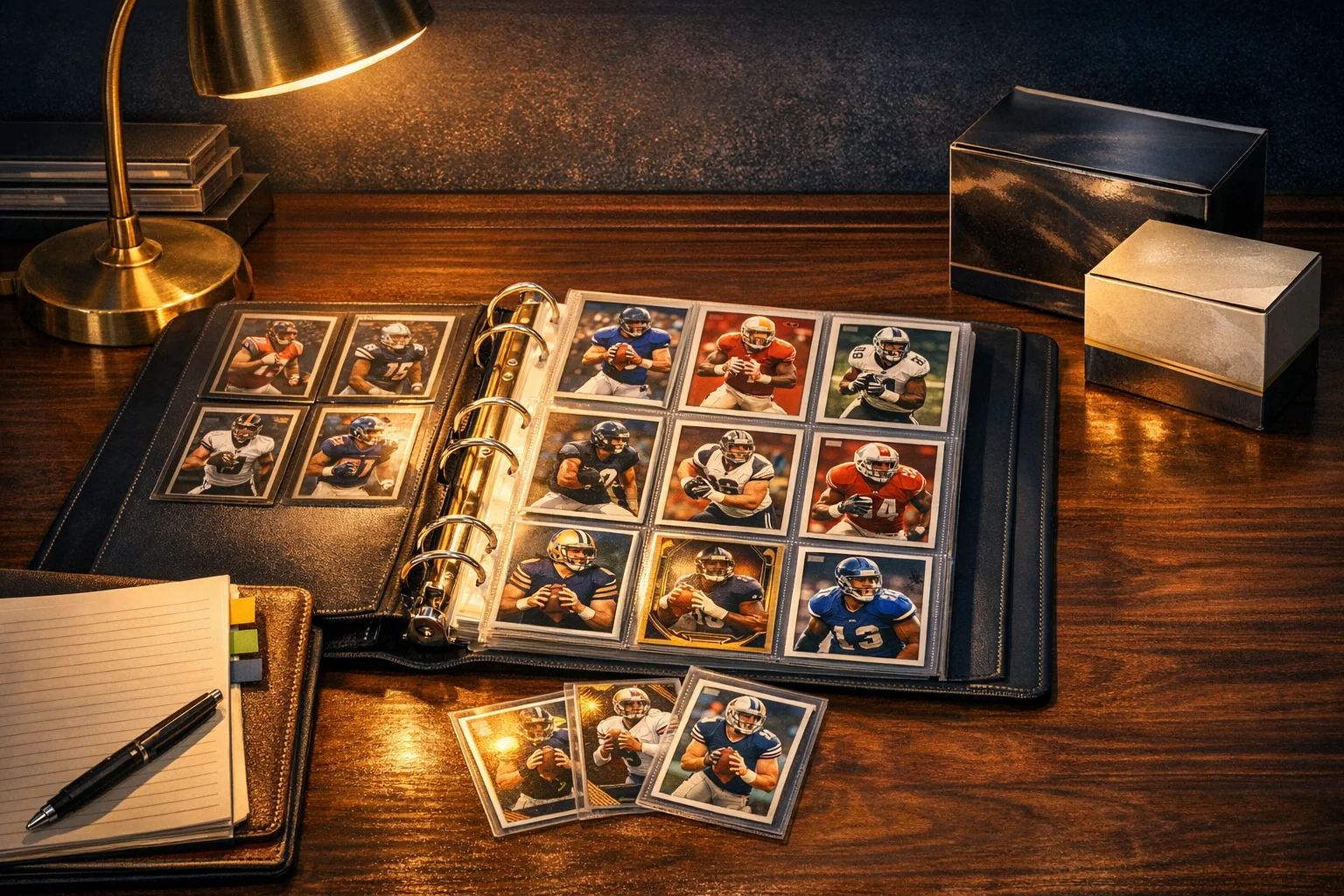
Illustration generated for this guide; not a photograph of an actual card, product or event.
Photo Gallery