Older hockey cards can look simple until you try to buy them well. A familiar player, a clean front, and a price that seems reasonable can still hide the two problems that catch collectors most often: misidentification and missed condition flaws. Cards from the same season may come from different brands, use different photos, carry different checklist sizes, or reflect roster moves differently. On older cardboard, a wrinkle, edge touch, or border issue that barely shows in a casual scan can matter far more than you expect.
You do not need to memorize every set to make better decisions. What helps most is a structure you can repeat: sort the card into the right era, confirm the exact issue, learn the set’s common flaws, and then judge condition with a clear standard. Once you start doing that, vague listings become easier to decode, “same card” assumptions become less dangerous, and you gain confidence whether you collect stars, sets, or the early premium years.
Start with eras, because “older hockey” is not one market
The phrase older hockey cards covers several very different collecting environments. If you treat all of them the same, you will ask the wrong questions. A practical dividing line is pre-1980, which many collectors use as a shorthand for vintage. That line is not a law of the hobby, but it is useful because it separates earlier material, where surviving condition is often tougher, from later periods that many collectors experience differently.
From there, three broad buckets are especially useful. The first is pre-1980 vintage, where scarcity, wear tolerance, and major rookie or star cards often shape buying decisions. The second is the long Topps and O-Pee-Chee mainstream period, especially from the late 1960s into the late 1980s, where related but not always identical issues create many of the most common beginner mistakes. The third is the Upper Deck period beginning with 1990 hockey cards, which introduced a more premium presentation and, by the mid-1990s, helped push memorabilia-driven products into the hockey-card conversation.
Why does this matter? Because the era tells you what kind of homework matters most. On pre-1980 cards, you may be weighing originality and acceptable wear more than sharpness. On 1970s and 1980s Topps or O-Pee-Chee, you may be deciding whether two similar-looking cards are actually different issues. On early Upper Deck material, you may be sorting out where a card fits in the shift from traditional base-set collecting toward more premium packaging and new product concepts.
Think of era as your first filter, not your final answer. If you know the era before you study the listing, you are less likely to compare apples to oranges. That alone can save you from overpaying for the wrong version or walking past a legitimate card because you assumed a difference meant a mistake.
- Use era as an organizing tool: pre-1980 vintage, Topps and O-Pee-Chee classics, then Upper Deck from 1990 forward
- Let the era change your questions before it changes your budget
- Do not assume the same buying standards work equally well across all older hockey
Learn the Topps and O-Pee-Chee relationship before you trust a listing
One of the easiest ways to make a bad buy in older hockey is to assume Topps and O-Pee-Chee are interchangeable. Sometimes the fronts look close enough that a quick glance makes them seem identical. That does not mean they are the same card. In multiple seasons, the differences can include checklist length, photo choice, back design, print language, and whether a player’s team situation was updated by the time the card reached market.
A strong example is 1968-69. O-Pee-Chee issued a separate set with 216 cards, while the Topps counterpart had 132. The O-Pee-Chee backs also differ in appearance, and release timing could affect how player movement was reflected. That means a seller who writes only the year and player name may be leaving out information you actually need in order to identify the card correctly.
The same lesson shows up again in 1970 and 1979. In 1970, Topps and O-Pee-Chee are closely related but not exact duplicates. In 1979, release timing again matters, because later O-Pee-Chee distribution allowed some transaction updates that did not appear the same way on Topps. This is not trivia for historians. It changes how you compare listings, how you describe a card in your own collection, and how you decide whether a cheaper option is actually the same item.
Imagine a buyer looking for a favorite star from a season that exists in both brands. Listing A says only the player name and year, shows the front only, and prices the card lower. Listing B names the brand, gives the card number, and includes clear front and back images. Listing A may feel like the bargain, but it may also be the riskier buy. If you cannot confirm the brand and exact issue, you are not really comparison shopping yet.
A simple rule goes a long way: on older hockey, never stop at player and year. Confirm year, brand, and card number. If both Topps and O-Pee-Chee versions exist, compare the front and back. That extra minute of work is often what separates an informed purchase from a hopeful guess.
- Treat player name plus year as incomplete identification
- Confirm the brand and card number before comparing prices
- When Topps and O-Pee-Chee versions exist, front and back images both matter
Condition on older hockey starts with four pillars, not a vague first impression
Collectors often say a card is clean, rough, sharp, or presentable. Those words can be useful shorthand, but they are not a method. A better starting point is the same four-part structure graders use: centering, corners, edges, and surface. Older hockey becomes much easier to evaluate once you slow down and examine every card through those four lenses.
Centering is often the first flaw you will notice, especially on designs with large white borders or strong color framing. Corners tell you about handling and storage. Edges can show chipping, rough cuts, wear, or signs that deserve a closer look for alteration. Surface covers a wider range of problems: scratches, wrinkles, stains, print defects, gloss breaks, discoloration, and creases. On older cardboard, surface issues can be more important than a quick scan suggests because they often disappear in poor lighting or soft photography.
This matters because older cards do not age like modern premium cards. Many were handled heavily, stored imperfectly, or cut less precisely to begin with. A card can be completely legitimate, attractive, and worth owning even if it is not high grade. If you apply modern perfection standards to all vintage and near-vintage hockey, you will either overspend, reject too many honest cards, or both.
Before you shop, decide which flaws you can live with. For example, you might accept off-centering on a white-border issue if the card is crease-free and original. You might tolerate touched corners on a scarcer pre-1980 card but avoid paper loss or staining. Setting those priorities in advance helps you stay rational when a card is in front of you and the bidding clock is running.
A useful hypothetical: suppose you are choosing between two copies of the same star card. One is well-centered but has a faint crease. The other is noticeably off-center but has a strong surface and no crease. There is no universal right answer. But if you know that creases bother you more than centering, the decision becomes easier and more consistent with your collection standards.
- Use centering, corners, edges, and surface every time
- Decide your deal-breakers before you start shopping
- An older card can be collection-worthy without being technically sharp
Eye appeal matters, but it should come after structure
Collectors are right to care about eye appeal. Two cards with similar technical flaws can present very differently. One may have strong color, a crisp image, and balanced framing that make it feel better than the grade on the holder. Another may be technically similar but look flat or distracting. That is part of collecting, and it is reasonable to pay attention to it.
The mistake is using eye appeal as a substitute for inspection. A card can have a handsome front and still hide a wrinkle, a light crease, back damage, or an edge problem. Older hockey is especially vulnerable to this because many flaws are easier to miss than newer collectors expect. A flattering scan can soften edge wear, bury a wrinkle in dark areas, or crop a border in a way that keeps you from asking the right question.
The safest sequence is objective first, subjective second. Start by checking the physical issues you can identify: centering, corner wear, edge quality, missing border, gloss breaks, staining, and creases. After that, ask the personal question: do I like how this card looks enough to own it? That order keeps you from talking yourself into a structurally weaker card just because the photography is appealing.
Consider another hypothetical. You are choosing between a numerically similar pair of 1970s cards. One has richer color and stronger centering at first glance, but the back shows a wrinkle and a rough edge. The other looks a little less dramatic but is more even overall. If you only follow eye appeal, you may buy the first and regret the hidden flaw later. If you inspect first and admire second, you can make a more durable choice.
Eye appeal is real. It just works best as a tie-breaker or preference layer, not as your only buying standard.
- Inspect for physical flaws before judging overall beauty
- A strong scan can hide wrinkles, trimming concerns, or back damage
- Use eye appeal to refine a decision, not replace due diligence
Research the exact set, because generic vintage advice misses the real traps
The jump from casual buyer to capable collector usually happens when you stop researching “vintage hockey cards” in general and start researching the exact set in front of you. Set-specific knowledge explains why some issues are much tougher in high grade, why some flaws are normal for one release but suspicious in another, and why two cards from nearby years can demand totally different standards.
Take 1979 Topps hockey. The blue borders are fragile, centering can be a recurring issue, and the card stock is often discussed as more fragile than its O-Pee-Chee counterpart. Some cards were also more vulnerable because of where they sat on the sheet. If you know that before you buy, you will study border chipping, rough cuts, and left-right centering much more carefully. If you do not know it, you may think you are seeing a random rough example when in fact you are seeing a set-specific pattern.
Now compare that with 1988 O-Pee-Chee. Large white borders make centering easier to judge at a glance, but they also make imbalance harder to ignore. A card can seem sharp from across the room and still show obvious centering weakness once you look directly at the frame. Certain cards are also associated with edge vulnerability because of sheet position. White-border sets reward careful scrutiny because small flaws present loudly.
Even earlier issues teach the same lesson in a different way. Sets tied to the Topps and O-Pee-Chee relationship may differ in card count, photos, and player presentation. That means the research task is not only condition-related. It is also identification-related. A buyer who studies the exact issue makes fewer mistakes before condition is even discussed.
If you collect by player, this habit matters just as much as it does for set builders. A favorite player can appear across decades of sets with very different printing traits. The more precisely you research the issue, the less likely you are to pay a premium for a problem card that only looked good because you did not know what the set usually looks like.
- 1979 Topps demands extra attention to blue-border wear, rough edges, and centering
- 1988 O-Pee-Chee makes centering and edge quality easy to see and easy to judge
- Exact-set knowledge helps with both condition and identification
Watch for alteration risk, especially on important vintage and near-vintage cards
Older hockey attracts serious attention, and serious attention always creates incentive for someone to improve a card artificially. That does not mean you should treat every sharp card as suspicious. It does mean you should learn what kinds of problems deserve a pause before you commit money.
The warning signs worth remembering are practical ones: a hooked edge, unusually sharp edges for the issue, inconsistent edge tone, or unnatural waviness. On a decades-old card, wear usually forms a pattern that makes visual sense. If one side looks much cleaner than the rest of the card in a way that feels unnatural, slow down. If corners show age but one edge looks freshly precise, ask for more images. If a dark border seems strangely even while the rest of the card shows ordinary wear, compare it with other examples from the same set.
This is where back scans and angle shots become valuable. A front-only image can conceal paper disturbance, color touch, or subtle trimming concerns. On a low-stakes card, you may decide that uncertainty is acceptable. On a major star, a key rookie, or any purchase that would sting if wrong, better images are part of sensible discipline.
Imagine you are considering a pre-1980 star in a raw listing. The front looks excellent, but there is no back image and no side angle. Another copy costs more but shows both sides clearly and presents wear that looks consistent with the era. The cheaper card may still be fine. But the better-documented copy reduces one of the biggest risks in older-card collecting: paying less for uncertainty and discovering later that the discount was not really a bargain.
The goal is not paranoia. The goal is pattern recognition. Once you compare enough cards from the same issue, normal cuts, normal wear, and unusual sharpness become easier to distinguish.
- Pause when wear patterns do not look natural for the age and issue
- Prioritize back scans and edge views on meaningful purchases
- Compare suspicious sharpness against other examples from the same set
Understand what changed with Upper Deck, and be precise about exclusivity
If your idea of older hockey includes the bridge into the modern era, it helps to know where Upper Deck fits. Upper Deck’s hockey-card partnership with NHL players dates to 1990, which makes 1990-91 a natural starting point for this next era. That timing matters because it marks a visible shift in presentation and product history compared with the Topps and O-Pee-Chee decades that came before it.
By the mid-1990s, Upper Deck also connected hockey cards to game-used jersey card concepts that became an important part of the hobby’s evolution. For a collector moving forward from classic cardboard, that is one of the clearest signs that the category was changing. The research job begins to include not just set identification and print quirks, but also understanding how a product fits into a broader shift in what collectors expected from a pack.
Be careful, though, with licensing language. A product being listed for sale is not the same thing as a company holding exclusive trading-card rights. Historically, a 2019 league-and-players announcement stated that Upper Deck had been the exclusive NHL and NHLPA trading-card partner from 2004 through the 2009-10 season, and again from 2014-15 within the context of that renewal. That historical point is useful when you are placing products on a timeline. It should not be stretched into a broader claim unless you are looking at documentation from the period you are actually studying.
For collectors, the meaning is straightforward. Early Upper Deck hockey belongs to a transition period. Later Upper Deck products sit within a different licensing environment than the earliest years. That context helps explain why certain brands existed at some times and not others, and why an older listing from one era may have a very different place in hobby history than a superficially similar listing from another.
If you collect across decades, that precision will help you avoid muddled assumptions. “Upper Deck era” is useful shorthand. But when exclusivity matters to your understanding of a product, keep the claim tied to the specific historical period you can identify.
- Upper Deck’s hockey-card partnership dates to 1990
- Mid-1990s jersey-card history marks a clear product shift within hockey cards
- Exclusive rights and product listings are different facts and should not be treated as interchangeable
Use a repeatable buying workflow so price is the last step, not the first
The simplest way to improve your results is to follow the same order every time. Start with exact identification. Then research the set. Then judge condition. Only after those steps should you compare price. Many avoidable mistakes happen because collectors do the reverse: they see a good player and a tempting number, assume the card is what they think it is, and let price drive the rest of the decision.
Step one is exact issue identification: year, brand, and card number. If Topps and O-Pee-Chee counterparts exist, verify which one you are considering. Step two is set-specific research: what are the normal flaws, what borders are fragile, and what kinds of centering or edge problems are common? Step three is image review using the four condition pillars. Step four is only then a market question: given what this exact card is, and given its actual condition, does the asking price make sense to you?
A practical scenario makes the value of this sequence obvious. Suppose you find two listings for what appears to be the same late-1970s star. One is cheaper but vague, front-only, and missing the brand in the title. The other is fully identified, better photographed, and priced a little higher. If you begin with price, the cheaper listing leads. If you begin with identification and condition, the second listing may be the smarter buy because it reduces the odds of a misidentified issue or a hidden flaw.
This workflow also keeps your collecting goals in focus. A set builder may value correct identification and consistency more than squeezing out the absolute cheapest copy. A player collector may accept more wear if the card is original and attractive. An era collector moving into early Upper Deck may care more about owning a representative product from a key period than about chasing the best technical grade.
Good habits do not remove all risk. They just keep risk visible. And in older hockey, visible risk is easier to manage than the kind you only discover after the card arrives.
- Research in this order: identify, study the set, inspect condition, then consider price
- Do not compare two listings until you know they are truly the same issue
- A slightly higher price can be safer when the card is better documented
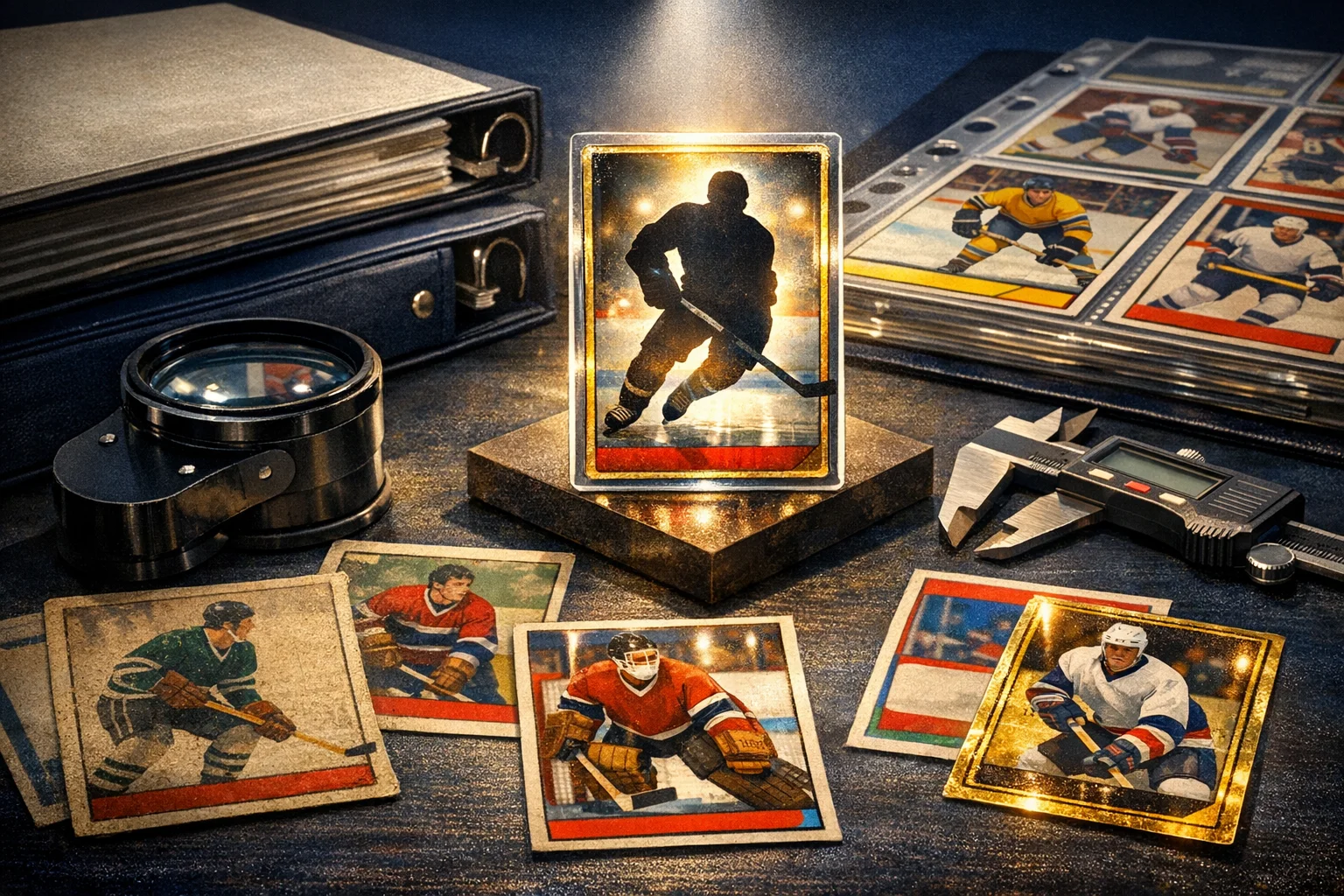
Illustration generated for this guide; not a photograph of an actual card, product or event.
Photo Gallery