Older football cards can be exciting, confusing, and expensive in all the wrong ways if you rush the basics. Unlike newer products, they often come with era-specific printing quirks, scarcer issue patterns, more condition sensitivity, and a higher chance of restoration or misidentification.
The good news is that you do not need to memorize every set before you buy intelligently. What you do need is a reliable framework: a practical way to divide eras, a repeatable condition checklist, and a disciplined process for matching a card to the right set, variation, and recent sold examples.
This guide is built for collectors who want to research older football cards with fewer assumptions and better questions. The goal is not to tell you what to buy, but to help you understand what you are looking at before money changes hands.
1. Start with a practical era framework, not a perfect one
Football cards do not come with one universally accepted master timeline, so a practical hobby framework is more useful than arguing over exact labels. A clean starting point is to separate prewar and early issues from postwar vintage, then separate that vintage material from the modern market. That approach gives you a working map for identification, budgeting, and expectation-setting.
A beginner-friendly structure is: prewar and early issues before 1948, postwar vintage from 1948 through 1980, and modern from 1981 to the present. That cutoff is useful because Beckett’s football database currently groups 1980 and older as vintage and 1981 forward as modern. It also points collectors toward 1948 as the key postwar starting line for mainstream football-card research.
Within that broad vintage band, it helps to think in sub-eras. The late 1940s and 1950s are foundational postwar issues. The 1960s and 1970s are the established mainstream vintage period for many football collectors. Then the 1980s into the early 1990s require a different mindset because print volume and market behavior changed dramatically. Hobby slang often calls the late-1980s-through-1993 period the Junk Wax Era, but that term is best treated as shorthand, not as a rigid official football-only category.
Why this matters in practice: if you inherit a stack of old football cards, a 1957 issue and a 1990 issue may both look old to a newer collector, but they usually belong to very different supply, grading, and pricing environments. Using the right era framework helps you avoid applying the wrong expectations to scarcity or condition.
- Practical collector framework: before 1948, 1948-1980, and 1981-present
- Use sub-eras to refine your research, especially when comparing 1950s cards to 1980s mass-produced issues
- Treat hobby era labels as useful shorthand, not universal law
2. Why 1948 is such an important pivot point
For older football cards, 1948 deserves special attention because Beckett identifies 1948 Bowman Football as the first football set of the modern era. Even if you also collect earlier material, that designation makes 1948 a practical anchor for postwar research. It is the year many collectors can use to separate the earlier, more fragmented world of prewar issues from the more recognizable postwar card market that follows.
That does not mean everything before 1948 should be ignored or treated as a footnote. Beckett’s football database includes issues dating back into the 1800s and early 1900s, which is an important reminder that football-card history is broader than postwar NFL-era cardboard. But if you are learning in stages, 1948 is a manageable line of demarcation.
1948 Bowman also matters because issue details can affect scarcity. Beckett notes that the set came in one-card penny packs and that some sheet-number patterns are scarcer than others. For collectors, that is a useful lesson beyond this one set: old cards that seem similar at first glance may not be equally available once you account for print patterns, series distribution, or production quirks.
The practical takeaway is simple. When a vintage football card appears expensive relative to another card from the same set, do not assume the difference is hype or overpricing. There may be a legitimate issue-level reason tied to how the cards were originally distributed.
- Use 1948 as a research pivot for postwar football cards
- Do not assume all cards in the same older set are equally available
- Scarcity can come from distribution patterns, not just star power
3. Condition on older football cards: what actually drives the grade
Condition is where many buyers get humbled by vintage football. The basic categories are straightforward: centering, corners, edges, and surface. PSA emphasizes all four, along with visible damage such as folds, creases, stains, and other defects. On older cards, those flaws are often easier to overlook in listing photos and much harder to ignore once the card is in hand or inside a graded holder with a disappointing number.
PSA’s descriptions of lower-grade issues are especially helpful because they mirror the kinds of wear older football cards accumulate over time: corner rounding, edge chipping, creasing, discoloration, and warping. That list is more useful than a vague statement like worn but nice for age. When you inspect a card, you want to translate appearance into specific categories that match how grading companies discuss condition.
There is another part newer collectors often miss. Grading is not purely mechanical. PSA says that while much of the process is objective, eye appeal and market acceptability also matter, especially for cards near centering thresholds. In plain language, two cards with similar technical wear can still feel different in the market if one presents cleaner, more balanced, and more attractive overall.
That does not mean grades are random. It means the number on the label does not tell the entire story. An older football card with moderate wear but strong eye appeal may attract more interest than a similarly graded copy with harsher staining, a distracting wrinkle, or visibly poor registration. If you only sort by grade, you can miss that difference.
- Evaluate centering, corners, edges, and surface separately
- Call out creases, stains, discoloration, warping, and chipping specifically
- Remember that eye appeal can affect outcomes near technical grade boundaries
4. A smarter inspection order for raw older football cards
When you inspect an older football card, the order matters. Start with authenticity and originality concerns before you start dreaming about the grade. A card with excellent corners but signs of trimming, recoloring, restoration, or tampering belongs in a completely different risk category than an honest lower-grade example. PSA explicitly says it will not grade cards with evidence of trimming, recoloring, restoration, tampering, or questionable authenticity.
After authenticity, check for creases and wrinkles under angled light. This step matters because older cards can hide bends that disappear in straight-on photos. Next, move to the surface: gloss, stains, paper loss, discoloration, and print wear. Then examine corners and edges for rounding, fraying, chipping, or signs that the card may have been altered. Only after those steps should you focus on centering and overall eye appeal.
That sequence helps prevent a common collector mistake: falling in love with a well-centered card while missing a severe surface problem or originality concern. Centering is easy to spot quickly, so many buyers overweight it. On older football cards, though, a hidden wrinkle or trimmed edge can matter far more than a few points of left-right imbalance.
A practical example: imagine two raw vintage football cards offered at similar prices. Card A has attractive centering but a wrinkle near the border and suspiciously sharp edges. Card B is slightly off-center, but the corners, surface, and edges look honest and untouched. For a collector prioritizing long-term confidence, Card B is often the safer starting point even before grading enters the conversation.
- Inspect in this order: authenticity, creases, surface, corners and edges, then centering
- Use angled light to reveal wrinkles and bends
- Do not let clean centering distract you from originality concerns
5. Why grade labels and eye appeal should be read together
Collectors often talk as if the grade is the whole card. On older football issues, that shortcut can lead to bad buys and bad sales comps. PSA’s standards make clear that eye appeal and market acceptability can influence the final result, particularly when a card sits near a threshold. That means you should learn to read the card itself, not just the number on the slab.
A useful modern tool here is PSA’s Grader Notes feature, introduced on June 25, 2024 for eligible service levels starting with Express. The educational value is bigger than the feature’s immediate convenience. It reinforces the same categories collectors should use when pre-screening cards: corners, edges, surface, and centering. If you can understand why a card missed a higher grade, you are less likely to overpay for another copy that looks similar at first glance.
For buyers, the practical lesson is to compare slabbed cards within the same grade more carefully than you might expect. A vintage football card in one holder may have a softer overall look, while another copy with the same number appears brighter, cleaner, and more balanced. The market often notices those differences even if a broad pricing tool compresses them into one bucket.
For sellers, this is also a reminder to describe flaws honestly rather than leaning on the label alone. If a card has a strong look for the grade, quality photos can help buyers see it. If it has a distracting defect, trying to hide that in scans only increases return risk and buyer skepticism.
- Do not treat the slab grade as the entire story
- Use flaw categories to compare same-grade copies more intelligently
- Strong photos matter because eye appeal still influences demand
6. Identification comes before valuation every single time
Older football-card research goes wrong most often at the identification stage. Before you estimate value, you need to identify the year, manufacturer, set, player, and card number as precisely as possible. PSA’s beginner guidance explicitly recommends using that full string when researching a card. That sounds basic, but it protects you from one of the hobby’s oldest mistakes: assuming cards that look similar are the same card.
This matters because older football issues can have reprints, similarly designed releases, and variations that materially change value. Even when there is no intentional reprint confusion, small differences in set name or card number can create misleading comparisons. A sold listing for the wrong year or wrong brand is not a comp, even if the front image seems close enough.
A practical workflow helps. First, read every visible clue on the card or holder: year, brand style, card number, back text, and league or team references. Second, match it to a checklist or database entry. Third, only then move into pricing. If you cannot identify the card with confidence, your value estimate is just a guess disguised as research.
If you buy from shows, estate lots, or online auctions with weak descriptions, make identification your first filter. Ask the seller what set and card number they believe it is. Ask for a clear image of the back. Ask whether the card is original or a reprint. If the answers are vague, the price should reflect that uncertainty.
- Identify year, manufacturer, set, player, and card number before checking comps
- Do not use lookalike cards as pricing substitutes
- Back scans and checklist matching are often the difference between confidence and guesswork
7. How to research sold prices without fooling yourself
Once the card is identified, move to realized sales rather than asking prices. PSA advises collectors to check eBay completed and sold results and, when possible, to focus on sales from the past three to six months in the same PSA grade. That is a strong baseline because it keeps you anchored to actual transactions instead of optimistic listings that may never sell.
eBay’s current Price Guide adds useful structure. The company says the tool is built from completed sales data, includes accepted Best Offer prices in the median sold price, updates every 24 hours, and can show pricing across grades along with historical sales trends up to two years. Those features make it useful for quick orientation, especially when you want to see whether the card trades actively across several grades.
But price tools are only as good as the match. On older football cards, you need to compare raw versus graded, exact grader and grade, qualifiers such as OC or MK, the correct set and variation, the right year and brand, the proper card number, and any known scarcity pattern. If one sold card is a clean straight grade and another is a qualified copy, the price gap can be meaningful. If one listing is a reprint or an imprecise title, it may not belong in your sample at all.
A practical buyer scenario: suppose you find a vintage football card that seems cheap based on a recent sale in the same numeric grade. Before calling it a bargain, check whether the recent comp was from a different grading company, whether it had stronger eye appeal, or whether your target card carries a qualifier or visible defect the comp did not. Precision is not overkill here. It is how you avoid paying a premium for the wrong comparison.
- Use sold data, not wishful asking prices
- Narrow comps by exact grade, grader, qualifiers, set, variation, and card number
- Treat pricing tools as a starting point, not a substitute for card-by-card comparison
8. Authenticity risk is higher with older football cards, so buy accordingly
Older football cards demand more skepticism than modern pack-fresh material. PSA’s standards state that cards showing evidence of trimming, recoloring, restoration, tampering, or questionable authenticity will not be graded. That alone should reshape how you think about bargains. A suspiciously sharp vintage card is not automatically a hidden gem. Sometimes it is simply a higher-risk item.
That risk should affect how you buy. If you are considering a raw older football card with meaningful value, better photos are not optional. You want clear front and back images, close looks at corners and edges, and enough resolution to study borders and surface issues. If the seller cannot or will not provide them, assume your uncertainty is part of the deal.
eBay’s Authenticity Guarantee can reduce some risk on eligible raw and graded trading cards that meet its program requirements, and eBay says approved grading holders include Beckett, PSA, Certified Collectibles Group, and SGC. But the protection has limits. eBay also says its inspection does not verify the authenticity of an in-person autograph, aftermarket relic, or aftermarket patch. That limitation matters if you are shopping older signed football cards or unusual memorabilia cards where modifications may not be obvious from a title alone.
The tradeoff is straightforward. Raw cards may offer more upside if they are original and undergraded, but they also carry more uncertainty. Graded cards can reduce some of that uncertainty, though they do not eliminate the need to inspect the card’s presentation and verify that the holder and description match what you think you are buying.
- Assume higher alteration risk with older football cards than with fresh modern pulls
- Ask for detailed images before buying significant raw cards
- Program-based authentication can help, but it does not verify every type of autograph or memorabilia element
9. Licensing context matters when older cards meet reprints, signed cards, and newer branded products
A guide to older football cards still needs some licensing context, especially when you are comparing vintage originals to later reprints or modern products featuring older players. As of April 2, 2026, Fanatics announced that Topps had returned as the NFL and NFLPA’s official exclusive trading card licensee, with rights that Fanatics said include official team logos, names, marks, helmet designs, uniforms, and official NFL branding. That is current licensing context as of the research date, not a permanent statement about all football-card periods.
For historical comparison, the NFLPA announced in 2014 that Panini America had entered an exclusive long-term agreement to become the sole manufacturer of NFLPA-licensed trading cards and stickers beginning with the 2016 NFL season. Topps’ own football-history page also states that Topps Chrome Football debuted in 1996, remained a staple through 2015, and returned in 2025. Put together, those facts show why collectors should not assume all football cards from the mid-2010s forward had the same combination of league, team, and player rights.
This becomes practical when you evaluate reprint products, commemorative issues, or signed cards tied to older stars. A familiar brand name does not by itself tell you what rights were in place for that release. Product-specific checking is safer than assumption, especially when team marks, player-group licensing, or autograph arrangements may differ.
One important caution: logo and player-group licensing do not automatically answer every autograph question. Signed older football cards should be treated as product-specific and listing-specific. If a seller implies broad rights or authenticity conclusions without clearly identifying the release, that is a prompt for more questions, not less.
- Current football-card licensing should be stated as of the research date
- Do not assume older-player reprints and signed products all had the same rights structure
- Treat autograph claims as product-specific, not automatically settled by brand or logo presence
10. A simple beginner workflow that keeps you out of the biggest traps
If you are just getting started with older football cards, the safest process is not glamorous. First, identify the card exactly. Second, screen condition honestly, starting with originality and major flaws. Third, research recent sold comps using exact matches. Fourth, decide whether grading makes sense based on value, authenticity risk, and your collecting goal. Fifth, be extra skeptical of vague autograph claims and cards that look unusually sharp for the era.
This order matters because each step depends on the last one. You cannot price what you have not identified. You should not estimate grading upside if you have not checked for trimming or wrinkles. And you should not assume a card deserves a premium just because a price tool shows a strong median for the title you typed in.
There are tradeoffs at every stage. Buying raw can be more flexible and sometimes cheaper, but it demands better inspection skills. Buying graded can create a more stable starting point, but not all same-grade copies are equal. Chasing star names is fun, but lower-profile commons can be better training cards for learning how vintage edges, centering, and surface problems really look.
The most useful mindset is to slow down. Older football cards reward careful collectors because so much of the hobby value is hidden in details: the exact set, the specific condition flaw, the subtle eye-appeal difference, the qualifier on the label, the rights attached to a newer release, or the authenticity question a casual buyer never asks. If you build your habits around those details, you give yourself a much better chance to buy with confidence.
- Identify first, price second
- Condition is more than centering and more than the slab number
- Use exact recent comps and ask more questions when a deal looks too easy
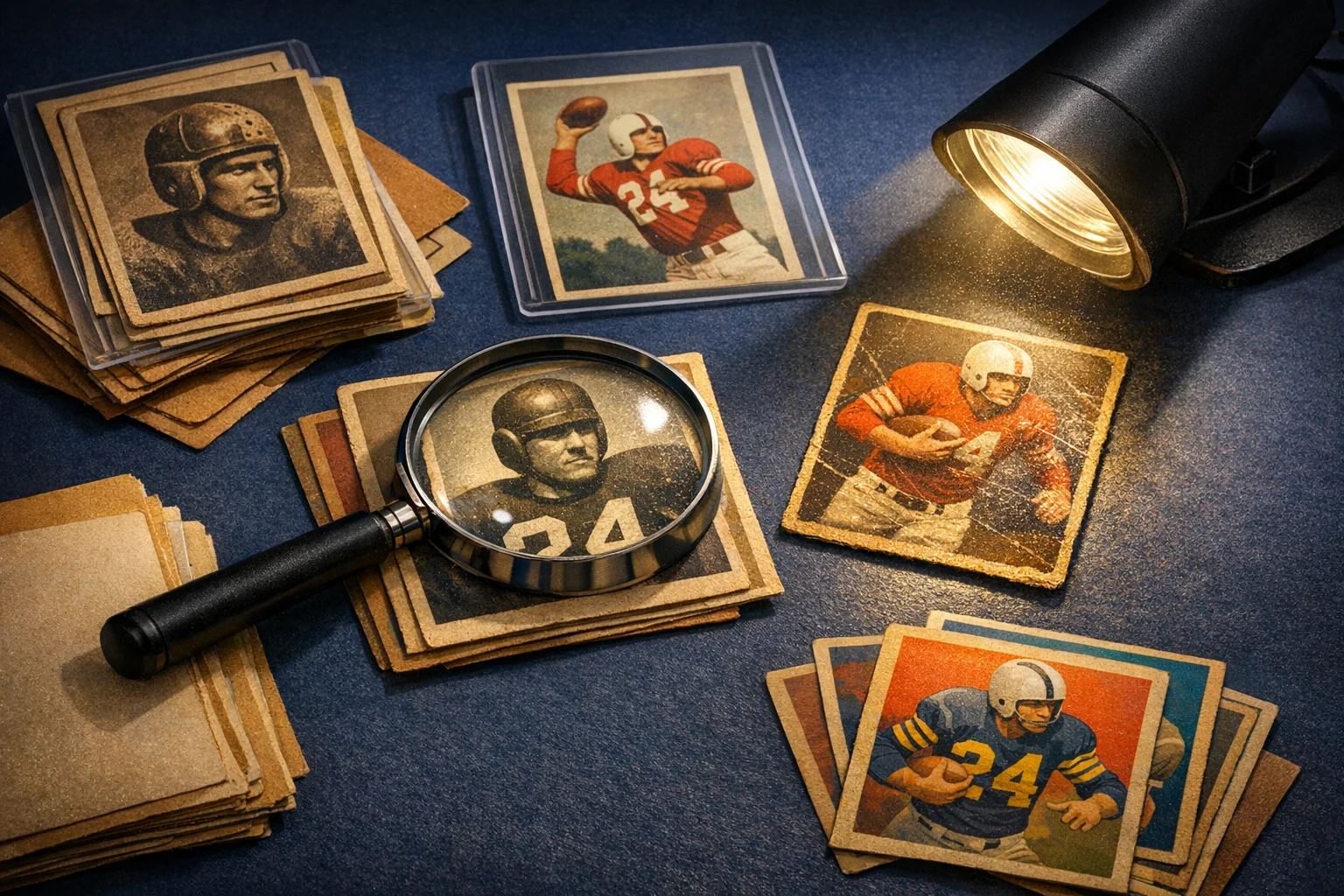
Illustration generated for this guide; not a photograph of an actual card, product or event.
Photo Gallery