The 1960 Topps Baseball set continues to stand out in the post-war market, and one big reason is the tension between broad collector appeal and true top-end scarcity. The design is instantly recognizable with its horizontal layout, and the checklist is loaded with Hall of Fame talent. That combination has kept the set relevant for vintage collectors for decades, but recent pricing patterns show a sharper trend inside the market: the strongest money is flowing toward the highest-graded examples.
Raw copies of many 1960 Topps cards still offer approachable entry points, especially compared with later sale prices for PSA 8, PSA 9, and PSA 10 examples. Once condition rarity enters the picture, the gap widens quickly. For key stars like Mickey Mantle and Willie Mays, that premium has been established for years. What is especially notable now is that lower-profile Hall of Famers with tiny top-pop counts are also producing eye-catching results when elite-grade examples surface.
Four cards illustrate the pattern particularly well: Willie Mays, Mickey Mantle, Luis Aparicio, and Hoyt Wilhelm. Each card shows a different angle of the same story, where collector demand meets a very limited supply of true gem-mint survivors.
Why 1960 Topps still commands attention
Vintage baseball collectors do not need much convincing to revisit 1960 Topps. The set checks several boxes at once. It features marquee names from one of baseball's richest eras, includes rookie-era and prime-era Hall of Famers, and offers a distinctive visual identity that separates it from many neighboring Topps releases. In a market where iconic sets often compete for attention, 1960 Topps remains a favorite because it combines aesthetics, history, and depth.
For more collector background, read 6 Most Valuable and Iconic 1989 Upper Deck Baseball Cards Still Driving the Hobby.
That appeal matters because it creates a large pool of potential buyers. When a set is admired by player collectors, team collectors, vintage set builders, and high-end registry participants at the same time, the best cards do not need much exposure to attract bidding. Scarcity in top grades becomes even more important in that environment.
Condition sensitivity is also central to the conversation. Centering, print quality, edges, and surface issues can make gem examples from this era exceptionally difficult to find. As a result, population reports at the very top often stay remarkably low, even for cards that exist in healthy overall numbers.
Willie Mays shows what true scarcity looks like
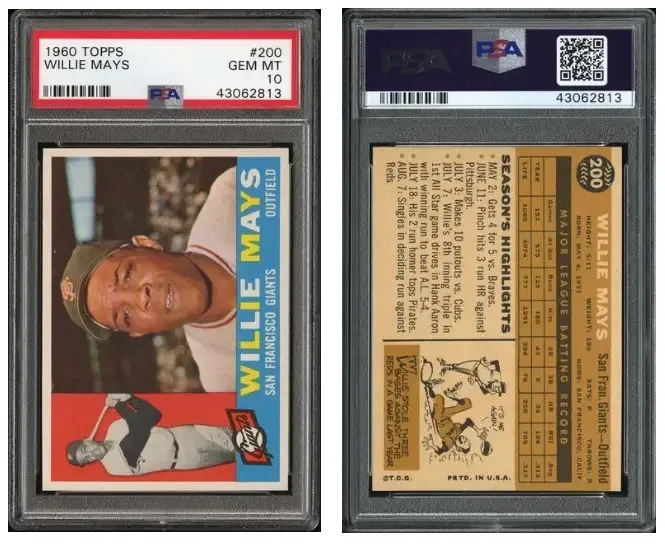
Card No. 200, Willie Mays of the San Francisco Giants, is one of the signature cards in the set. It pairs one of the hobby's most collected legends with a centerpiece card number, and the pricing structure reflects that status. Raw copies generally trade in the $90 to $120 range, making the card desirable but still reachable for many vintage collectors. In elite grades, the market changes dramatically.
For another perspective on this story, read 1960 Topps Baseball’s Top Grades Put Scarcity at the Center of Four Card Markets.
PSA population data provided for this card shows only 3 PSA 10s, along with 28 PSA 9s and 332 PSA 8s. That breakdown explains the premium immediately. Even within the graded market, there is a huge difference between an already-strong PSA 8 population and the tiny group of PSA 9s, with the PSA 10 level nearly nonexistent.
A public sale of a PSA 10 reached $75,000 on July 17, 2019. That figure underscores how star power and top-grade scarcity can combine into a single result that sits far beyond the raw market. Mays is already an all-time name with strong demand across nearly every era of collecting. When only a handful of gem-mint copies are available, the card crosses from collectible into trophy territory.
It also highlights an important truth about vintage pricing. Scarcity alone is not always enough, and star power alone is not always enough. When both appear together, the ceiling rises fast. The 1960 Topps Mays card is one of the clearest examples from the set.
Mickey Mantle remains a market driver in any grade
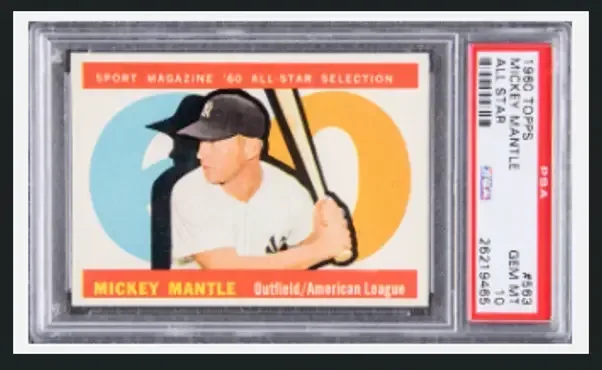
If Mays represents elite scarcity, Mickey Mantle represents relentless demand. Card No. 563 from the New York Yankees is one of the most watched entries in the 1960 Topps checklist because Mantle's market tends to draw interest from far beyond vintage set collectors. He remains one of the most liquid names in the entire baseball card hobby.
Raw copies of the 1960 Topps Mantle generally sell in the $275 to $350 range, already a significant level compared with most cards from the set. In graded form, the populations remain tight at the top, with only 4 PSA 10s, 74 PSA 9s, and 564 PSA 8s. Even though the PSA 8 and PSA 9 totals are larger than those of some other featured cards, the gem-mint tier is still extremely limited.
The highest recorded public sale for a PSA 10 reached $61,200 on March 8, 2021. That number trails the Mays PSA 10 high, but it still reflects substantial demand for one of the hobby's foundational names. Mantle cards often behave differently than many other vintage cards because collector appetite remains deep in almost every grade band, from raw examples up through elite registry-caliber slabs.
What makes Mantle especially important to the 1960 Topps discussion is that he acts as both a set anchor and a market signal. When collectors are confident in vintage blue-chip material, Mantle tends to benefit. When top-end examples appear, they usually attract immediate attention because there are so few opportunities to buy them at the highest level.
Lower-pop Hall of Famers are gaining traction
The most interesting movement inside vintage markets often happens just below the most obvious headline names. That is where Luis Aparicio and Hoyt Wilhelm enter the picture. Neither card begins from the same raw price baseline as Mantle or Mays, yet both show how quickly values can escalate when a low-cost vintage card becomes nearly impossible to find in PSA 10.
For collectors hunting condition rarities, that setup is powerful. A card does not need to be the set's most famous subject to become a major auction piece. It only needs the right combination of respected player, established collector base, and extremely low top-pop supply.
Luis Aparicio turns a modest raw card into a premium condition rarity
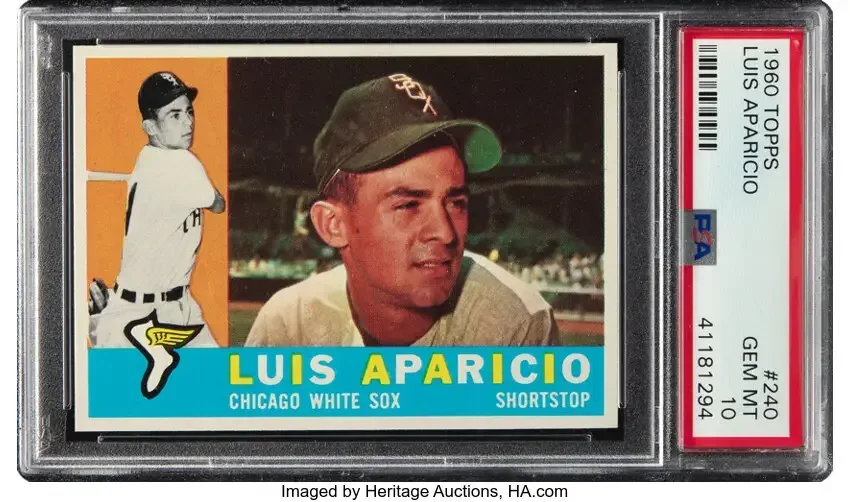
Card No. 240, Luis Aparicio of the Chicago White Sox, is a perfect example of how grade can completely reshape value. Raw copies generally sell in a range of $5 to $15. That makes it one of the more affordable Hall of Fame cards in the set for collectors who are focused on ownership rather than condition rarity.
At the top of the grading scale, however, the population tightens dramatically. The card has just 1 PSA 10, along with 21 PSA 9s and 164 PSA 8s. That lone PSA 10 turns the card into a distinctly different kind of asset than its raw counterpart.
The highest public sale for the PSA 10 reached $31,720 on May 16, 2026. That result is striking not just because of the final price, but because of the contrast with the raw market. It is a vivid reminder that vintage grading is not simply about improving a card's value by a percentage. In rare cases, the jump from raw to true gem-mint can create an entirely different market category.
Aparicio's Hall of Fame standing, speed-driven legacy, and vintage appeal all help support interest. Still, the single biggest factor here is population pressure. When the only PSA 10 example becomes available, bidders are not comparing it to other gem copies. They are competing for the only one.
Hoyt Wilhelm shows the same premium dynamic
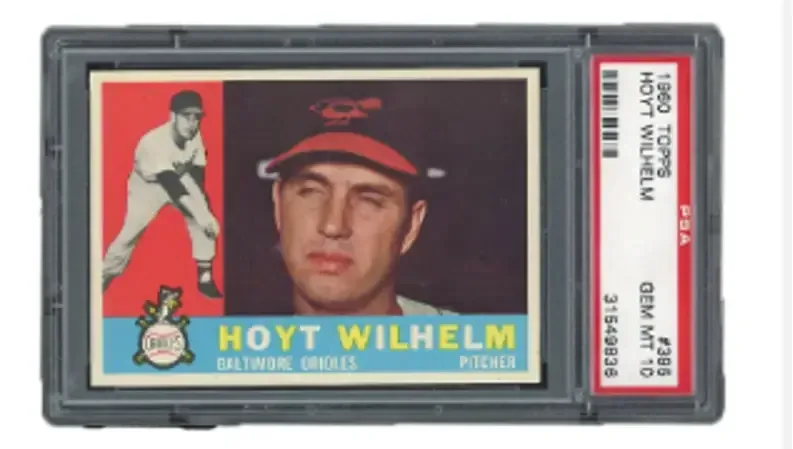
Card No. 359, Hoyt Wilhelm of the Baltimore Orioles, follows a very similar path. Raw copies generally sell between $5 and $10, placing the card in the affordable range for vintage collectors building the set or pursuing Hall of Fame runs on a budget. But that affordability disappears at the very top.
The population report for Wilhelm lists 1 PSA 10, 18 PSA 9s, and 199 PSA 8s. Like Aparicio, the card has only a single PSA 10, and that scarcity transformed its pricing profile when a public example sold.
The highest public sale for the PSA 10 also reached $31,720 on May 16, 2026. Matching the Aparicio result is notable because it suggests the market is increasingly willing to place serious money behind elite-grade copies of respected Hall of Famers, even when those players do not typically generate the same broad hobby conversation as Mantle or Mays.
Wilhelm's card reinforces a key lesson for collectors who study population reports closely. The biggest price shocks in vintage do not always come from the biggest names. Sometimes they come from cards with a small but motivated buyer pool colliding with an almost nonexistent top-grade supply.
Population counts are shaping the 1960 Topps market
When the four cards are viewed together, a clear pattern emerges:
- Willie Mays, No. 200: Raw roughly $90 to $120, with 3 PSA 10s, 28 PSA 9s, and 332 PSA 8s. PSA 10 public high: $75,000.
- Mickey Mantle, No. 563: Raw roughly $275 to $350, with 4 PSA 10s, 74 PSA 9s, and 564 PSA 8s. PSA 10 public high: $61,200.
- Luis Aparicio, No. 240: Raw roughly $5 to $15, with 1 PSA 10, 21 PSA 9s, and 164 PSA 8s. PSA 10 public high: $31,720.
- Hoyt Wilhelm, No. 359: Raw roughly $5 to $10, with 1 PSA 10, 18 PSA 9s, and 199 PSA 8s. PSA 10 public high: $31,720.
Those numbers show that collector behavior is not being driven only by player fame. Fame still matters, especially at the top of the hobby, but scarcity in the highest grades is influencing the market in a major way. The difference between a few hundred PSA 8s and a single PSA 10 can be massive.
It also suggests that the 1960 Topps market is functioning on multiple levels at once. Raw buyers can still participate. Mid-grade collectors can target eye appeal and affordability. High-grade vintage specialists, meanwhile, are competing in a much narrower and more expensive arena where population counts may matter as much as the player pictured on the front.
What collectors should watch next
For anyone tracking 1960 Topps Baseball, the next sales to watch are likely not just the obvious stars. Mantle and Mays will always draw headlines, but the low-pop Hall of Fame cards may continue to surprise when elite examples reach the open market. As more collectors become comfortable paying strong premiums for condition rarity, the set's lesser-publicized cards can gain momentum quickly.
The horizontal design and loaded checklist ensure that 1960 Topps will remain a cornerstone vintage issue. What is becoming clearer is that the set's biggest price moves often happen where demand meets the smallest certified supply. In practical terms, that means PSA 10 and even PSA 9 examples of key cards may remain the most closely watched segment of the market, especially when population counts stay this tight.
For collectors building the set, chasing Hall of Famers, or looking for vintage condition rarities, 1960 Topps continues to offer one of the most compelling combinations of history, design, and upside in the baseball card hobby.
Photo Gallery