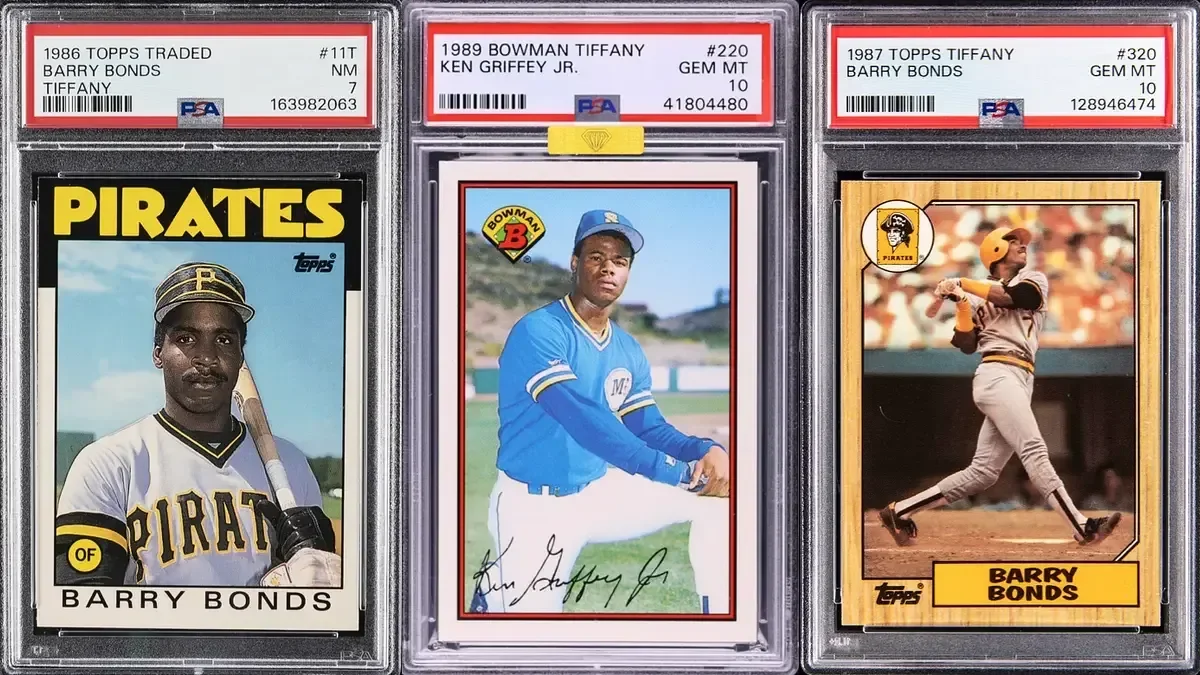
Tiffany baseball cards remain one of the most interesting exceptions to the so-called Junk Wax Era. While standard 1980s baseball cards were printed in massive numbers, these premium factory sets were far more limited and were never pack-pulled. They were issued as complete sets with glossy fronts, brighter white card stock, and a cleaner presentation that gave collectors a noticeably sharper version of familiar designs.
That combination of scarcity and star power has kept demand strong for decades, especially when key rookie cards are involved. PSA 10 population gaps between Tiffany versions and standard cards can be dramatic, and sale prices often reflect it. Some of the biggest examples now reach five figures, putting a select group of Tiffany sets in a category of their own.
Here are the top 3 Tiffany baseball card sets of the 1980s based on rookie strength, scarcity, hobby significance, and market performance.
Why Tiffany sets still matter
Beginning in 1984, Topps released limited "Collector's Edition" factory sets that collectors later nicknamed Tiffany because of their more upscale look. The cards typically feature a glossy coating on the front and bright white backs instead of the duller gray stock seen on many standard issues. Print runs were also far smaller than regular flagship and traded products.
For more collector background, read 1997 Pinnacle Inside Baseball Part 2 Break Delivers a Rare Albert Belle Diamond Edition.
Those production differences matter even more when they line up with major rookie cards. A premium version of a Barry Bonds, Bo Jackson, Mark McGwire, Roger Clemens, or Don Mattingly rookie becomes much more desirable when only a fraction of the standard supply exists in top grade. That is why Tiffany cards from the mid-to-late 1980s continue to command such strong prices.
1. 1986 Topps Traded Tiffany
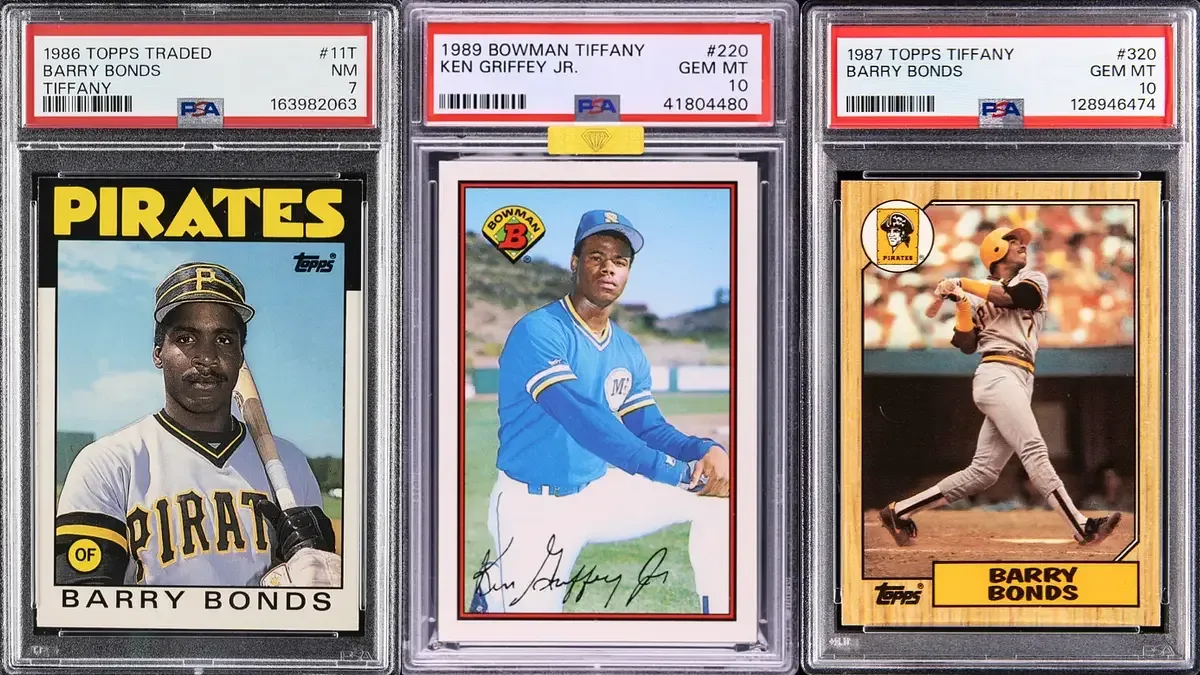
If one Tiffany set best captures the appeal of this niche, it is 1986 Topps Traded Tiffany. The checklist is loaded with star rookie power, and the print run was exceptionally tight at about 5,000 sets. For many collectors, this is the crown jewel of 1980s Tiffany baseball.
The set's biggest draw is the concentration of major names. Barry Bonds, Bo Jackson, Jose Canseco, and Will Clark all appear here, giving the release one of the most important rookie lineups of the decade. That kind of depth helps explain why this set sits at the top for so many collectors.
Key cards and recent price points
The Bo Jackson rookie card, #50T, recently reached an all-time high of $25,500 in PSA 10. Its Tiffany PSA 10 population sits at 37, compared with 1,154 for the standard version. That standard PSA 10 has sold around $2,100, showing just how large the premium can be for the Tiffany issue.
Barry Bonds rookie card #11T is nearly as important. A Tiffany PSA 10 recently hit $18,000, while the standard PSA 10 was around $1,003. Population data tells the same story: 456 for the Tiffany versus 5,145 for the standard card.
Those are not just healthy premiums. They are major market separations driven by scarcity, demand, and the long-term appeal of iconic rookies from the era.
Why collectors rank it No. 1
This set stands out because it brings together elite player selection and one of the smallest production totals of the decade. It also delivers the upgraded Tiffany finish on a traded set that already carried extra importance in the 1980s, when update and traded releases often housed the most desirable rookie cards.
For collectors who want the most sought-after Tiffany rookie cards from the 1980s, 1986 Topps Traded Tiffany usually starts the conversation.
How to identify 1986 Topps Traded Tiffany
This is one of the trickier Tiffany issues to verify quickly because both the standard and Tiffany versions have white backs. The easiest difference is in the fine print on the reverse. Regular 1986 Topps Traded cards have two small asterisks on the back. The Tiffany versions do not. Collectors can also look for the glossier front surface, though the difference can be subtle in some lighting.
2. 1985 Topps Tiffany
1985 Topps Tiffany combines one of the strongest star lineups of the decade with a version of the flagship set that is notably cleaner and tougher than its standard counterpart. The regular 1985 Topps release is famous for print quality issues, including off color examples and greenish tint problems, so the Tiffany treatment offers both rarity and a visual upgrade.
This set includes some of the most expensive and coveted cards tied to Mark McGwire and Roger Clemens, while also carrying rookie appeal for Kirby Puckett, Dwight Gooden, Eric Davis, and Orel Hershiser. Few Tiffany sets can match that blend of star rookies and long-term hobby relevance.
Key cards and recent price points
Mark McGwire's '84 USA Baseball Team rookie card, #401, is one of the headline pieces in the entire Tiffany world. A recent PSA 10 sale reached $29,000, while the standard PSA 10 has sold around $5,000. The Tiffany PSA 10 population is only 35, compared with 306 for the standard version.
Roger Clemens rookie card #181 is another flagship card from the set. A Tiffany PSA 10 recently sold for $22,600, while a standard PSA 10 has been around $2,652. Population numbers again show the separation: 49 in Tiffany PSA 10 versus 383 in the standard release.
These values underline how much the market rewards premium scarcity when attached to cornerstone 1980s stars.
Why it ranks in the top three
1985 Topps Tiffany has a compelling mix of rookie strength, brand familiarity, and condition-driven appeal. The base 1985 Topps design is one of the most recognizable sets of the decade, and the Tiffany version gives collectors a much sharper copy of a classic issue. When that visual bump meets a rookie class led by McGwire and Clemens, prices tend to follow.
Another factor is that collectors often view Tiffany as the best way to own certain hallmark 1980s cards without stepping into ultra-obscure regional or test issues. That keeps 1985 Topps Tiffany highly liquid and consistently relevant.
How to identify 1985 Topps Tiffany
The easiest marker on the back is the absence of the asterisk in fine print. Standard 1985 Topps cards have that symbol, while Tiffany versions do not. The Tiffany cards also have brighter backs and glossier fronts, giving them a more polished appearance than the regular issue.
3. 1984 Topps Tiffany
The first Tiffany baseball set carries a different kind of appeal. Beyond the player checklist, 1984 Topps Tiffany owns real historical importance because it started the premium run. For many collectors, that first-year status gives it a place near the top even before the key rookie cards enter the picture.
Production is estimated at about 7,000 sets, a very small number compared with the standard 1984 Topps release. The set also includes 49 Hall of Famers along with one of the defining rookie cards of the decade in Don Mattingly. Darryl Strawberry adds another major name to the mix.
Key cards and recent price points
Don Mattingly rookie card #8 is the centerpiece. A Tiffany PSA 10 recently sold for $11,800, while the standard PSA 10 was around $2,033. Population data helps explain the difference: just 54 Tiffany PSA 10s compared with 964 standard PSA 10s.
Nolan Ryan #470 is another standout from the set. A Tiffany PSA 10 recently sold for $5,655, while the standard PSA 10 has been around $1,450. Population counts show 28 Tiffany PSA 10s versus 418 standard PSA 10s.
Those numbers reinforce how first-year Tiffany material can attract strong demand even beyond rookie-card collectors.
Why 1984 Topps Tiffany still commands attention
Collectors are often drawn to beginnings, and this set represents the launch point for the entire Tiffany concept in baseball. It is also a release where scarcity, nostalgia, and visual appeal all line up. The classic 1984 design looks especially strong with the glossier Tiffany finish, and the Mattingly rookie gives the set a true flagship card.
Because it was the first of its kind, 1984 Topps Tiffany has a prestige factor that newer issues cannot duplicate. In a market that values both key rookies and hobby history, that matters.
How to identify 1984 Topps Tiffany
The Tiffany version has a shinier front and brighter reverse stock than the standard card. While the difference is not as text-based as some later Tiffany issues, the cleaner white back and glossier finish are the main visual cues collectors use to separate the premium set from the regular 1984 Topps release.
What drives Tiffany premiums versus standard cards
The gap between Tiffany and standard 1980s baseball cards comes down to three main factors: print run, condition rarity, and player selection. Standard issues were printed in enormous quantities, while Tiffany sets were produced in much smaller numbers and sold as complete factory products.
That reduced supply becomes even more powerful in high grade. When a key rookie has a PSA 10 population measured in double digits or low triple digits for Tiffany and thousands for the standard version, the price spread can become enormous. Add in star names like Bo Jackson, Barry Bonds, Roger Clemens, Mark McGwire, and Don Mattingly, and the market tends to reward the scarcer option.
Presentation helps too. Collectors generally prefer the glossy finish and brighter stock, especially for iconic 1980s designs. Tiffany cards often feel like the premium version of a familiar classic rather than an entirely separate product, which keeps them approachable while still making them scarce.
Collector checklist for buying 1980s Tiffany cards
Anyone shopping these sets should focus on a few basics before making a purchase.
- Confirm the version: Several Tiffany releases require checking back text or fine-print differences, not just front gloss.
- Study PSA population counts: Population gaps help explain why prices diverge so sharply from standard issues.
- Prioritize cornerstone rookies: The market is usually strongest for headline names such as Bo Jackson, Barry Bonds, Roger Clemens, Mark McGwire, and Don Mattingly.
- Watch eye appeal closely: Centering, gloss, print quality, and clean white backs matter, especially on raw copies.
- Know the set context: First-year status, traded-set rookie strength, and flagship brand recognition all influence long-term demand.
For collectors chasing the best Tiffany baseball cards of the 1980s, these three sets offer the strongest combination of scarcity, hobby importance, and elite rookie content, with 1986 Topps Traded Tiffany leading the group thanks to its loaded checklist and tiny production total.
Photo Gallery