Baseball card collecting gets expensive fastest when every release feels important. The antidote is not buying nothing. It is choosing a clear purpose before you choose your next box, lot, or single.
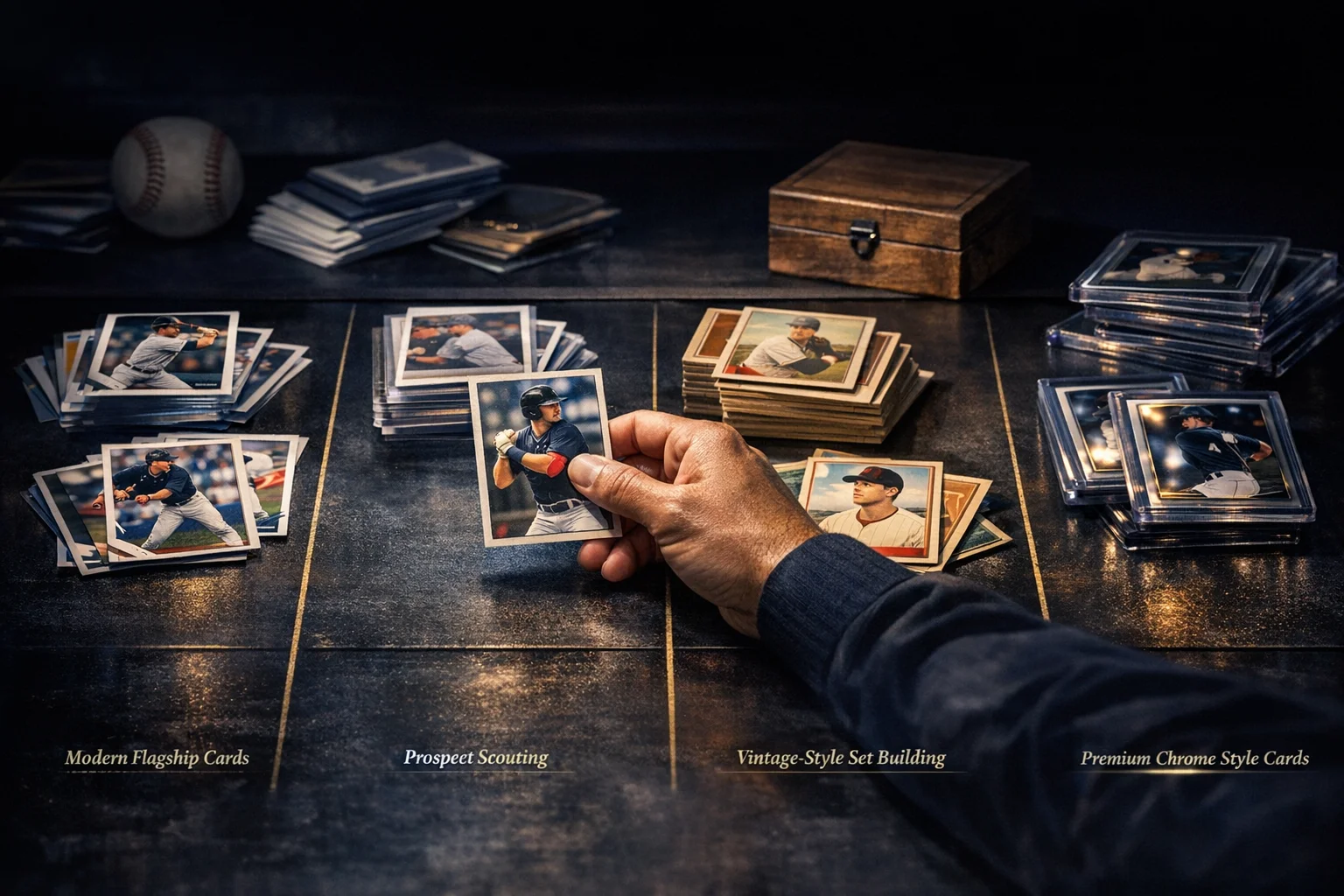
For most collectors, the best starting move is to pick one primary lane: Topps flagship for broad MLB coverage and rookie visibility, Bowman Chrome for prospects and 1st Bowman cards, Topps Heritage for checklist-driven set building, or Topps Chrome for a more premium modern approach centered on stars, rookies, parallels, and autographs.
Once that lane is clear, the rest of the plan becomes simpler. You can decide which players belong, which purchases are distractions, and how much of your budget should go to singles versus sealed wax.
Start with a collecting goal instead of a release calendar
A focused collection begins with one honest question: what do you want this hobby to do for you? Some collectors want a season-by-season MLB snapshot. Others want to follow prospects before they reach the majors. Some want the satisfaction of completing a set, while others care most about a few standout cards from one player or one team.
That distinction matters because the major baseball set families are built for different kinds of collecting. Topps presents Series 1 as part of its annual flagship run with stars, rookies, team cards, and full-season set collecting across Series 1, Series 2, and Update. Bowman Chrome is explicitly organized around prospects and 1st Bowman cards. Topps Heritage says the product is built for set builders. Topps Chrome emphasizes chromium cards, stars, rookies, legends, and autographs.
If you skip that first choice, you usually end up collecting by mood. That means a hobby box because it looks fun, a prospect because someone is buzzing about him, a shiny parallel because it catches your eye, and a few unrelated singles because they seem cheap enough. None of those purchases is automatically bad. The problem is that they do not necessarily add up to a collection with direction.
Try a simple sentence before you buy anything else: I want my baseball collection to help me follow blank. Fill that blank with one team, one active star, one rookie class, one prospect cohort, or one annual set project. Once you can say that clearly, products stop competing for your attention in the same way.
- Good goals: one MLB team, one player career arc, one rookie class, one prospect watchlist, one annual set build
- Weak goals: every hot release, every shiny parallel, every name you hear in a big week
Choose the set lane that matches how you like to collect
If you want the broadest MLB entry point, Topps flagship is the cleanest place to start. Topps says 2026 Series 1 has a 350-card base set with stars, top rookies, Future Stars, league leaders, and team cards, and it explicitly promotes team collecting and the larger flagship season across Series 1, Series 2, and Update. For a collector who wants current major leaguers, recognizable rookie cards, and an annual structure that is easy to understand, that is a strong foundation.
If your real interest is scouting and early speculation, Bowman Chrome is a different experience entirely. Topps describes 2026 Bowman Chrome as a prospect-focused release with a 100-card base set and a separate 100-card Bowman Prospect set built around 1st Bowman cards. That makes it the obvious lane for collectors who like following player development before MLB rookie-card attention takes over.
Heritage fits a more patient personality. Topps says 2026 Heritage uses the 1977 Topps design, has a 400-card base set, and is built for set builders. That wording matters. Heritage is not just something to rip; it is something to organize, chase thoughtfully, and work through over time. If you enjoy coherence more than volatility, Heritage gives you a project rather than a constant stream of side quests.
Topps Chrome is the premium-modern lane. Topps says 2026 Topps Chrome has a 300-card base set with stars, rookies, and legends, and that autographs are a cornerstone, including some of the first on-card signatures from the 2026 rookie class. If you want fewer cards with more shine, more parallel chasing, and a stronger pull toward autograph-focused collecting, Chrome is a better fit than flagship.
The key is not deciding which brand is universally best. It is deciding which format best matches the kind of satisfaction you want. Breadth, prospecting, completion, and premium hits are four different hobbies living under one baseball umbrella.
- Choose flagship for broad MLB coverage and easier team collecting
- Choose Bowman Chrome for 1st Bowman and prospect-focused collecting
- Choose Heritage for a slower, checklist-based annual project
- Choose Topps Chrome for premium rookies, stars, parallels, and autographs
Do not mix up 1st Bowman cards with MLB rookie cards
One of the easiest ways to overspend is to treat every early card as the same milestone. In baseball, that causes confusion fast. Topps says Bowman Chrome Prospects feature players who have not yet earned MLB rookie designation, and players receiving their first card in the brand carry the 1st Bowman logo. That makes 1st Bowman an important landmark, but it is not the same thing as an MLB rookie card.
MLB’s rookie-eligibility rules help define the difference. According to MLB’s glossary, a player remains a rookie unless he has exceeded any of these thresholds in prior seasons: 130 at-bats, 50 innings pitched, or 45 total days on an active MLB roster during the championship season, excluding injured-list time. MLB also notes that rookie eligibility is required for appearance on MLB Pipeline prospect lists.
For collectors, the practical takeaway is that prospect cards and rookie cards usually represent separate phases of a player’s hobby story. A 1st Bowman can appeal because it is an early professional-card milestone tied to projection and development. A flagship or Chrome rookie card usually belongs to the player’s arrival stage in the majors. Some collectors want both. Others should decide which stage matters more to them before buying.
That choice can save real money. If you mainly care about major-league performance and visibility, buying into every pre-rookie card may just scatter your budget. If you genuinely enjoy prospecting, then chasing 1st Bowman cards makes more sense, but you should recognize that you are paying for possibility rather than established MLB results. Those are different risks and different collecting experiences.
A simple organizational fix helps: write want lists by card stage, not only by player name. Instead of listing one prospect and buying whatever appears first, note whether you want the 1st Bowman, the first mainstream rookie, the first Chrome rookie, or a later autograph. That one habit keeps your collection from drifting into duplicates that feel different in the moment but do not serve your actual goal.
- 1st Bowman is a brand milestone, not the same thing as an MLB rookie card
- Prospect cards usually reflect pre-rookie status and projection
- Rookie cards and prospect cards can both matter, but for different reasons
- Use want lists that specify the stage of card you actually want
Pick players with rules you can repeat all year
A focused collection gets easier when your player targets fit one repeatable structure. Without structure, every breakout month, call-up rumor, and social media clip becomes a temptation. You do not need to remove spontaneity from collecting, but you do need some rule that tells you what belongs and what does not.
One practical approach is to choose a single player bucket. That bucket could be your favorite MLB team, one franchise cornerstone, one active star on a Hall-of-Fame path, one rookie class, or one prospect cohort. This is analysis rather than a formal checklist from a league or manufacturer, but it lines up naturally with the way the major products are built. Flagship supports team and season-wide collecting. Chrome supports concentration around stars and rookies. Bowman supports limited prospect tracking.
If you want lower risk, leaning toward established MLB stars is usually simpler than trying to forecast a dozen prospects at once. Topps Series 1 and Topps Chrome both emphasize current stars and rookies, which makes them easier landing spots for collectors who want cards tied to visible major-league performance. That does not make them risk-free. It just means the player story is more developed than it is in a pure prospect lane.
If you prefer upside, keep your prospect list deliberately small. Five to ten names can be enough to make Bowman collecting feel informed rather than frantic. Once the list gets too large, you stop building a focused collection and start approximating a personal checklist of everyone you might regret missing. That is a recipe for budget creep.
Collectors who like draft-driven prospecting should also remember that not every amateur star enters pro-card relevance on the same schedule. MLB’s Rule 4 Draft glossary lays out who enters the amateur draft pool from the United States and Canada, including high school graduates, junior-college players, and four-year college players after junior year or age 21. In hobby terms, that means talent pipelines move on different clocks, so patience matters.
- Pick one player bucket and hold it for a full season if possible
- If prospecting, cap the watchlist so you can follow it intelligently
- If collecting stars, decide whether you want rookies only or later-year cards too
- Draft interest and card timing do not always move together
Build your budget around singles first and wax second
A realistic budget starts with sealed-wax honesty. Recent sold eBay examples from 2026 showed a Topps Chrome Baseball hobby box at $329.99, a Bowman Chrome Baseball hobby box at $489.99, and Topps Heritage hobby boxes around $152.95 to $169.95. Those are illustrative market snapshots rather than official MSRP or a complete price index, but they still show how quickly one purchase can dominate your year.
The practical implication is hard to ignore. For many collectors, a single Bowman Chrome hobby box can consume a modest annual baseball budget by itself. Even one Topps Chrome hobby box is large enough to crowd out a lot of singles. Heritage appears more manageable on the sealed side, but repeated wax purchases there can still overtake what it would cost to build a thoughtful singles-based project.
That is why singles-first planning works so well. Singles let you direct money toward cards you already know fit your lane. Sealed wax gives you entertainment, surprise, and the thrill of possibility, but it also guarantees some mix of duplicates, cards outside your goals, and the chance that your biggest spend yields very little you actually wanted.
A practical method is to budget backward. First, list the cards or checklist goals you definitely want this year. That might be your team’s flagship rookies, a Heritage base run, or one player’s rookie and second-year cards. Treat that as the core budget. Only after that should you decide how much money you are comfortable spending on ripping packs for fun.
This approach does not kill the excitement of opening boxes. It simply stops entertainment spending from disguising itself as strategy. In a focused collection, wax can still have a role. It just should not be the only plan.
- Use sold-box examples as reality checks, not universal pricing law
- Secure your core singles goals before buying hobby wax
- The more specific your collection, the more efficient singles become
- Treat ripping as fun with uncertainty, not as the default way to build
Match your hobby plan to a budget lane you can maintain
Collectors often start with a wish list and only later notice the cost. It works better the other way around. Decide what your annual baseball budget can really support, then build a plan that fits it. A sustainable collection is not the one with the most exciting week. It is the one you can still enjoy next year.
If your annual budget is under $250, expensive hobby wax is usually a bad fit. Based on the sold examples above, one Bowman Chrome hobby box alone would exceed that range, and one Topps Chrome box would eat most or all of it. At this level, the strongest options are singles, lower-cost lots, one-team flagship runs, or a controlled Heritage project assembled gradually rather than through repeated box purchases.
In the roughly $250 to $750 range, you gain room for one or two sealed decisions without letting them swallow the year. This can support a flagship rookie collection, a Heritage build with selective short-print hunting, or a player collection anchored by a few Chrome singles plus one box for fun. The main discipline here is seasonal pacing. Do not spend the whole year’s money during one release month.
Above $750, multi-lane collecting becomes possible. You can mix flagship with Chrome, run a prospect watchlist alongside one team build, or add a few premium autograph targets. But a bigger budget does not eliminate tradeoffs. It just changes them. Duplicate purchases, speculative prospect stacks, and grading fees can still drain resources quickly if your plan is vague.
The healthiest budget is the one that survives boredom, hype, and a bad rip. If one disappointing box makes the hobby feel stressful, the budget was probably too aggressive for the way you actually collect.
- Under $250: focus on singles, team runs, and selective Heritage or flagship targets
- $250 to $750: one main lane plus limited wax works best
- $750 and up: multiple lanes are possible, but only with clear rules
- Leave room for months when nothing worth buying appears
Treat grading as a separate purchase, not an automatic next step
Grading can quietly reshape a baseball budget faster than many collectors expect. As of the September 29, 2026 research date, PSA’s trading-card grading page listed Standard at $59.99 per card, Priority at $79.99 per card, and Express at $199 per card, with Value tiers shown as temporarily unavailable. Even before shipping, insurance, or other submission costs, those service levels are enough to show how quickly grading decisions compete with card-buying money.
That does not mean grading is a mistake. It means grading should solve a clear problem. Maybe you want presentation for a favorite card, a more uniform player collection, or long-term holdered protection for a centerpiece. Those are all coherent reasons. What often causes trouble is treating grading as the automatic final step for every nice pull or every card that feels important in the moment.
Consider what a submission really costs in alternatives. A handful of cards at the Standard rate alone can equal a substantial singles budget, a Heritage box plus meaningful additions, or most of a Topps Chrome hobby box based on the sold example above. That is real opportunity cost, especially in a focused collection where every dollar should move the theme forward.
A useful question is simple: what changes if this card gets graded? If the answer is clearer display, long-term organization, or stronger protection for a card you already love, the case is easier to make. If the answer is mostly the hope that a number on a label will justify the purchase, it may be smarter to wait.
For many collectors, especially those building a thoughtful raw set or a player run, grading works best as a selective tool rather than a routine habit.
- As of 2026-09-29, PSA listed Standard at $59.99, Priority at $79.99, and Express at $199
- A few grading submissions can equal a major chunk of a yearly card budget
- Grade with a purpose: protection, presentation, or collection structure
- Raw cards are often the more efficient choice in a focused build
Three collection models that are easier to finish than they sound
The one-team flagship build is one of the most practical models in the hobby. You collect only your team’s cards across Series 1, Series 2, and Update, with extra focus on rookies, team cards, and a few favorite veterans. Because Topps itself emphasizes team collecting and the annual flagship structure, this model gives you a clear shopping rule without requiring you to chase every release.
A one-player career-arc build is more curated. Here, you might target a player’s flagship rookie, Chrome rookie, one or two meaningful parallels, and a few later-year cards that fit your taste. This works especially well for established stars because you can build a narrative rather than a pile: arrival cards, breakout-era cards, and one or two signatures or inserts if they fit the budget. The tradeoff is concentration risk. If you tire of the player, the collection may feel narrow, so choose someone you genuinely enjoy following.
The prospect watchlist build is the most exciting and the easiest to overdo. Keep it small. Limit yourself to a short Bowman list, then follow those players as they move from 1st Bowman interest toward rookie-card relevance. This structure works best for collectors who like reading player development rather than simply buying hype. The tradeoff is volatility. Some names will stall, and that is part of the lane, not a failure of the plan.
A fourth strong option is the annual Heritage build. Because Heritage is explicitly built for set builders, it gives checklist-minded collectors a clear ladder of goals: base set only, base plus short prints, or a selective expansion into variations and Chrome parallels. This route suits people who enjoy progress and organization more than speculation.
Whichever model you choose, define what finished means before you begin. Does your team build include only base rookies? Does your player PC stop at one key rookie in each major brand? Does your Heritage project include short prints or not? Collections become sustainable when finish lines are visible.
- One-team flagship build: broad, approachable, and easy to track through the season
- One-player career arc: focused and story-driven, but intentionally narrow
- Prospect watchlist: exciting, research-heavy, and best kept small
- Annual Heritage build: ideal for collectors who enjoy checklist progress
Use five questions before every purchase
A focused collection is protected one buying decision at a time. The easiest way to avoid drift is to ask the same short set of questions before any purchase, whether it is a single, a lot, or a hobby box.
First, does this clearly fit my lane? A premium prospect auto might be exciting, but if you are building a team flagship run, that does not make it progress. Second, does it fill a defined need? Good examples include completing a team page, landing a key rookie, checking off a Heritage short print, or adding the one Chrome rookie your player collection was missing.
Third, would a single do this job better than wax? If what you really want is one specific rookie or one specific prospect, the answer is often yes. Fourth, what am I giving up by buying this now? That tradeoff might be two other singles, one grading submission, or the flexibility to buy later in the season when your priorities are clearer.
Fifth, would I still be happy owning this card if it never became more valuable or more popular? That is the question that separates collecting from reflex. If the answer is no, you may be buying noise instead of building something coherent.
These questions are not meant to make collecting sterile. They are meant to preserve the fun by keeping your collection legible to you. When every card has a reason to be there, the whole project feels better, even if the budget is modest.
- Does it fit my lane?
- Does it fill a need I already defined?
- Would a single work better than a box?
- What am I giving up by spending this money now?
- Would I still want this card without hype?
Illustration generated for this guide; not a photograph of an actual card, product or event.
Photo Gallery