Set building sounds simple until you realize that “complete” can mean four very different things. In one product, it may mean the numbered base checklist and nothing else. In another, it may include short prints, image variations, inserts, parallels, or even every color version of every card.
The safest way to avoid an expensive misunderstanding is to decide your finish line before you spend. Official checklist and odds resources from Topps, Panini, and Upper Deck make that possible, but they also make something else clear: modern sets are often built in layers, and not every layer belongs in the same collecting goal.
If you want a set that feels satisfying instead of endless, the key question is not “Can I complete this?” It is “Which version of complete am I chasing, and does the official checklist make that realistic for me?”
Start by defining your target, not your budget
Most set-building mistakes begin with a fuzzy goal. A collector buys boxes thinking they are working toward “the set,” then later discovers that the release also includes short prints, image variations, multiple parallel colors, and separate insert programs. At that point, the original plan becomes hard to price, hard to track, and harder to finish.
A better approach is to name the exact type of set you want before you buy a single pack or single card. Panini’s collector education materials distinguish base cards, parallels, and inserts as separate categories, while Upper Deck’s glossary separately defines inserts, parallels, and short prints. That distinction matters because it gives you permission to stop treating every non-base card as part of the same job.
In practical terms, you should write down your target in one sentence. Examples: “I’m building the 350-card base set only.” “I want the base set plus manufacturer-listed SPs.” “I want the base set and just two insert sets I actually like.” “I’m attempting a master-style build and I know that includes variations.” That one sentence becomes your rulebook when the product starts tempting you into side quests.
This is also where honesty matters. If you enjoy finishing projects, a tightly defined base set may be more rewarding than a vague chase that keeps expanding. If you enjoy hunting rare layers and do not mind incompletion, a broader target may fit you better. Neither style is more legitimate. The only bad plan is confusing one for the other.
- Useful first question: What exactly counts toward my finish line?
- Useful second question: What am I explicitly excluding?
- Useful third question: Am I chasing satisfaction, rarity, or both?
Use the official checklist first, because memory is not a checklist
Set builders often rely on hobby shorthand, forum summaries, or what they remember from opening day. That can work until a product has hidden numbering quirks, late-added variations, or a checklist page that gets updated. The safest first document is the official checklist from the card maker or brand owner.
Topps says its checklist page covers releases dating back to 2018 and its odds page covers releases dating back to 2022, while also stating that it does not maintain those resources before those dates. As of the research date, that means newer Topps builders usually have an official starting point, but older builds may require more caution because official coverage is not equally deep across eras.
Panini’s official checklist search page was active as of the research date and marked with a recent update timestamp, making it a current locator for Panini brands. Upper Deck’s checklist hub and checklist pages also function as practical planning tools because individual pages can display fields such as set name, rookie designation, autograph, memorabilia, serial numbering, SPs, and odds.
The practical move is simple: save the checklist on day one. Download the PDF if one is offered. If it is page-based, print to PDF or keep a dated copy in your records. That is not paranoia. It is organization. Manufacturers update product pages, change site structure, and maintain different historical windows. If your definition of complete depends on a particular checklist version, preserve it.
You do not need an elaborate system. A folder named by year, brand, and sport is enough. Put the checklist, odds sheet if available, and your own target notes in the same place. Later, when you are deciding whether a missing card is actually part of your build, you will be glad you anchored yourself to an official list instead of hobby memory.
- Save both the checklist and the odds sheet when available.
- Record the date you saved them.
- Note whether your build is based on the base checklist, a full product checklist, or your own narrowed target.
Learn the four layers that most often get mixed together
For set builders, the biggest source of confusion is that several card types can sit under the same product name. Panini defines base cards as the standard cards in a set. It defines parallels as alternate versions of those cards with changes such as color, finish, numbering, or scarcity. It defines inserts as separate themed cards that are not part of the base set. Upper Deck separately defines short prints as cards printed in lower quantities than other cards in the set.
Once you absorb those definitions, a lot of hobby language becomes easier to sort. A base set is the numbered standard run. A short print may or may not be numbered in the same obvious way, but it exists as a scarcer layer. A variation may share a card number or concept with the base card while changing an image or another detail. An insert is its own program entirely, even if it is packaged in the same product.
Why does this matter? Because many collectors accidentally pay master-set prices for what they only wanted as a base set, or they declare victory too early because they never counted the SPs. The checklist categories tell you whether those cards belong in your goal.
A useful rule is to stop saying “I need everything from this release” unless you have confirmed what “everything” means. Modern products often use the same release to support several kinds of collectors at once: base set builders, insert chasers, parallel rainbow hunters, autograph collectors, and player collectors. You do not need to satisfy all of them to have a complete collecting experience of your own.
As analysis, think of these layers as separate lanes rather than a ladder you must climb. Base is not inferior. Insert collecting is not incomplete. A variation chase is not automatically a smarter buy. Each lane simply asks for a different level of time, money, and tolerance for scarcity.
- Base set: the standard numbered run.
- SP or variation: extra scarcity or an alternate version that can complicate “complete.”
- Insert set: a separate themed checklist, not automatically part of the base build.
- Parallel: alternate color, finish, numbering, or scarcity version of an existing card.
Treat variations as the point where costs and definitions can spiral
If there is one place where modern set building stops being simple, it is variations. Official Topps product materials make that plain. Topps describes 2026 Heritage Baseball as a 400-card base set with a deep lineup of short prints and variations, and frames the release as one that tests the dedication of set builders. That language is a clue, not just a sales pitch. It tells you the product was designed with multiple layers of completion in mind.
Topps’ 2026 Series 1 guidance makes the same lesson even clearer in a flagship setting. The product has a 350-card checklist, but also includes multiple parallel and variation layers, including Golden Mirror Base Image Variation cards and Player Number Variations. So when someone says they completed Series 1, that statement still needs translation. They may mean the 350-card base set. They may mean base plus one or more variation groups. They almost certainly do not mean every parallel of every card unless they say so explicitly.
This is where disciplined language helps. If you are discussing your project with dealers, traders, or other collectors, say “base set complete,” “base plus SPs complete,” or “working on a master-style build.” That protects you from your own assumptions and from other people’s assumptions.
A practical buying example: suppose you are halfway through a flagship base set and discover image variations you had not budgeted for. You now have three reasonable options. One, stick to base only and finish strong. Two, add a small variation subset you genuinely enjoy. Three, restart your plan as a larger project with a different budget and timetable. What you should not do is drift into option three while still pretending you are on option one. That is how set building becomes frustrating.
The honest tradeoff is that variations can make a set far more interesting visually and intellectually. They can also destroy the clarity that makes set building fun in the first place. Some collectors love that extra puzzle. Others are better served by drawing a line around the base run and refusing to apologize for it.
- When discussing your build, define whether “complete” includes SPs or variations.
- Use the manufacturer’s wording to identify which cards are base and which are extra layers.
- If variation groups are large, choose them intentionally instead of absorbing them by accident.
A sealed complete-set product can be the smartest beginner finish line
If your goal is the satisfaction of finishing, an official complete-set product can be one of the best on-ramps in the hobby. Topps’ 2026 Topps Baseball Complete Set says the box contains all 700 cards from 2026 Topps Series 1 and Series 2 Baseball. The hobby-box listing further notes 704 cards per set and 4 short print rookie cards per set. That structure simplifies the main build while still leaving a small chase element inside the sealed product.
For many collectors, that is a better experience than trying to assemble the same flagship base set entirely from packs. You eliminate duplicate overload, reduce the chance of getting stalled on commons, and get a clear finish line from the start. If your actual dream is “I want the standard flagship base cards for the year,” this kind of product aligns with the goal cleanly.
But there is an important limit. A complete-set box is not the same thing as every flagship card released that year. Topps separately presents Update as its own release and frames the full Topps Baseball year across Series 1, Series 2, and Update as a larger challenge. So the sealed complete set solves Series 1 plus Series 2 base, not necessarily your personal definition of the whole flagship year.
That distinction matters because many collectors say “full flagship set” when they really mean “the annual complete set box,” while others mean all three flagship branches. Neither usage is automatically wrong, but they are not identical projects. Before buying, decide whether your finish line ends at Series 1 plus Series 2 base or extends to Update as well.
As analysis, this is one of the healthiest places in the hobby to be conservative. If a product literally exists to deliver a bounded set, let it do that job. Save the riskier pack ripping for products you are approaching as entertainment or for narrower chase goals.
- Best for a clean finish: official complete-set products.
- Best for thrill and discovery: packs, but usually with more duplicates and uncertainty.
- Question to ask: Does my definition of the yearly set include Update or only the complete-set box contents?
Let pack structure and odds decide whether wax makes sense
Collectors often choose their goal first and their acquisition method second. For modern set building, that order should usually be reversed. Once you know what the official checklist looks like, study the pack structure and odds information to decide whether buying sealed product is efficient, inefficient, or purely for fun.
Upper Deck’s checklist format is especially useful as a teaching tool because individual checklist pages can display fields including serial numbering, SPs, and odds. On the 2025-26 Upper Deck Ice Hockey checklist page, the table format includes those columns, and base entries shown list two base cards per pack. Information like that helps you estimate how quickly a base build might advance and how slowly rarer layers might move.
Topps also directs collectors to official odds pages for current releases, and many product pages link both a checklist and an odds sheet. That combination is what should govern ambition. If a release has a large base checklist and several rare variation layers, the odds may tell you immediately that opening wax toward a master-style set is unrealistic for most collectors.
A practical scenario: say you want base plus a small SP group. If the pack structure suggests strong base collation and the SP group is finite, wax plus trading may be reasonable. But if the product includes many scarce variations with long odds, singles buying becomes the more rational route for the advanced pieces, even if you still open some boxes for enjoyment.
This does not mean sealed wax is a bad set-building tool. It means wax is a tool with a job description. It is excellent for creating momentum, learning a product, and pulling a lot of standard cards quickly. It is often poor at delivering the exact last 10 percent of a set, and even worse at reliably finishing scarce variation layers. The closer you get to the edges of the checklist, the more selective your buying usually needs to become.
- Read odds before committing to SPs, variations, or rainbow goals.
- Use wax for momentum; use singles and trades for precision.
- If base cards per pack are low, full base-set building from packs may be slower than expected.
Build a realistic goals ladder instead of one giant impossible target
The most useful set-building plan is not a dream target. It is a ladder of targets. By giving yourself tiers, you can stop at a satisfying point instead of feeling that anything short of a master set is failure.
A strong beginner tier is one official sealed complete set or one clearly bounded base set from a single release. The appeal here is clarity. You know the size of the task, you know what counts, and you can measure progress easily. This tier teaches the habits that matter most: checklist use, card organization, and controlled purchasing.
An intermediate tier is base plus a small, pre-chosen subset of SPs or variations. This works best when you decide in advance which extra layers matter to you. Maybe you love a specific image variation style. Maybe you only want rookie SPs. Maybe you want one insert set that matches the product’s theme. The point is that you are expanding on purpose, not because the product nudged you there.
An advanced tier is a product-specific master-style build attempted only after checking official checklist structure, odds, and numbering. Some products make this finite enough to map. Others look finite at first and then sprawl across parallels, exclusives, and scarce variations until the definition collapses. The odds sheet and checklist will usually tell you which kind of release you are dealing with.
For most collectors, the least realistic target is every parallel of every card in a modern flagship-style release. That does not make it a bad chase. It makes it a specialist chase. It requires money, patience, and a comfort level with cards that may be difficult to locate regardless of budget. If that is not you, there is no shame in choosing a version of complete that you can actually finish and enjoy.
As analysis, a ladder protects your enthusiasm. Reaching tier one or tier two is motivating. Declaring only one huge finish line can turn every partial success into disappointment.
- Tier 1: base only or sealed complete set.
- Tier 2: base plus a narrowly chosen SP or variation group.
- Tier 3: base plus selected inserts you genuinely want.
- Tier 4: master-style build only after checklist and odds review.
Create a tracking system that matches the complexity of the set
A base set can be tracked with a printed checklist and a pen. A variation-heavy modern release usually needs more structure. The mistake many collectors make is using the same tracking method for both, then wondering why the project gets messy.
For a simple base build, your system only needs card number, have-or-need status, and maybe condition notes if that matters to you. For an expanded build, add category columns: base, SP, variation, insert, and parallel. If the official checklist or product page identifies specific variation types, mirror those names in your own sheet. That keeps your language consistent with the manufacturer’s language.
Another useful habit is to separate “needed to finish” from “nice to add later.” If your finish line is base plus SPs, then inserts belong on a wishlist, not a need list. That small distinction reduces the psychological drag that comes from looking perpetually incomplete.
Physical organization should follow the same logic. Keep base cards in numerical order. Store non-base layers separately unless they are explicitly part of your target. If you mix parallels and inserts into the same run, you can make a nearly finished base set look incomplete every time you review it.
You also need version control. When a product has multiple checklist documents or a page plus a downloadable file, note which one you are using. That is especially helpful for newer products whose information ecosystem can be spread across product pages, checklist hubs, and odds PDFs.
None of this has to be fancy. A spreadsheet, notes app, or printed checklist can all work. The point is to make the set legible to yourself. The more modern products add variations and parallel layers, the more your organization system becomes part of the collecting skill itself.
- Track base and non-base layers in separate columns.
- Keep a separate wishlist for cards outside your defined finish line.
- Store base numerically; store variations and inserts separately unless they are part of your official target.
Know when to stop, redefine, or split the project
A good set builder is not just someone who finishes. It is someone who can recognize when a project needs a boundary. Modern checklists reward discipline because they can always offer one more layer to chase.
Sometimes the right move is to stop at the base set and declare success. Sometimes it is to split a project into phases: finish base now, revisit SPs later, and ignore inserts unless they become a separate goal. Sometimes it is to redefine the project entirely after learning that the official variation structure is much deeper than expected.
This is especially important in products that openly signal challenge. When Topps says Heritage has a deep lineup of short prints and variations and tests the dedication of set builders, believe that message. It does not mean you should avoid the product. It means you should avoid pretending that its hardest layers are mandatory for everyone.
A healthy checkpoint question is: if I started from zero today, would I still choose this exact finish line? If the answer is no, you are allowed to revise it. Collecting goals are not contracts. They are tools for enjoyment and focus.
The bigger lesson is that “complete” is not a universal badge. It is a definition you choose and then execute clearly. If you can explain your target, track it with an official checklist, and finish within your own rules, you have done real set-building work. In a hobby full of expanding product trees, that kind of clarity is a strength, not a compromise.
- Stop if the next layer does not add enjoyment.
- Split broad projects into base first, extras later.
- Redefine “complete” when official checklist depth makes the original plan unrealistic.
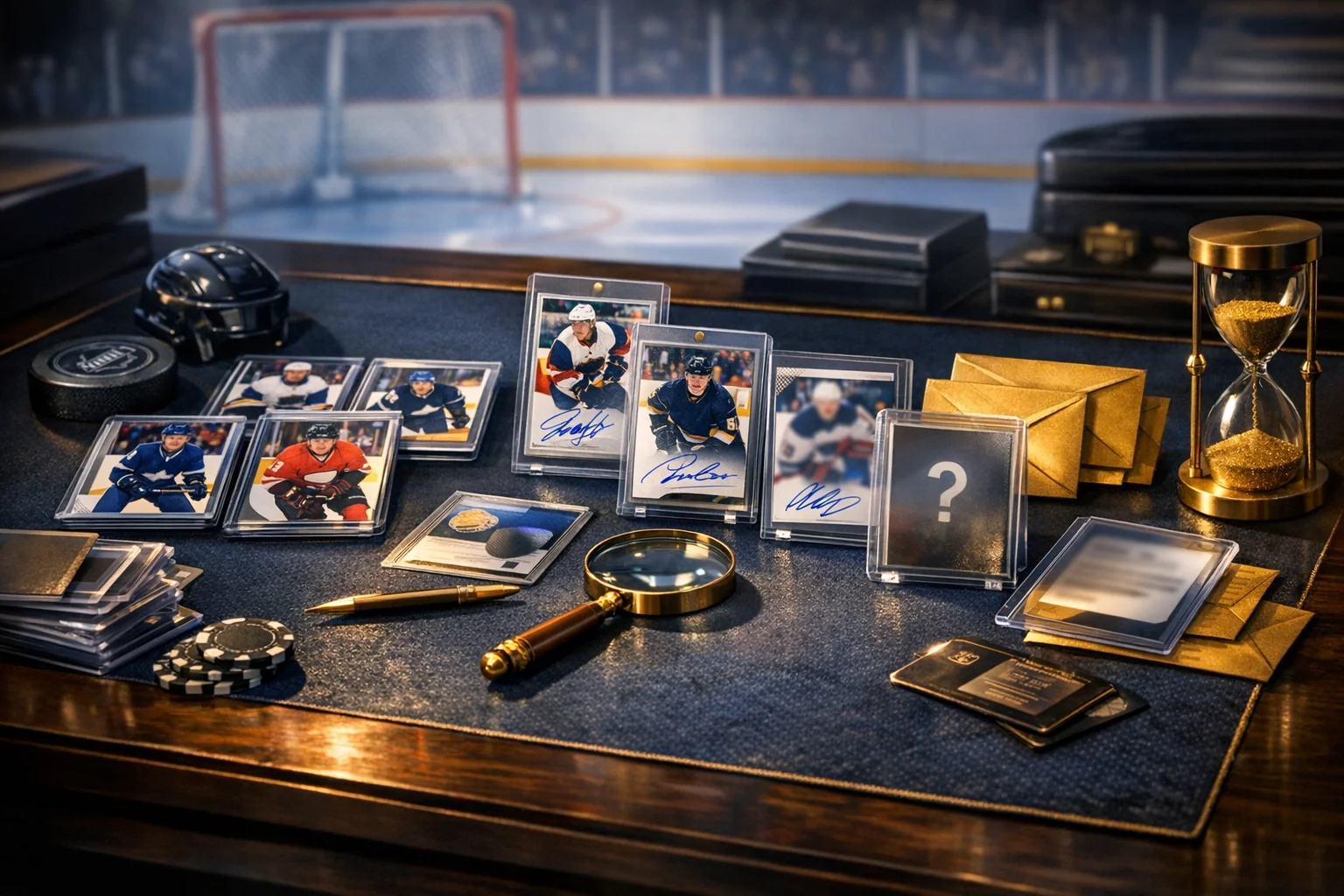
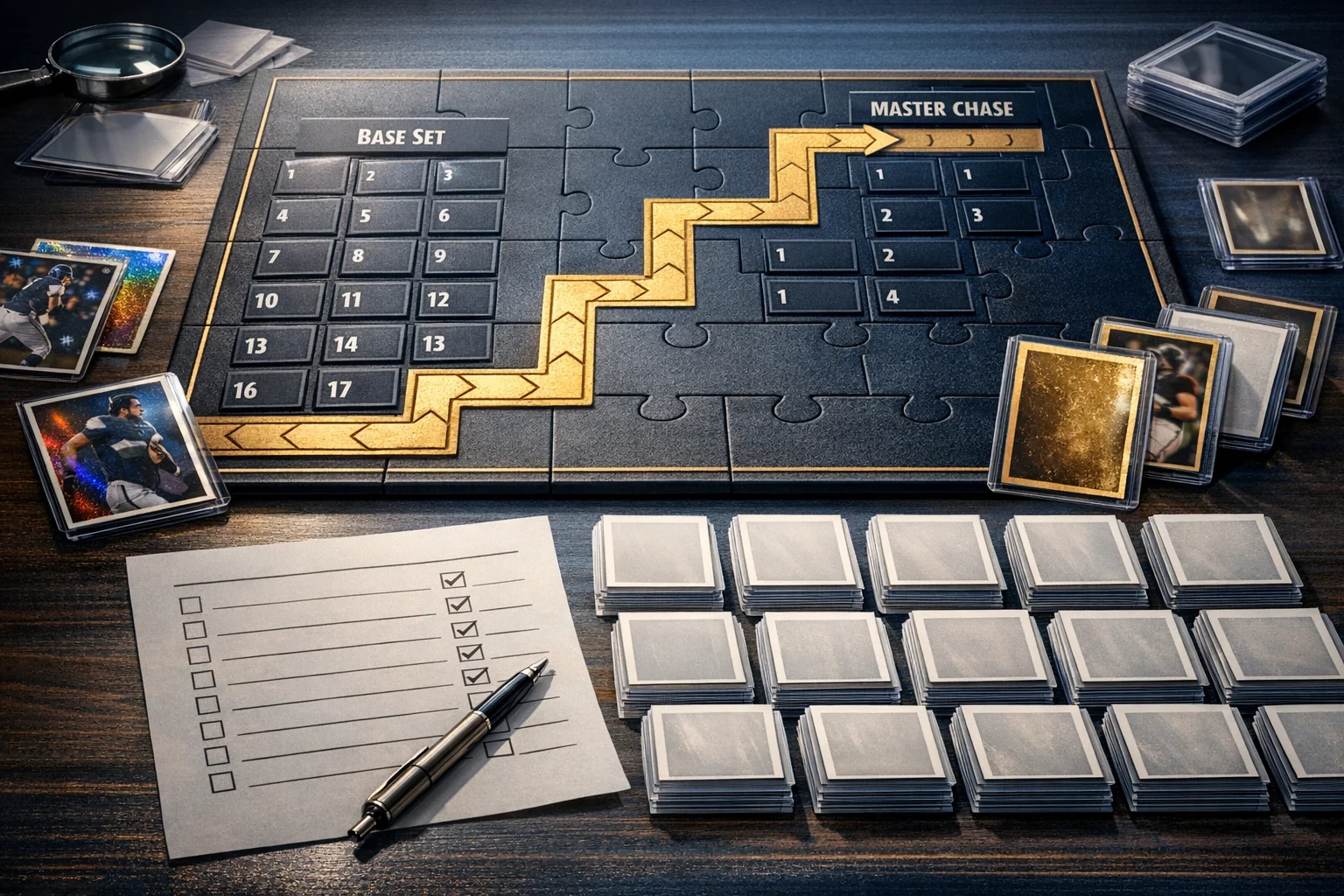
Illustration generated for this guide; not a photograph of an actual card, product or event.
Photo Gallery